Archive
Some views of the festivities at the Sleeping Bear Dunes National Lakeshore Dune Climb for the transit of Mercury earlier today
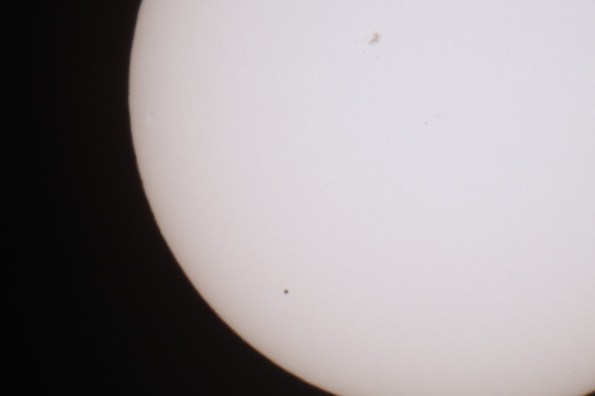
Mercury and some sunspots at 8:30 a.m. through my telescope. Thought I’d take a shot before we had visitors. C8 Cassigrainian focus, ISO 100, 1/100 second.
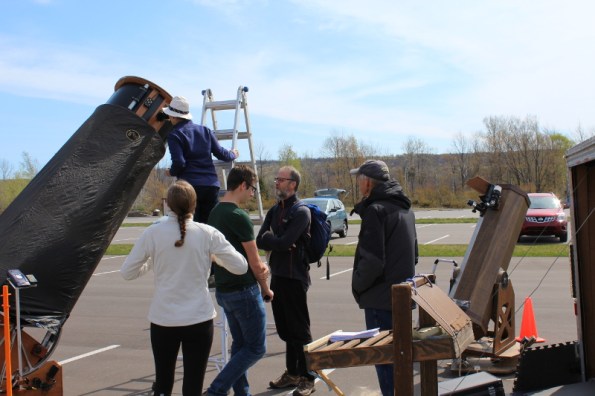
Checking the transit via the “Dobinator” through the Grand Traverse Astronomical Society’s (GTAS) 25 inch Dobsonian stopped down with an 8″ solar filter.
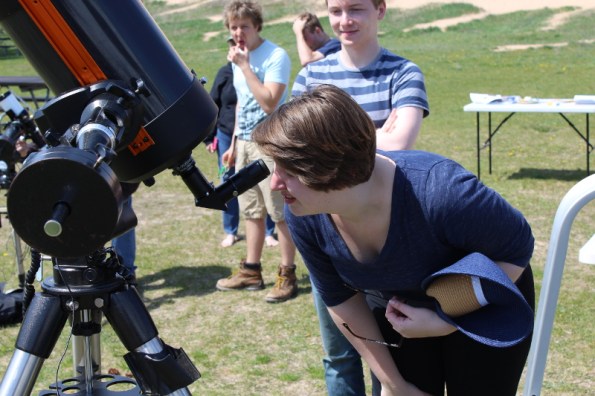
Viewing the transit through my Celestron C8.
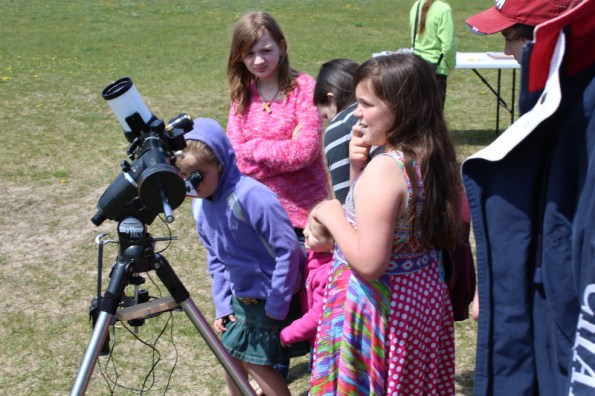
Kids viewing the transit through the society’s Lunt hydrogen alpha solar telescope.
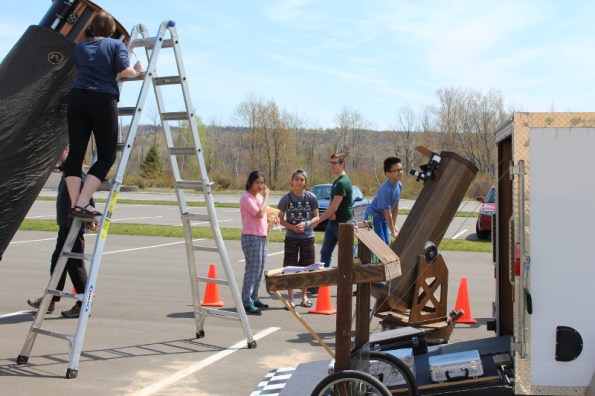
Youngster viewing the transit through Emmett Holmes’ 13″ homemade Dobsonian telescope and Poncet tracking mount.
Credit: Bob Moler
05/09/2016 – Ephemeris – The transit of Mercury is today!
Ephemeris for Monday, May 9th. The Sun rises at 6:21. It’ll be up for 14 hours and 36 minutes, setting at 8:58. The Moon, 3 days past new, will set at 12:12 tomorrow morning.
In less than an hour from now the planet Mercury will begin to cross the face of the Sun. It starts at 7:12 a.m. The transit will end at 2:42 this afternoon. Mercury is a tiny planet making a tiny dot against the face of the Sun, and smaller than any sunspot. If it’s clear or when its clear come out and view part of the transit. The Northwestern Michigan College’s Rogers Observatory will be open for that period. Also telescopes with be stationed at the Dune Climb at the Sleeping Bear Dunes National Lakeshore by yours truly to view the transit. The event is not visible to the naked eye and dangerous to even attempt. If you miss this transit, there will be another in 2019, 3 ½ years from now. After that, a Mercury transit visible from here will have to wait until 2049.
Times are for the Traverse City/Interlochen area of Michigan. They may be different for your location.
Addendum
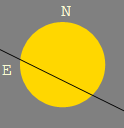
The track of Mercury across the face of the Sun. Mercury will travel from upper left to lower right. Mercury will not be visible until it impinges upon the disk of the Sun. Credit IOTA’s program Occult4.
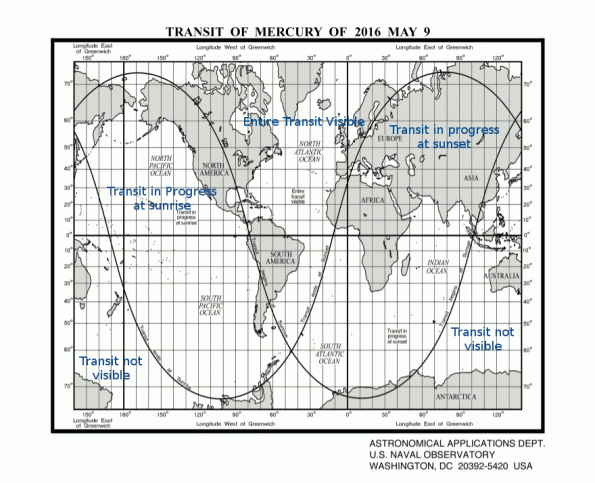
Transit visibility map with added captions to make it more readable. Credit United States Naval Observatory, The Astronomical Almanac Online.
For more information see my prior day’s posts.
 Bob Moler's Ephemeris Blog