Archive
01/31/2017 – Ephemeris – Looking ahead at February 2017
Ephemeris for Tuesday, January 31st. The Sun will rise at 8:02. It’ll be up for 9 hours and 48 minutes, setting at 5:50. The Moon, 3 days before first quarter, will set at 10:06 this evening.
February is the shortest month, even so the daylight hours throughout the month will be getting longer. Daylight hours will increase from 9 hours and 50 minutes tomorrow to 11 hours and 7 minutes on the 28th. The sunrise time will decrease from 8:01 tomorrow to 7:21 at months end. The sunset times will increase from 5:51 tomorrow to 6:29 on the 28th. Along with that the altitude of the sun at noon will increase from 28.4 degrees today to 38.6 degrees at month’s end. It will be a degree lower for folks in the Straits area because they are a degree of latitude farther north. Local noon, by the way for Interlochen and Traverse City is about 12:55 p.m. On the evening of the 10th the Moon will enter the Earth’s outer shadow with an penumbral lunar eclipse. I’ll have more information on that then. Moon will be near the planets Mars and Venus in the southwestern sky early tonight.
Times are for the Traverse City/Interlochen area of Michigan. They may be different for your location.
Addenda
February Star Charts
Evening
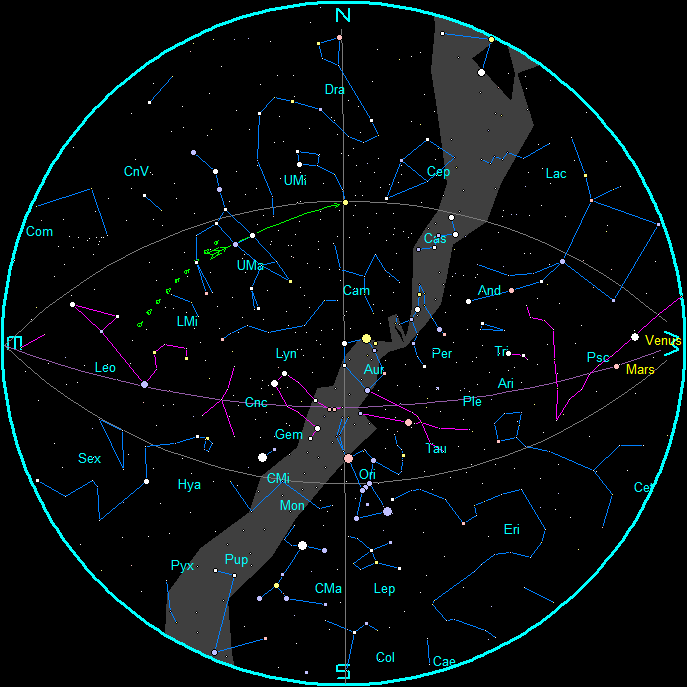
Star Chart for February 2017. Created using my LookingUp program. Click on image to enlarge.
Morning
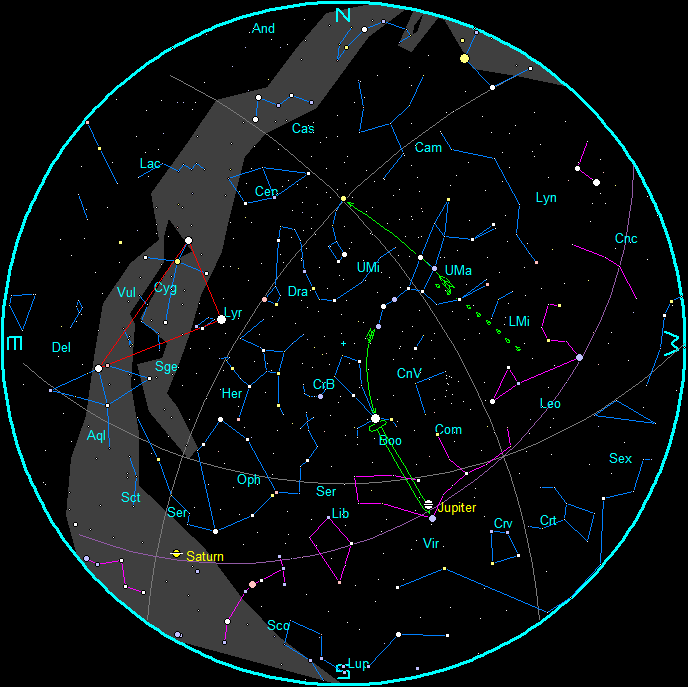
Star Chart for February 2017 mornings. Created using my LookingUp program. Click on image to enlarge.
The planets and stars are plotted for the 15th at 9 p.m. EST, and again at 6 a.m. Those are chart times. Note, Traverse City is located approximately 45 minutes behind our time meridian. (An hour 45 minutes behind our daylight saving time meridian. during EDT and 45 minutes behind our daylight standard time meridian. during EST). To duplicate the star positions on a planisphere you may have to set it to 1:45 or 0:45 earlier than the current time if you were near your time meridian.
Add a half hour to the chart time every week before the 15th and subtract a half hour for every week after the 15th.
For a list of constellation names to go with the abbreviations click here.
- Pointer stars at the front of the bowl of the Big Dipper point to Polaris the North Star
- Follow the arc of the handle of the Big Dipper to the star Arcturus, and
- Straighten to a spike to Spica
- The Summer Triangle is shown in red
Evening nautical twilight ends at 6:56 p.m. EST on the 1st, increasing to 7:31 p.m. EST on the 28th.
Evening astronomical twilight ends at 7:30 p.m. EST on the 1st, increasing to 8:05 p.m. EST on the 28th.
Morning astronomical twilight starts at 6:22 a.m. EST on the 1st, and increasing to 5:45 a.m. EST on the 28th.
Morning nautical twilight starts at 6:56 a.m. EST on the 1st, and Increasing to 6:19 a.m. EST on the 28th.
NASA Calendar of Planetary Events
Credit: Sky Events Calendar by Fred Espenak and Sumit Dutta (NASA’s GSFC)
To generate your own calendar go to http://eclipse.gsfc.nasa.gov/SKYCAL/SKYCAL.html
Times are Eastern Time and follow the time change dates.
Date        Time    Event
Feb 01  We          Venus: 45.5° E
    02  Th  5:11 am Venus-Mars: 5.4° N
    03  Fr 11:19 pm First Quarter
    05  Su  4:14 pm Moon-Aldebaran: 0.2° S
    06  Mo  8:59 am Moon Perigee: 368800 km
    07  Tu  1:34 pm Moon North Dec.: 18.9° N
    10  Fr  7:33 pm Full Moon
    10  Fr  7:45 pm Penumbral Lunar Eclipse
    11  Sa  9:04 am Moon-Regulus: 0.8° N
    11  Sa  2:49 pm Moon Ascending Node
    15  We  9:55 am Moon-Jupiter: 2.9° S
    18  Sa  2:33 pm Last Quarter
    18  Sa  4:14 pm Moon Apogee: 404400 km
    20  Mo  6:44 pm Moon-Saturn: 3.9° S
    21  Tu  3:50 pm Moon South Dec.: 18.8° S
    26  Su  1:28 pm Moon Descending Node
    26  Su  9:54 am Annular Solar Eclipse - South Atlantic
    26  Su  9:58 am New Moon
Mar 01  We          Venus: 32.5° E
February 2017 Calendar
LU             Ephemeris of Sky Events for Interlochen/TC
February, 2017    Local time zone: EST
+-----------------------------------------------------------------------+
| DATE |  SUN     SUN  DAYLIGHT|   TWILIGHT*    |MOON  RISE OR    ILLUM |
|      |  RISE    SET    HOURS |  END    START  |PHASE SET** TIME FRACTN|
+=======================================================================+
|Wed  1| 08:01a  05:51p  09:50 | 06:57p  06:55a |      Set  11:15p   26%|
|Thu  2| 08:00a  05:53p  09:52 | 06:59p  06:54a |      Set  12:25a   37%|
|Fri  3| 07:59a  05:54p  09:55 | 07:00p  06:53a |F Qtr Set  01:35a   48%|
|Sat  4| 07:57a  05:56p  09:58 | 07:01p  06:52a |      Set  02:45a   59%|
+------+-----------------------+----------------+-----------------------+
|Sun  5| 07:56a  05:57p  10:00 | 07:03p  06:51a |      Set  03:53a   70%|
|Mon  6| 07:55a  05:58p  10:03 | 07:04p  06:50a |      Set  04:56a   80%|
|Tue  7| 07:54a  06:00p  10:06 | 07:05p  06:48a |      Set  05:54a   89%|
|Wed  8| 07:52a  06:01p  10:09 | 07:06p  06:47a |      Set  06:45a   95%|
|Thu  9| 07:51a  06:03p  10:11 | 07:08p  06:46a |      Set  07:28a   99%|
|Fri 10| 07:50a  06:04p  10:14 | 07:09p  06:45a |Full  Rise 05:59p  100%|
|Sat 11| 07:48a  06:06p  10:17 | 07:10p  06:43a |      Rise 07:06p   99%|
+------+-----------------------+----------------+-----------------------+
|Sun 12| 07:47a  06:07p  10:20 | 07:12p  06:42a |      Rise 08:12p   96%|
|Mon 13| 07:45a  06:08p  10:23 | 07:13p  06:41a |      Rise 09:16p   90%|
|Tue 14| 07:44a  06:10p  10:26 | 07:14p  06:39a |      Rise 10:18p   84%|
|Wed 15| 07:42a  06:11p  10:28 | 07:15p  06:38a |      Rise 11:18p   76%|
|Thu 16| 07:41a  06:13p  10:31 | 07:17p  06:37a |      Rise 12:18a   67%|
|Fri 17| 07:39a  06:14p  10:34 | 07:18p  06:35a |      Rise 01:16a   58%|
|Sat 18| 07:38a  06:15p  10:37 | 07:19p  06:34a |L Qtr Rise 02:12a   48%|
+------+-----------------------+----------------+-----------------------+
|Sun 19| 07:36a  06:17p  10:40 | 07:21p  06:32a |      Rise 03:07a   39%|
|Mon 20| 07:34a  06:18p  10:43 | 07:22p  06:31a |      Rise 03:59a   30%|
|Tue 21| 07:33a  06:20p  10:46 | 07:23p  06:29a |      Rise 04:49a   21%|
|Wed 22| 07:31a  06:21p  10:49 | 07:25p  06:28a |      Rise 05:34a   14%|
|Thu 23| 07:30a  06:22p  10:52 | 07:26p  06:26a |      Rise 06:16a    8%|
|Fri 24| 07:28a  06:24p  10:55 | 07:27p  06:25a |      Rise 06:54a    3%|
|Sat 25| 07:26a  06:25p  10:58 | 07:28p  06:23a |      Rise 07:29a    0%|
+------+-----------------------+----------------+-----------------------+
|Sun 26| 07:25a  06:26p  11:01 | 07:30p  06:21a |New   Set  06:43p    0%|
|Mon 27| 07:23a  06:28p  11:04 | 07:31p  06:20a |      Set  07:53p    2%|
|Tue 28| 07:21a  06:29p  11:07 | 07:32p  06:18a |      Set  09:03p    7%|
+-----------------------------------------------------------------------+
* Nautical Twilight
** Moonrise or moonset, whichever occurs between sunset and sunrise
Penumbral Lunar Eclipse February 10/11, 2016
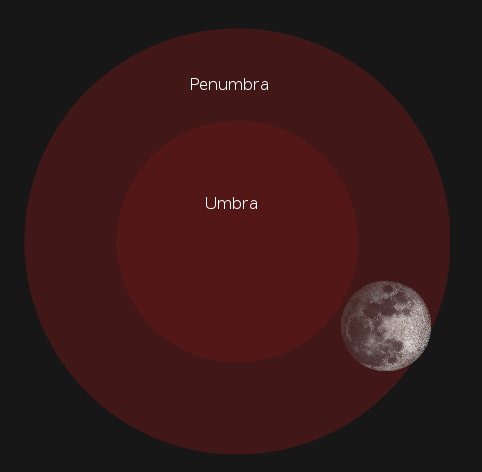
The moment of mid-eclipse at 7:45 p.m. February 10, 2016 EST (0:45 UT February 11). The Moon is traveling from upper right to lower left. Orientation is alt-az for northern Michigan. Created using Cartes du Ciel (Sky Charts).
In the early evening hours of February 10th the Moon will pass through the Earth’s outer or penumbral shadow. It will not get particularly dark since the Moon will still be somewhat illuminated by the Sun.
Anything shows two types of shadows in the sunlight. Your shadow appears fuzzy. That fuzziness is your penumbra, where the sunlight is only partially blocked. The dark inner part of your shadow is your umbra.
The eclipse starts at 5:34 p.m. (22:34 UT) at which time you will see nothing out of thee ordinary. Since the Moon is entering the shadow at a shallow angle it will take 2 hours and 11 minutes to reach the maximum eclipse. I’m guessing here, but one will probably not notice anything before 7 p.m. (0:00 UT) To help see the effect better, put on sunglasses. They will reduce the Moon’s glare to help see the darkening effect. Officially the eclipse will end at 9:53 p.m. (2:53 UT the 11th)
Binocular Comet 45P/Honda-Mrkos-Pajdusakova
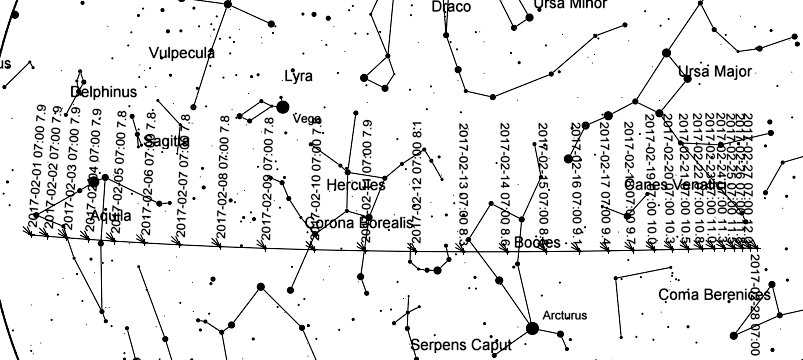
Comet 45P’s track for February. The comet is expected to be about a magnitude brighter than displayed (7th magnitude). Created using Cartes du Ciel (Sky Charts).
In the chart above the comet’s position is marked by a comet symbol. The comet’s tail, if visible at all, will actually point to the right along its track. The data for this chart is taken from Seiichi Yoshida’s Weekly Information about Bright Comets: http://www.aerith.net/comet/weekly/current.html
 Bob Moler's Ephemeris Blog