Archive
Ephemeris: 08/27/2026 – Nearly total lunar eclipse visible tonight
his is Bob Moler with Ephemeris for Thursday, August 27th. Today the Sun will be up for 13 hours and 28 minutes, setting at 8:28, and it will rise tomorrow at 7:00. The Moon, 1 day before full, will set at 7:25 tomorrow morning.
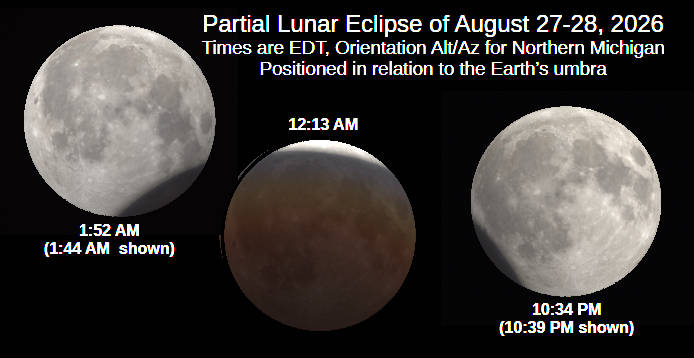
Late tonight and into tomorrow morning, clouds permitting, we will be able to see a partial eclipse of the moon. The moon will be almost totally immersed in the earth’s umbral shadow, with only a tiny sliver of the top of it visible at maximum eclipse. The partial eclipse starts at 10:34 PM EDT. The maximum of eclipse will be at 12:13 AM, and it will end at 1:52 AM. So it will be great viewing for those who can stay up late to see it. The moon will pass through the northern part of the earth’s shadow and since about 93% of the moon’s diameter will be immersed, the reddish appearance of the moon in the shadow might be apparent to the naked eye, and should be apparent in binoculars. The dusky appearance of the moon may appear half an hour before and after the eclipse. Use sunglasses to make the penumbral shadow easier to see.
The astronomical event times given in this blog are for the Traverse City/Interlochen area of Michigan (Lat 44.7° N, Long 85.7° W; EDT, UT – 4 hours) unless stated otherwise. Times will be different for other locations.
Addendum

Ephemeris: 08/25/2026 – Thursday’s lunar eclipse – and when eclipses can occur
This is Ephemeris for Tuesday, August 25th. Today the Sun will be up for 13 hours and 34 minutes, setting at 8:31, and it will rise tomorrow at 6:58. The Moon, 3 days before full, will set at 5:06 tomorrow morning.
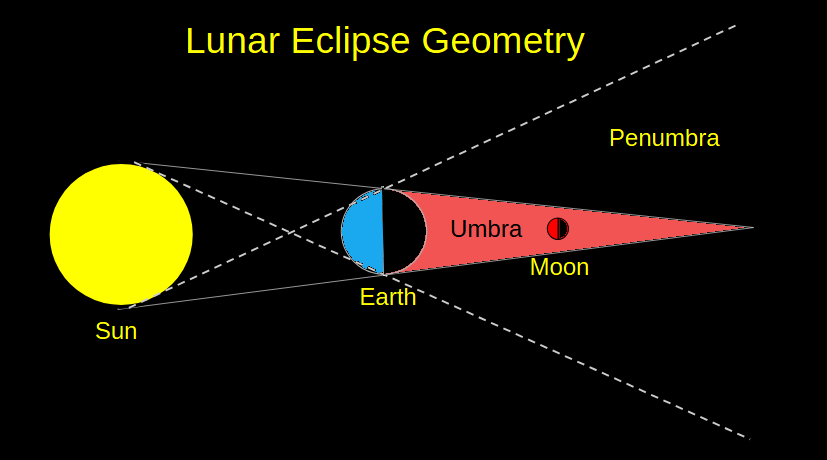
This Thursday’s partial lunar eclipse will occur only 15 days after the last eclipse, a nibble of a solar eclipse for us, and a total eclipse for others on August 12th. Eclipses occur in seasons of about a month long that occur at a bit less than six month intervals, so eclipses will occur a little earlier next year to this. That’s because the crossing points of the Moon’s and the Earth’s orbital planes regress slowly westward. In an eclipse season two eclipses will occur: a solar and a lunar eclipse. On rare occasions when a lunar eclipse occurs in the center of a season a partial solar eclipse can occur two weeks before and again after the lunar eclipse, but they will affect the opposite polar regions of the Earth. For Thursday night, the partial eclipse will start at 10:34 PM. Maximum eclipse occurs at 12:13 AM, and will end at 1:52 AM.
The astronomical event times given in this blog are for the Traverse City/Interlochen area of Michigan (Lat 44.7° N, Long 85.7° W; EDT, UT – 4 hours) unless stated otherwise. Times will be different for other locations.
Addendum
Ephemeris: 08/24/2026 – Get ready for a significant partial lunar eclipse Thursday night
This is Ephemeris for Monday, August 24th. Today the Sun will be up for 13 hours and 37 minutes, setting at 8:33, and it will rise tomorrow at 6:57. The Moon, 4 days before full, will set at 3:57 tomorrow morning.
Late Thursday night and into Friday morning, clouds permitting, we will be able to see a partial eclipse of the moon. The moon will be almost totally immersed in the earth’s umbral shadow, with only a tiny sliver of the top of it visible at maximum eclipse. The partial eclipse starts at 10:34 PM EDT Thursday night (2:34 UT Friday morning the 28th). The maximum of eclipse will be at 12:13 AM (4:13 UT), and it will end at 1:52 AM (5:52 UT). So it will be nice viewing for those who can stay up late to see it. The moon will pass through the northern part of the earth’s shadow and since about 93% of the moon’s diameter will be immersed, the reddish appearance of the moon in the shadow might be apparent, and will definitely be apparent in binoculars.
The astronomical event times given in this blog are for the Traverse City/Interlochen area of Michigan (Lat 44.7° N, Long 85.7° W; EDT, UT – 4 hours) unless stated otherwise. Times will be different for other locations.
Addendum
Ephemeris: 03/02/2026 – There’s a total lunar eclipse tomorrow morning
This is Ephemeris for Monday, March 2nd. Today the Sun will be up for 11 hours and 13 minutes, setting at 6:32, and it will rise tomorrow at 7:16. The Moon, 1 day before full, will set at 7:19 tomorrow morning.
Early tomorrow morning* there will be total lunar eclipse. A lunar eclipse, also known as an eclipse of the Moon occurs when the full moon moves into the earth’s shadow cutting off most of its sunlight. A little sunlight does get in by being bent around the Earth by its atmosphere through all the sunrises and sunsets going on at that time. The moon’s color generally becomes dark red, this also depends on the Earth’s atmosphere and the amount of clouds, smoke and volcanic ash that are in it at the time. The partial phase will begin at 4:50 AM and will last until totality starts at 6:04 AM. Totality will last until 7:02 AM. The growing twilight may cause the totally eclipsed Moon to disappear before then.
The astronomical event times given in this blog are for the Traverse City/Interlochen area of Michigan (Lat 44.7° N, Long 85.7° W; EST, UT – 5 hours) unless stated otherwise. Times will be different for other locations.
* The Moon sets for us in Michigan before the end of the eclipse. Locations west of us in North America and the Pacific get to see the entire eclipse.
Addendum
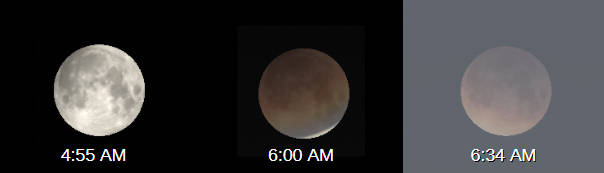
| Total Lunar Eclipse March 3, 2026 Events for the Grand Traverse area (Eastern Standard Time) |
|
| Time | Event |
| 03:44 AM | Begin Penumbral phase. This is the theoretical start of the eclipse. Nothing will appear to happen until about half an hour before the partial phase starts. Then the upper left part of the Moon will appear to darken. |
| 04:50 AM | Begin Partial phase. The umbra will encroach onto the Moon from upper left to lower right. The dull red of the umbral shadow may be discerned near the beginning of totality. |
| 05:40 AM | Astronomical Twilight begins. The Sun is 18° below the horizon. |
| 06:04 AM | Begin Totality. The expected dull red of the Moon will be brighter on the edge nearest the edge of the umbral shadow. How long will the totally eclipsed Moon be visible? |
| 06:14 AM | Nautical Twilight begins. The Sun is 12° below the horizon. |
| 06:34 AM | Mid-Eclipse |
| 07:03 AM | End Totality. Will a tiny slice of the Moon become visible in the brightening sky before it sets? |
| 07:18 AM | Sunrise |
| 07:19 AM | Moonset |
For more about lunar eclipses in general, see my post for last year’s lunar eclipse: Almost everything you wanted to know about lunar eclipses.
Ephemeris: 02/26/2026 – Get ready for next Tuesday morning’s Lunar Eclipse!
This is Ephemeris for Thursday, February 26th. Today the Sun will be up for 11 hours and 1 minute, setting at 6:26, and it will rise tomorrow at 7:23. The Moon, 2 days past first quarter, will set at 5:27 tomorrow morning.
Early next Tuesday morning there will be total lunar eclipse. A lunar eclipse, also known as an eclipse of the Moon occurs when the full moon moves into the earth’s shadow, causing it to become much darker. Usually a fair amount of sunlight does get in by being bent around the Earth by its atmosphere through all the sunrises and sunsets going on at that time. The moon’s color generally becomes very dark red, this also depends on the Earth’s atmosphere and the amount of clouds, smoke and volcanic ash that’s in the Earth’s atmosphere at that time. The partial phase will begin at 4:50 AM and will last until totality starts At 6:04 AM totality will last until 7:02 AM. The growing twilight may cause the moon to actually disappear.
The astronomical event times given in this blog are for the Traverse City/Interlochen area of Michigan (Lat 44.7° N, Long 85.7° W; EST, UT – 5 hours) unless stated otherwise. Times will be different for other locations.
Addendum
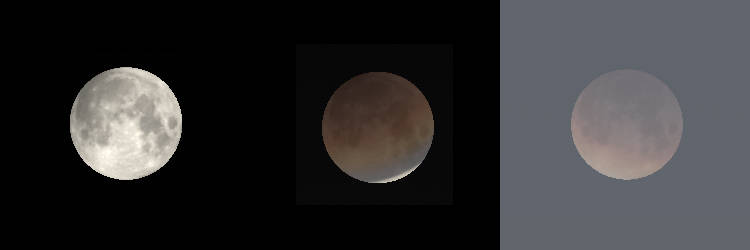
| Total Lunar Eclipse March 3, 2026 Events for the Grand Traverse area (Eastern Standard Time) | |
| Time | Event |
| 03:44 AM | Begin Penumbral phase. This is the theoretical start of the eclipse. Nothing will appear to happen until about half an hour before the partial phase starts. Then the upper left part of the Moon will appear to darken. |
| 04:50 AM | Begin Partial phase. The umbra will encroach onto the Moon from upper left to lower right. The dull red of the umbral shadow may be discerned near the beginning of totality. |
| 05:40 AM | Astronomical Twilight begins. The Sun is 18° below the horizon. |
| 06:04 AM | Begin Totality. The expected dull red of the Moon will be brighter on the edge nearest the edge of the umbral shadow. How long will the totally eclipsed Moon be visible? |
| 06:14 AM | Nautical Twilight begins. The Sun is 12° below the horizon. |
| 06:34 AM | Mid-Eclipse |
| 07:03 AM | End Totality. Will a tiny slice of the Moon become visible in the brightening sky before it sets? |
| 07:18 AM | Sunrise |
| 07:19 AM | Moonset |
Eclipse event times are strictly convertible by time zone. Twilight, sunrise and moonset events depend on one’s location. For locations west of Michigan, the eclipse may occur completely in darkness.
Ephemeris: 03/13/2025 – Get ready for tomorrow morning’s total lunar eclipse
This is Ephemeris for Thursday, March 13th. Today the Sun will be up for 11 hours and 48 minutes, setting at 7:46, and it will rise tomorrow at 7:56. The Moon, 1 day before full, will set at 8:06 tomorrow morning.
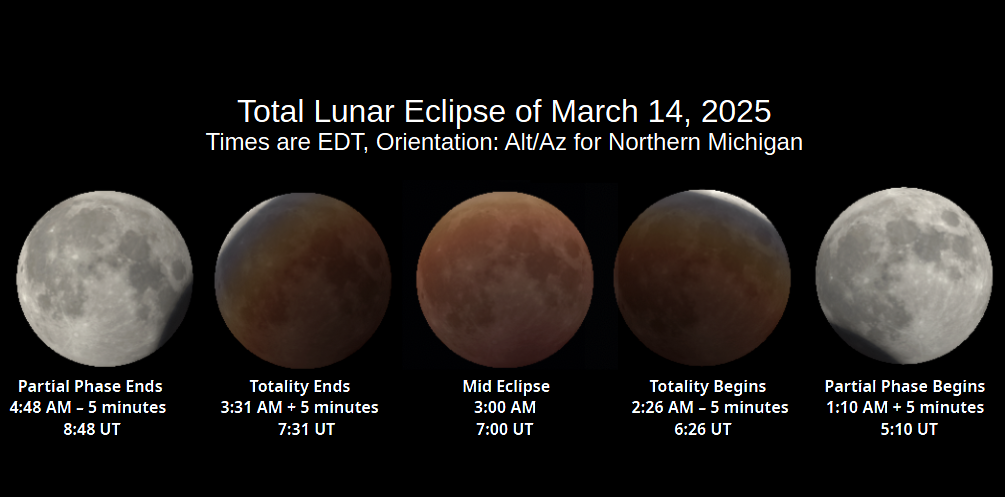
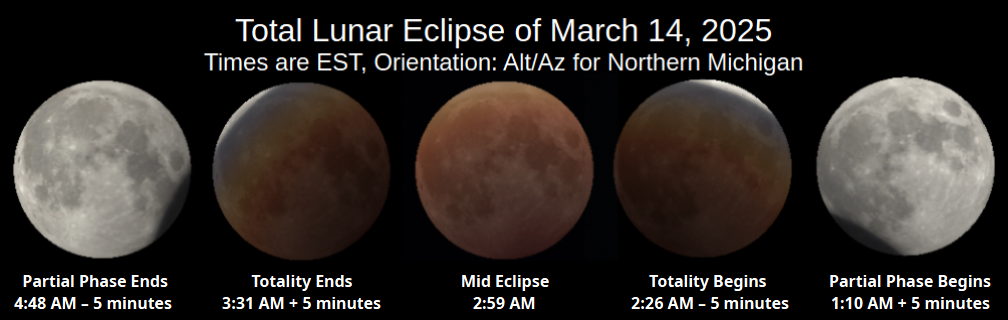
Late, late, late, tonight, or actually early tomorrow morning there will be a total eclipse of the Moon. The moment of full moon, which is necessary for a lunar eclipse will occur at 2:55 AM tomorrow, and the middle of the eclipse will be 5 minutes later. The partial phase of the lunar eclipse will start at 1:10 AM. This partial phase will grow until 2:26 AM when totality will begin. During this period of time the Moon should have a dull reddish color because it is illuminated only by the light filtering through the Earth’s atmosphere from the combined sunrises and sunsets around the world at that time. The total phase will end at 3:31 AM. The ending partial phase will continue until 4:48 AM.
The astronomical event times given are for the Traverse City/Interlochen area of Michigan (EDT, UT – 4 hours). Times will be different for other locations.
Addendum
Ephemeris: 03/07/2025 – GTAS Meeting tonight (also on Zoom): Previewing 3/14’s total lunar eclipse
This is Ephemeris for Friday, March 7th. Today the Sun will be up for 11 hours and 29 minutes, setting at 6:38, and it will rise tomorrow at 7:07. The Moon, 1 day past first quarter, will set at 4:28 tomorrow morning.
The Grand Traverse Astronomical Society will host its February meeting tonight at 8 PM at Northwestern Michigan College’s Joseph H Rogers Observatory. The talk for the evening will be given by yours truly. One week from today, Friday, March 14th in the early morning hours, there will be a total eclipse of the Moon. That is my subject. I will explore some notable lunar eclipses of the past, what they are, and why we don’t see them every full moon. I’ll talk about other facts about lunar eclipses. The observatory is located on Birmley Rd. South of Traverse City between Garfield and Keystone roads. The meeting will also be available via Zoom. Instructions to join the meeting will be on the society’s website, gtastro.org.
The astronomical event times given are for the Traverse City/Interlochen area of Michigan (EST, UT – 5 hours). Times will be different for other locations.
Addendum
Ephemeris: 03/22/2024 – There will be a penumbral eclipse of the Moon Monday morning
This is Ephemeris for Friday, March 22nd. Today the Sun will be up for 12 hours and 17 minutes, setting at 7:58, and it will rise tomorrow at 7:39. The Moon, 3 days before full, will set at 7:16 tomorrow morning.
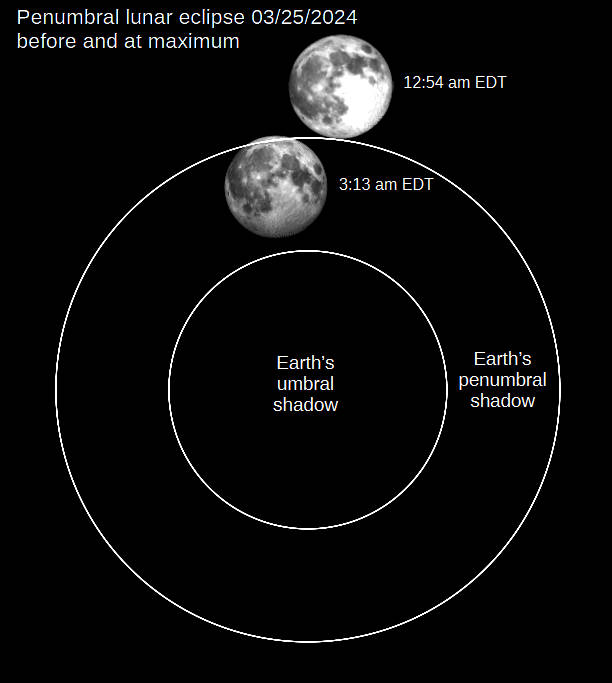
We are in an eclipse season. These occur at a bit less than 6 months intervals, and last about 35 days. During this period we will have a solar eclipse and a lunar eclipse. Of course the big eclipse of this eclipse season is the April 8th total solar eclipse, which will be visible from the United States and be visible from here as a very deep partial eclipse. We start off this eclipse season with a lunar eclipse, not a really great lunar eclipse, but a lunar eclipse nonetheless. It is a penumbral eclipse where the Moon enters the Earth’s outer shadow where the Sun is only partially blocked to it. What we will see will be not much. It will reach its maximum at 3:13 am Monday morning, when the bottom part of the Moon will be slightly darker than the top.
The astronomical event times given are for the Traverse City/Interlochen area of Michigan (EDT, UT–4 hours). They may be different for your location.
Addendum
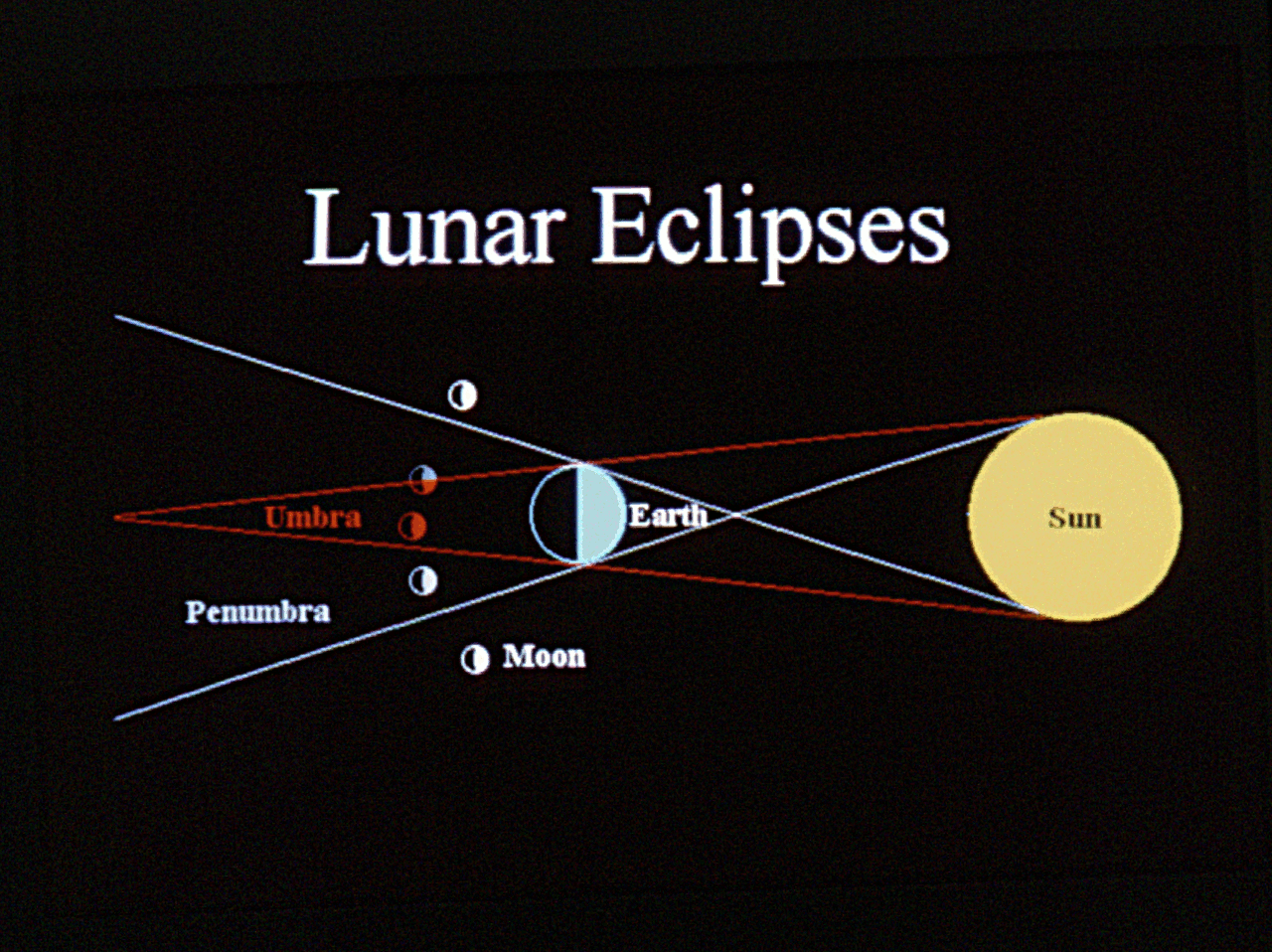
12/22/2022 – Ephemeris – Hunting for the Star of Bethlehem: When did Herod the Great Die – Part 2
This is Ephemeris for Thursday, December 22nd. Today the Sun will be up for 8 hours and 48 minutes, setting at 5:05, and it will rise tomorrow at 8:17. The Moon, 1 day before new, will rise at 8:56 tomorrow morning.
According to the Gospel of Matthew, Jesus was born in the last years of the reign of Herod the Great, and the Jewish historian Josephus puts Herod’s death shortly after an eclipse of the Moon. There may have been an error in the Josephus history that has been propagated since the middle of the 16th century, that when corrected shifts the eclipse in question forward three years to 1 BCE. The conjunctions of Jupiter and Saturn of 7 BCE would be four years too early. Under this scenario, Jesus would have been born in the spring of 2 BCE, the time of year when shepherds would indeed be out at night with their flocks, because this was lambing season. What the Magi would have seen was, on two occasions, the planets Venus and Jupiter appear to merge into a single star.
The astronomical event times given are for the Traverse City/Interlochen area of Michigan (EST, UT –5 hours). They may be different for your location.
Addendum
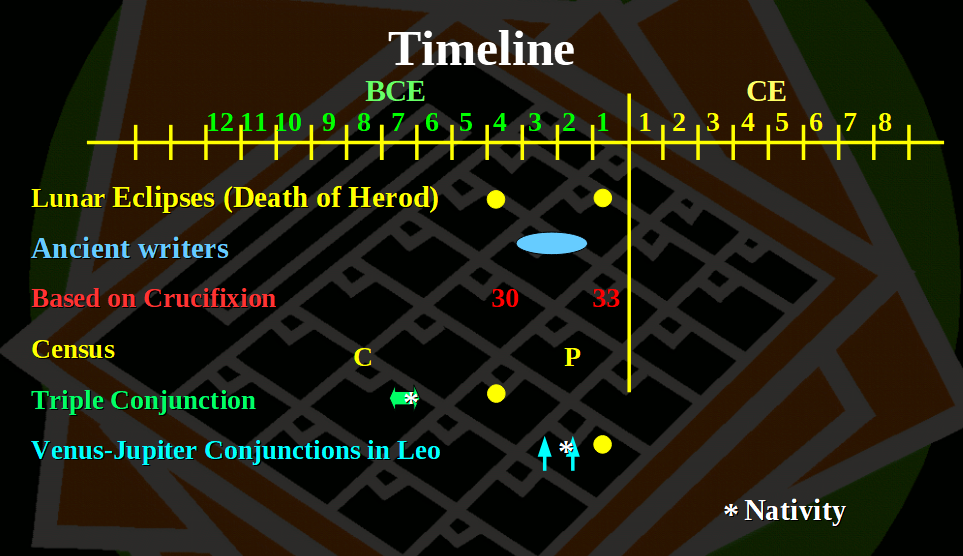
This is a timeline I developed of the events surrounding the Birth of Jesus. On the top line in yellow are the two eclipses of the Moon that occurred in the time period we’re interested in: 4 BCE and 1 BCE. One of then was the eclipse Josephus mentions that occurred shortly before the death of Herod the Great, who was alive to greet the Magi, who came to Jerusalem seeking the newborn King of the Jews. The second line highlights 3 and 2 BCE that the early Christian writers Irenaeus, Tertullian and Clement of Alexandria based Jesus’ birth year to Roman events which can be pegged to the Roman Calendar which has a direct relationship to our own calendar. The next line contains hits based on the Crucifixion of Jesus at age 33, where the Last Supper was a Seder on the first day of Passover. The next line with C and P are two censuses of Augustus in our time period. The next to the last line shows the relation of the triple conjunction in 7 BCE with Jesus’ birth and Herod’s death. The bottom line related the two Venus-Jupiter conjunctions with Jesus’ birth and Herod’s death.
Where the lunar eclipse of March 13 of 4 BCE was a slight partial eclipse. The lunar eclipse of January 10 of 1 BCE was total, which occurred three or four months before Passover. Herod’s death and the chaos that ensued, according to Josephus, before Passover also means the March 13, 4 BCE eclipse, occurring 1 month before Passover does not provide the length of time for all these events to transpire:
- Josephus mentions an eclipse of the moon.
- Herod went beyond the river Jordan to the warm baths at Callirrhoe by the Dead Sea.
- He knew he was near death as the treatments failed, so he returned to Jericho.
- Before he did, he had his soldiers paid a bonus.
- He ordered all the principal men of the Jews to meet with him under penalty of death. Those who did come, were imprisoned at the Hippodrome to be killed upon his death.
- Herod then attempted suicide.
- Herod’s son Antipater attempted to take the throne, and was executed.
- Five days later, Herod died.
- Herod had bequeathed the kingdom to another son, Archlaus, who then organized the funeral for Herod.
- The funeral procession could have taken up to 25 days.
- Then there were 7 days of mourning after that.
- Archlaus sent his generals to Caesar on his behalf to have him declared King.
- The people were beginning to demand lighter taxes and the release of those whom Herod had imprisoned.
- At that point, Josephus mentioned that Passover was approaching.
- Finally, it was Passover.
Obviously, all these events could not be squeezed into one 29 to 30 lunar month in 4 BCE. Defenders of the 4 BCE death of Herod would say that the Passover mentioned was the next year’s Passover, giving 12 or 13 months for the events to occur. In that case, why mention Passover at all?
Missing from the timeline above is Luke’s mention of Quirinius being Governor of Syria. However, there is a problem. Luke states the at the time of Jesus’ birth that Quirinius was Governor of Syria. The problem is that he wasn’t Governor of Syria until 6 and 7 CE, at least 8 years after the events of the Nativity. And the question of who was Governor of Syria wouldn’t have mattered until 6 CE, when Judea actually became part of the Province of Syria. In the period we’re looking at, Quintilius Varus was Syria’s governor. Could the two names be switched due to a copyist error? Anyway, this was before Judea became part of Syria, so it wouldn’t have mattered who was governor of Syria when Jesus was born. Luke’s account is not much help in dating the year of Jesus’ birth.
Tomorrow, I’ll finish up with the two conjunctions of Jupiter and Venus against the stars of Leo, which was the celestial sign of Judah and the land of Judea.
11/08/2022 – Ephemeris – Solar Eclipses in our future
This is Ephemeris for Election Day, Tuesday, November 8th. Today the Sun will be up for 9 hours and 51 minutes, setting at 5:22, and it will rise tomorrow at 7:31. The Moon, at full today, will rise at 5:28 this evening.
If you are listening to me early this morning, and it’s clear there is a lunar eclipse in progress. The eclipse will be total before 6:41 am, and partial until the Moon sets at 7:40 am. We will have to wait until March 2025 to see the next total lunar eclipse from our area.
However, we will be able to see two partial solar eclipses in the next year and a half. The first is October 14th, 2023. Nearly half of the Sun will be blocked by the Moon for us. The next one is the big one! April 8th, 2024 is a total eclipse less than a day’s drive away. The path of totality runs from Texas to Maine, just clipping the southeast corner of Michigan. Here in Northern Michigan, nearly 90% of the Sun will be covered by the Moon, so it will get noticeably dark at the peak of the eclipse.
The astronomical event times given are for the Traverse City/Interlochen area of Michigan (EDT, UT – 5 hours). They may be different for your location.
Addendum
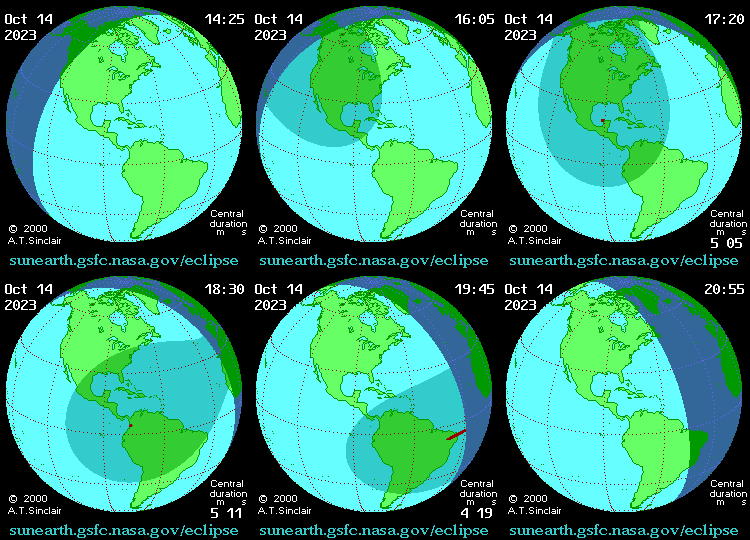
Areas on the Earth where the solar eclipse of October 14, 2023 can be seen via animation. The gray area is where the partial eclipse is visible. The dot is the place where the ring of the annular eclipse can be seen. Credit: NASA, A. T. Sinclair.
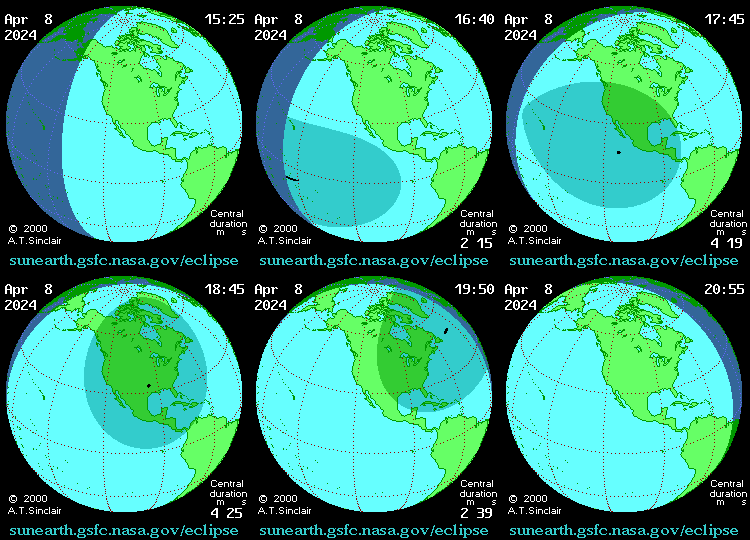
Areas on the Earth where the solar eclipse of April 8, 2024 can be seen via animation. The gray area is where the partial eclipse is visible. The dot is the place where the totally eclipsed Sun can be seen. Credit: NASA, A. T. Sinclair.
For more information on solar and lunar eclipses past and present, go here, NASA’s Eclipse Website.

