07/19/2017 – Ephemeris – Our weekly look at the bright planets
Ephemeris for Wednesday, July 19th. Today the Sun will be up for 15 hours and 5 minutes, setting at 9:21, and it will rise tomorrow at 6:16. The Moon, 3 days past last quarter, will rise at 3:33 tomorrow morning.
Let’s take our weekly look at the bright planets. Jupiter is in the west-southwest as it gets dark in the evening. The bright blue-white star Spica, which pales in comparison to Jupiter, is seen left of it. In even the smallest telescopes Jupiter’s four largest moons can be seen. They shift positions from night to night. Jupiter will set at 12:32 a.m. Saturn can now be seen in the evening as twilight fades in the south. The reddish star Antares is off to the right of Saturn. Saturn’s rings are spectacular in telescopes. Saturn will set at 3:46 a.m. In the morning sky, brilliant Venus will rise at 3:22 a.m. and be visible until about quarter to 6 tomorrow morning. Mercury sets too close to sunset to be easily seen now.
The times given are for the Traverse City/Interlochen area of Michigan. They may be different for your location.
Addendum
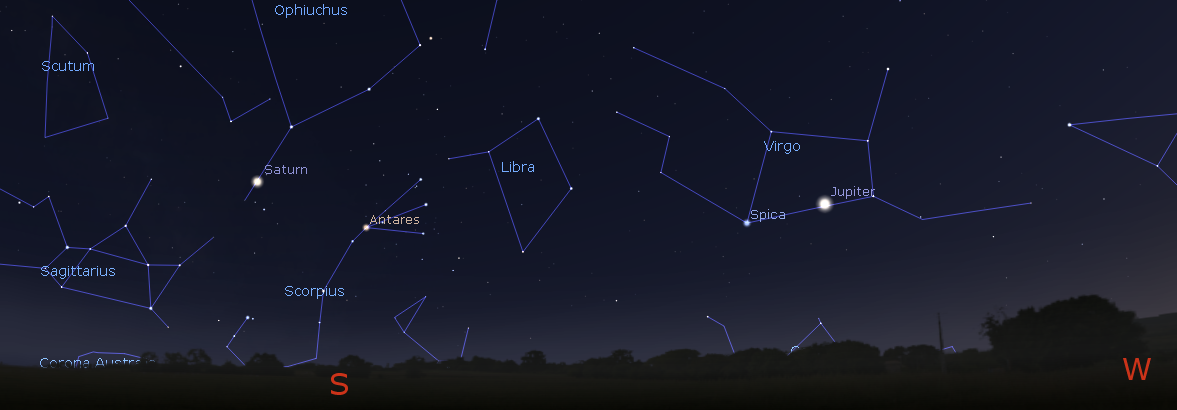
Jupiter and Saturn with the southern summer constellations at 10:30 p.m., July 19, 2017. Created using Stellarium. Click on the image to enlarge.
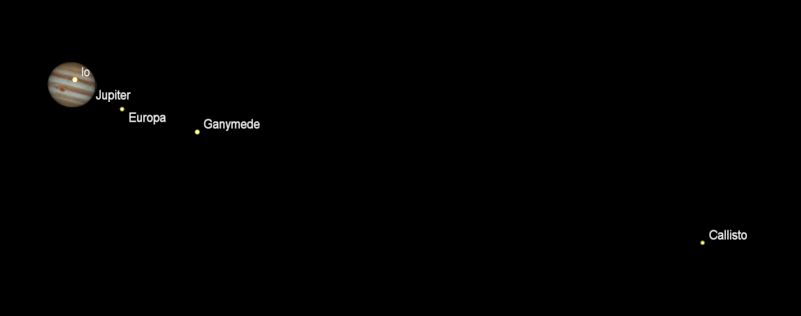
Jupiter and three of its moons. Io can be seen here in transit of the planet, but very difficult in reality, at 10:30 p.m,. July 19, 2017. Created using Cartes du Ciel (Sky Charts).
Project Pluto has the following events for the 12/13th:
Time is UT. Events prior to 20 July 2:35 UT (10:35 p.m. 19 July EDT) or later than 4:24 UT or 12:24 a.m. EDT will not be visible from Northern Michigan. Data from Project Pluto: https://www.projectpluto.com/jevent.htm#jun. The website also has a link to a list of Great Red Spot transits.
I : Tra start: 20 Jul 2017 1:21
I : Sha start: 20 Jul 2017 2:35
I : Tra end : 20 Jul 2017 3:32
II : Occ start: 20 Jul 2017 4:24
I : Sha end : 20 Jul 2017 4:46
II : Occ end : 20 Jul 2017 6:54
II : Ecl start: 20 Jul 2017 6:55
II : Ecl end : 20 Jul 2017 9:17
Satellites: I = Io and II = Europa
Tra = Transit of a satellite across the face of Jupiter, Sha = Transit of a moon’s shadow, Ecl = Eclipse (In Jupiter’s shadow), Occ = Occultation (Moon behind the planet).
The Great Red Spot transit: 20 Jul 2017 02:50 (10:50 p.m. 19 July EDT).
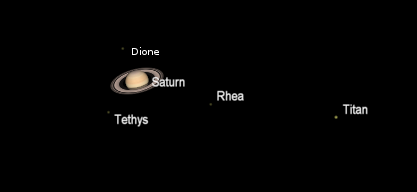
Saturn and its brightest moons overnight July 19/20, 2017. Created using Cartes du Ciel (Sky Charts).
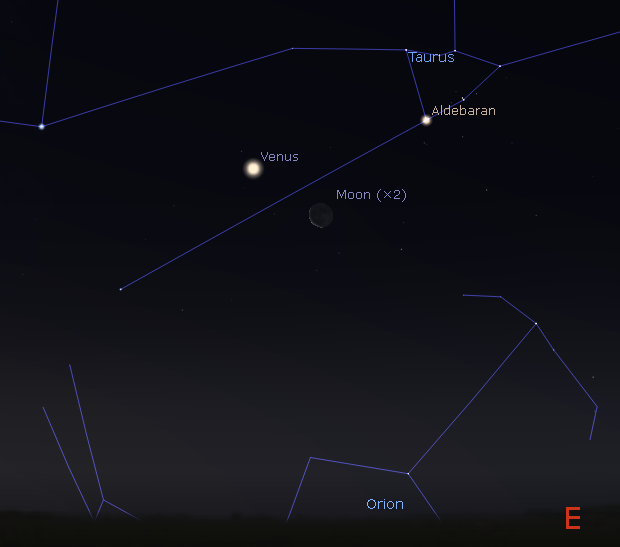
Venus and the Moon at twice its actual size at 5 a.m. July 20, 2017. Created using Stellarium.
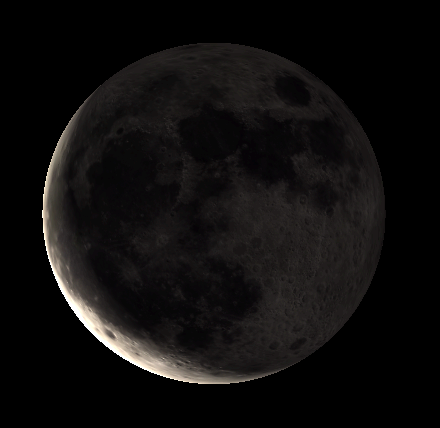
The Moon as it might be seen in binoculars showing also Earth shine at 5 a.m. July 20, 2017. Created using Stellarium.
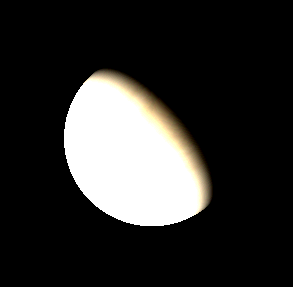
Venus as it might be seen through a telescope at 5 a.m. July 20, 2017. This is displayed at a larger scale/magnification than the Jupiter or Saturn images above. Created using Stellarium.
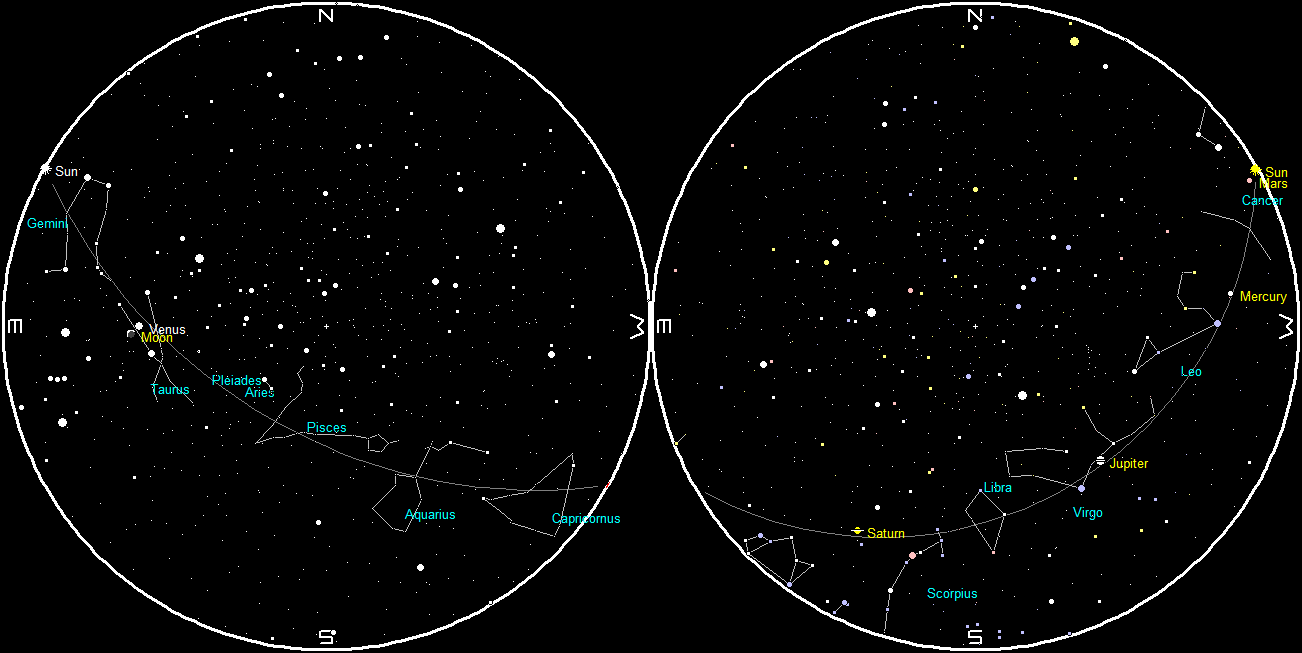
Planets at sunset and sunrise of a single night starting with sunset on the right on July 19, 2017. The night ends on the left with sunrise on July 20. Click on the image to enlarge. Created using my LookingUp program.
-
July 19, 2017 at 12:58 am07/19/2017 – Ephemeris – Our weekly look at the bright planets – MeasurementDataBases for Industry & Science
 Bob Moler's Ephemeris Blog