Archive
03/15/2018 – Ephemeris – Mercury at greatest separation (elongation) from the Sun today
Ephemeris for the Ides of March, Thursday, March 15th. The Sun will rise at 7:55. It’ll be up for 11 hours and 53 minutes, setting at 7:48. The Moon, 2 days before new, will rise at 7:45 tomorrow morning.
Today the planet Mercury will be at its greatest separation east from the Sun. It is called its greatest eastern elongation from the Sun. It is at an angle of 18.4 degrees from the Sun. It will be seen in the west about 8:15 for about an hour before it sets. It will be above right of the much brighter Venus. Mercury is probably at its best place to be observed than any time this year, with eastern elongation happening near the vernal equinox and is placed at a high angle above the Sun. The best morning appearance of Mercury will be its greatest western elongation on August 26th, almost a month short of the autumnal equinox, where it won’t be placed at as great an angle above the rising Sun.
The times given are for the Traverse City/Interlochen area of Michigan. They may be different for your location.
Addendum
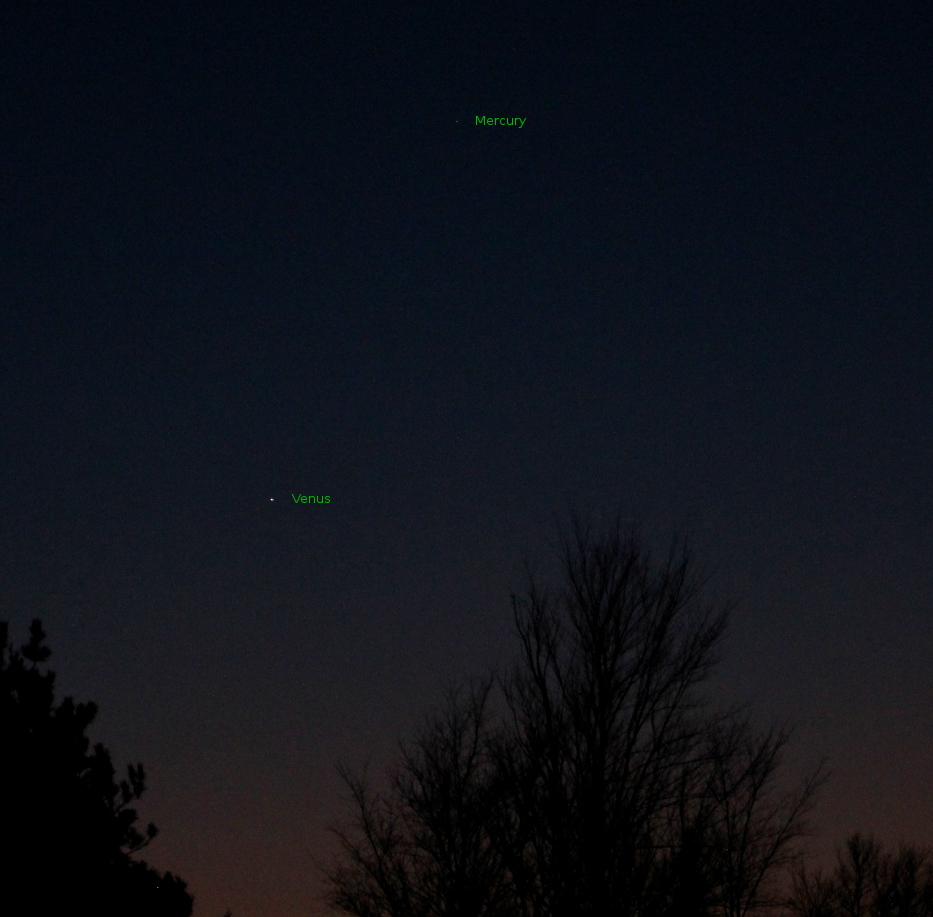
Venus and Mercury photographed last night at 8:20 EDT March 14, 2018. Did some tweaks to bring out Mercury in GIMP. Canon EOS Rebel T5, 75 mm, though reduced by 67%; f/4, 1/400 sec., ISO 1600. Click on image to enlarge. Click on image to enlarge. Credit Bob Moler.
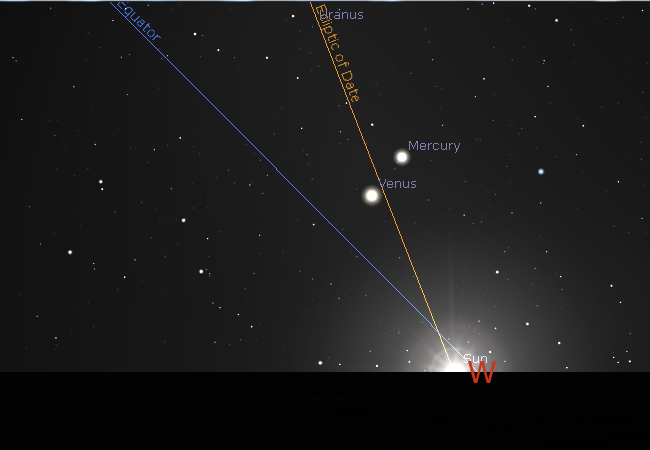
Stellarium’s showing of Venus and Mercury at 8:15 p.m. March 15. 2018.
Note in the above image, the steepness of the ecliptic (plane of the Earth’s orbit) is to the horizon in the spring. Its angle to the celestial equator is 23.5°. The angle the celestial equator makes with the horizon is your co-latitude (90° – your latitude). At my location my latitude is 44.7°, so the celestial equator meets the horizon at 45.3°. On the March equinox the ecliptic, near where the planets hang out, reaches its most vertical at nearly 70°. This makes planets, including Mercury appear higher in the sky near sunset, and as they set, moving parallel to the equator, will stay up their longest.
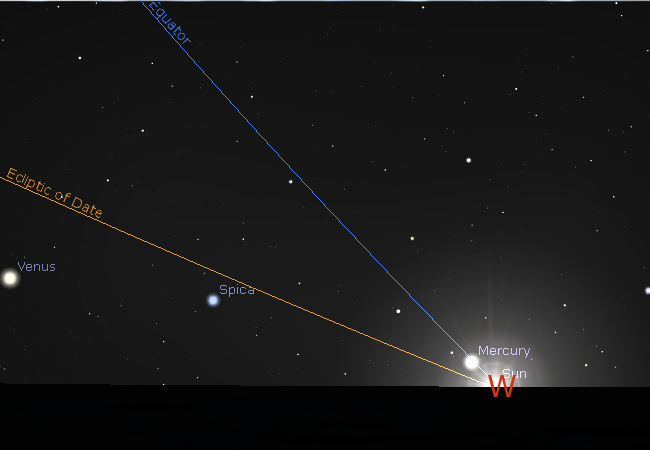
Celestial equator and ecliptic at the September equinox showing how low it appears. Created using Stellarium.
On the September equinox the ecliptic, near where the planets hang out, reaches its most horizontal at near 22°. This makes planets, including Mercury appear lower in the sky near sunset, and as they set, moving parallel to the equator, will set shortly after the Sun. This September Venus happens to be approaching its inferior conjunction and is very close to the Earth. This exaggerates its orbital inclination. in this case shows the planet a good deal south of the ecliptic.
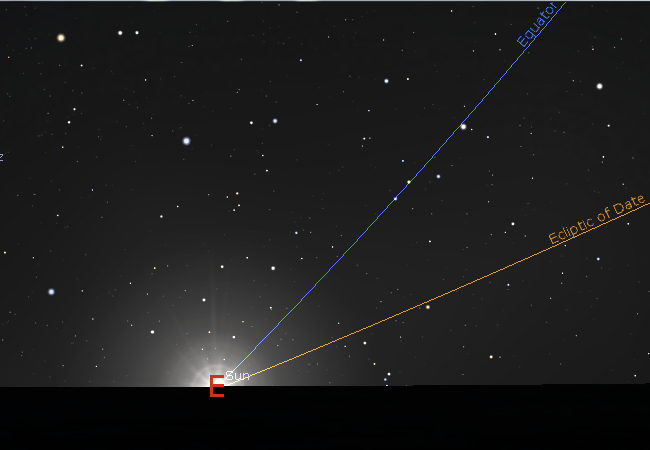
At the spring equinox close morning planets to the Sun will be hard to spot, being low to the horizon.
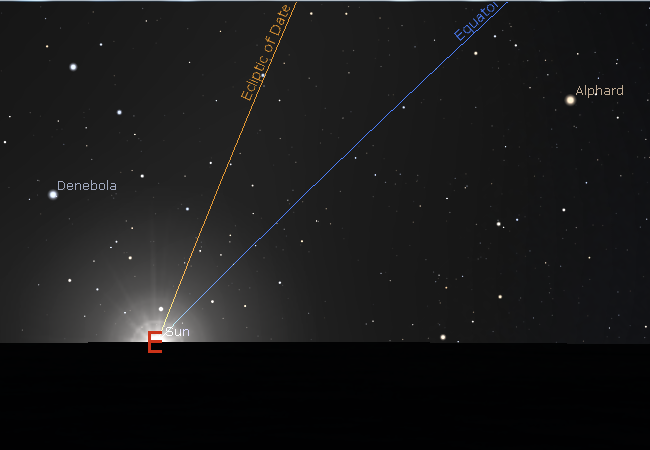
Celestial equator and ecliptic at the September equinox mornings showing how high it appears. Created using Stellarium.
Update
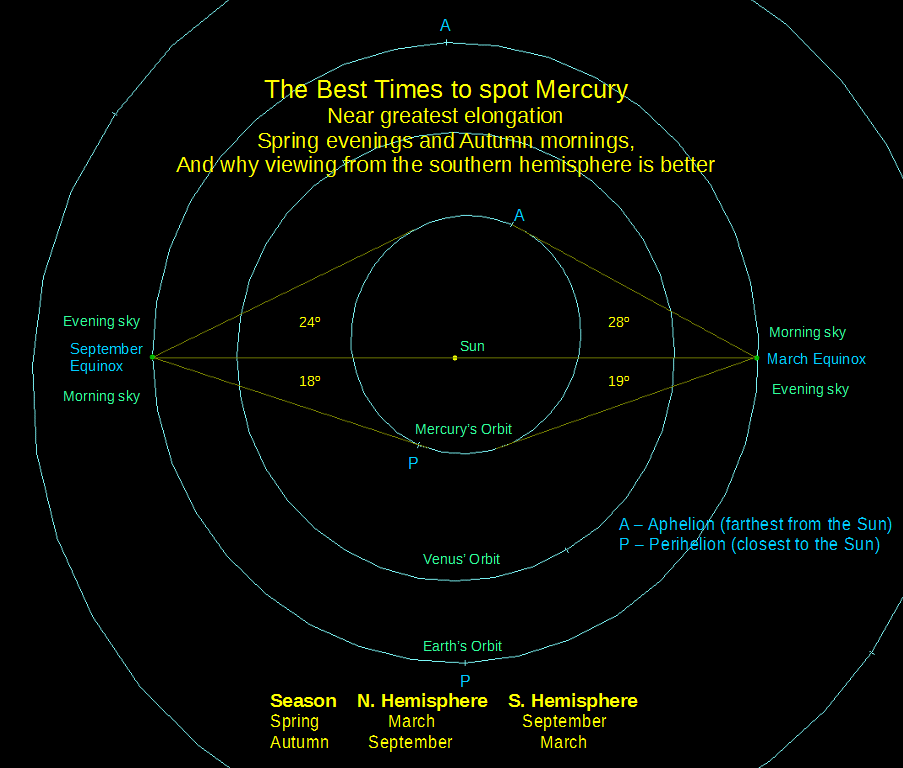
The angles of the elongation of Mercury at the equinoxes. Click on image to enlarge. Created using my LookingUp program.
Due to the eccentricity of Mercury’s orbit and its orientation with respect to the Earth’s positions at the equinoxes, observers on the southern hemisphere of the Earth get a better view of Mercury than us northerners.
(I created a similar diagram for posting yesterday, but found right before the scheduled posting time that it was incorrect in its orientation, so I redid it this morning.)
 Bob Moler's Ephemeris Blog