Archive
03/20/2018 – Ephemeris – Spring begins later today!
Ephemeris for Tuesday, March 20th. The Sun will rise at 7:45. It’ll be up for 12 hours and 9 minutes, setting at 7:55. The Moon, 3 days past new, will set at 11:30 this evening.
At 12:15 p.m. the season of spring will begin. It may or may not feel it in our neck of the woods, but astronomically at that time the Sun will appear to cross a point in the sky called the vernal equinox. Equinox means equal night, when the Sun is up for 12 hours, and set for 12 hours. It does, if you don’t look too close, and in the old days clock weren’t that accurate anyway. The vernal equinox is the point in the sky where the Sun crosses the celestial equator, which is above the Earth’s equator heading north. The North Pole will begin 6 months of daylight, while the rest of the northern hemisphere will bask in more than 12 hours of sunlight a day. The reverse is true in the southern hemisphere where autumn will start.
The times given are for the Traverse City/Interlochen area of Michigan. They may be different for your location.
Addendum
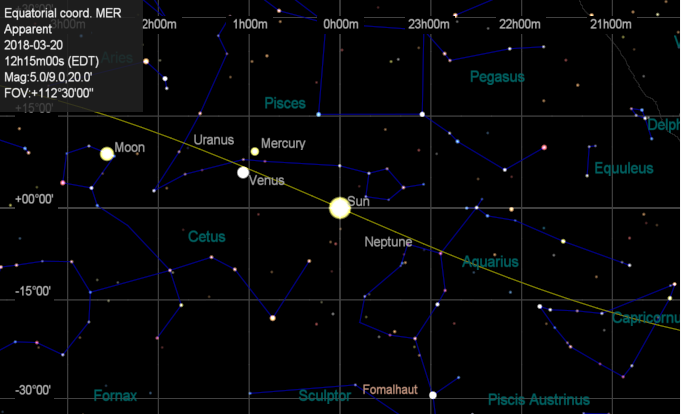
The Sun at the vernal equinox point in the sky at 12:15 p.m. EDT (16:15 UT) March 20, 2018. That point is the starting point in measurements on the celestial sphere. 0 hours right ascension, 0 degrees declination. The yellow line is the ecliptic, the plane of the Earth’s orbit and the apparent path of the Sun, whivh moves about one degree per day from lower right to upper left. Created using Cartes du Ciel (Sky Charts).
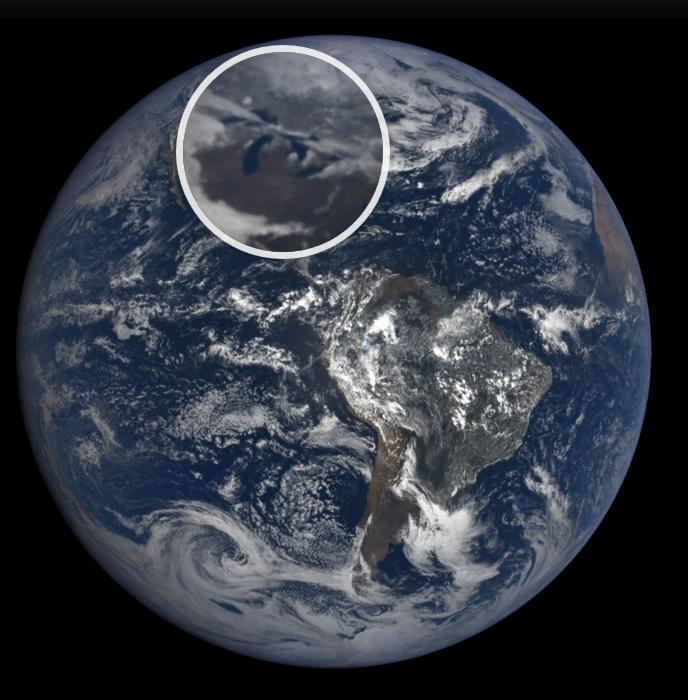
The Earth from 2 days before the vernal equinox, with the north pole not quite in sunlight. I’ve added a magnifying spot showing Michigan. The white stuff fringing the upper part of the Michigan mitten is snow. It was a rare clear day Saturday when this image was taken. Credit NOAA/NASA/DSCOVR satellite/EPIC camera.
The DSCOVR satellite was 914,903 miles (1,472,394 km) sunward of the Earth at the time of the image. The satellite is in a halo orbit of the Lagrangian L1 point between the Earth and the Sun.
 Bob Moler's Ephemeris Blog