Archive
Ephemeris: 09/28/2026 – What happens to the Earth during Autumn
This is Ephemeris for Monday, September 28th. Today the Sun will be up for 11 hours and 51 minutes, setting at 7:28, and it will rise tomorrow at 7:38. The Moon, 2 days past full, will rise at 8:04 this evening.
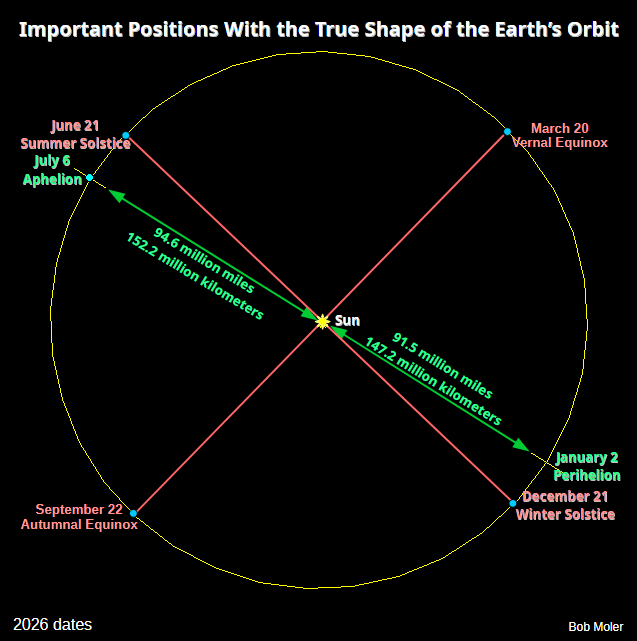
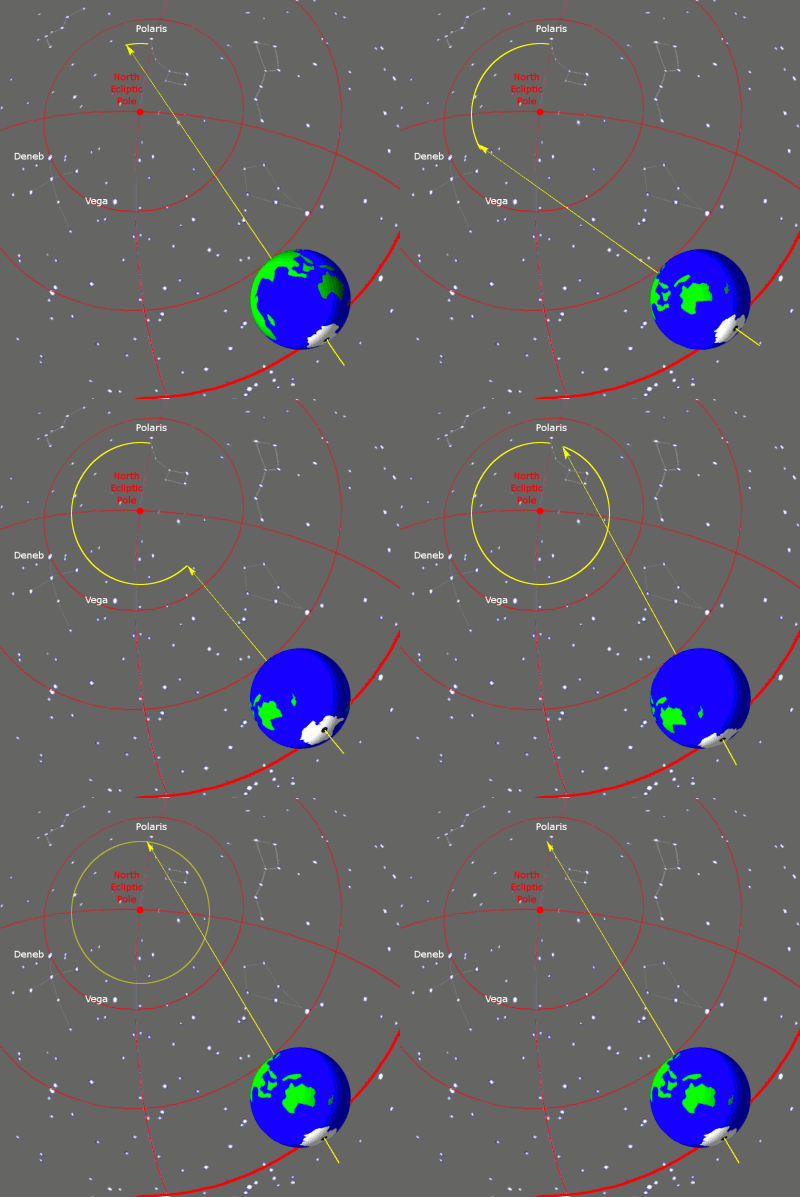
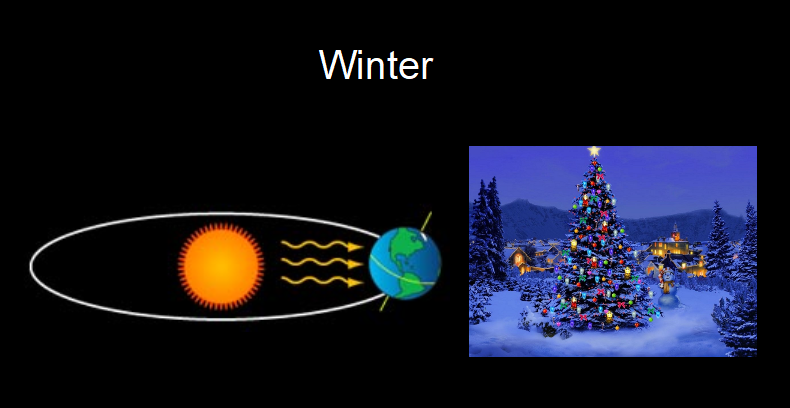
Autumn is a season of change. The Sun, at noon each day, will not rise as high as the previous day. Sunrises will occur progressively later each day, while the Sun sets progressively earlier. This is not occuring by the earth moving away from the sun giving us colder temporatures. In fact throughout autumn we’re moving slowly closer to the Sun. But the entire yearly range in the sun’s distance change is only 3 million miles out of 93 million. The reason for the change of season is the tilt of the axis of the Earth to its orbital plane around the sun. The axis of the Earth points in a single direction, currently towards the star Polaris, so as the Earth moves around the Sun the Earth’s axis appears to change its orientation with the Sun.
The astronomical event times given in this blog are for the Traverse City/Interlochen area of Michigan (Lat 44.7° N, Long 85.7° W; EDT, UT – 4 hours) unless stated otherwise. Times will be different for other locations.
Addendum
Ephemeris: 09/22/2026 – Autumn will fall upon us tonight
This is Ephemeris for Tuesday, September 22nd. Today the Sun will be up for 12 hours and 10 minutes, setting at 7:40, and it will rise tomorrow at 7:31. The Moon, half way from first quarter to full, will set at 3:58 tomorrow morning.
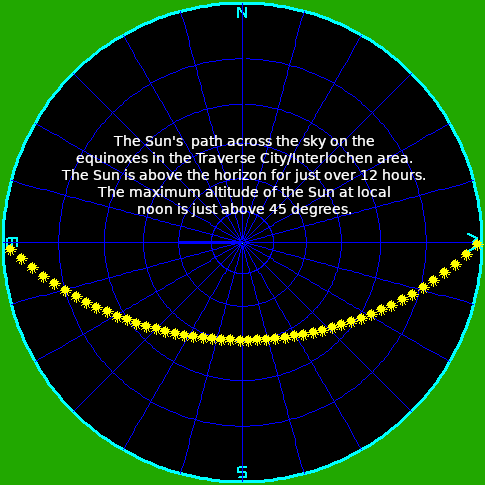
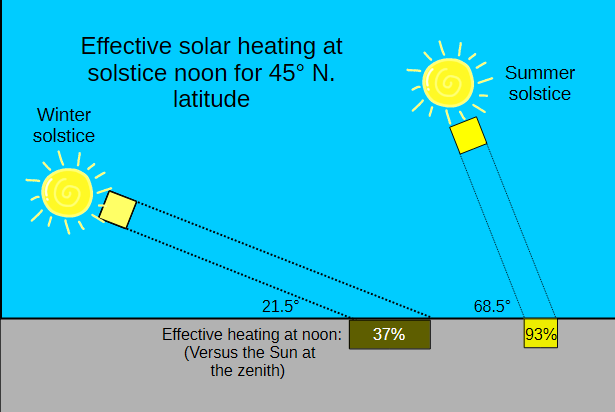
The season of fall is about to, ah well, fall upon us and in a few weeks so will the leaves. At 8:06 this evening (00:06 UT tomorrow) the Sun will cross the celestial equator heading south. The celestial equator is an imaginary line in the sky above the earth’s equator. At that point, the Sun will theoretically set at the North Pole and rise at the South Pole. The day is called the autumnal equinox and the daylight hours today is 12 hours and 10 minutes instead of 12 hours exactly. That’s due to our atmosphere and our definition of sunrise and sunset. The reason for the cooler weather now and the cold weather this winter is that the length of daylight is shortening, and the Sun rides lower in the sky, spreading its heat over a larger area, thus diluting its intensity.
The astronomical event times given in this blog are for the Traverse City/Interlochen area of Michigan (Lat 44.7° N, Long 85.7° W; EDT, UT – 4 hours) unless stated otherwise. Times will be different for other locations.
Addendum
Ephemeris: 06/19/2026 – Summer begins Sunday as the Sun reaches the summer solstice
This is Ephemeris for Juneteenth, Friday, June 19th. Today the Sun will be up for 15 hours and 34 minutes, setting at 9:31, and it will rise tomorrow at 5:57. The Moon, 2 days before first quarter, will set at 12:58 tomorrow morning.
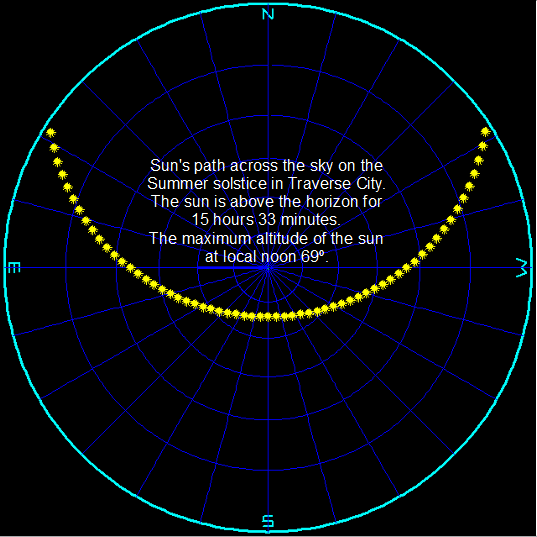
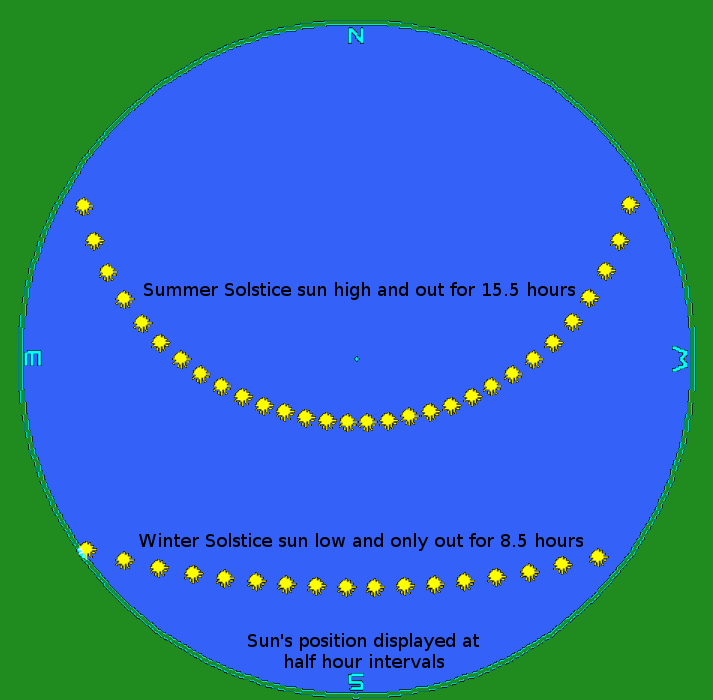
Summer will arrive at 4:25 AM Sunday morning (8:25 UT). Then the Sun will be out 15 hours 34 minutes for us in the Interlochen/Traverse City area. That’s within the same minute as today. Also, the Sun will reach up to nearly 69 degrees altitude above the southern horizon at local noon, that’s 1:44 pm. After the summer solstice we will begin to climb down from those extreme values, at first slowly, but with increasing rapidity as summer goes on. However, the Northern Hemisphere is continuing to warm up. Our warmest average temperatures tend to be near the end of July. What’s really neat is, the Earth is farther from the Sun than it was six months ago as winter started. It doesn’t make us any cooler, but makes summer longer.
The astronomical event times given in this blog are for the Traverse City/Interlochen area of Michigan (Lat 44.7° N, Long 85.7° W; EDT, UT – 4 hours) unless stated otherwise. Times will be different for other locations.
Addendum
Ephemeris: 03/19/2026 – Anticipating the beginning of spring
See Aurora alert below
This is Ephemeris for Thursday, March 19th. Today the Sun will be up for 12 hours and 6 minutes, setting at 7:54, and it will rise tomorrow at 7:45. The Moon, 1 day past new, will set at 9:02 this evening.
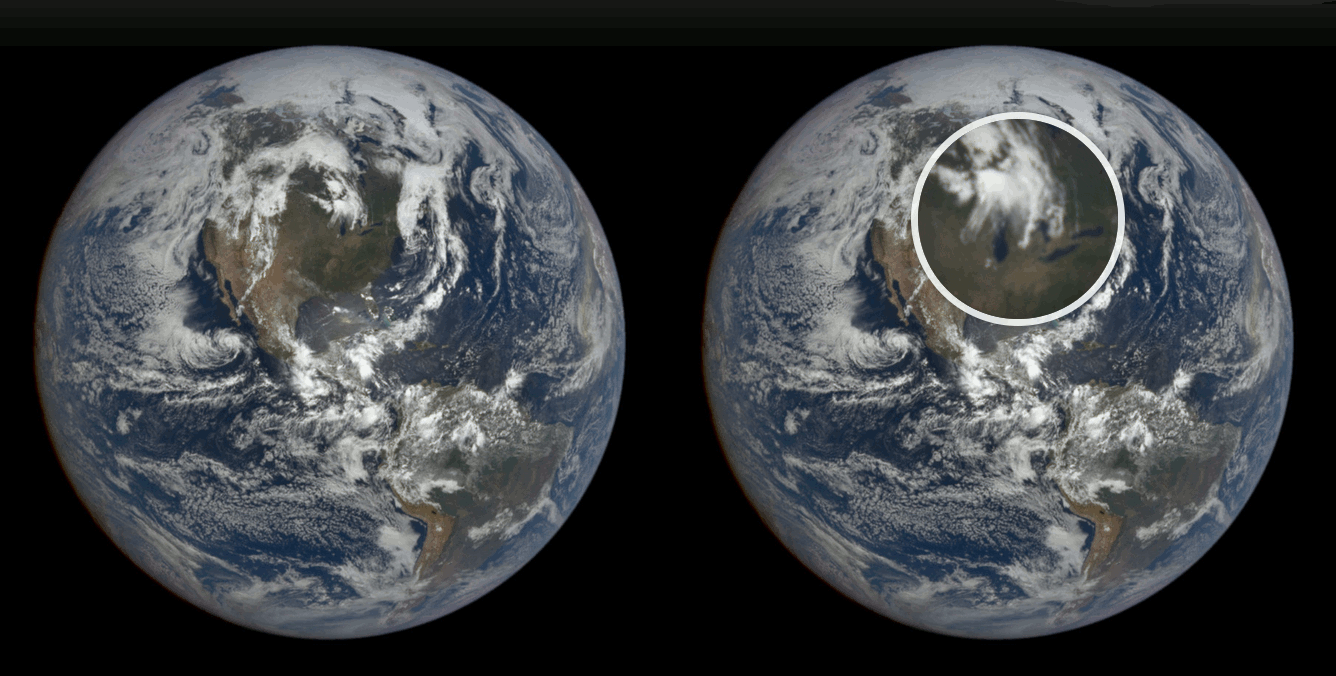
This is the last full day of winter. It seems strange that we know so accurately when the seasons begin and end astronomically, but never know what the weather’s going to do tomorrow with that same accuracy. The main reason is the number of variables involved. With the solar system, the earth and the sun in particular. There are very few variables. For instance, the masses of the Earth and the Sun, they’re distance apart and the gravitational constant, will give you a very close approximation. For the weather, there are tons of variables, plus what a butterfly did in Alaska last October. Knowing the date of the vernal equinox the first day of spring was and is important for agriculture, knowing when the world will warm up again.
The astronomical event times given in this blog are for the Traverse City/Interlochen area of Michigan (Lat 44.7° N, Long 85.7° W; EST, UT – 5 hours) unless stated otherwise. Times will be different for other locations.
Addendum

Aurora Alert
According to Spaceweather.com the Earth will be hit with 2 CMEs (Coronal Mass Ejections) from the Sun on the 19th and 21st respectively. See also NOAA’s Space Weather Prediction Center.
Ephemeris: 03/12/2026 – Cancer the crab used to welcome summer
This is Ephemeris for Thursday, March 12th. Today the Sun will be up for 11 hours and 44 minutes, setting at 7:45, and it will rise tomorrow at 7:58. The Moon, 1 day past last quarter, will rise at 5:25 tomorrow morning.
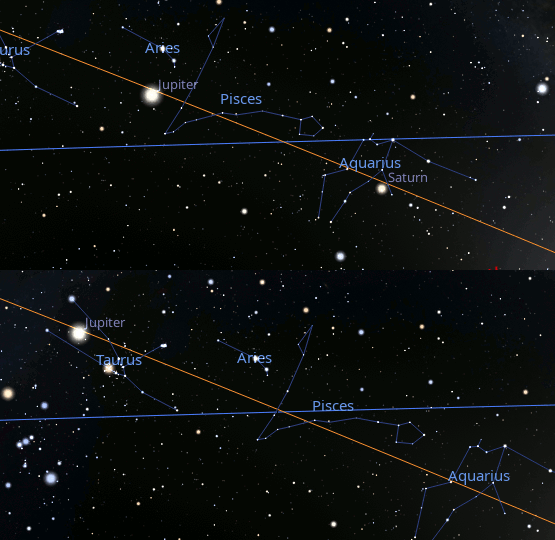
There’s a line on some globes and maps at approximately 23 1/2° north latitude called the Tropic of Cancer. It’s related to the constellation Cancer the crab. However, Cancer no longer fits that role that it was named to a couple of thousand years ago, when the sun entered the constellation of Cancer on the first day of summer. That’s the latitude on the Earth where the Sun was directly overhead on the first day of summer. Now that an honor goes to Gemini. The way we draw the figure of that constellation, the Sun is right near Castor’s big toe on the first day of summer. But I don’t think they’re going to change the name anytime soon. The reason for the change is that the Earth’s axis slowly wobbles like a top or gyroscope as they slow down. The effect is called precession.
The astronomical event times given in this blog are for the Traverse City/Interlochen area of Michigan (Lat 44.7° N, Long 85.7° W; EST, UT – 5 hours) unless stated otherwise. Times will be different for other locations.
Addendum
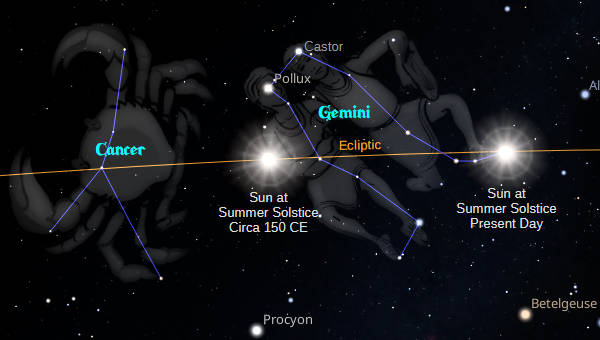
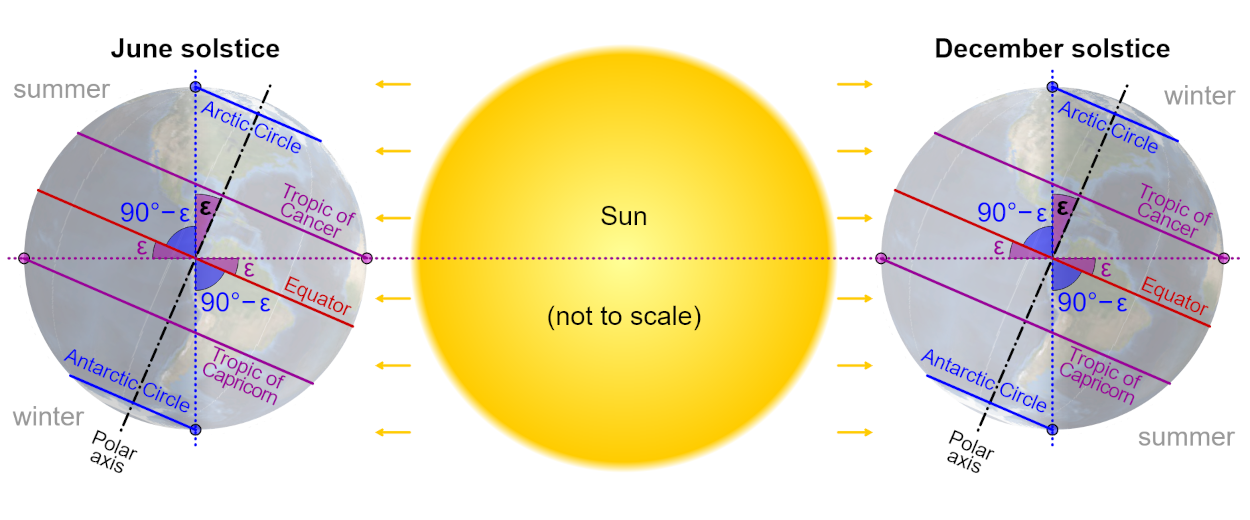
The Greek letter epsilon in the image above represents the tilt of the Earth’s axis of around 23.5°. Astronomers call it the obliquity of the ecliptic, the angle between the ecliptic and the celestial equator as seen in the illustration below.
Ephemeris: 03/06/2026 – The Fisher announces the coming of the maple sugaring season
This is Ephemeris for Friday, March 6th. Today the Sun will be up for 11 hours and 25 minutes, setting at 6:37, and it will rise tomorrow at 7:09. The Moon, 3 days past full, will rise at 10:30 this evening.
March is a month of transitions. The stars of the winter skies, that is Orion and his merry band of bright stars, move to the west as those of spring rise in the east. The Big Dipper is ascending in the northeastern sky, after lying low in the north during the long dark evenings in the heart of winter. The dipper is the hind end of the Great Bear, officially Ursa Major. The Anishinaabe peoples of the Great Lakes region saw the Big Dipper as the hind end and tail of a magical creature called Fisher, or in their language Ojiig, who brought summer to the Earth. Its position in the sky around the pole announces the seasons. The Fisher’s ascension high into the northeastern sky signals the start of the maple sugaring season later this month.
The astronomical event times given in this blog are for the Traverse City/Interlochen area of Michigan (Lat 44.7° N, Long 85.7° W; EST, UT – 5 hours) unless stated otherwise. Times will be different for other locations.
Addendum
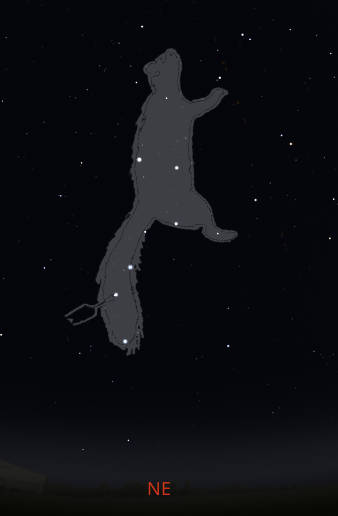
For the story of the Fisher, and how he got that arrow stuck in his tail, check out The story of the Fisher Star.
Ephemeris: 02/02/2026 – Groundhog Day’s significance
This is Ephemeris for Ground Hog Day, Monday, February 2nd. Today the Sun will be up for 9 hours and 52 minutes, setting at 5:53, and it will rise tomorrow at 7:59. The Moon, 1 day past full, will rise at 7:00 this evening.
I don’t know if Punxsutawney Phil will see his shadow this morning or not, but February 2nd was a special day to the ancients. It is also Candlemas day for the Catholic Church, and celebrated as a cross-quarter day, the middle of the season of Winter. Though the exact date of the middle of winter is the 4th. And if Phil sees his shadow, and we do get 6 more weeks of winters, that’s OK too. By the calendar it’s actually more like 7 weeks to the vernal or spring equinox and the official end of winter. Of the other cross-quarter days, two stand out today. They’re May 1st, May Day, and Halloween, October 31st. As far as winter goes, we’ve had lots of snow, and some extremely cold temperatures a couple of weeks ago.
The astronomical event times given in this blog are for the Traverse City/Interlochen area of Michigan (Lat 44.7° N, Long 85.7° W; EST, UT – 5 hours) unless stated otherwise. Times will be different for other locations.
Addendum

Ephemeris: 01/05/2026 – We just passed perihelion… Can’t you feel the warmth?
This is Ephemeris for Monday, January 5th. Today the Sun will be up for 8 hours and 57 minutes, setting at 5:16, and it will rise tomorrow at 8:19. The Moon, 2 days past full, will rise at 8:10 this evening.
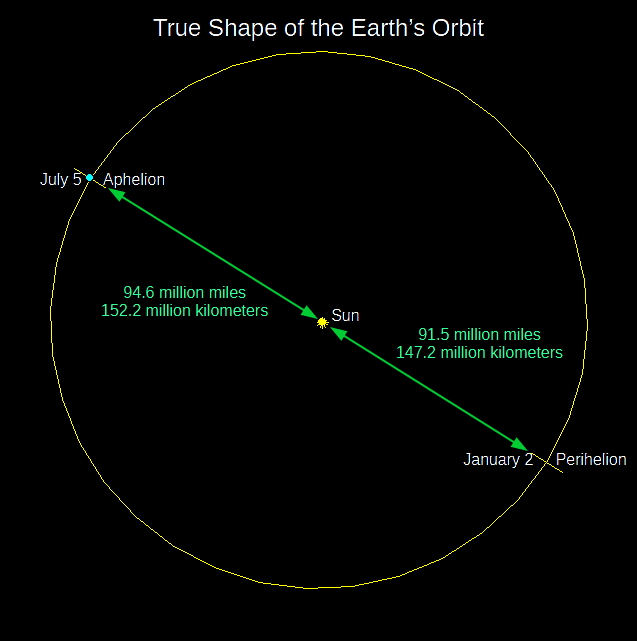
While we were busy with other matters, several astronomical events happened over the weekend. First, on Friday we had our latest sunrise, so our lengthening days are beginning to show up in the morning now. On Saturday the Earth passed perihelion, that is its closest point in its orbit to the Sun. That doesn’t make things any warmer, but it does make winter the shortest season by about four days shorter than summer. Not that you could tell in Northern Michigan. The distance of the Earth from the Sun is still hanging around 91.4 million miles. The earth is moving faster so we move through winter quicker. Also, there was a meteor shower, the Quadrantids, which peaked on Saturday, but was pretty much wiped out by the full moon.
The astronomical event times given in this blog are for the Traverse City/Interlochen area of Michigan (Lat 44.7° N, Long 85.7° W; EST, UT – 5 hours) unless stated otherwise. Times will be different for other locations.
Addendum
Ephemeris: 12/19/2025 – Winter begins Sunday
This is Ephemeris for Friday, December 19th. Today the Sun will be up for 8 hours and 48 minutes, setting at 5:04, and it will rise tomorrow at 8:16. The Moon is new today, and won’t be visible.
The thermometer and snowfall tell us that winter ought to be here. Well, it will be at 10:03 Sunday morning. At that point, the winter solstice, the Sun will be directly over the Tropic of Capricorn at 23 ½ degrees south latitude. It’s an odd name because 2,000 years ago the Sun was in indeed entering Capricornus. Now it will be entering Sagittarius, right above the spout of the teapot asterism we know so well in summer. From then on the Sun will be climbing up the sky each noon until June 21st next year when summer will start. To which I say: Go Sun Go! The Sun will almost make it up to 22 degrees above the southern horizon at local noon, which is 12:40 pm, in Interlochen and be out for only 8 hours and 48 minutes. If it stayed that low all year, we’d be in a deep freeze, possibly colder than Antarctica.
The astronomical event times given in this blog are for the Traverse City/Interlochen area of Michigan (Lat 44.7° N, Long 85.7° W; EST, UT – 5 hours) unless stated otherwise. Times will be different for other locations.
Addendum
Ephemeris: 11/04/2025 – The Persephone Period starts tomorrow
This is Bob Moler with Ephemeris for Election Day for some, Tuesday, November 4th. Today the Sun will be up for 10 hours and 1 minute, setting at 5:26, and it will rise tomorrow at 7:26. The Moon, 1 day before full, will set at 7:41 tomorrow morning.
Tomorrow the daylight hours drops below 10 hours. This begins something which has been called the Persephone Period. It is named after the Greek goddess Persephone, goddess of spring, who is abducted by Hades the god of the underworld to be his bride. When he did, all the vegetation on the earth began to die. So he had to allow her to appear above ground for a part of the year so that the vegetation and the grain would grow. So the Persephone Period is the time when she is in the underworld. It lasts from now to early February. That may have worked for a country like Greece around the Mediterranean, but we have harsher weather here. It takes a much longer time for spring to arrive.
The astronomical event times given in this blog are for the Traverse City/Interlochen area of Michigan (Lat 44.7° N, Long 85.7° W; EDT, UT – 4 hours) unless stated otherwise. Times will be different for other locations.
Addendum