Archive
11/23/2020 – Ephemeris – Our Moon is different
This is Bob Moler with Ephemeris for Monday, November 23rd. Today the Sun will be up for 9 hours and 16 minutes, setting at 5:07, and it will rise tomorrow at 7:52. The Moon, 2 days past first quarter, will set at 1:55 tomorrow morning.
The Earth’s Moon is different from most other moons. First it is very big when compared to the Earth. The Moon is a bit more than quarter the Earth’s diameter. Only Pluto’s moon Charon is larger compares to its primary, being half the size of Pluto. Most big moons orbit over their planet’s equator. Our Moon orbits the Earth close to the plane of Earth’s orbit of the Sun. That’s why the Moon is seen passing the planets each month. The Moon is too big to have been captured by the Earth in a chance flyby. The moon rocks brought back during Apollo showed that the Moon was made of the same crustal material as the Earth, so the impact theory was put forth that the Moon was the result of a collision of the Earth and a Mars sized body soon after they were formed.
The event times given are for the Traverse City/Interlochen area of Michigan. They may be different for your location.
Addendum
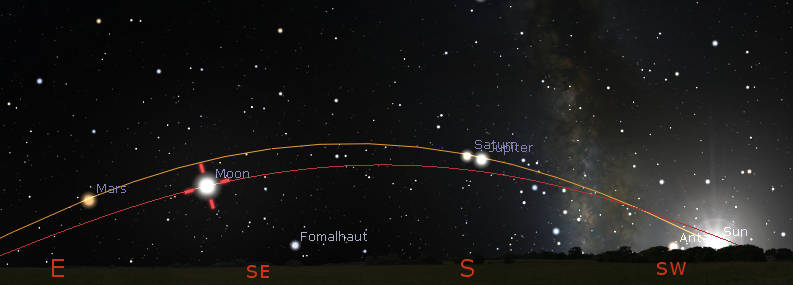
The Moon’s orbit (red) vs the ecliptic or plane of the Earth’s orbit (orange). The Moon’s orbit is tilted to the Earth’s orbit by 5 degrees. This is for 4:30 pm or a little more than a half hour before sunset. The black sky is due to removing atmospheric scattering in the program. Click on the image to enlarge. Created using Stellarium.
In the image note that the Moon’s orbit crosses the ecliptic just east of the Sun’s position. That crossing point is called the Moon’s descending node, since the Moon’s eastward motion will take it from north of the ecliptic to south of it. When the Sun is close to a node eclipses can occur. The ascending node is at the opposite side of the ecliptic so both solar and lunar eclipses occur in an eclipse season that lasts about a month.
An indeed there will be a penumbral eclipse of the Moon on the 30th, and a total solar eclipse for Chile and Argentina December 14th. The nodes don’t stay in one place, but they move westward, making one rotation around the ecliptic in 18.61 years. Since the nodes are moving westward it is called the regression of the nodes. So eclipse seasons occur about every 5 2/3 months, moving backwards in the calendar.
 Bob Moler's Ephemeris Blog