12/17/2020 – Ephemeris – Betelgeuse, Betelgeuse… Nope not saying it again
This is Bob Moler with Ephemeris for Thursday, December 17th. Today the Sun will be up for 8 hours and 48 minutes, setting at 5:03, and it will rise tomorrow at 8:15. The Moon, 3 days past new, will set at 8:18 this evening.
The constellation Orion the hunter will have completely risen by 8 pm this evening. The leftmost bright red star in his shoulder is Betelgeuse. It’s phonetically spelled name (Beetle Juice) made the title of a movie in 1988. A year ago it’s dramatic dimming for a while caused some to wonder that it was about to explode in a supernova. Betelgeuse does normally vary a bit in brightness, but that was the most ever recorded. It’s a red giant star with a mass of 16 to 19 times the Sun’s. Its distance is thought to be about 550 light years away. It is difficult to measure the distance of single bright stars, even with satellites. Its age is maybe 8 to 8 ½ million years old out of a life expectancy of 10 million years, compared to the Sun’s 10 billion year life expectancy.
The event times given are for the Traverse City/Interlochen area of Michigan. They may be different for your location.
Addendum
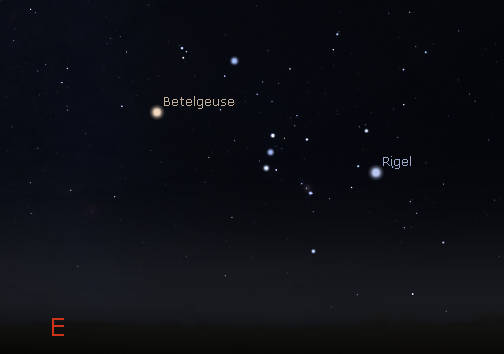
Orion at 8 pm or about 3 hours after sunset in mid December. Its seven brightest stars make an unmistakable pattern with only Betelgeuse and Rigel labeled. Created using Stellarium.

This comparison image shows the star Betelgeuse before and after its unprecedented dimming. The observations, taken with the SPHERE instrument on ESO’s Very Large Telescope in January and December 2019, show how much the star has faded and how its apparent shape has changed. Credit: ESO/M. Montargès et al.

An image of the star Betelgeuse taken in infrared shows it’s surrounded by a vast cloud of dust that erupted from the surface (the bright star itself is masked out, though an image of it has been superposed there for scale — the star is about the size of the orbit of Jupiter, over a billion km wide). Credit: ESO/P. Kervella/M. Montargès et al., Acknowledgement: Eric Pantin via Phil Plait’s Bad Astronomy blog on syfy.com.
 Bob Moler's Ephemeris Blog