Archive
03/08/2022 – Ephemeris – It’s International Women’s Day
03/29/2022 – Ephemeris – Finding zodiacal light
This is Ephemeris for Tuesday, March 29th. Today the Sun will be up for 12 hours and 37 minutes, setting at 8:06, and it will rise tomorrow at 7:27. The Moon, 3 days before new, will rise at 7:10 tomorrow morning.
The evening sky will stay dark for the rest of the week, so it’s time to look for the zodiacal light in the evening. It is a faint but towering glow that can be seen after the end of astronomical twilight on moonless nights. It is seen in the west in the evening in late winter and early spring. The axis of the glow is the ecliptic, the apparent annual path of the Sun in the sky, along which lie the constellations of the zodiac. It’s a glow whose wide base is in the west that extends upwards and to the left. Right now, the end of astronomical twilight is about 9:49 p.m. and advancing at a rate of a minute or two each night. Go to a spot with a dark western sky, no big cities or towns out that way. Zodiacal light is caused by dust spread out around the Sun.
The astronomical event times given are for the Traverse City/Interlochen area of Michigan (EDT, UT – 4 hours). They may be different for your location.
Addendum
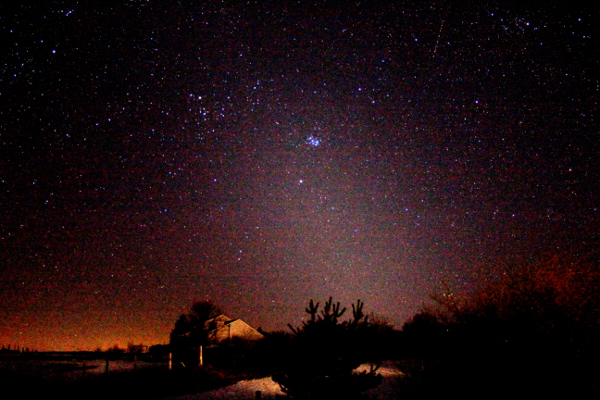
The western sky at 10:22 pm, March 25, 2019. Mars appears below the Pleiades in zodiacal light. Credit, mine – Canon EOS Rebel T5, 18mm f.l., f/3.5, 8 sec. ISO 12,800.
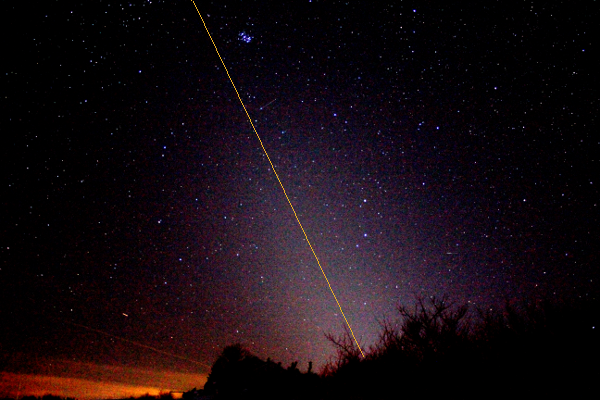
I’ve added the approximate ecliptic line from an image I took from a year earlier.
My article in April’s Stellar Sentinel, the newsletter of the Grand Traverse Astronomical Society, about zodiacal light.
One of the hardest of the night sky phenomena to spot is zodiacal light. The top picture above is my last photo of the zodiacal light. The photo is showing it brighter than it looks to the naked eye.
Zodiacal light is seen in the west in the evening in late winter and early spring and in the east in the morning in late summer and early autumn. The axis of the glow is near the ecliptic, the plane of the Earth’s orbit, along which lie the constellations of the zodiac.
This glow seems to have been first recorded by the Arabs around 630 CE. It was first recognized as a morning phenomenon as a false dawn, appearing before the first real glow of astronomical twilight. This false dawn was a big deal for the Islamic faithful, whose morning prayers must be made after the true dawn, or astronomical twilight, when the center of the Sun is 18° below the horizon.
How I usually recognize that I’m looking at the zodiacal light is kind of like not seeing the forest for the trees. That is, in certain parts of the sky, the sky doesn’t seem as dark as other parts. It helps to know where the zodiacal light is supposed to be. Once found, you’ll know what to look for, so finding it in the future will be easier.
In February 2017, on a relatively warm, but clear night, I went out to the Dune Climb at the Sleeping Bear Dunes. Part of the parking lot was plowed. I set up my tracking mount with my 5” scope that had a camera mount to photograph Orion and the Milky Way around Cassiopeia, Perseus and Taurus.
Having not thought about zodiacal light at the time, but while examining and processing the images later on, I began to notice that parts of the sky background not associated with the Milky Way were not as dark as I expected. It was on the side of the Milky Way closest to the ecliptic. These were telephoto shots, so the pyramidal shape of zodiacal light was not apparent. However, in recreating the sky at the time of the observations using Stellarium, it confirmed that it was the area where zodiacal light would be present.
What causes zodiacal light? The cause is dust, micron sized dust from comets and asteroids. Most of these lie in and near the plane of the solar system, which is why zodiacal light is centered on the ecliptic and the constellations of the zodiac and increases in brightness toward the Sun.
The free planetarium program Stellarium (stellarium.org) has added a zodiacal light effect in recent releases. Click on the Sky and viewing options icon at the left edge of the window, In the Sky tab there is a checkbox for zodiacal light and an intensity value to be selected. In order to see the effect, the Atmosphere icon at the bottom of the viewing window must be turned off. The effect is very subtle.
It is best seen around the vernal equinox in the evening and autumnal equinox tn the morning because at these times the ecliptic is closest to vertical. In the evening it tilts to the left, in the morning it tilts to the right. The closer one is to the equator, the more vertical the zodiacal light will appear. It would be a year-round phenomenon for observers in the tropics.
As an aside, Brian May, lead guitarist for the rock band Queen, with an uncanny resemblance to Sir Isaac Newton, earned a PhD in astrophysics in 2007 with his dissertation: A Survey of Radial Velocities in the Zodiacal Dust Cloud. It analyzed the motions of the particles of dust that make up the zodiacal dust cloud, which produces zodiacal light.
The best time to see this phenomenon will be the last week of March to the first few days of April 2022, before the Moon is a couple of days old.
 Bob Moler's Ephemeris Blog