Archive
06/05/2023 – Ephemeris Extra – Venus prepares to leave the evening sky
Based on the article of the same name printed in the Grand Traverse Astronomical Society’s June Stellar Sentinel newsletter.
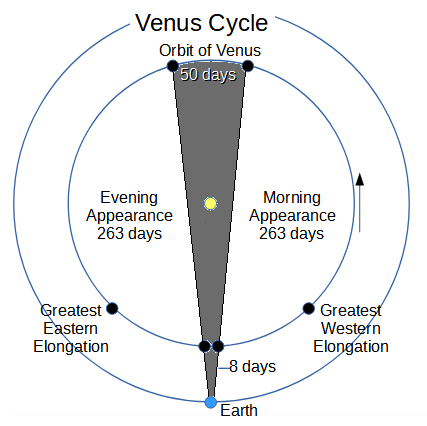
Venus will not only leave the evening sky in dramatic fashion, but will enter the morning sky in an even more dramatic fashion in the latter half of August. Venus takes 225 days to orbit the Sun, but from an Earth also orbiting the Sun, the period from successive inferior or superior conjunctions of the Sun take 584 days or 19.2 months (1 year 7.2 months), or 9.6 months in the evening and morning skies respectively.
The interval from greatest eastern elongation, and inferior conjunction, when Venus passes between the Sun and the Earth is around 70 days. On June 4th, Venus will be at its greatest eastern elongation. The sight line from the Earth to Venus will be tangent to Venus’ orbit. Any Venusians, floating above their clouds, would see the Earth at quadrature, that is 90 degrees from the Sun.
Venus, at greatest eastern elongation, is heading straight toward us, so it will grow rapidly in apparent size. Venus begins the month with an apparent diameter of 22.9”. (” means seconds of arc. 1 second of arc = 1/3600 of a degree). At the end of the month Venus will have increased in apparent size to 33.5”, as can be seen with the illustration below. For comparison, Jupiter’s average apparent diameter is around 41”.
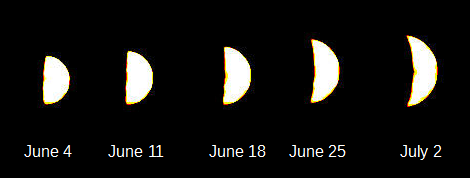
Sometime in July Venus will appear large enough to be able to detect it’s crescent phase in seven power binoculars. At inferior conjunction its apparent size will grow to 57.8”. Pity there won’t be a transit of Venus of the Sun to see it. By the way, if you missed the transits of 2004 and 2012, you won’t see another, unless you are a small child now, and will live to a very old age. There won’t be another transit of Venus until 2117.
The Mayan culture of Central America and the Yucatan Peninsula based one of their calendars on the Venus Cycle. It turns out that five Venus cycles equals a period just shy of eight years. That’s why we had 2 Venus transits eight years apart, June 8, 2004 and June 6, 2012. The next transits will be December 11, 2117 and December 8, 2125.
The Dresden Codex is one of only a handful of surviving Mayan books. It has a whole section on the Venus Cycle and how it fits into an 8 year Sequence. 13 eight year sequences equals 104 years, a Venus Round. Well, not quite, 103.91 years actually.
Venus has been ignored by NASA since the Magellan mission in the 1990s which mapped the surface through the clouds with radar. Recent reexamination of the results have suggested that there may have been relatively recent volcanism on the planet, even during the period that Magellan was imaging the surface of the planet.
NASA plans two missions to the planet toward the end of this decade. VERITAS stands for “Venus Emissivity, Radio Science, InSAR, Topography, and Spectroscopy” it’s a satellite map the surface in much greater detail than Magellan did. It will also map infrared emissions from Venus’ surface to map rock types.
DAVINCI+ stands for “Deep Atmosphere Venus Investigation of Noble gases, Chemistry, and Imaging” and will drop through the atmosphere taking measurements, and will take images of the surface like the Huygens probe did on Saturn’s largest moon Titan back in 2005.
In the past the Soviet Union sent landers and floated balloons in Venus’ atmosphere. The only active spacecraft that I know of orbiting Venus now is Japan’s Akatsuki, which is studying its atmosphere. However spacecraft using Venus as a gravity assist to get to Mercury or close to the Sun, have turned their instruments to Venus as they passed by.
Major Venusian events for the rest of 2023 (Eastern Time)
- June 4, 6:59 am – Venus at greatest eastern elongation 45.4°
- June 13, 7:05 am – Venus 0.5° north of the Beehive cluster
- June 21, 8:47 pm – Venus 4.1° south of the Moon
- July 1, 2:48 am – Venus in a quasi-conjunction with Mars, separation 3.6°
- July 7 – Greatest brilliancy, magnitude -4.7 (~36 days before inferior conjunction)
- July16, 3:49 am – Venus in a quasi-conjunction with Regulus
- July 27, 7:00 am – Mercury 5.1° north of Venus
- August 13, 7:10 am – Venus at inferior conjunction, 7.4° south of the Sun
- September 19 – Greatest brilliancy. Magnitude -4.8
- October 9, 2:10 am – Venus 2.3° south of Regulus
- October 23, 5:59 pm – Venus greatest western elongation 46.4°
- November 9, 4:28 am – Venus 1.1° south of the Moon
- November 29, 5:29 am – Venus 4.2°north of Spica
- December 9, 11:53 am – Venus 3.9° north of the Moon
Created from NASA’s SKYCAL Sky Events Calendar.
06/05/2023 – Ephemeris – Venus was it’s farthest apparent distance from the Sun yesterday
This is Ephemeris for Monday, June 5th. Today the Sun will be up for 15 hours and 25 minutes, setting at 9:24, and it will rise tomorrow at 5:58. The Moon, 2 days past full, will rise at 11:47 this evening.
Yesterday, Venus was as far away from the Sun as it gets in this evening appearance of Venus. The event is called greatest eastern elongation, meaning it’s as far to the east of the Sun as it gets. Both Venus and Mercury have these events, because they orbit the Sun inside of the Earth’s orbit, they never stray far from the Sun. In less than two and a half months, Venus will leave the evening sky, pass between the Earth and Sun in inferior conjunction, and enter the morning sky. Until then Venus will get larger in telescopes and become a thinner and thinner crescent, as we see more of its night side and less of its day side. By mid July, Venus should appear large enough to see its tiny crescent in a pair of binoculars.
The astronomical event times given are for the Traverse City/Interlochen area of Michigan (EDT, UT –4 hours). They may be different for your location.
Addendum
 Bob Moler's Ephemeris Blog