Archive
Ephemeris: 07/25/2023 – Is the universe twice as old as we think?
This is Ephemeris for Tuesday, July 25th. Today the Sun will be up for 14 hours and 55 minutes, setting at 9:16, and it will rise tomorrow at 6:22. The Moon, at first quarter today, will set at 12:44 tomorrow morning.
Is the universe twice as old as we thought? That’s a conclusion of a study printed in the monthly notices of the Royal Astronomical Society by Rajendra Gupta from the University of Ottawa, in which he postulates that the structure and chemical composition of very early galaxies found by the James Webb Space Telescope turn out to be more developed than one would expect for objects so soon after The Big Bang. The problem with hypothesizing an older universe is to explain what we see currently that have shown that the universe is 13.8 billion years old. One of the things he hypothesized was something called tired light, where light loses energy and is red-shifted not just because of the expansion of the universe but over time and distance. Stay tuned.
The astronomical event times given are for the Traverse City/Interlochen area of Michigan (EDT, UT –4 hours). They may be different for your location.
Addendum
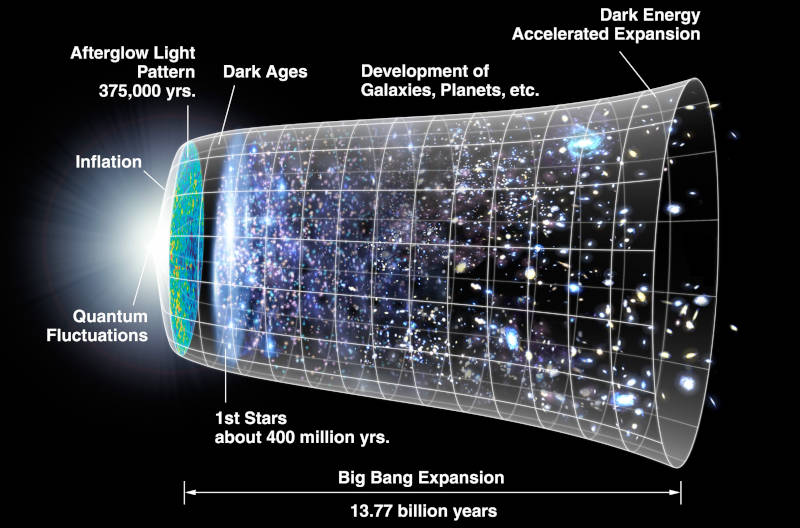
Timeline of the universe. A representation of the evolution of the universe over 13.77 billion years. The far left depicts the earliest moment we can now probe, when a period of “inflation” produced a burst of exponential growth in the universe. (Size is depicted by the vertical extent of the grid in this graphic.) For the next several billion years, the expansion of the universe gradually slowed down as the matter in the universe pulled on itself via gravity. More recently, the expansion has begun to speed up again as the repulsive effects of dark energy have come to dominate the expansion of the universe. The afterglow light seen by WMAP was emitted about 375,000 years after inflation and has traversed the universe largely unimpeded since then. The conditions of earlier times are imprinted on this light; it also forms a backlight for later developments of the universe. Public Domain.
Diagram is from Wikipedia. Above is the expansion of the universe as commonly understood. Not mentioned in the program script above, is the requirement, according to Gupta’s hypothesis, that the basic constants of the universe change over time. As Carl Sagan explained, “Extraordinary claims require extraordinary evidence.” So more evidence is needed. His hypothesis won’t be the only explanation put forth, so there will be more to test. That’s job security for astrophysicists and cosmologists.
 Bob Moler's Ephemeris Blog