Archive
Ephemeris: 08/10/2023 – The Perseid meteor shower will reach its peak early Sunday morning
This is Bob Moler with Ephemeris for Thursday, August 10th. Today the Sun will be up for 14 hours and 17 minutes, setting at 8:56, and it will rise tomorrow at 6:40. The Moon, 2 days past last quarter, will rise at 1:43 tomorrow morning.
Back before astronomers recognized the major meteor shower that occurs at this time of year, the streaks of light in the sky of “falling” or “shooting” stars were called, by Christians, the Tears of Saint Lawrence, who was martyred on this day in the year 258. The bits of comet debris, ranging from the size of sand grains to that of a pea, hit our atmosphere at 38 miles (59 kilometers) per second and quickly vaporize due to friction, causing the streak of light we call a meteor. They are called the Perseids since they appear to come from the constellation of Perseus, located in the northeastern sky. They will be best seen Saturday night and into Sunday morning, with rates of up to one a minute, on average, especially in the early morning hours.
The astronomical event times given are for the Traverse City/Interlochen area of Michigan (EDT, UT –4 hours). They may be different for your location.
Addendum
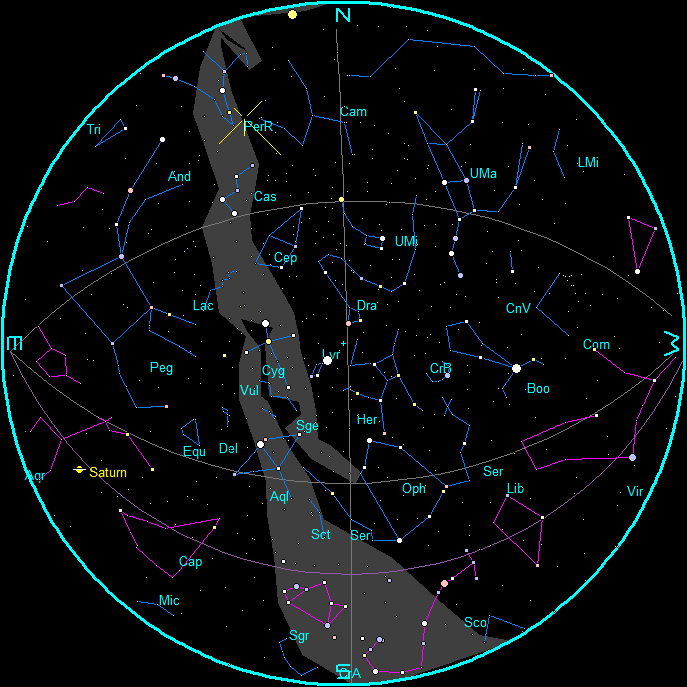
The Dome of the sky for the night of August 12th and 13th, 2023 at 10:30 PM for northern Michigan. The Perseid radiant is in the northeast and fairly low in the sky, and marked in yellow with the caption PerR. It will continue to rise in the northeast throughout the night. The constellation names are abbreviated. Their full names can be found here. Large images can be truncated on the right. Click or tap on the image to enlarge and display the complete image. Created using my LookingUp app.
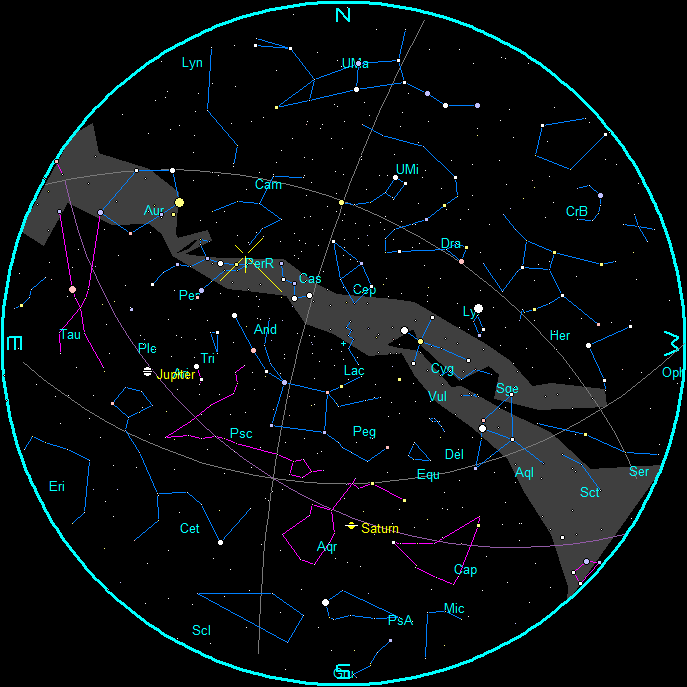
The Dome of the sky for August 12th and 13th, 2023 at 3 AM for northern Michigan. The Perseid radiant is in the northeast, much higher in the sky, and marked in yellow with the caption PerR. The constellation names are abbreviated. Their full names can be found here. Large images can be truncated on the right. Click or tap on the image to enlarge and display the complete image. Created using my LookingUp app.
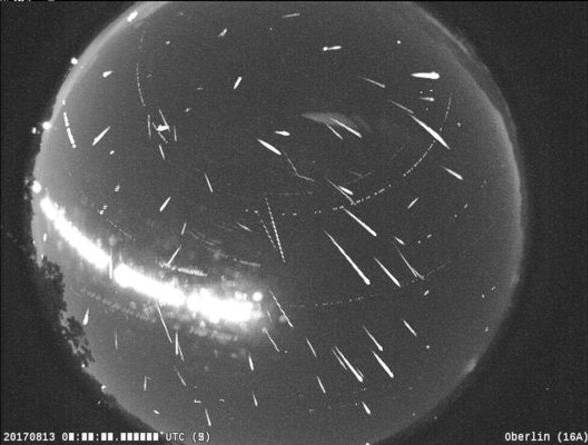
Remember, the meteors only seem to come from the radiant. They will appear all over the sky! The meteors of a shower travel in parallel paths, like train tracks, disappearing to a point in the distance.
 Bob Moler's Ephemeris Blog