Ephemeris Extra: 08/31/2023 – Comet C/2023 P1 (Nishimura) may be visible to the naked eye in September
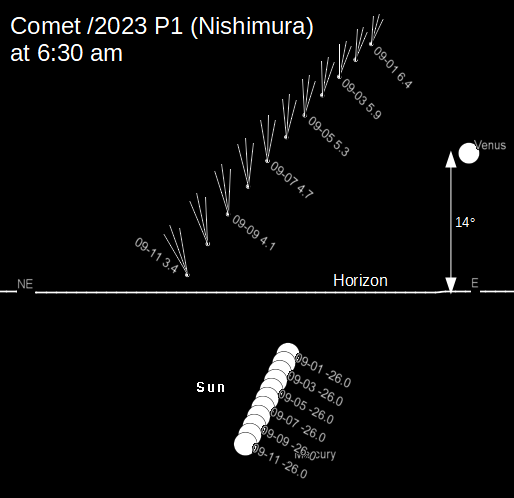
Comet Nishimura is shown at 6:30 AM in the east northeast for the mornings of September 1st through 11th. Venus stays pretty much at the same altitude of 14 degrees during this period. The Sun is shown here below the horizon. The comet and the Sun are labeled every other day with the month and day and estimated magnitude. Created using Cartes du Ciel (Sky Charts) by the author.
On August 12th this year Hideo Nishimura of Kakegawa, Japan discovered a comet that now bears his name. The comet has a chance of becoming a naked eye object this month, but for only a few days. It is a rapidly moving comet, and it is heading southward. We will only get a short period of time when it is possibly visible to the naked eye.
I’m sorry about all the weasel words about the brightness of the comet, but comets are notorious for being unpredictable with their brightness. They may brighten suddenly, they may dim suddenly, they may fall apart. We never know what happens to a comet until it happens.
Early brightness estimates were all over the place from 9th to 14th magnitude a range of 5 magnitudes or a brightness range of 100 from bright to dim. The comet was discovered only 12 days ago, as I write this, so there’s not very many brightness estimates to base future magnitudes on, even if the comet is well-behaved.
I’ve printed a chart, below, of the comet’s position in relation to the stars of Cancer and Leo for the period September 1 through 13th. The comet should be at least a binocular object during this period. I’ve also included a table of comet positions in altitude and azimuth for the start of astronomical and nautical twilight. The times of morning nautical twilight are listed on the Star Chart Page. Astronomical twilight starts about 36 minutes before nautical twilight this time of year.
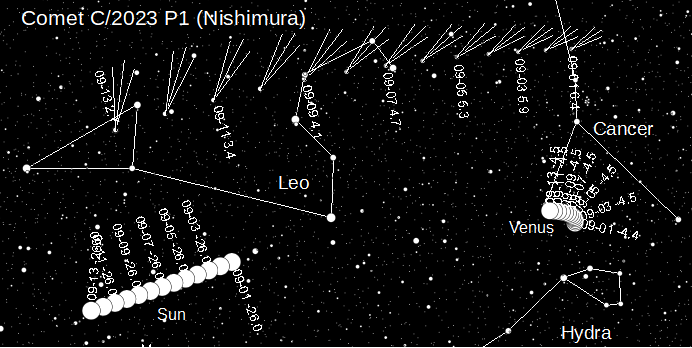
Comet Nishimura plotted against the stars of Cancer and Leo, along with the Sun and Venus. The comet, Venus and the Sun are labeled every other day with the month and day and estimated magnitude. Created using Cartes du Ciel (Sky Charts) by the author.
A pair of binoculars are the best way to view a comet that is just barely visible to the naked eye, or is competing with twilight. In both charts, the tail of the comet shows the direction that the tail would flow from and not its length.
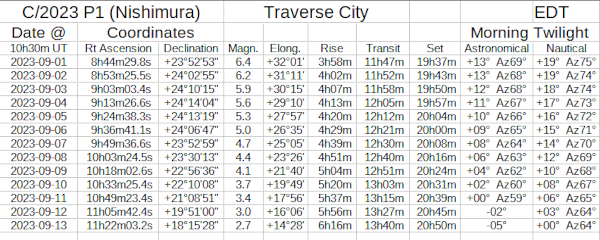
A table of positions of the comet at the beginning of astronomical and nautical twilight. Created using Cartes du Ciel.
At last report (August 26), it was half a magnitude dimmer than the predictions I have.
 Bob Moler's Ephemeris Blog