Archive
Ephemeris: 12/11/2023 – This is the week of the Geminid meteor shower
This is Bob Moler with Ephemeris for Monday, December 11th. Today the Sun will be up for 8 hours and 52 minutes, setting at 5:02, and it will rise tomorrow at 8:10. The Moon, 1 day before new, will rise at 8:09 tomorrow morning.
The Geminid meteor shower will reach its peak this week, well Thursday afternoon, actually. I’m talking about this early hoping that we might get a clear night this week to see them. The Geminids are the most active annual meteor shower. Up to 120 meteors may be visible per hour at its peak when it’s the radiant in Gemini is directly overhead which would be on Wednesday or Thursday mornings this week. At those times it will be about half a day before or after the peak, but with such a high number of meteors it should be a spectacular show anyway. The Geminids are produced by a rock comet called Phaethon, which was discovered in 1983 by the Infrared Astronomy Satellite, the first to perform an infrared survey of the entire sky.
The astronomical event times given are for the Traverse City/Interlochen area of Michigan (EST, UT –5 hours). They may be different for your location.
Addendum
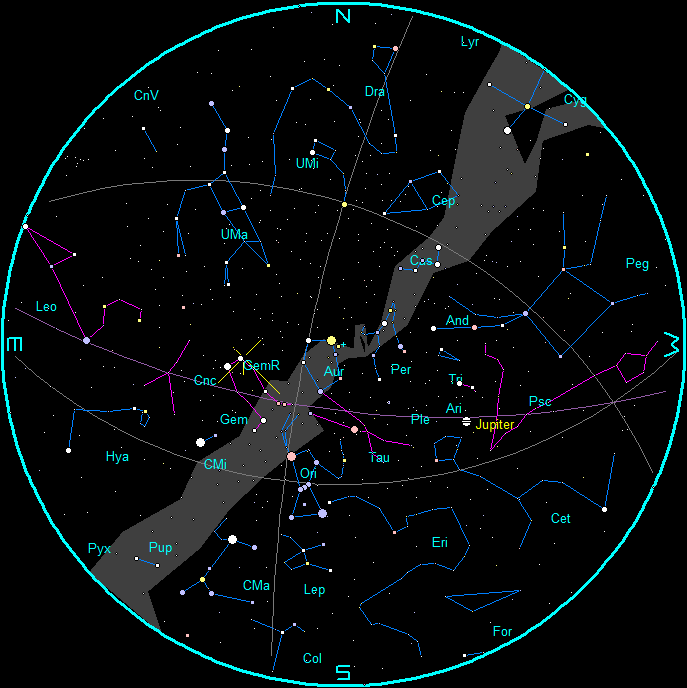
The Geminids are supposed to reach about 120 an hour at peak which would be at one or two in the morning which is about 12 hours after their actual peak. So that we won’t get the 120, but there’s an equal chance to spot them on the night of the 13/14th or 14/15th. Click or tap on the image to enlarge it. Image created using my Looking Up app.
 Bob Moler's Ephemeris Blog