Ephemeris: 09/20/2024 – Fall will fall upon us Sunday
This is Ephemeris for Friday, September 20th. Today the Sun will be up for 12 hours and 14 minutes, setting at 7:42, and it will rise tomorrow at 7:29. The Moon, 3 days past full, will rise at 8:55 this evening.
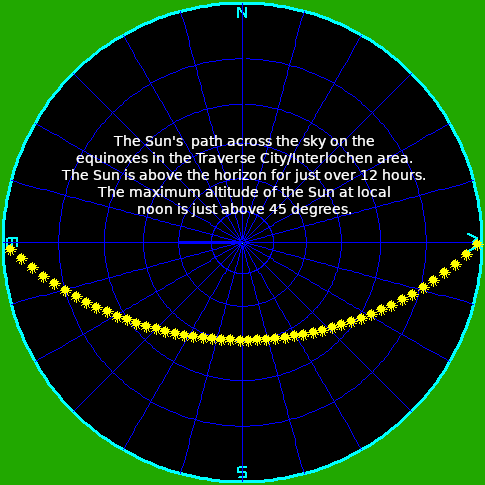
The season of fall is about to, well, fall upon us and in a few weeks so will the leaves. At 8:44 Sunday morning (12:44 UT Sunday) the Sun will cross the celestial equator heading southward. The celestial equator is an imaginary line in the sky above the earth’s equator. At that point, the Sun will theoretically set at the North Pole and rise at the South Pole. The day is called the autumnal equinox and the daylight hours of Sunday will be 12 hours and 8 minutes instead of 12 hours exactly. That’s due to our atmosphere and our definition of sunrise and sunset. The reason for the cooler weather we are heading into is that the length of daylight is shortening, and the Sun rides lower in the sky, spreading its heat over a larger area, thus diluting its intensity.
The astronomical event times given are for the Traverse City/Interlochen area of Michigan (EDT, UT – 4 hours). Times will be different for other locations.
Addendum

 Bob Moler's Ephemeris Blog