Archive
Ephemeris: 10/07/2024 – Comet Tsuchinshan-ATLAS will be visible starting Saturday Night
This is Ephemeris for Monday, October 7th. Today the Sun will be up for 11 hours and 22 minutes, setting at 7:11, and it will rise tomorrow at 7:50. The Moon, 3 days before first quarter, will set at 9:15 this evening.
In January of last year a Chinese observatory discovered a comet which was subsequently lost. A month and a half later another observatory in South Africa rediscovered it. That’s why the comet is named, Tsuchinshan-ATLAS after the two observatories. It was soon learned that the comet had a chance of becoming visible to the unaided eye in late September and October 2024, this month. Despite having a dimming episode earlier this year the comet promises to be naked eye and possibly even spectacular. The comet is moving from the south to the north and in a direction counter to the orbiting planets around the Sun. We will begin to see it low in the West after sunset starting Saturday.
The astronomical event times given are for the Traverse City/Interlochen area of Michigan (EDT, UT – 4 hours). Times will be different for other locations.
Addendum
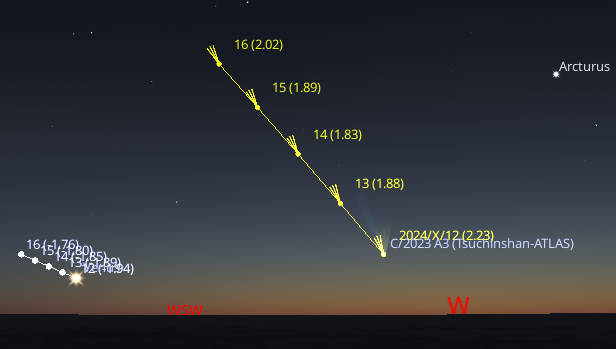
The comet will pass almost directly between the Earth and the Sun on the evening of the 9th. It’ll be about halfway between the Earth and the Sun at that point. It should be picked up by the Solar and Heliospheric Observatory satellite (SOHO) which is orbiting the Earth-Sun L1 Lagrange point a million miles sunward from the Earth with its C3 coronagraph*. Then the comet’s tail should be pointing almost directly at the Earth. As the comet swings out away from the Sun it will also be more rapidly moving away from Earth. This is because the comet has an orbit that is counter to that of the orbits of the Earth and the rest of the planets around the Sun and will rapidly fade as it increases its distance.
A note on the discovery designation: C/2023 A3 is C for comet; 2023, the year of discovery; A3, third object reportedly discovered in the first half of January.
The SOHO Real-time GIF Movies webpage is: https://soho.nascom.nasa.gov/data/realtime/gif/. Select LASCO/C3. It provides a time-lapse image of the Sun’s corona taken at hourly intervals for about the last 4 days.
 Bob Moler's Ephemeris Blog