This is Ephemeris for Friday, October 11th. Today the Sun will be up for 11 hours and 10 minutes, setting at 7:04, and it will rise tomorrow at 7:55. The Moon, 1 day past first quarter, will set at 1:22 tomorrow morning.
While I think the first time the spot Comet Tsuchinshan-ATLAS will be tomorrow night, sharp-eyed observers with binoculars might be able to find the comet tonight just about due west near the horizon after 7:30 PM it will be a difficult task being so close to the sun The comet will set at 8:09 PM, however if the tail is bright enough it may still be visible. The comet’s tail should be relatively short since it’s actually pointing back towards us. That may also make the tail somewhat brighter since we’re looking down through the thicker part of the tail rather than through its side. I’ve seen a lot of comets in my time, the first ones in 1957. There were two bright comets that year.
The astronomical event times given are for the Traverse City/Interlochen area of Michigan (EDT, UT – 4 hours). Times will be different for other locations.
Addendum
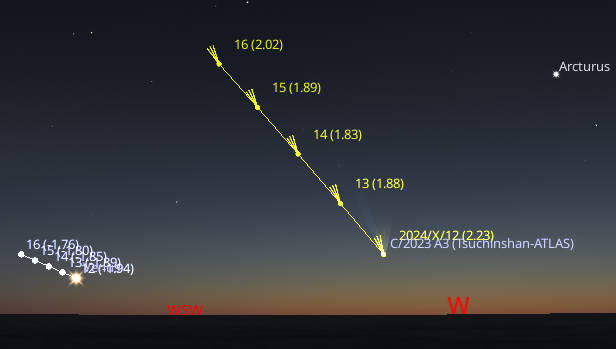
The track of comet C/2023 A3 (Tsuchinshan-ATLAS) for five nights at 8 pm starting with Saturday the 12th. It might be visible tonight but the sky might be too bright. On that date we might be able to see the tail without seeing the head of the comet in the twilight. It should be interesting. The bright track on the lower left is Venus. Each label is the date and estimated magnitude. The comet is expected to be brighter than those estimates, especially during the first week of its appearance. Created using Stellarium.
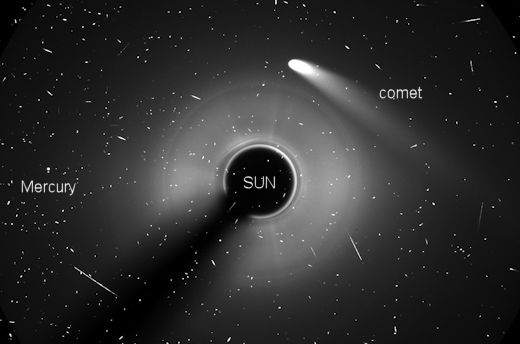
Comet Tsuchinshan-ATLAS as it appeared late Wednesday night or Thursday morning passing almost directly between the Earth and the Sun. Unlike other comets detected by the Solar and Heliospheric Observatory (SOHO) coronagraph this comet is nowhere near the Sun. It is halfway between them. And as of the time I am creating this post, Thursday evening, the tail of the comet is still visible in the chronograph. Most of the speckles and all of the streaks seen are subatomic particles from the coronal mass ejection (CME) that hit the spacecraft when the image was taken, and the same CME that is giving us an aurora tonight as of this posting. The SOHO spacecraft is in a halo orbit around the L1 Lagrange point between the Sun and the Earth, about a million miles sunward from the Earth. A coronagraph has a blank disc to cover the bright sun creating an artificial solar eclipse. The actual size of the bright disk of the sun is about to quarter the diameter of the blocking disk. Credit: NASA/ESA. Via Spaceweather.com.
 Bob Moler's Ephemeris Blog