Ephemeris: 11/18/2024 – How to get two spacecraft to come together gently in space
This is Bob Moler with Ephemeris for Monday, November 18th. Today the Sun will be up for 9 hours and 26 minutes, setting at 5:11, and it will rise tomorrow at 7:45. The Moon, 3 days past full, will rise at 7:22 this evening.
Orbital mechanics is a science of how orbits work around the Earth, Sun, or any other body. Back in the mid 1960s when NASA was starting it’s work to get to the Moon with the Gemini program they had quite a time getting rendezvous and docking right. Buzz Aldrin, the second man to step foot on the Moon, who is still around by the way, figured it all out – before he became an astronaut. It’s counter-intuitive. To speed up you slow down to drop into a lower orbit which is faster. To slow down, speed up and climb into a higher orbit which slows you down. There’s more to it than that, but basically objects in orbit just don’t seem to behave the way you think they ought to. And that’s how things work in space.
The astronomical event times given are for the Traverse City/Interlochen area of Michigan (EST, UT – 5 hours). Times will be different for other locations.
Addendum
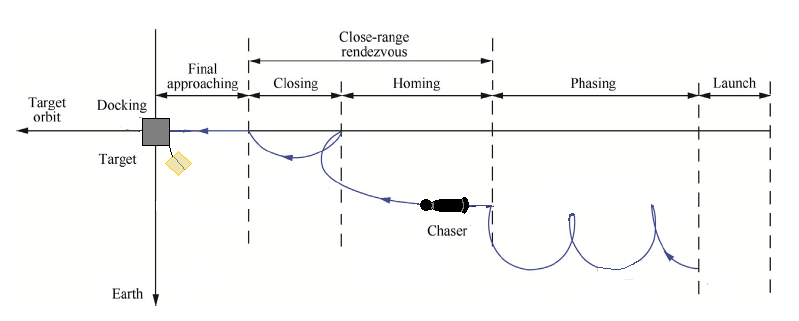
In this diagram time is represented on the horizontal axis from right to left, the altitude of the spacecraft and its target is on the vertical axis. The chaser vehicle is launched as the launch site crosses the plane of the orbit of the target. Changing the plane of an orbit is very expensive, energywise, so it’s best to launch in the same orbital plane. It enters an elliptical orbit, most initial orbits are pretty elliptical and so there’s a low point, or perigee, where the chaser enters orbit, and a high point which is the apogee. This is below the target orbit so that the chasing vehicle can catch up to the target. Lower orbits are faster than higher orbits, this is the phasing part. When the chaser gets pretty close it raises its orbit so that the starting point apogee is the new perigee and the new apogee is the altitude of the orbit of the target. The orbit stays elliptical for a little while so that the chasing spacecraft can slowly catch up to the target. In the final approach the orbits just about match so that the chaser very slowly catches up to the target.
I’ve seen similar diagrams on NASA broadcasts of Crew Dragon launches.
 Bob Moler's Ephemeris Blog