Archive
Ephemeris: 12/10/2024 – Jupiter’s four bright moons
This is Ephemeris for Tuesday, December 10th. Today the Sun will be up for 8 hours and 52 minutes, setting at 5:02, and it will rise tomorrow at 8:10. The Moon, 2 days past first quarter, will set at 3:39 tomorrow morning.
The bright star like object in the east in the evenings is the planet Jupiter. If one were to look at Jupiter through binoculars it would appear somewhat larger than a star would look. It has several dimmer stars from one side to the other of it, and if one looked the next night those little stars would have moved. Those are not stars at all, but the four largest moons of Jupiter. This would be easily apparent in the telescope. These are the four Galilean moons. They were observed by Galileo in either late 1609 or early 1610. Another astronomer, Simon Marius discovered these moons at about the same time, but Galileo was first to publish. So he gets the honor. However, Simon Marius is the one who gave them the names we know them by today. Their names, in order of their distance from Jupiter, are: Io, Europa, Ganymede, and Callisto. Each is a fascinating world in its own right.
The astronomical event times given are for the Traverse City/Interlochen area of Michigan (EST, UT – 5 hours). Times will be different for other locations.
Addendum
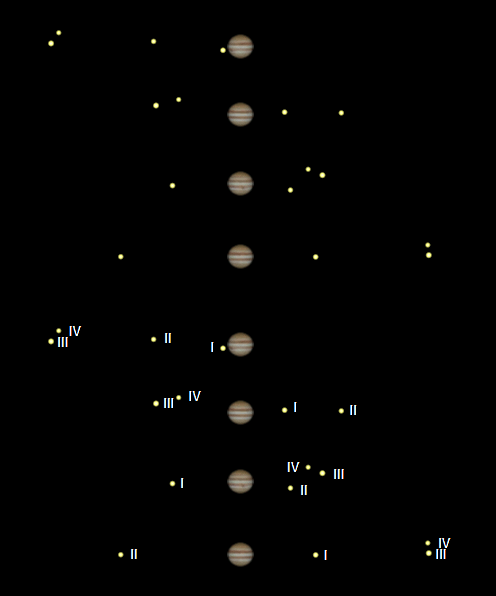
The periods of these satellites is interesting. Io orbits Jupiter in 1.8 days. Europa orbits in 3.6 days twice as long as Io. Ganymede orbits Jupiter in 7.2 days which is twice as long as Europa. Callisto takes 16.7 days to orbit Jupiter, and that is longer than twice Ganymede’s orbital period, and so is not in resonance with Ganymede. So the first three are in a 2:1orbital resonance with each other.
 Bob Moler's Ephemeris Blog