Ephemeris: 11/06/2025 – An astronomer thinks a nova will appear soon
This is Ephemeris for Thursday, November 6th. Today the Sun will be up for 9 hours and 56 minutes, setting at 5:24, and it will rise tomorrow at 7:29. The Moon, 1 day past full, will rise at 5:50 this evening.
We’ve been waiting for the past year or so for the eruption of a nova in the constellation Corona Borealis the Northern Crown. It last erupted in 1946. Eruptions are about 80 years apart. Astronomer Jean Schneider of the Paris Observatory has made a study of this particular nova. It occurs in a binary star system with a white dwarf and a much larger star that orbit each other every 228 days. So it is possible that the Nova occurs at one point in that orbit. And based on the last eruption in 1946, November 10th, give or take, is one of the days we might look to see the eruption. If it doesn’t happen that day its next likely occurrence is around June 25th next year. It will appear just left of Corona Borealis low in the west northwest around 7 PM, and as bright as the normally brightest star in that constellation.
The astronomical event times given in this blog are for the Traverse City/Interlochen area of Michigan (Lat 44.7° N, Long 85.7° W; EDT, UT – 4 hours) unless stated otherwise. Times will be different for other locations.
Addendum
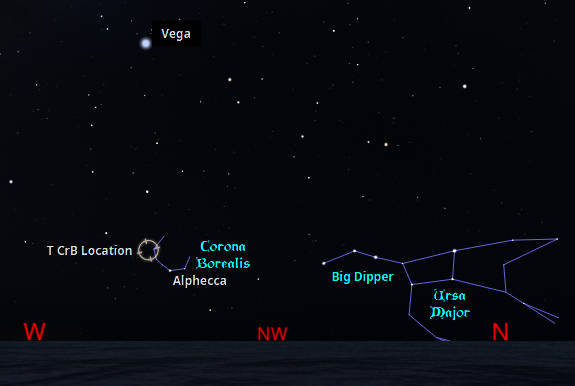
The website Spaceweather.com monitors reports of the brightness of the star on the right side of its page under the heading of T CrB NOVA WATCH. It is currently around 10th magnitude, invisible to the naked eye and barely visible in binoculars. It is expected to grow to 2nd magnitude or 1,600 times it’s normal brightness, about as bright as a Big Dipper star or Alphecca, near it, in Corona Borealis. The nova will fade rapidly, and will be visible to the naked eye for only about a week.
 Bob Moler's Ephemeris Blog