Home > Concepts, Eclipses, Ephemeris Program > Ephemeris: 02/17/2026 – There’s an annular solar eclipse today… if you’re a penguin

Ephemeris: 02/17/2026 – There’s an annular solar eclipse today… if you’re a penguin

February 17, 2026

This is Ephemeris for Fat Tuesday, February 17th. Today the Sun will be up for 10 hours and 34 minutes, setting at 6:14, and it will rise tomorrow at 7:38. The Moon is new today, and won’t be visible.

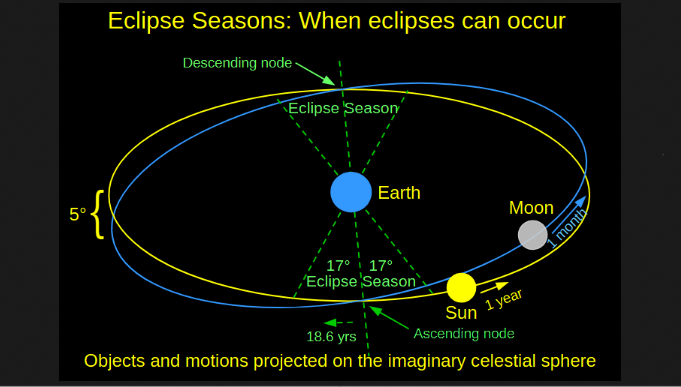
This morning there is an annular solar eclipse occurring. Don’t run outside to see it, especially if you’re here in northern Michigan. The eclipse is only visible in the Southern Ocean and Antarctica. However, this eclipse marks the beginning of an eclipse season, and we will have an eclipse that will be visible for our location in two weeks: a total lunar eclipse, which will be visible before sunrise on Tuesday morning, March 3rd. There are two periods were eclipses will occur in a year, with at least one of the sun and the moon. These periods are separated by a little less than six months, and last about 35 days. That’s about 5 1/2 days longer than a lunar month, so it is possible to squeeze in another eclipse, though not this time.

The astronomical event times given in this blog are for the Traverse City/Interlochen area of Michigan (Lat 44.7° N, Long 85.7° W; EST, UT – 5 hours) unless stated otherwise. Times will be different for other locations.

Addendum
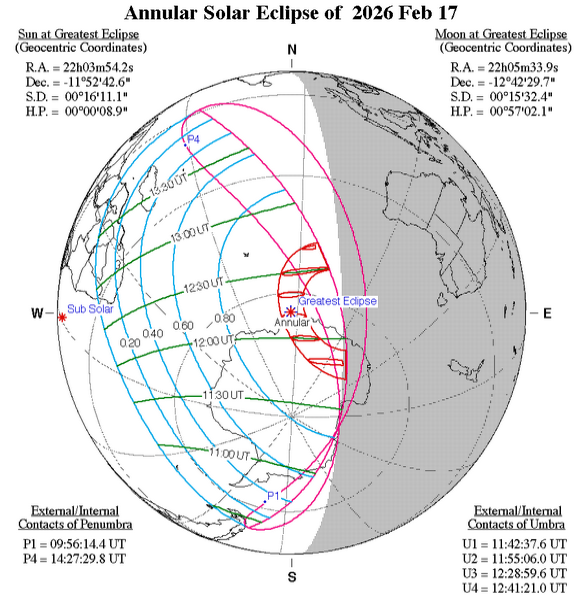
An adaption of the NASA eclipse map for the annular solar eclipse of February 17th 2026. The path of angularity is almost completely on Antarctica and a bit of the Southern Ocean.
An adaption of the NASA eclipse map for the annular solar eclipse of February 17th 2026. The path of angularity is almost completely on Antarctica and a bit of the Southern Ocean. The area of partial eclipse will extend from southern Africa along the eastern African coast and Madagascar. They will see a very slight partial eclipse. The eclipse season started about February 11th and will extend for 35 days. It will include a lunar eclipse which will be visible for us on the morning of March 3rd. Map by Fred Espenak. The original map is located at https://eclipse.gsfc.nasa.gov/SEplot/SEplot2001/SE2026Feb17A.GIF
This is a diagram showing how eclipse seasons occur, due to the motions of the sun the moon and the wobbling of the moon’s orbit. The nodes which are the crossing points of the planes of the moons and the earth’s orbit around the sun shift westward over a period of 18.6 years. This causes the eclipse seasons to move earlier and earlier in the year over 18.6 years. Eclipses can occur when the sun is within 17° of the ascending or the descending nodes which is why eclipses eclipse seasons occur every six months and the season is long enough to squeeze in at least two eclipses, one each of the sun and the moon, and possibly a third if one occurs at the very beginning of the eclipse season.