Archive
Ephemeris: 04/06/2026 – A Ghostly pyramid of light
This is Ephemeris for Monday, April 6th. Today the Sun will be up for 13 hours and 2 minutes, setting at 8:16, and it will rise tomorrow at 7:12. The Moon, 4 days before last quarter, will rise at 1:38 tomorrow morning.
The evening sky will stay dark for the rest of the week, so it’s time to look for the zodiacal light in the evening. It is a faint but towering glow that can be seen after the end of astronomical twilight on moonless nights. It is seen in the west in the evening in late winter and early spring. The axis of the glow is the ecliptic, the apparent annual path of the Sun in the sky, along which lie the constellations of the zodiac. It’s a glow whose wide base is in the west that extends upwards and tilted to the left. Right now, the end of astronomical twilight is about 10 PM and advancing at a rate of a minute or two each night. Go to a spot with a dark western sky, with no big cities or towns out that way. Zodiacal light is caused by dust spread out around the Sun.
The astronomical event times given in this blog are for the Traverse City/Interlochen area of Michigan (Lat 44.7° N, Long 85.7° W; EST, UT – 5 hours) unless stated otherwise. Times will be different for other locations.
Addendum
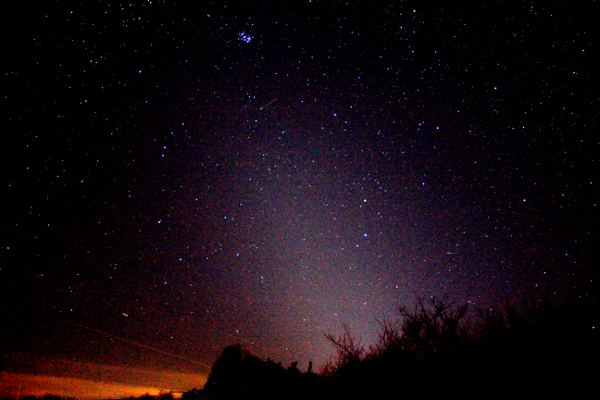
The photograph above has been increased in brightness and contrast, and of course compressed into a small picture. The zodiacal light encompasses a fairly large part of the sky. It is difficult to see. It wasn’t until my 20s that I was able to get to a dark enough spot to actually see it. But once you have spotted it, and know what you’re looking for, it is easy to detect again. A good way to find it is to scan near the horizon from northwest to southwest and notice the darkness of the sky. You’ll probably notice that towards the center of that scan the sky is not as dark as it is at the edges. Then you can follow it up into the sky and leaning to the left. This time of year the Pleiades will be at the apex of the left leaning pyramid of light. It is easiest seen on mornings near the vernal equinox, and in the mornings near the autumnal equinox where it leans to the right.
 Bob Moler's Ephemeris Blog