Archive
Ephemeris: 07/10/2025 – More news about potentially hazardous asteroid 2024 YR4
This is Ephemeris for Thursday, July 10th. Today the Sun will be up for 15 hours and 21 minutes, setting at 9:28, and it will rise tomorrow at 6:08. The Moon, at full today, will rise at 9:58 this evening.
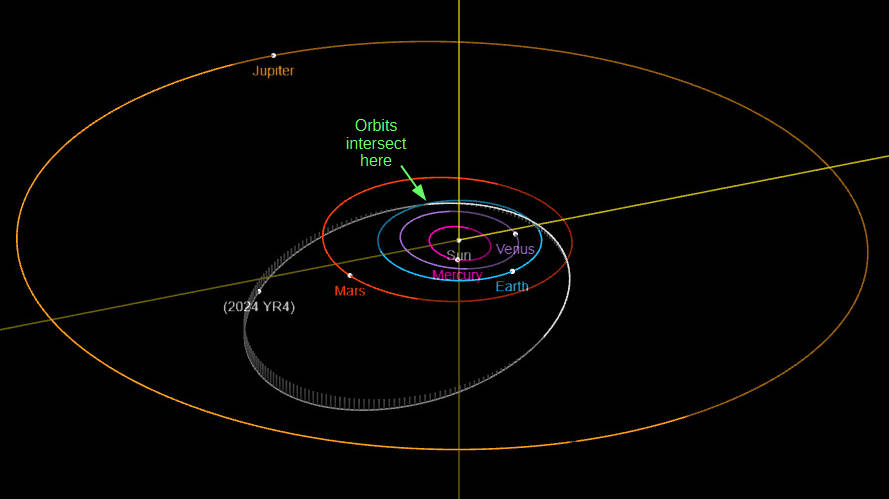
In recent programs I’ve talked about an asteroid, 2024 YR4, that has a 4% chance of hitting the Moon in 2032, and the possibility that debris from the lunar impact would make it all the way back to the Earth and cause problems with our satellites. The asteroid is too far away now to for further observations, so that’s where the probability stands. The asteroid has a four-year orbit of the Sun so toward the latter part of the year 2028 it should again be in range for astronomers to observe and refine its orbit to see if the probability of striking the Moon increases or even decreases. According to a recent paper about the ejecta from the impact, there seems a better chance of earthward debris if the asteroid hits the trailing part of the Moon, that is its right side as we see it.
The astronomical event times given in this blog are for the Traverse City/Interlochen area of Michigan (Lat 44.7° N, Long 85.7° W; EDT, UT – 4 hours) unless stated otherwise. Times will be different for other locations.
Addendum
Ephemeris: 06/30/2025 – Asteroid hitting the Moon in 2032 may cause spectacular meteor shower and danger to satellites
This is Ephemeris for International Asteroid Day, Monday, June 30th. Today the Sun will be up for 15 hours and 31 minutes, setting at 9:32, and it will rise tomorrow at 6:01. The Moon, 2 days before first quarter, will set at 12:46 tomorrow morning.
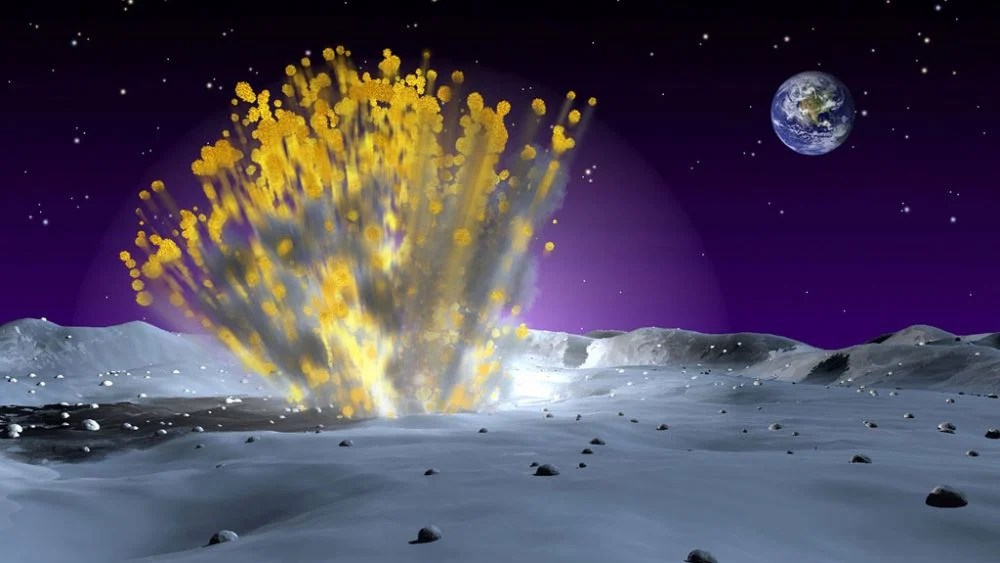
This is the 117th anniversary of the Tunguska Event, an asteroid strike that hit Siberia in 1908. An asteroid, thought to be of similar size, will pass close to the Earth, but has a 4% chance of hitting the Moon on December 22nd 2032. The asteroid was discovered near the end of last year and has the designation 2024 YR4. For a while there was a fear that this asteroid might hit the Earth. However, it was soon found that the asteroid would not hit the Earth but had a chance of hitting the Moon. Recently a paper was written that looked at what would happen to the ejecta of an impact of this asteroid on the Moon. It could be a hazard to the satellites orbiting the Earth.
The astronomical event times given in this blog are for the Traverse City/Interlochen area of Michigan (Lat 44.7° N, Long 85.7° W; EDT, UT – 4 hours) unless stated otherwise. Times will be different for other locations.
Addendum
Further reading
The Mother of All Meteor Showers Could Threaten Satellites By Evan Gough, Universe Today
Original paper: The Potential Danger to Satellites due to Ejecta from a 2032 Lunar Impact by Asteroid 2024 YR4 by Paul Wiegert et al.
Ephemeris: 03/04/2025 – Looks like asteroid 2024 YR4 will miss the Earth
This is Ephemeris for Fat Tuesday, March 4th. Today the Sun will be up for 11 hours and 20 minutes, setting at 6:35, and it will rise tomorrow at 7:12. The Moon, 2 days before first quarter, will set at 1:02 tomorrow morning.
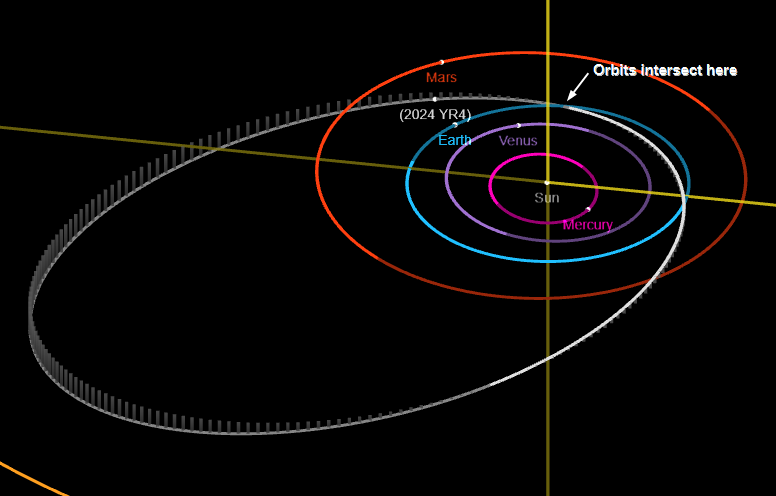
I’ve got some good news for a change. The recently discovered small asteroid with the provisional designation 2024 YR4 it’s not going to hit the Earth on December 22nd, 2032. More precisely the percentage chance of hitting the Earth is now down to four thousandths of a percent. The recalculation was due to observations from the Subaru Telescope in Hawaii. Three separate organizations calculated the chances of the asteroid to hit. That means this number is of very high confidence. The new center of the locus that they calculated for the asteroid’s passage by the Earth now comes closer to the orbit of the Moon than it does the Earth. So that’s one less thing to worry about, although astronomers will be keeping tabs on it.
The astronomical event times given are for the Traverse City/Interlochen area of Michigan (EST, UT – 5 hours). Times will be different for other locations.
Addendum
Ephemeris: 02/14/2025 – A Valentine’s Day Rendezvous
This is Ephemeris for St Valentine’s Day, Friday, February 14th. Today the Sun will be up for 10 hours and 26 minutes, setting at 6:10, and it will rise tomorrow at 7:42. The Moon, 2 days past full, will rise at 8:34 this evening.
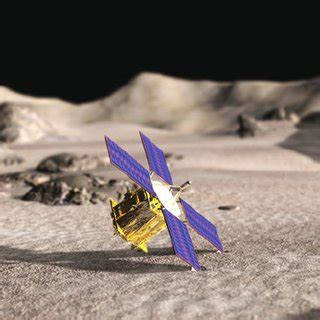
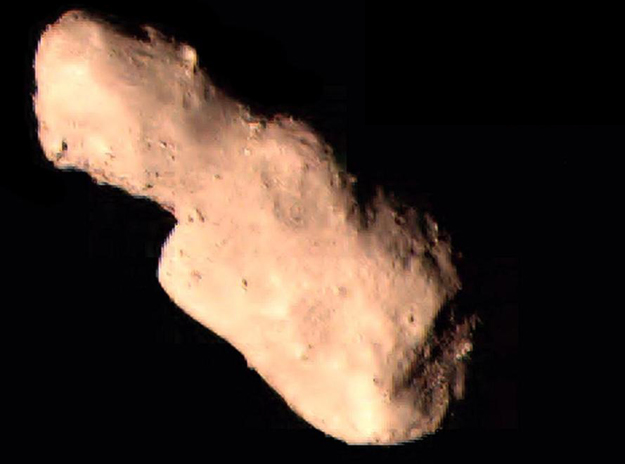
Twenty-five years ago to the day, the NEAR-Shoemaker* spacecraft entered into orbit of the near Earth asteroid 433 Eros. It wasn’t originally planned to enter orbit of the asteroid named after the Greek god of love on Valentine’s Day, 2000. It arose after an aborted course correction a year earlier. After solving the problem, a new course was plotted and NEAR-Shoemaker was gently inserted into orbit of this 21 mile long asteroid, shaped like a bent bread stick with a bite taken out of the center of it. The spacecraft spent almost a year orbiting Eros at various altitudes. The spacecraft ended its mission by gently dropping onto the middle of the asteroid, where it stayed alive for ten days before succumbing to the cold.
The astronomical event times given are for the Traverse City/Interlochen area of Michigan (EST, UT – 5 hours). Times will be different for other locations.
* The spacecraft was launched as NEAR for Near Earth Asteroid Rendezvous. It was renamed en route NEAR-Shoemaker after Eugene Shoemaker’s death in 1997. Shoemaker was a geologist who trained Apollo astronauts and proved that the Barringer Meteor Crater was indeed an impact site and not a volcanic caldera, and that most of the Moon’s craters were also caused by impacts. He with his wife Carolyn and David Levy discovered Comet Shoemaker-Levy 9, which crashed into Jupiter in 22 pieces in July 1994, gaining worldwide attention.
Addendum
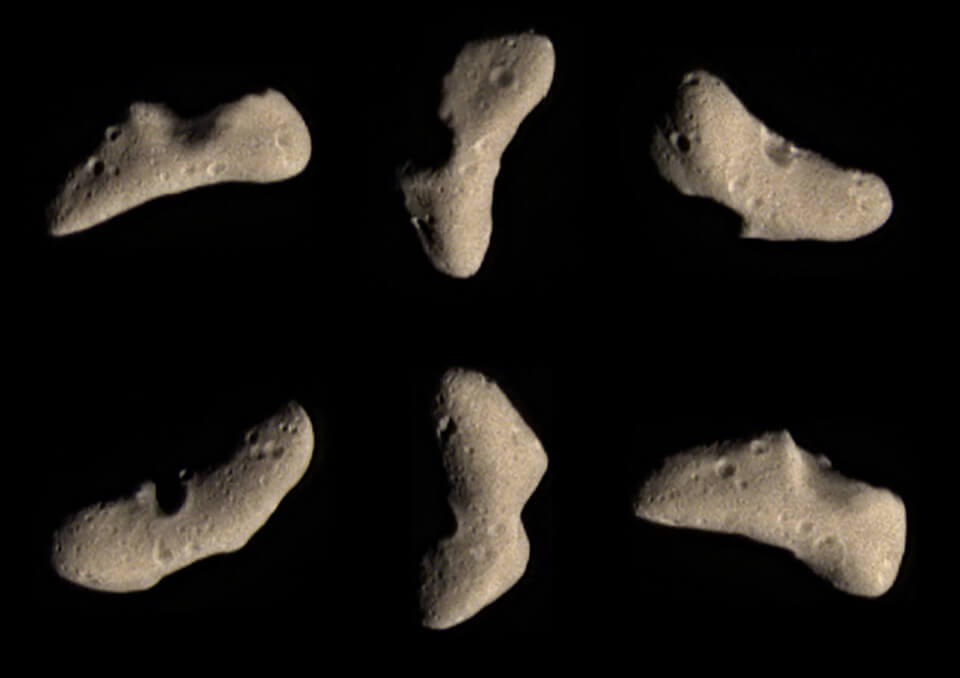
NASA/JPL/JHUAPL. Caption from: https://eros2019.imcce.fr/eros.html via Google Translate.
Ephemeris: 02/11/2025 – Newly discovered asteroid may have our number
This is Ephemeris for Tuesday, February 11th. Today the Sun will be up for 10 hours and 17 minutes, setting at 6:06, and it will rise tomorrow at 7:47. The Moon, 1 day before full, will set at 8:06 tomorrow morning.
Late last year a tiny asteroid was found because it was close to the Earth and given the designation 2024 YR4. After observing it for a month it was discovered that it had a 1½ % chance of hitting the Earth when it came around again in 2032. Remember the fireball that exploded over Chelyabinsk Russia almost exactly 10 years ago? It exploded high in the air, and caused flying glass injuries to over a thousand people who saw the flash and rushed to the windows to see it when the atmospheric shock wave arrived. This object appears to be about 3 times the size of that object, nearly a football field in diameter, and thus could be 27 times the mass and volume. It’s four year orbit of the Sun will bring it back close to Earth in 2028 for us to get a better look at it and its orbit, and the last chance to alter its orbit.
The astronomical event times given are for the Traverse City/Interlochen area of Michigan (EST, UT – 5 hours). Times will be different for other locations.
Addendum
Ephemeris: 12/12/2023 – The source of the Geminid meteor shower
This is Bob Moler with Ephemeris for Tuesday, December 12th. Today the Sun will be up for 8 hours and 51 minutes, setting at 5:02, and it will rise tomorrow at 8:11. The Moon is new today, and won’t be visible.
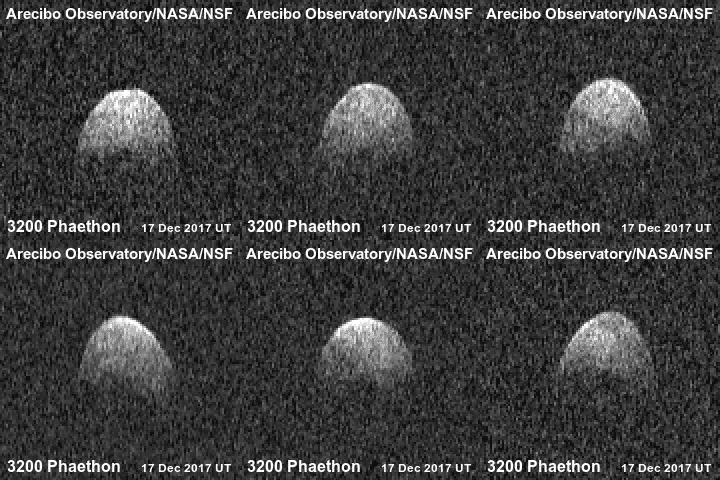
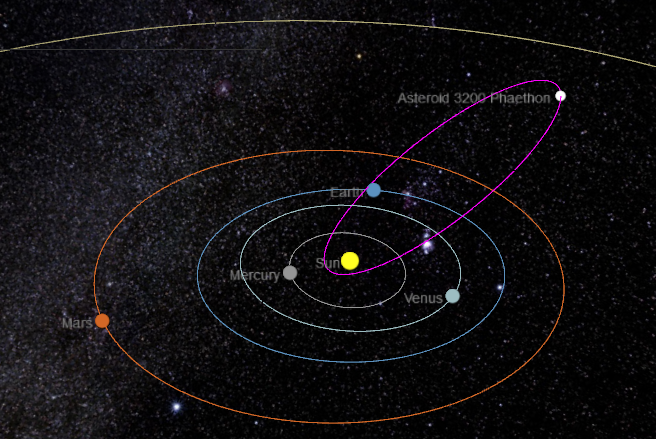
The Geminid meteor shower, which will peak this Thursday, is caused by a small body called 3200 Phaethon which looks like an asteroid but has the orbit of a comet, coming close to the Sun and back out to the asteroid belt. It’s probably a dead comet, with all the volatiles sublimated away leaving only the rocky bits. It is named Phaethon, because at the time it was the asteroid that came closest to the Sun. In Greek mythology Phaethon, the son of Helios the Sun god borrowed his father’s chariot that carried the Sun to take it out for a spin one day with disastrous results. The Geminid meteor shower was first recognized in 1862. The hourly rates of the Geminids have increased every year since then. The meteor stream has completely filled in the orbit of Phaethon, and they’re being pushed around by the gravitational effect of the planets and the pressure of sunlight.
The astronomical event times given are for the Traverse City/Interlochen area of Michigan (EST, UT –5 hours). They may be different for your location.
Addendum
Ephemeris: 11/15/2023 – Other possible contact binary solar system bodies
This is Ephemeris for Thursday, November 16th. Today the Sun will be up for 9 hours and 32 minutes, setting at 5:13, and it will rise tomorrow at 7:42. The Moon, 3 days past new, will set at 7:34 this evening.
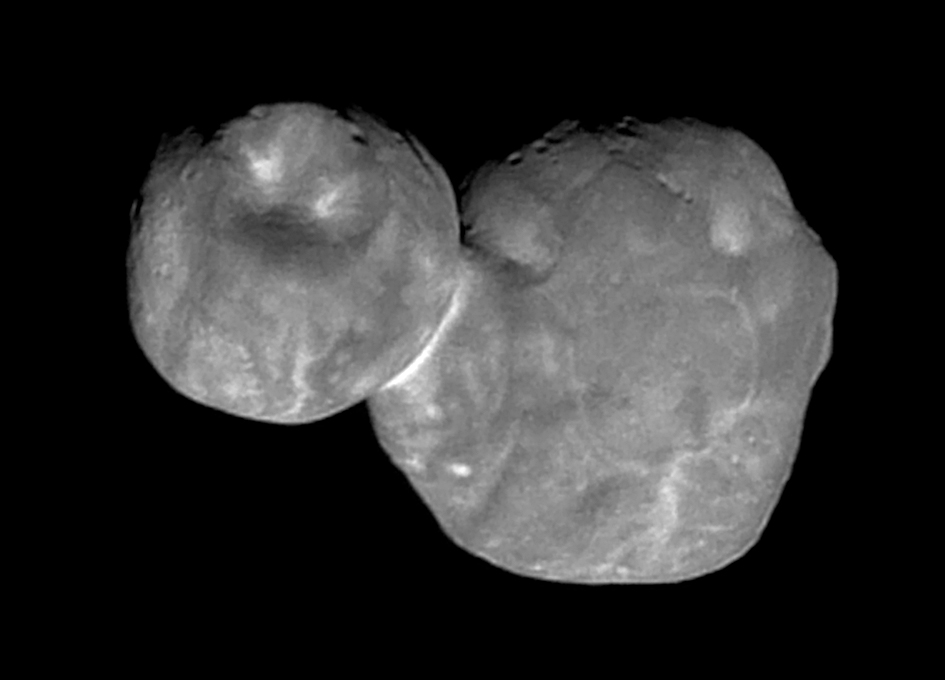
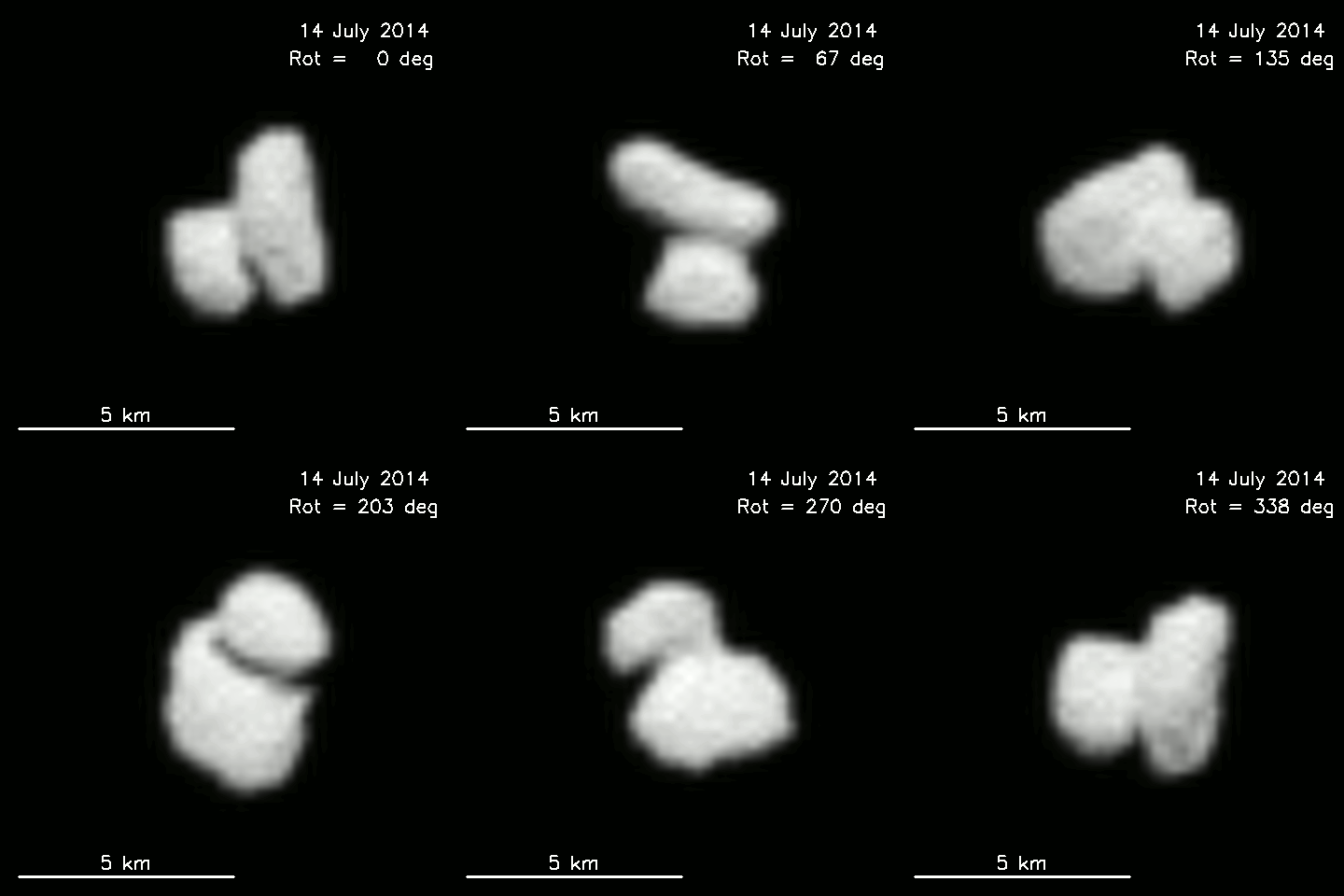
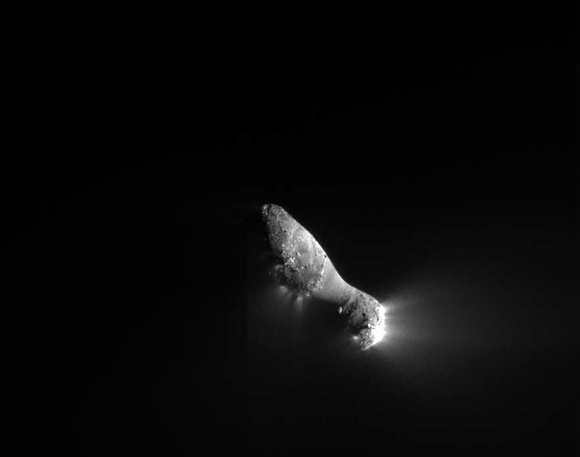
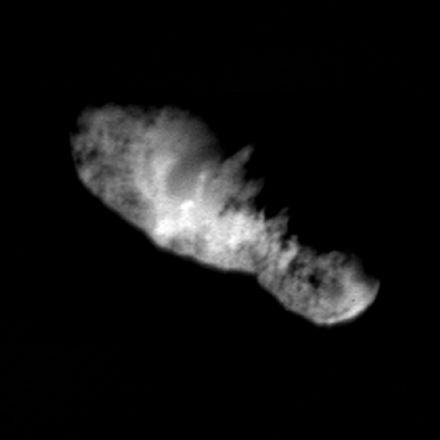
Thinking about it after seeing the contact the binary satellite of the asteroid that the Lucy spacecraft just flew by I have memories of several other bodies that could be contact binaries. The first one is that the New Horizons spacecraft passed four years ago which looked like two bodies stuck together, actually two pancakes because they weren’t spherical, but they were rather flattened. That Kuiper Belt Object now has the name Arrokoth. Comet 67 P, I won’t try to pronounce its name (Churyumov-Gerasimenko), that the Rosetta spacecraft orbited a few years ago, kinda looked like a rubber ducky with a small part attached to a larger part. It could be a contact binary. Again and there are a couple of comet nuclei that look like bowling pins. They may be contact binaries too.
The astronomical event times given are for the Traverse City/Interlochen area of Michigan (EST, UT –5 hours). They may be different for your location.
Addendum
Ephemeris: 11/14/2023 – Lucy sees an asteroid with a double moon
This is Bob Moler with Ephemeris for Tuesday, November 14th. Today the Sun will be up for 9 hours and 37 minutes, setting at 5:15, and it will rise tomorrow at 7:39. The Moon, 1 day past new, will set at 5:48 this evening.
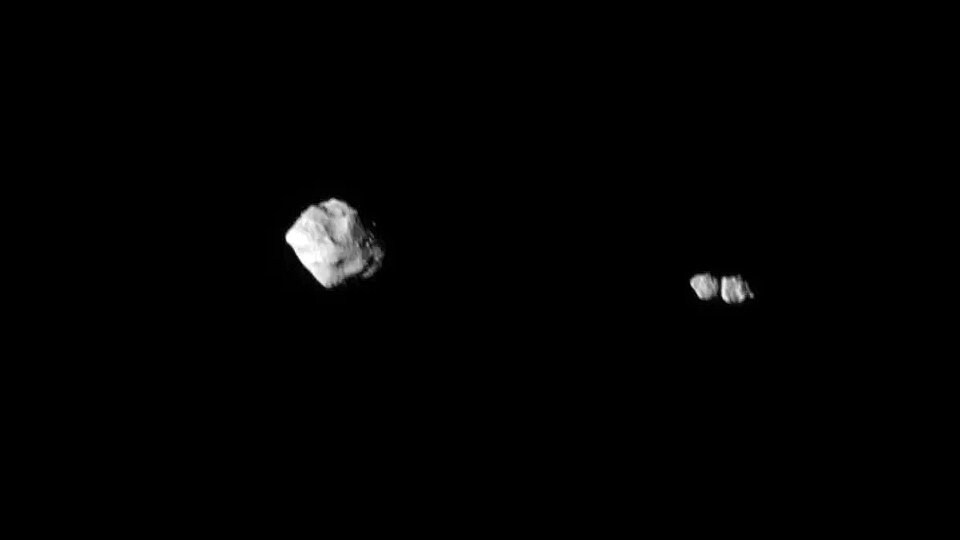
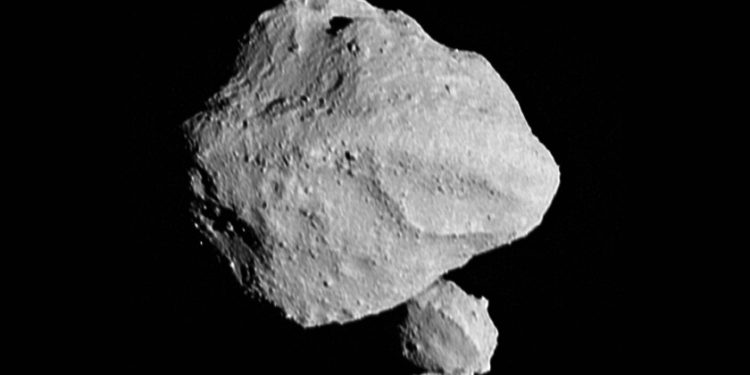
Two years ago a spacecraft called Lucy was sent out towards the Trojan Asteroids of Jupiter. On the way there it was going to pass another small asteroid, but they found another one that Lucy would come close to, the mission planners tweaked its orbit earlier this year. So Lucy can get close to the small asteroid called Dinkinesh. When Lucy got close to Dinkinesh earlier this month, it took photos, and they found that it had a satellite, and they took other photos from a different angle, and they found out that the satellite actually was two satellites in contact, a contact binary, two bodies stuck together. So that was quite a surprise. Neither body looked smooshed, so their collision appears to have been very gentle.
The astronomical event times given are for the Traverse City/Interlochen area of Michigan (EST, UT –5 hours). They may be different for your location.
Addendum
Dinkinesh is the Ethiopian name for the fossil, since it was found in Ethiopia. The name for the fossil given by the discoverers was Lucy, mainly because The Beatles song Lucy in the sky with diamonds was a big hit back then, and it was constantly played in the camp.
The next main belt asteroid that Lucy is going to pass on its way out to Jupiter’s Trojan asteroids is named Donaldjohansson in honor of the discoverer of the Lucy fossil. Jupiter’s Trojan asteroids are two groups of asteroids in the same orbit as Jupiter. One set is 60 degrees ahead of Jupiter in its orbit and the second set is 60 degrees behind Jupiter in its orbit. They’re there because they are at special gravitational points called Lagrangian points. The point ahead of Jupiter is the L4 point and the one trailing is L5. You may have heard me talk about L1 and L2 points having to do with the Earth and Sun system. These are two other Lagrangian points in line with the Sun-Earth axis, that are useful to orbit spacecraft around. There’s another one, but we don’t think there’s anything out there because that’s on the other side of the Sun from us, and none of the other planets have a body opposite to the Sun from them either, so the L3 point is not a viable point.
Ephemeris: 10/02/2023 – This week: Launch to Psyche
This is Bob Moler with Ephemeris for Monday, October 2nd. Today the Sun will be up for 11 hours and 40 minutes, setting at 7:21, and it will rise tomorrow at 7:42. The Moon, 3 days past full, will rise at 9:00 this evening.
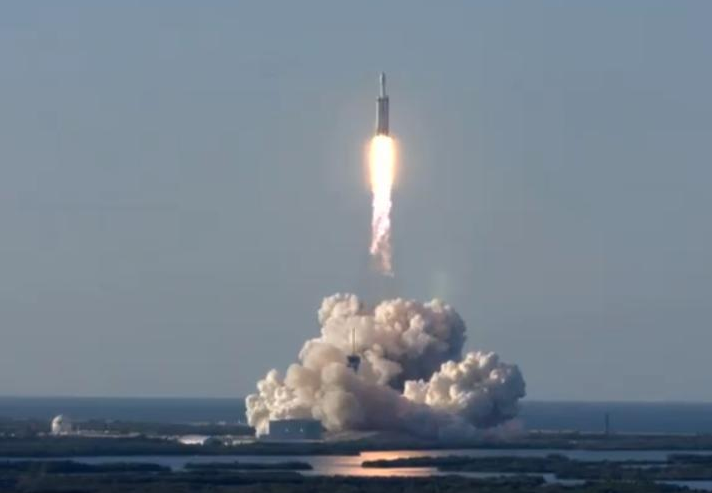
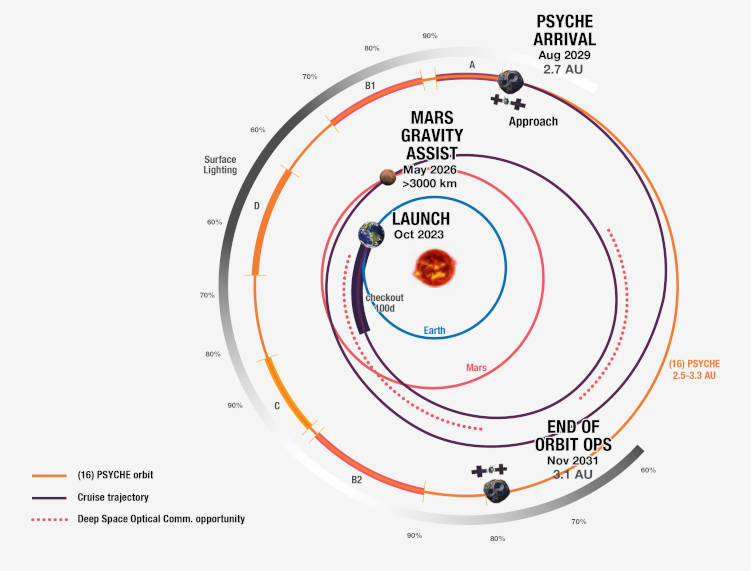
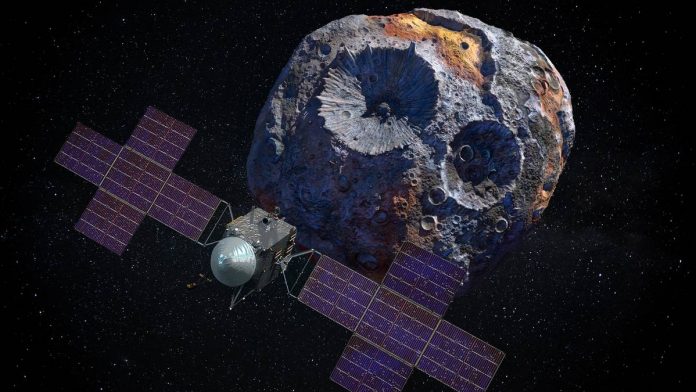
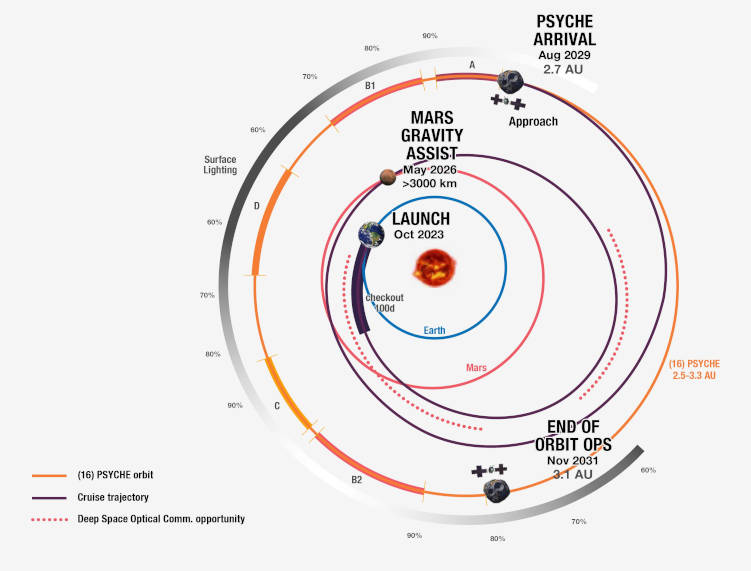
This Thursday, October 5th at 10:38 AM will be the first opportunity to launch a SpaceX Falcon Heavy rocket with the Psyche spacecraft to the asteroid 16 Psyche. It’ll be a nearly 5 1/2 year trip to this asteroid, which is metal rich, and quite unlike any asteroid that we’ve ever studied before with a spacecraft. There is a 20 day launch window starting October 5th with lunch possibilities during the 10 o’clock hour each day. Due to the design of SpaceX Falcon rockets there is only one time a day they can launch, due to the fact that they super chill their fuel and oxidizer to make them more dense to squeeze the most fuel and oxidizer into the rocket. They need to load them immediately prior to launch. Any hold in the countdown will allow them to expand and in the case of the liquid oxygen, to boil off.
The astronomical event times given are for the Traverse City/Interlochen area of Michigan (EDT, UT –4 hours). They may be different for your location.
Addendum
Ephemeris: 09/26/2023 – I’ve got some asteroid news today
This is Ephemeris for Tuesday, September 26th. Today the Sun will be up for 11 hours and 58 minutes, setting at 7:33, and it will rise tomorrow at 7:35. The Moon, 3 days before full, will set at 4:59 tomorrow morning.
I’ve got some asteroid news today. It’s good news. Two days ago, Sunday the 24th the OSIRIS REx return capsule landed in Utah with its precious cargo of rock and dust from the asteroid Bennu. And as of the time I’m recording this, I don’t know what was in the capsule. Although when they captured the material from Bennu they actually captured much more than they thought they would get, and had trouble closing the cover on the collection device.
Today is the one-year anniversary of the DART spacecraft’s collision with the small asteroid satellite Dimorphos. The latest news is that the original increase in the period of the orbit around Didymos by 33 minutes increased by another minute since. Nobody seems to know exactly why.
The astronomical event times given are for the Traverse City/Interlochen area of Michigan (EDT, UT –4 hours). They may be different for your location.
Addendum

 Bob Moler's Ephemeris Blog