Archive
01/22/2019 – Ephemeris – What the heck is an ephemeris?
Ephemeris for Tuesday, January 22nd. Today the Sun will be up for 9 hours and 25 minutes, setting at 5:37, and it will rise tomorrow at 8:11. The Moon, 1 day past full, will rise at 7:41 this evening.
What the heck is an ephemeris? According to Wikipedia: “In astronomy and celestial navigation, an ephemeris (plural: ephemerides; from Latin ephemeris, meaning ‘diary’, from the Greek,… meaning ‘diary, <or> journal’) gives the positions of… astronomical objects… at a given time or times. Historically, positions were given as printed tables of values, given at regular intervals of date and time.” My tables are now databases which I generate for the year during the prior December from published algorithms. I will show all on my blog today: It’s at bobmoler.wordpress.com. (You are already here) I used to have to interpolate values from printed ephemerides.
The times given are for the Traverse City/Interlochen area of Michigan. They may be different for your location.
Addendum
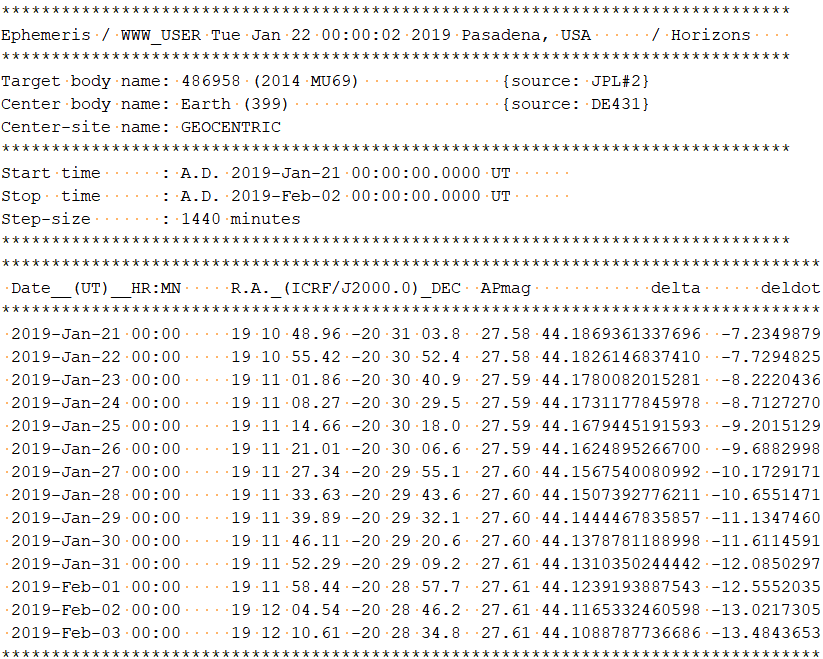
Here are sections of an ephemeris of the positions of 2014 MU69, Ultima Thule that the New Horizons flew past on New Years day. Created by JPL’s Horizons web site.
R.A. is right ascension – East-west position in the sky, like longitude on the Earth, only it’s in hours, minutes and seconds. One hour = 15 degrees.
DEC is declination – North-south position, in the sky, exactly like latitude on the Earth in degrees, minutes and seconds.
J2000.0 means that the above coordinates are based on where the vernal equinox point in the sky was on January 1, 12:00 Terrestrial Time, 2000. Or January 1, 2000, 11:58:55.816 UTC as reported in Wikipedia.
APmag – Apparent visual magnitude. Magnitudes are like golf scores. The higher magnitude the dimmer the object. It’s really, really, really dim.
delta – Distance from the Earth in terms of Astronomical Units (AU). 1 AU is Earth’s mean distance from the Sun.
deldot – The change in delta. Note that is negative. 5 days after New Horizons passed Ultima Thule that spacecraft and Ultima Thule passed behind the Sun. Now the Earth in its orbit is approaching Ultima as we are coming around the Sun.
How my data is created
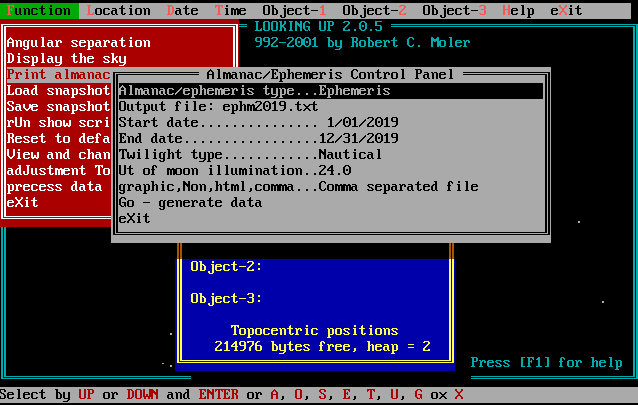
I use my LookingUp for DOS program to generate sunrise/sunset, moonrise/moonset tables for the year. I also create planetary ephemeris tables here.
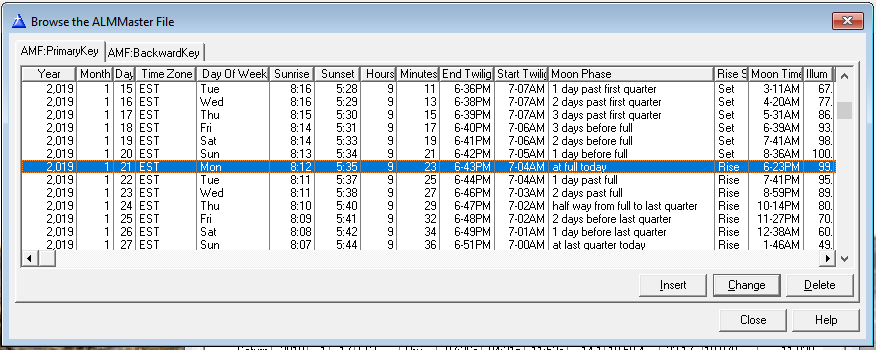
My Ephemeris Helper program massages the raw data from the above program to create this Almanac Master table.
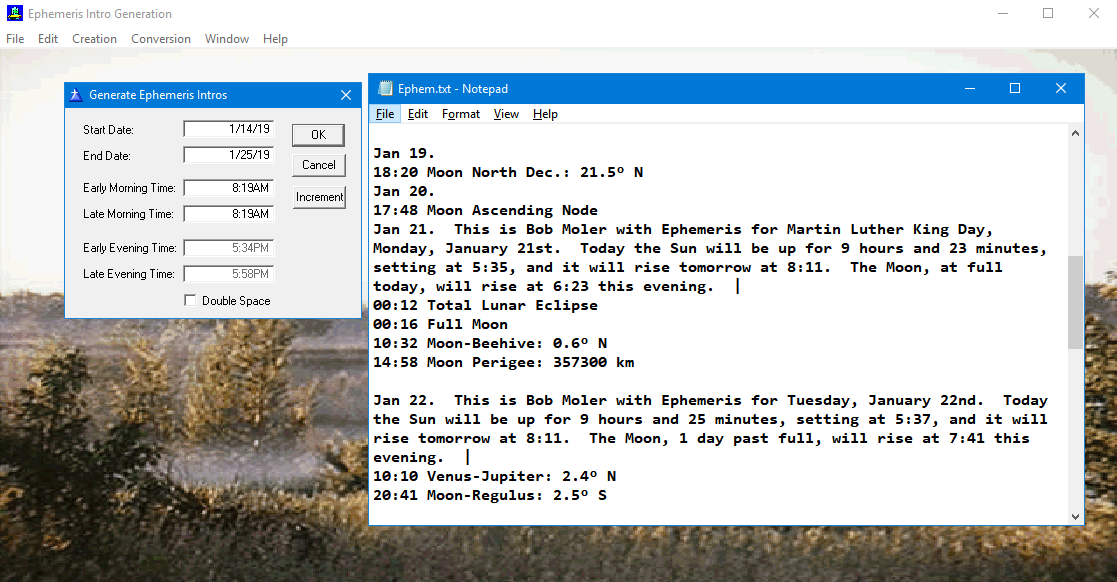
The first 15 or so seconds of the Ephemeris program is created by the Ephemeris Helper program from the Almanac Master, a Holiday Table, A One Time Event Table created from NASA’s SKYCAL Calendar Table, and Reoccurring Events Table.
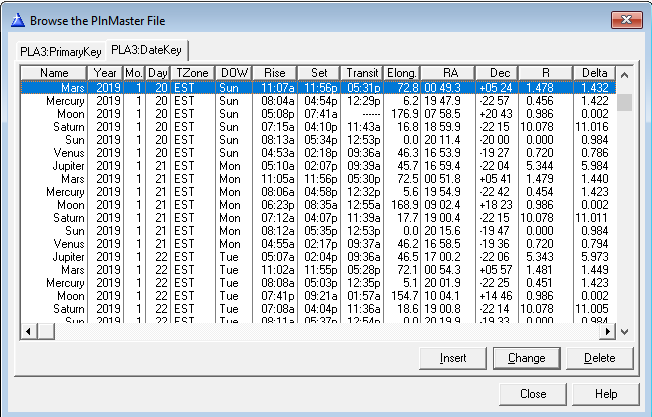
The Planet Master table in the Ephemeris Helper program which I use each Wednesday for planet positions.
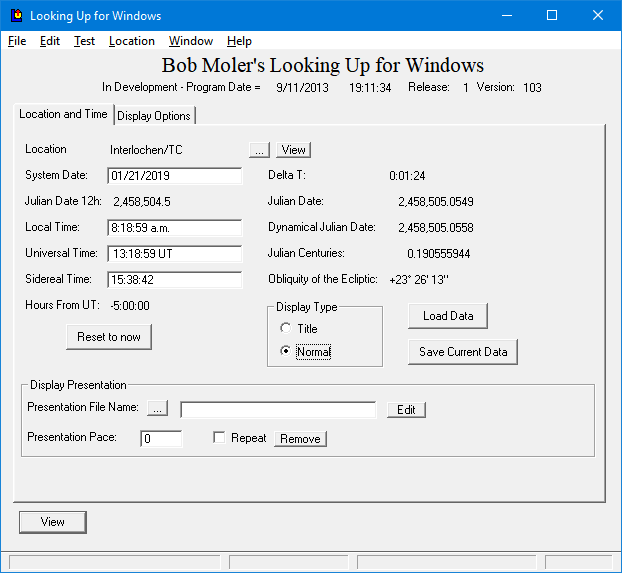
First tab of the LookingUp for Windows program which I don’t use much for the radio program but has uses on this blog and for illustrations for the Stellar Sentinel, the newsletter for the Grand Traverse Astronomical Society, that I edit, which is sent to members and distributed free via email to educators.
Source for the algorithms that I use is Astronomical Algorithms by Jean Meeus, Willmann-Bell 1991.
01/15/2019 – Ephemeris – Welcome 8:19 a.m. listeners
Ephemeris for Tuesday, January 15th. Today the Sun will be up for 9 hours and 11 minutes, setting at 5:28, and it will rise tomorrow at 8:16. The Moon, 1 day past first quarter, will set at 3:11 tomorrow morning.
Welcome to the 8:19 a.m. listeners to this program. Due to the two-hour span from the 6:19 and 8:19 airings it was thought to always give you event times in advance, which is why I’m giving tomorrow’s sunrise times. Don’t worry tomorrow’s sunrise time will never be more than 2 minutes before or after today’s. Right now, sunrise times are retreating by a half-minute a day. It’s faster in spring and fall. For more information see my blog: bobmoler.wordpress.com. Transcripts of the program are there with illustrations and additional information. And today a way to create your own sunrise and sunset calendar.
The times given are for the Traverse City/Interlochen area of Michigan. They may be different for your location.
Addendum
The times of rising and setting of celestial objects is accurate for only one spot on the Earth. In the case of the times I give, it’s for my house. There’s a good reason for it. I live approximately half way between Interlochen and Traverse City. In the early days I interpolated from astronomical tables in the Royal Astronomical Society of Canada’s Observers Handbook. I preferred it to the Naval Observatory’s Astronomical Almanac, which was more expensive. Anyway I had a relatively flat horizon everywhere but north, so if I climbed on the roof I could check out and verify the rising and setting times. Note that the times assume a flat sea horizon.
About accurate times: At my latitude celestial objects rise and set one minute later for each 12 1/3 miles (19.85 km) you are west of me, or a good landmark would be Traverse City West Senior High School. For every 12 1/3 miles east of there rising and setting events would be earlier by a minute. The correction for latitude or north and south isn’t that simple. See the illustration below:
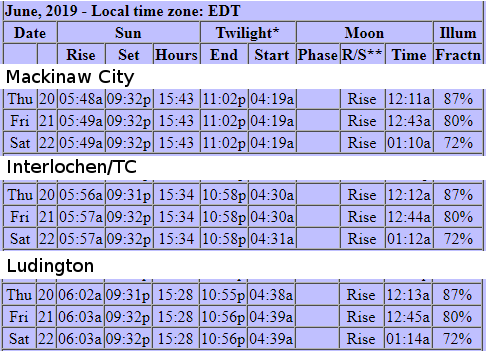
These are snippets of calendars for three locations that are in a straight line from south-southwest to north-northeast in the IPR listening area. A line drawn perpendicular to it to the west-northwest is to the Sun’s setting point. Thus the setting times for all three locations are the same. However their rising times are the most divergent, as are the daylight hours.
On my Ephemeris website, not to be confused with the blog that you are now reading, I have rise and set calendars for: Cadillac, Interlochen/Traverse City (Source for times on the Ephemeris program), Ludington, Mackinaw City, Petoskey, Eagle Harbor – Keweenaw Peninsula, Houghton Lake, and Earth’s Equator at the Prime Meridian. Go Here: http://ephemeris.bjmoler.org/calendar.htm.
If you’d like these times for a different location go to the Complete Sun and Moon Data for One Day, or Sun or Moon Rise/Set Table for One Year from the United States Naval Observatory (USNO). It calculates sunrise, sunset, moonrise, moonset, and twilight for locations in the US and other locations world-wide. Note that these do not follow the changes to and from Daylight Saving Time.
05/01/2018 – Ephemeris – Previewing May Skies
Ephemeris for Tuesday, the first day of May. The Sun rises at 6:32. It’ll be up for 14 hours and 15 minutes, setting at 8:47. The Moon, 2 days past full, will rise at 10:32 this evening.
They say April showers bring May flowers, but I don’t think they meant snow showers. Daylight hours in the Interlochen/Traverse City area will increase from 14 hours and 15 minutes today to 15 hours 19 minutes on May 31st. The altitude, or angle, of the sun above the southern horizon at local noon will ascend from 60 degrees today to 67 degrees at month’s end. The altitude of the sun in the Straits area will be a degree lower than that but your length of daylight will be a few minutes longer. Local apparent noon this month, when the sun passes due south, will be about 1:38 p.m. The Eta Aquariid meteor shower will reach its peak about 3 a.m. this Saturday morning the 5th, but the bright morning Moon will interfere.
The times given are for the Traverse City/Interlochen area of Michigan. They may be different for your location.
Addendum
May Evening Sky Chart
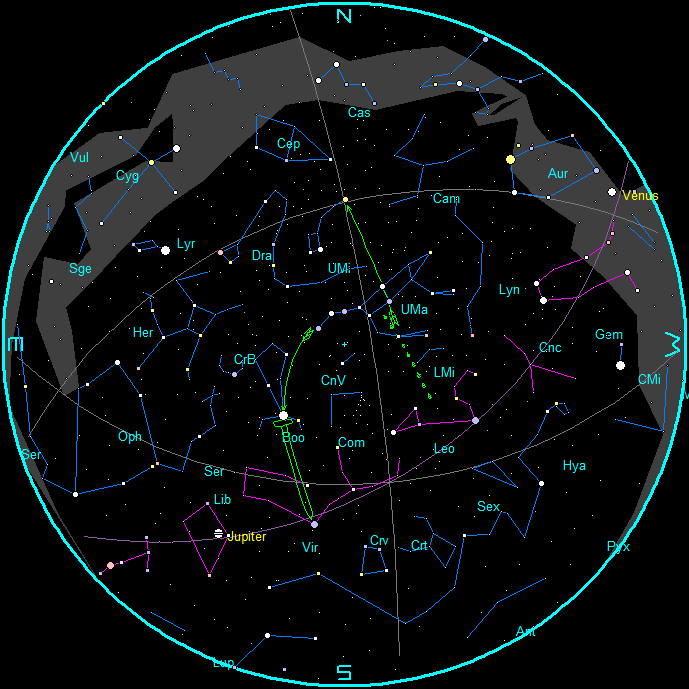
Star Chart for May 2018 (11 p.m. EDT May 15, 2018). Created using my LookingUp program. Click on image to enlarge.
The planets and stars are plotted for the 15th at 11 p.m. EDT in the evening and 5 a.m. for the morning chart. These are the chart times. Note that Traverse City is located approximately 45 minutes behind our time meridian. (An hour 45 minutes behind our daylight saving time meridian during EDT and 45 minutes behind our daylight standard time meridian. during EST). To duplicate the star positions on a planisphere you may have to set it to 1 hour 45 minutes (Daylight Time) or 45 minutes (Standard Time) earlier than the current time.
Note the chart times of 11 p.m. and 5 a.m. are for the 15th. For each week before the 15th add ½ hour (28 minutes if you’re picky). For each week after the 15th subtract ½ hour. The planet positions are updated each Wednesday on this blog. For planet positions on dates other than the 15th, check the Wednesday planet posts on this blog.
May Morning Star Chart
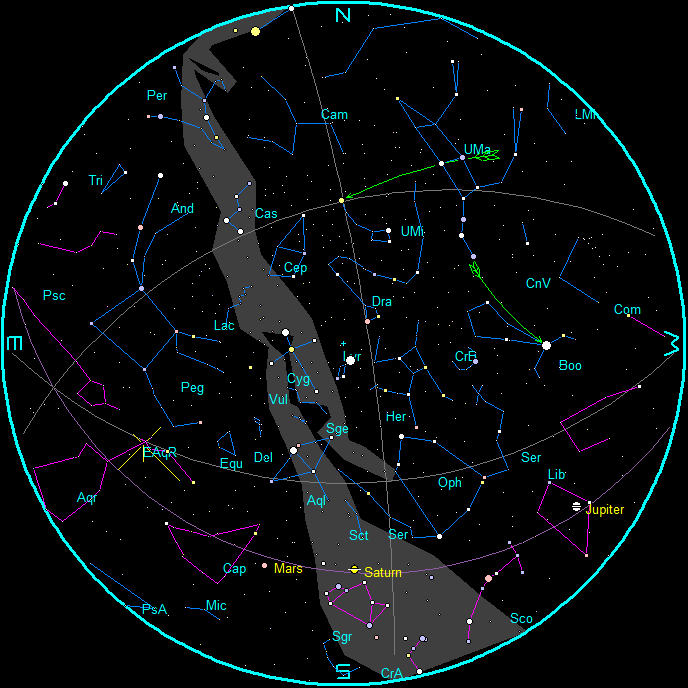
Star Chart for May 2018 mornings based on 5 a.m. May 15th. Created using my LookingUp program. Click on image to enlarge.
For a list of constellation names to go with the abbreviations click here.
Star chart annotations
- Pointer stars at the front of the bowl of the Big Dipper point to Polaris the North Star.
- Leaky Big Dipper drips on Leo.
- Follow the arc of the handle of the Big Dipper to the star Arcturus and
- Continue with a spike to Spica.
- The Summer Triangle is in red.
- EAqr is the Eta Aquariid meteor shower radiant. This shower will be plagued by a waning gibbous moon. It will be addressed in the May 3rd program. This is a shower of bits from Halley’s Comet.
Twilight
Evening nautical twilight ends at 10:02 p.m. EDT on the 1st, increasing to 10:44 p.m. EDT on the 31st.
Evening astronomical twilight ends at 10:46 p.m. EDT on the 1st, increasing to 11:42 p.m. EDT on the 31st.
Morning astronomical twilight starts at 4:40 a.m. EDT on the 1st, and decreasing to 3:45 a.m. EDT on the 31st.
Morning nautical twilight starts at 5:25 a.m. EDT on the 1st, and decreasing to 4:44 a.m. EDT on the 31st.
NASA Calendar of Planetary Events
    Date    Time    Event
May 01  Tu          Venus: 27.2° E
    02  We  9:24 am Venus-Aldebaran: 6.4° N
    04  Fr  4:31 pm Moon-Saturn: 1.9° S
    04  Fr  7:00 pm Moon South Dec.: 20.6° S
    05  Sa  3:03 am Eta Aquarid Shower: ZHR = 60
    05  Sa  8:35 pm Moon Apogee: 404500 km
    06  Su  3:24 am Moon-Mars: 3° S
    07  Mo  6:24 am Moon Descending Node
    07  Mo 10:09 pm Last Quarter
    08  Tu  8:10 pm Jupiter Opposition
    13  Su  1:21 pm Moon-Mercury: 2.5° N
    15  Tu  7:48 am New Moon
    17  Th  2:11 pm Moon-Venus: 4.8° N
    17  Th  5:06 pm Moon Perigee: 363800 km
    18  Fr 11:02 am Moon North Dec.: 20.7° N
    20  Su  7:57 am Moon-Beehive: 1.7° N
    20  Su  9:13 am Moon Ascending Node
    21  Mo  8:53 pm Moon-Regulus: 1.5° S
    21  Mo 11:49 pm First Quarter
    27  Su  1:39 pm Moon-Jupiter: 4.3° S
    29  Tu 10:20 am Full Moon
    31  Th  9:20 pm Moon-Saturn: 1.8° S
Jun 01  Fr          Venus: 34.5° E
Sky Events Calendar by Fred Espenak and Sumit Dutta (NASA’s GSFC),
http://eclipse.gsfc.nasa.gov/SKYCAL/SKYCAL.html
If you go to the above site you can print out a list like the above for the entire year
or calendar pages for your time zone.
Sun and Moon Rising and Setting Events
     LU                  Ephemeris of Sky Events for Interlochen/TC
     May, 2018    Local time zone: EDT
     +-----------------------------------------------------------------------+
     | DATE |  SUN     SUN  DAYLIGHT|   TWILIGHT*    |MOON  RISE OR    ILLUM |
     |      |  RISE    SET    HOURS |  END    START  |PHASE SET** TIME FRACTN|
     +=======================================================================+
     |Tue  1| 06:32a  08:47p  14:15 | 10:00p  05:20a |      Rise 10:32p   96%|
     |Wed  2| 06:31a  08:49p  14:17 | 10:01p  05:18a |      Rise 11:31p   91%|
     |Thu  3| 06:29a  08:50p  14:20 | 10:03p  05:17a |      Rise 12:26a   85%|
     |Fri  4| 06:28a  08:51p  14:23 | 10:04p  05:15a |      Rise 01:15a   78%|
     |Sat  5| 06:27a  08:52p  14:25 | 10:06p  05:13a |      Rise 02:00a   69%|
     +------+-----------------------+----------------+-----------------------+
     |Sun  6| 06:25a  08:53p  14:28 | 10:07p  05:12a |      Rise 02:39a   60%|
     |Mon  7| 06:24a  08:55p  14:30 | 10:09p  05:10a |L Qtr Rise 03:14a   51%|
     |Tue  8| 06:23a  08:56p  14:33 | 10:11p  05:08a |      Rise 03:45a   41%|
     |Wed  9| 06:21a  08:57p  14:35 | 10:12p  05:06a |      Rise 04:14a   32%|
     |Thu 10| 06:20a  08:58p  14:38 | 10:14p  05:05a |      Rise 04:42a   23%|
     |Fri 11| 06:19a  08:59p  14:40 | 10:15p  05:03a |      Rise 05:09a   15%|
     |Sat 12| 06:18a  09:00p  14:42 | 10:17p  05:02a |      Rise 05:38a    8%|
     +------+-----------------------+----------------+-----------------------+
     |Sun 13| 06:16a  09:02p  14:45 | 10:18p  05:00a |      Rise 06:09a    3%|
     |Mon 14| 06:15a  09:03p  14:47 | 10:20p  04:59a |      Rise 06:45a    1%|
     |Tue 15| 06:14a  09:04p  14:49 | 10:21p  04:57a |New   Set  09:20p    1%|
     |Wed 16| 06:13a  09:05p  14:52 | 10:23p  04:56a |      Set  10:32p    3%|
     |Thu 17| 06:12a  09:06p  14:54 | 10:24p  04:54a |      Set  11:40p    9%|
     |Fri 18| 06:11a  09:07p  14:56 | 10:26p  04:53a |      Set  12:41a   17%|
     |Sat 19| 06:10a  09:08p  14:58 | 10:27p  04:51a |      Set  01:33a   26%|
     +------+-----------------------+----------------+-----------------------+
     |Sun 20| 06:09a  09:09p  15:00 | 10:29p  04:50a |      Set  02:17a   37%|
     |Mon 21| 06:08a  09:10p  15:02 | 10:30p  04:49a |F Qtr Set  02:55a   48%|
     |Tue 22| 06:07a  09:12p  15:04 | 10:32p  04:47a |      Set  03:27a   59%|
     |Wed 23| 06:06a  09:13p  15:06 | 10:33p  04:46a |      Set  03:56a   70%|
     |Thu 24| 06:05a  09:14p  15:08 | 10:34p  04:45a |      Set  04:24a   79%|
     |Fri 25| 06:05a  09:15p  15:09 | 10:36p  04:44a |      Set  04:52a   87%|
     |Sat 26| 06:04a  09:16p  15:11 | 10:37p  04:43a |      Set  05:20a   93%|
     +------+-----------------------+----------------+-----------------------+
     |Sun 27| 06:03a  09:16p  15:13 | 10:38p  04:42a |      Set  05:51a   97%|
     |Mon 28| 06:02a  09:17p  15:15 | 10:39p  04:41a |      Set  06:24a   99%|
     |Tue 29| 06:02a  09:18p  15:16 | 10:41p  04:40a |Full  Rise 09:21p  100%|
     |Wed 30| 06:01a  09:19p  15:18 | 10:42p  04:39a |      Rise 10:18p   98%|
     |Thu 31| 06:00a  09:20p  15:19 | 10:43p  04:38a |      Rise 11:10p   95%|
     +-----------------------------------------------------------------------+
     * Nautical Twilight
     ** Moonrise or moonset, whichever occurs between sunset and sunrise
03/30/2018 – Ephemeris – Previewing April skies
Ephemeris for Good Friday, Friday, March 30th. The Sun will rise at 7:27. It’ll be up for 12 hours and 40 minutes, setting at 8:07. The Moon, 1 day before full, will set at 7:50 tomorrow morning.
The 4th month of the year begins on Sunday. Daylight hours in the Interlochen/Traverse City area and will increase from 12 hours and 46 minutes Sunday to 14 hours 12 minutes on April 30th. The altitude, or angle, of the Sun above the southern horizon at local noon will be 50 degrees Sunday and will ascend to 60 degrees on April 30th. The altitude of the Sun in the Straits area will be a degree lower. The actual time of local apparent noon when the sun passes due south, will be about 1:43 p.m. The Lyrid meteor shower will reach it’s peak on the early afternoon of the 22nd. So the early morning hours between 3 and 5 a.m. are the best time to see it when the Moon has set and the radiant is high in the sky.
Addendum
April Evening Sky Chart
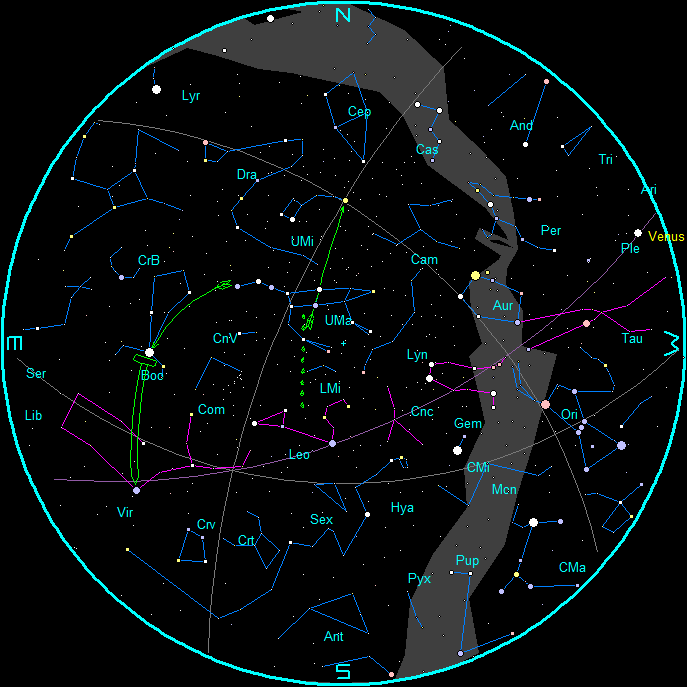
Star Chart for April 2018 (10 p.m. EDT April 15, 2018). Created using my LookingUp program. Click on image to enlarge.
The planets and stars are plotted for the 15th at 9 p.m. EDT in the evening and 5 a.m. for the morning chart. These are the chart times. Note that Traverse City is located approximately 45 minutes behind our time meridian. (An hour 45 minutes behind our daylight saving time meridian during EDT and 45 minutes behind our daylight standard time meridian. during EST). To duplicate the star positions on a planisphere you may have to set it to 1 hour 45 minutes (Daylight Time) or 45 minutes (Standard Time) earlier than the current time.
Note the chart times of 10 p.m. and 5 a.m. are for the 15th. For each week before the 15th add ½ hour (28 minutes if you’re picky). Watch out for the time change. For each week after the 15th subtract ½ hour. The planet positions are updated each Wednesday on this blog. For planet positions on dates other than the 15th, check the Wednesday planet posts on this blog.
April Morning Star Chart
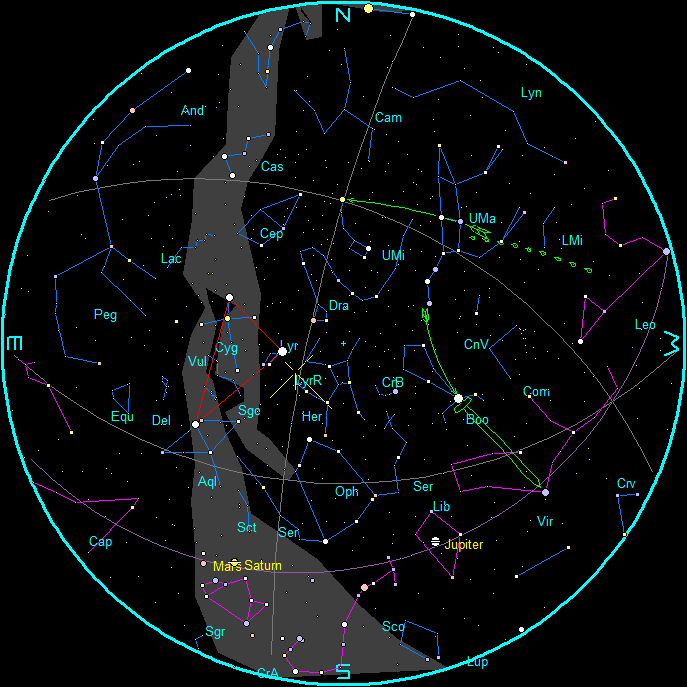
Star Chart for April 2018 mornings based on 5 a.m. April 15th. Created using my LookingUp program. Click on image to enlarge.
For a list of constellation names to go with the abbreviations click here.
Star chart annotations
- Pointer stars at the front of the bowl of the Big Dipper point to Polaris the North Star.
- Leaky Big Dipper drips on Leo.
- Follow the arc of the handle of the Big Dipper to the star Arcturus and
- Continue with a spike to Spica.
- The Summer Triangle is in red.
- LyrR is the Lyrid meteor shower radiant. The Lyrid meteor shower will reach its peak for us on the morning of the 22nd. The actual peak time is variable for this shower and can occur as early as 6 a.m. to as late as 5 p.m. Also the peak numbers of meteors are variable. Best time to observe without the Moon is between 3 a.m. and the start of twilight.
Twilight
Evening nautical twilight ends at 9:17 p.m. EDT on the 1st, increasing to 10:00 p.m. EDT on the 30th.
Evening astronomical twilight ends at 9:54 p.m. EDT on the 1st, increasing to 10:44 p.m. EDT on the 30th.
Morning astronomical twilight starts at 5:47 a.m. EDT on the 1st, and decreasing to 4:43 a.m. EDT on the 30th.
Morning nautical twilight starts at 6:23 a.m. EDT on the 1st, and decreasing to 5:27 a.m. EDT on the 30th.
NASA Calendar of Planetary Events
    Date    Time    Event
Apr 01  Su          Venus: 19.9° E
    01  Su  1:47 pm Mercury Inferior Conj.
    02  Mo  3:02 pm Mars-Saturn: 1.3° N
    03  Tu 10:14 am Moon-Jupiter: 4.2° S
    07  Sa  8:50 am Moon-Saturn: 2.1° S
    07  Sa 10:37 am Moon South Dec.: 20.3° S
    07  Sa  2:15 pm Moon-Mars: 3.5° S
    08  Su  1:32 am Moon Apogee: 404100 km
    08  Su  3:18 am Last Quarter
    10  Tu  4:09 am Moon Descending Node
    15  Su  9:57 pm New Moon
    17  Tu  3:29 pm Moon-Venus: 5.5° N
    18  We 10:35 am Uranus Conjunction
    19  Th 12:45 am Moon-Aldebaran: 1.1° S
    20  Fr 10:44 am Moon Perigee: 368700 km
    21  Sa  3:38 am Moon North Dec.: 20.4° N
    22  Su  1:49 pm Lyrid Shower: ZHR = 20
    22  Su  5:46 pm First Quarter
    23  Mo  2:17 am Moon-Beehive: 2° N
    23  Mo  8:19 am Moon Ascending Node
    24  Tu 12:47 pm Venus-Pleiades: 3.5° S
    24  Tu  3:39 pm Moon-Regulus: 1.2° S
    29  Su  1:59 pm Mercury Elongation: 27° W
    29  Su  8:58 pm Full Moon
    30  Mo  1:16 pm Moon-Jupiter: 4.1° S
May 01  Tu          Venus: 27.2° E
Sky Events Calendar by Fred Espenak and Sumit Dutta (NASA’s GSFC),
http://eclipse.gsfc.nasa.gov/SKYCAL/SKYCAL.html
If you go to the above site you can print out a list like the above for the entire year
or calendar pages for your time zone.
Sun and Moon Rising and Setting Events
     LU                  Ephemeris of Sky Events for Interlochen/TC
     April, 2018    Local time zone: EDT
     +-----------------------------------------------------------------------+
     | DATE |  SUN     SUN  DAYLIGHT|   TWILIGHT*    |MOON  RISE OR    ILLUM |
     |      |  RISE    SET    HOURS |  END    START  |PHASE SET** TIME FRACTN|
     +=======================================================================+
     |Sun  1| 07:23a  08:10p  12:46 | 09:15p  06:19a |      Rise 09:35p   97%|
     |Mon  2| 07:21a  08:11p  12:49 | 09:16p  06:17a |      Rise 10:40p   93%|
     |Tue  3| 07:19a  08:12p  12:53 | 09:18p  06:15a |      Rise 11:44p   87%|
     |Wed  4| 07:18a  08:14p  12:56 | 09:19p  06:13a |      Rise 12:44a   80%|
     |Thu  5| 07:16a  08:15p  12:59 | 09:20p  06:11a |      Rise 01:41a   71%|
     |Fri  6| 07:14a  08:16p  13:02 | 09:22p  06:09a |      Rise 02:33a   62%|
     |Sat  7| 07:12a  08:17p  13:05 | 09:23p  06:07a |      Rise 03:20a   53%|
     +------+-----------------------+----------------+-----------------------+
     |Sun  8| 07:10a  08:19p  13:08 | 09:25p  06:05a |L Qtr Rise 04:03a   43%|
     |Mon  9| 07:09a  08:20p  13:11 | 09:26p  06:03a |      Rise 04:40a   34%|
     |Tue 10| 07:07a  08:21p  13:14 | 09:28p  06:01a |      Rise 05:14a   25%|
     |Wed 11| 07:05a  08:22p  13:17 | 09:29p  05:59a |      Rise 05:45a   17%|
     |Thu 12| 07:03a  08:24p  13:20 | 09:31p  05:57a |      Rise 06:14a   11%|
     |Fri 13| 07:01a  08:25p  13:23 | 09:32p  05:55a |      Rise 06:42a    5%|
     |Sat 14| 07:00a  08:26p  13:26 | 09:34p  05:53a |      Rise 07:10a    2%|
     +------+-----------------------+----------------+-----------------------+
     |Sun 15| 06:58a  08:27p  13:29 | 09:35p  05:51a |New   Set  08:05p    0%|
     |Mon 16| 06:56a  08:29p  13:32 | 09:37p  05:49a |      Set  09:16p    1%|
     |Tue 17| 06:55a  08:30p  13:35 | 09:38p  05:47a |      Set  10:27p    5%|
     |Wed 18| 06:53a  08:31p  13:38 | 09:40p  05:45a |      Set  11:38p   11%|
     |Thu 19| 06:51a  08:32p  13:41 | 09:41p  05:43a |      Set  12:47a   19%|
     |Fri 20| 06:50a  08:34p  13:44 | 09:43p  05:41a |      Set  01:50a   29%|
     |Sat 21| 06:48a  08:35p  13:47 | 09:44p  05:39a |      Set  02:46a   40%|
     +------+-----------------------+----------------+-----------------------+
     |Sun 22| 06:46a  08:36p  13:49 | 09:46p  05:37a |F Qtr Set  03:34a   51%|
     |Mon 23| 06:45a  08:37p  13:52 | 09:47p  05:35a |      Set  04:15a   62%|
     |Tue 24| 06:43a  08:39p  13:55 | 09:49p  05:33a |      Set  04:51a   73%|
     |Wed 25| 06:41a  08:40p  13:58 | 09:50p  05:31a |      Set  05:22a   82%|
     |Thu 26| 06:40a  08:41p  14:01 | 09:52p  05:29a |      Set  05:52a   90%|
     |Fri 27| 06:38a  08:42p  14:04 | 09:53p  05:28a |      Set  06:20a   95%|
     |Sat 28| 06:37a  08:44p  14:06 | 09:55p  05:26a |      Set  06:48a   99%|
     +------+-----------------------+----------------+-----------------------+
     |Sun 29| 06:35a  08:45p  14:09 | 09:57p  05:24a |Full  Rise 08:25p  100%|
     |Mon 30| 06:34a  08:46p  14:12 | 09:58p  05:22a |      Rise 09:30p   99%|
     +-----------------------------------------------------------------------+
     * Nautical Twilight
     ** Moonrise or moonset, whichever occurs between sunset and sunrise
The times given are for the Traverse City/Interlochen area of Michigan. They may be different for your location.
03/29/2018 – Ephemeris – The Easter date is set by the first full moon of spring and a developing conjunction
Ephemeris for Thursday, March 29th. The Sun will rise at 7:29. It’ll be up for 12 hours and 37 minutes, setting at 8:06. The Moon, 2 days before full, will set at 7:21 tomorrow morning.
This Sunday, April 1st will be Easter for western churches. Because it falls on the first Sunday after the first full moon since March 21st. The Full Moon is Saturday the 31st. It happens that Passover begins at sundown the 31st. Orthodox churches will celebrate Easter on April 8th, a week later. It’s going to be a somewhat busy weekend in the sky also. Sunday Mercury will pass from the evening sky to the morning sky in an event called an inferior conjunction of the Sun. It is not visible, but folks in the southern hemisphere will easily spot Mercury late in April. In the morning sky Mars will pass below Saturn between the mornings of the 2nd and 3rd. They are close to the same brightness, but Mars is distinctly redder.
The times given are for the Traverse City/Interlochen area of Michigan. They may be different for your location.
Addendum
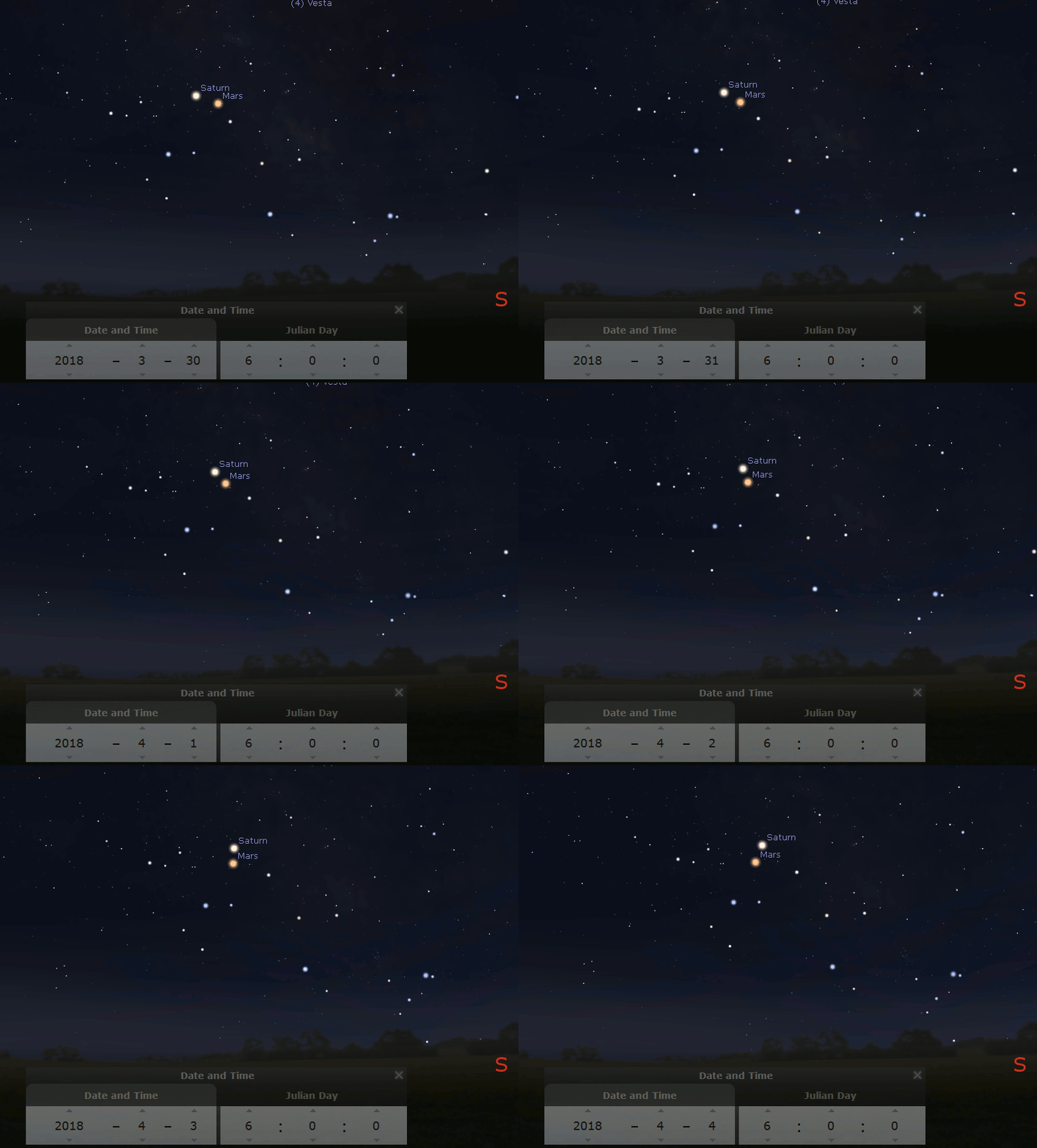
Conjunction animation of Mars passing Saturn at daily intervals at 6 a.m. for March 30 to April 4, 2018. This will occur above the Teapot asterism of the constellation of Sagittarius. Created using Stellarium ans GIMP.
03/01/2018 – Ephemeris – Previewing March skies
Ephemeris for Thursday, March 1st. The Sun will rise at 7:20. It’ll be up for 11 hours and 10 minutes, setting at 6:30. The Moon, at full today, will rise at 6:16 this evening.
Let’s look at the skies for the month of March. The Sun will pass the celestial equator in March as the promising season of spring will begin. Daylight hours in the Interlochen/Traverse City area and will increase from 11 hours and 10 minutes today to 12 hours 43 minutes on the 31st. The altitude, or angle, of the Sun above the southern horizon at local noon will be just under 38 degrees today and will ascend to nearly 50 degrees on the 31st. The altitude of the Sun in the Straits area will be a degree lower. Local apparent noon this month, when the Sun passes due south, will be about 12:49 p.m. and an hour later when daylight time starts. Spring will begin on the 20th at 12:15 p.m. Daylight Time, which now rules most of the year will start on the 11th.
The times given are for the Traverse City/Interlochen area of Michigan. They may be different for your location.
Addendum
March Evening Sky Chart
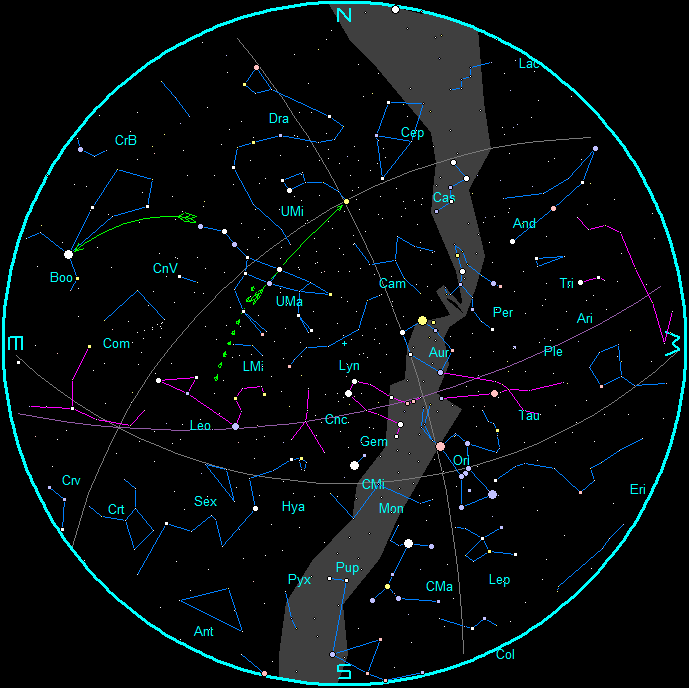
Star Chart for March 2018 (10 p.m. EDT March 15, 2018). Created using my LookingUp program. Click on image to enlarge.
The planets and stars are plotted for the 15th at 9 p.m. EDT in the evening and 6 a.m. for the morning chart. These are the chart times. Note that Traverse City is located approximately 45 minutes behind our time meridian. (An hour 45 minutes behind our daylight saving time meridian. during EDT and 45 minutes behind our daylight standard time meridian. during EST). To duplicate the star positions on a planisphere you may have to set it to 1 hour 45 minutes (Daylight Time) or 45 minutes (Standard Time) earlier than the current time if you are near your time meridian. Note that Daylight time starts at 2 a.m. Sunday March 11th for most US states.
Note the chart times of 10 p.m. and 6 a.m. are for the 15th. For each week before the 15th add ½ hour (28 minutes if you’re picky). Watch out for the time change. For each week after the 15th subtract ½ hour. The planet positions are updated each Wednesday on this blog. For planet positions on dates other than the 15th, check the Wednesday planet posts on this blog.
March Morning Star Chart
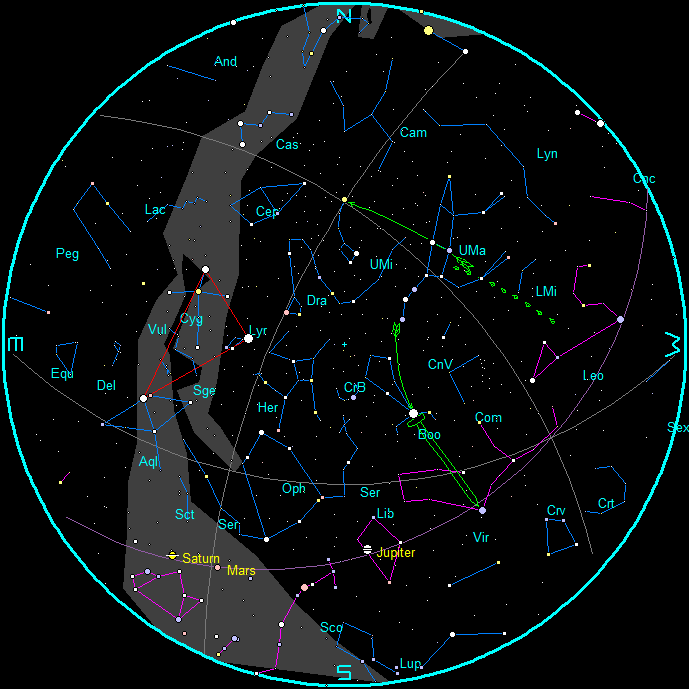
Star Chart for March 2018 mornings based on 6 a.m. March 15th. Created using my LookingUp program. Click on image to enlarge.
For a list of constellation names to go with the abbreviations click here.
Star chart annotations
- Pointer stars at the front of the bowl of the Big Dipper point to Polaris the North Star.
- Leaky Big Dipper drips on Leo.
- Follow the arc of the handle of the Big Dipper to the star Arcturus and
- Continue with a spike to Spica.
- The Summer Triangle is in red.
Twilight
Evening nautical twilight ends at 7:32 p.m. EST on the 1st, increasing to 9:16 p.m. EDT on the 31st.
Evening astronomical twilight ends at 8:06 p.m. EST on the 1st, increasing to 9:52 p.m. EDT on the 31st.
Morning astronomical twilight starts at 5:44 a.m. EST on the 1st, and decreasing to 5:49 a.m. EDT on the 31st.
Morning nautical twilight starts at 6:17 a.m. EST on the 1st, and decreasing to 6:25 a.m. EDT on the 31st.
NASA Calendar of Planetary Events
    Date    Time    Event
Mar 01  Th          Venus: 12.4° E
    01  Th 12:09 am Moon-Regulus: 0.9° S
    01  Th  7:51 pm Full Moon (Worm Moon)
    04  Su  8:32 am Neptune Solar Conjunction
    07  We  1:57 am Moon-Jupiter: 4.4° S
    09  Fr  6:20 am Last Quarter
    09  Fr  7:37 pm Moon-Mars: 4.2° S
    10  Sa  9:37 pm Moon-Saturn: 2.5° S
    11  Su  1:39 am Moon South Dec.: 20.1° S
    11  Su  2:00 am Daylight Saving Time begins
    11  Su  4:13 am Moon Apogee: 404700 km
    13  Tu 11:48 pm Moon Descending Node
    15  Th 10:59 am Mercury Greatest Eastern Elongation: 18.4°
    17  Sa  9:12 am New Moon
    18  Su  3:07 pm Moon-Venus: 3.9° N
    19  Mo  3:51 am Mercury-Venus: 3.8° N
    20  Tu 12:15 pm Vernal Equinox
    22  Th  6:33 pm Moon-Aldebaran: 0.9° S
    24  Sa 11:35 am First Quarter
    24  Sa 10:04 pm Moon North Dec.: 20.2° N
    26  Mo  1:17 pm Moon Perigee: 369100 km
    26  Mo  8:52 pm Moon-Beehive: 2.2° N
    27  Tu  6:56 am Moon Ascending Node
    28  We  9:38 am Moon-Regulus: 1° S
    31  Sa  8:37 am Full Moon (Blue Moon)
Apr 01  Su          Venus: 19.9° E
Sky Events Calendar by Fred Espenak and Sumit Dutta (NASA’s GSFC),
http://eclipse.gsfc.nasa.gov/SKYCAL/SKYCAL.html
If you go to the above site you can print out a list like the above for the entire year
or calendar pages for your time zone.
Sun and Moon Rising and Setting Events
     LU                  Ephemeris of Sky Events for Interlochen/TC
     March, 2018    Local time zone: EST
     +-----------------------------------------------------------------------+
     | DATE |  SUN     SUN  DAYLIGHT|   TWILIGHT*    |MOON  RISE OR    ILLUM |
     |      |  RISE    SET    HOURS |  END    START  |PHASE SET** TIME FRACTN|
     +=======================================================================+
     |Thu  1| 07:20a  06:30p  11:10 | 07:33p  06:17a |Full  Rise 06:16p  100%|
     |Fri  2| 07:18a  06:31p  11:13 | 07:35p  06:15a |      Rise 07:29p   99%|
     |Sat  3| 07:16a  06:33p  11:16 | 07:36p  06:13a |      Rise 08:40p   95%|
     +------+-----------------------+----------------+-----------------------+
     |Sun  4| 07:15a  06:34p  11:19 | 07:37p  06:12a |      Rise 09:48p   89%|
     |Mon  5| 07:13a  06:35p  11:22 | 07:38p  06:10a |      Rise 10:53p   82%|
     |Tue  6| 07:11a  06:37p  11:25 | 07:40p  06:08a |      Rise 11:57p   73%|
     |Wed  7| 07:09a  06:38p  11:28 | 07:41p  06:06a |      Rise 12:58a   64%|
     |Thu  8| 07:07a  06:39p  11:31 | 07:42p  06:05a |      Rise 01:56a   55%|
     |Fri  9| 07:06a  06:41p  11:35 | 07:44p  06:03a |L Qtr Rise 02:50a   45%|
     |Sat 10| 07:04a  06:42p  11:38 | 07:45p  06:01a |      Rise 03:40a   36%|
     +------+-----------------------+----------------+-----------------------+
     | EDT  |      Time Change      |                |                       |
     |Sun 11| 08:02a  07:43p  11:41 | 08:46p  06:59a |      Rise 05:25a   27%|
     |Mon 12| 08:00a  07:45p  11:44 | 08:48p  06:57a |      Rise 06:05a   19%|
     |Tue 13| 07:58a  07:46p  11:47 | 08:49p  06:55a |      Rise 06:42a   12%|
     |Wed 14| 07:57a  07:47p  11:50 | 08:50p  06:54a |      Rise 07:15a    7%|
     |Thu 15| 07:55a  07:48p  11:53 | 08:52p  06:52a |      Rise 07:45a    3%|
     |Fri 16| 07:53a  07:50p  11:56 | 08:53p  06:50a |      Rise 08:13a    0%|
     |Sat 17| 07:51a  07:51p  12:00 | 08:54p  06:48a |New   Set  08:06p    0%|
     +------+-----------------------+----------------+-----------------------+
     |Sun 18| 07:49a  07:52p  12:03 | 08:56p  06:46a |      Set  09:13p    2%|
     |Mon 19| 07:47a  07:54p  12:06 | 08:57p  06:44a |      Set  10:21p    7%|
     |Tue 20| 07:45a  07:55p  12:09 | 08:58p  06:42a |      Set  11:30p   13%|
     |Wed 21| 07:44a  07:56p  12:12 | 09:00p  06:40a |      Set  12:39a   22%|
     |Thu 22| 07:42a  07:57p  12:15 | 09:01p  06:38a |      Set  01:48a   32%|
     |Fri 23| 07:40a  07:59p  12:18 | 09:02p  06:36a |      Set  02:53a   43%|
     |Sat 24| 07:38a  08:00p  12:21 | 09:04p  06:34a |F Qtr Set  03:54a   54%|
     +------+-----------------------+----------------+-----------------------+
     |Sun 25| 07:36a  08:01p  12:25 | 09:05p  06:32a |      Set  04:47a   65%|
     |Mon 26| 07:34a  08:02p  12:28 | 09:06p  06:30a |      Set  05:34a   76%|
     |Tue 27| 07:32a  08:04p  12:31 | 09:08p  06:28a |      Set  06:14a   85%|
     |Wed 28| 07:31a  08:05p  12:34 | 09:09p  06:26a |      Set  06:49a   92%|
     |Thu 29| 07:29a  08:06p  12:37 | 09:11p  06:25a |      Set  07:21a   97%|
     |Fri 30| 07:27a  08:07p  12:40 | 09:12p  06:23a |      Set  07:50a  100%|
     |Sat 31| 07:25a  08:09p  12:43 | 09:13p  06:21a |Full  Rise 08:27p  100%|
     +-----------------------------------------------------------------------+
     * Nautical Twilight
     ** Moonrise or moonset, whichever occurs between sunset and sunrise
01/05/2017 – Ephemeris – About Ephemeris rise and set times, an annual confession
Thursday, January 5th. The Sun will rise at 8:19. It’ll be up for 8 hours and 58 minutes, setting at 5:17. The Moon, at first quarter today, will set at 1:23 tomorrow morning.
Lets talk about the Ephemeris program itself. The format has changed little in the 41 ½ years it’s been on the air. The problem with talking about rising and setting phenomenon is that back when I started IPR has only one transmitter and that was next to the studio Now it has transmitters covering just about all of the northwestern part of the Lower Peninsula of Michigan. So your rise and set time can be quite different. On my Ephemeris website I have the times listed for the year for several locations in the IPR listening area under calendars. On any search engine search for Bob Moler Ephemeris. The Ephemeris Blog ( you’re already here) contains transcripts of the programs with illustrations and more in depth explanations.
Times are for the Traverse City/Interlochen area of Michigan. They may be different for your location.
Addendum
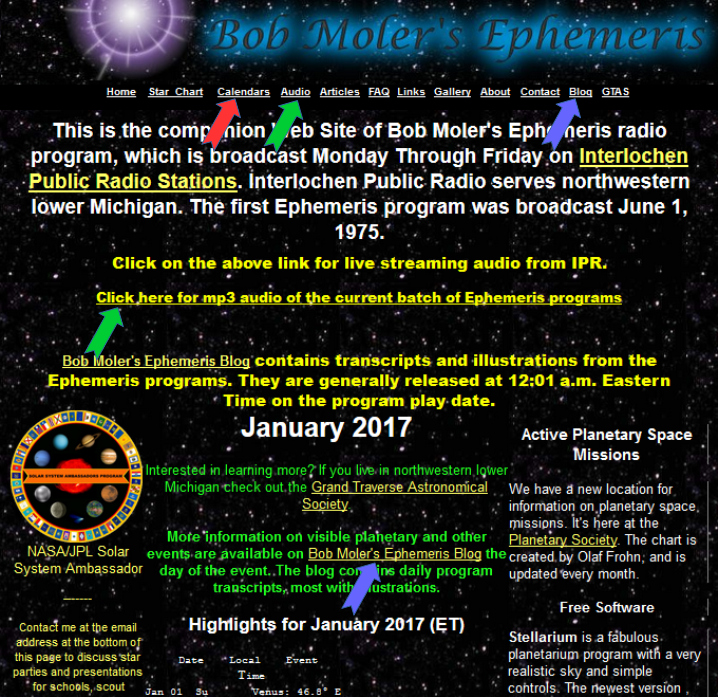
Bob Moler’s Ephemeris main web page. http://ephemeris.bjmoler.org.
The red arrow points to the calendars for some locations, The green arrows point to program mp3s for the current week. The blue arrows point to links to this blog.
Calendars currently available:
Cadillac
Interlochen/Traverse City (Source for the times on the Ephemeris program)
Ludington
Mackinaw City
Petoskey
Eagle Harbor – Keweenaw Peninsula
Houghton Lake
Earth’s Equator at the Prime Meridian (Just for fun. See how the daylight hours stay pretty much at 12 hours)
12/31/2016 – Ephemeris year end
No radio program today, being the weekend, so at the end of the calendar page below are the stats for today, the 31st. This is the form of the calendar that I have on my Ephemeris website, which I update monthly. It was created with the same data that the first portion of my program is generated from. I have yearly calendars for 6 communities in the Interlochen Public Radio area in northwestern lower Michigan, and 1 in the U.P. (That’s the Upper Peninsula, if you’re not from around here.)
You will have to hold off your New Years festivities for a bit tonight. Not long, just one second. Today, December 31st, 2016 will be 24 hours and 1 second long. This “leap second” will be added as the 61st second of the minute 6:59 p.m. EST (23:59 UT). The reason is that the Earth’s rotation is slowing down ever so slightly, compared to the atomic clocks at the Bureau of Time. There is some discussion of eliminating this leap second. Most scientists want to use a constant time stream, and don’t give a hang about the rotation of the Earth. The positions of the Earth, Moon and the other planets would be incorrect if we used time strictly based on the Earth’s rotation. Atomic time which is also affected by special and general relativity is used by GPS navigation satellites. A one second jump in time, at our latitude (45° north) is equivalent of the earth’s rotation of about two tenths of a mile. I hope everyone’s coordinated on this.
Ephemeris of Sky Events for Interlochen/TC |
||||||||||
| December, 2016 – Local time zone: EST | ||||||||||
|---|---|---|---|---|---|---|---|---|---|---|
| Date | Sun | Twilight* | Moon | Illum | ||||||
| Rise | Set | Hours | End | Start | Phase | R/S** | Time | Fractn | ||
| Thu | 1 | 08:00a | 05:03p | 09:03 | 06:48p | 06:15a | Set | 07:10p | 6% | |
| Fri | 2 | 08:01a | 05:03p | 09:01 | 06:47p | 06:16a | Set | 08:02p | 11% | |
| Sat | 3 | 08:02a | 05:02p | 09:00 | 06:47p | 06:17a | Set | 08:59p | 18% | |
| Sun | 4 | 08:03a | 05:02p | 08:58 | 06:47p | 06:18a | Set | 09:59p | 26% | |
| Mon | 5 | 08:04a | 05:02p | 08:57 | 06:47p | 06:19a | Set | 11:02p | 36% | |
| Tue | 6 | 08:05a | 05:02p | 08:56 | 06:47p | 06:20a | Set | 12:08a | 46% | |
| Wed | 7 | 08:06a | 05:02p | 08:55 | 06:47p | 06:21a | F Qtr | Set | 01:16a | 57% |
| Thu | 8 | 08:07a | 05:02p | 08:54 | 06:47p | 06:22a | Set | 02:26a | 68% | |
| Fri | 9 | 08:08a | 05:02p | 08:53 | 06:47p | 06:22a | Set | 03:39a | 78% | |
| Sat | 10 | 08:09a | 05:02p | 08:52 | 06:47p | 06:23a | Set | 04:53a | 87% | |
| Sun | 11 | 08:10a | 05:02p | 08:51 | 06:48p | 06:24a | Set | 06:08a | 94% | |
| Mon | 12 | 08:11a | 05:02p | 08:51 | 06:48p | 06:25a | Set | 07:21a | 98% | |
| Tue | 13 | 08:12a | 05:02p | 08:50 | 06:48p | 06:26a | Full | Rise | 05:18p | 100% |
| Wed | 14 | 08:12a | 05:02p | 08:49 | 06:48p | 06:26a | Rise | 06:17p | 98% | |
| Thu | 15 | 08:13a | 05:02p | 08:49 | 06:49p | 06:27a | Rise | 07:21p | 94% | |
| Fri | 16 | 08:14a | 05:03p | 08:48 | 06:49p | 06:28a | Rise | 08:28p | 88% | |
| Sat | 17 | 08:14a | 05:03p | 08:48 | 06:49p | 06:28a | Rise | 09:35p | 80% | |
| Sun | 18 | 08:15a | 05:03p | 08:48 | 06:50p | 06:29a | Rise | 10:41p | 70% | |
| Mon | 19 | 08:16a | 05:04p | 08:48 | 06:50p | 06:29a | Rise | 11:44p | 61% | |
| Tue | 20 | 08:16a | 05:04p | 08:48 | 06:51p | 06:30a | L Qtr | Rise | 12:46a | 51% |
| Wed | 21 | 08:17a | 05:05p | 08:48 | 06:51p | 06:30a | Rise | 01:46a | 41% | |
| Thu | 22 | 08:17a | 05:05p | 08:48 | 06:52p | 06:31a | Rise | 02:45a | 32% | |
| Fri | 23 | 08:18a | 05:06p | 08:48 | 06:52p | 06:31a | Rise | 03:43a | 24% | |
| Sat | 24 | 08:18a | 05:07p | 08:48 | 06:53p | 06:32a | Rise | 04:40a | 16% | |
| Sun | 25 | 08:18a | 05:07p | 08:48 | 06:53p | 06:32a | Rise | 05:37a | 10% | |
| Mon | 26 | 08:19a | 05:08p | 08:49 | 06:54p | 06:32a | Rise | 06:33a | 5% | |
| Tue | 27 | 08:19a | 05:09p | 08:49 | 06:55p | 06:33a | Rise | 07:26a | 2% | |
| Wed | 28 | 08:19a | 05:09p | 08:50 | 06:55p | 06:33a | Rise | 08:16a | 0% | |
| Thu | 29 | 08:19a | 05:10p | 08:50 | 06:56p | 06:33a | New | Set | 05:57p | 1% |
| Fri | 30 | 08:19a | 05:11p | 08:51 | 06:57p | 06:34a | Set | 06:53p | 3% | |
| Sat | 31 | 08:20a | 05:12p | 08:52 | 06:58p | 06:34a | Set | 07:52p | 7% | |
| * Astronomical Twilight | ||||||||||
| ** Moonrise or moonset, whichever occurs between sunset and sunrise | ||||||||||
The far right column of the table, the Moon’s illuminated fraction, may or may not appear in the calendar above depending on you browser or screen size. It is correct on the Ephemeris website.
05/31/2016 – Ephemeris – Previewing June’s bright skies
Ephemeris for Tuesday, May 31st. Today the Sun will be up for 15 hours and 20 minutes, setting at 9:20, and it will rise tomorrow at 6:00. The Moon, 2 days past last quarter, will rise at 3:55 tomorrow morning.
Tomorrow will be the first of June, so let’s preview June skies. There will be a lot of sunlight in June. The daylight hours will increase a bit from 15 hours and 21 minutes tomorrow to 15 hours and 34 minutes on the 20th, the solstice, retreating back to 15 hours 31 minutes at month’s end. At this time of the year the sunset times for Ludington, Interlochen, Petoskey and Mackinaw City are very nearly the same.* However the sunrise times are at their most divergent. With Ludington’s sunrise being 14 minutes later than Mackinaw City’s. The altitude of the sun above the southern horizon at local noon will increase from about 67 and a half degrees to 68 and three-quarters on the 20th. Local noon, when the sun is actually due south will occur at about 1:43 p.m.
Times are for the Traverse City/Interlochen area of Michigan. They may be different for your location.
* See http://ephemeris.bjmoler.org/calendar.htm
Addendum
June Star Chart
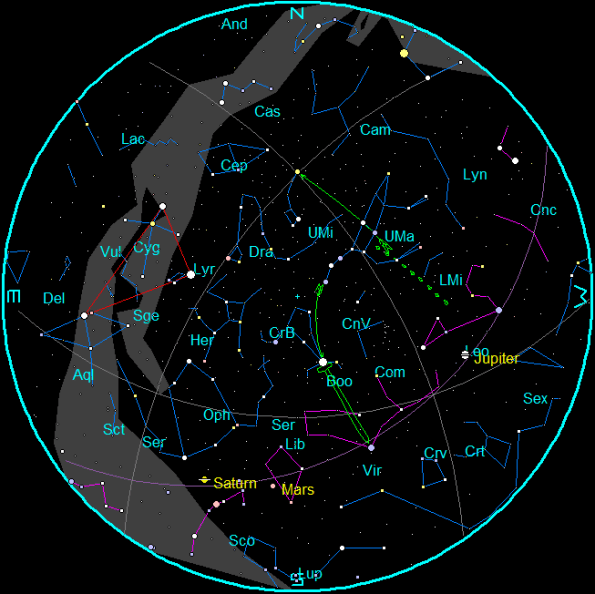
Star Chart for June 2016. Created using my LookingUp program. To enlarge in Firefox Right-click on image then click View image.
The planets and stars are plotted for the 15th at 11 p.m. EDT. That is chart time. Note, Traverse City is located approximately 45 minutes behind our time meridian. (An hour 45 minutes behind our daylight saving time meridian.) To duplicate the star positions on a planisphere you may have to set it to 1:45 earlier than the current time if you are near your time meridian.
Evening nautical twilight ends at 10:45 p.m. EDT on the 1st, increasing to 10:57 p.m. EDT on the 30th.
Morning nautical twilight starts at 4:36 a.m. EDT on the 1st, and decreasing to 4:35 a.m. EDT on the 30th.
Add a half hour to the chart time every week before the 15th and subtract a half hour for every week after the 15th. Before the 13th also subtract an hour for Standard Time.
For a list of constellation names to go with the abbreviations click here.
- Pointer stars at the front of the bowl of the Big Dipper point to Polaris the North Star
- A leaky Big Dipper drips on Leo
- Follow the arc of the handle of the Big Dipper to the star Arcturus
- Extend the arc to a spike to point to Spica.
- The Summer Triangle is outlined in red. Vega in Lyra (Lyr), Deneb in Cygnus (Cyg) and Altair in Aquila (Aql).
Calendar of Planetary Events
Credit: Sky Events Calendar by Fred Espenak and Sumit Dutta (NASA’s GSFC)
To generate your own calendar go to http://eclipse.gsfc.nasa.gov/SKYCAL/SKYCAL.html
Times are Eastern Time. Some additions made to aid clarity.
    Date    Time      Event
Jun 01  We            Venus: 1.5° W
    03  Fr  1:43 a.m. Saturn Opposition
    03  Fr  5:47 a.m. Moon-Mercury: 0.7° N
    03  Fr  6:55 a.m. Moon Perigee: 361100 km
    04  Sa 11:00 p.m. New Moon
    05  Su  4:59 a.m. Mercury Greatest Elongation: 24.2° W
    06  Mo  5:13 a.m. Moon North Dec.: 18.6° N
    06  Mo  5:34 p.m. Venus Superior Conjunction with the Sun.
    10  Fr 10:47 a.m. Moon-Regulus: 2.2° N
    11  Sa  3:35 p.m. Moon-Jupiter: 1.6° N
    11  Sa  6:20 p.m. Moon Ascending Node
    12  Su  4:10 a.m. First Quarter
    13  Mo  6:06 a.m. Mercury-Pleiades: 6.8° S
    15  We  8:00 a.m. Moon Apogee: 405000 km
    18  Sa  8:40 p.m. Moon-Saturn: 3.6° S
    18  Sa 11:39 p.m. Mercury-Aldebaran: 3.8° N
    20  Mo  7:02 p.m. Full Moon
    20  Mo  2:52 p.m. Moon South Dec.: 18.6° S
    20  Mo  6:35 p.m. Summer Solstice
    26  Su  1:28 a.m. Moon Descending Node
    27  Mo  2:19 p.m. Last Quarter
Jul 01                Venus: 6.8° E
03/25/2016 – Ephemeris – Easter, the reason for our calendar
Ephemeris for Good Friday, Friday, March 25th. The Sun will rise at 7:35. It’ll be up for 12 hours and 26 minutes, setting at 8:02. The Moon, 2 days past full, will rise at 10:17 this evening.
The so-called movable feasts of the church calendar are based on the date Easter falls on. They span from Ash Wednesday to Pentecost. And Easter is determined by astronomical events. In 1582 the fact that the actual vernal equinox had fallen 10 days behind the Julian calendar then in use which was decreed by Julius Caesar in 45 BC. Pope Gregory XIII in the 1580’s resolved to fix the situation and commissioned some astronomers to work on the problem. The solution was to fix the 10 day problem by eliminating the days October 5th through 14th of the October 1582 calendar and modifying the leap year rule to keep February 29th in calendars whose years were evenly divisible by 4, except those century years not also divisible by 400. Thus the year 2000 was a leap year, but 1900 and 2100 was and will not be.
Times are for the Traverse City/Interlochen area of Michigan. They may be different for your location.
Addendum
The Gregorian Calendar in essence decoupled Easter from Passover by keeping the formula first Sunday after the first full moon after March 21st, as a marker for the vernal equinox, and keeping March 21st on or near the vernal equinox. Passover this year starts sunset on April 22nd, while Orthodox Easter will occur on May 1st. The reason is the relationship between the Jewish lunar calendar and the Julian Calendar I mentioned in yesterday’s post. The difference between the Julian and Gregorian Calendars is now 13 days.
The error in the Gregorian calendar is at most 1 day in 3,300 years, in relation to the seasonal year. But the Gregorian Calendar makes calculating the date of Easter more complicated. It introduces something called Epact to the list of chronological cycles in an almanac. The quantity called Epact is the age of the moon on January 1st, and still has a relationship with the Metonic Cycle and the Golden Number which I discussed yesterday. This year the value is 21.
As I’ve admitted before, the first paragraph of these posts are generated by a computer program. Part of that program is a list of holidays, and those designated as movable feasts use the date of Easter as a starting point. I use the 10 step method from Astronomical Algorithms by Jean Meeus. Easter for the Julian Calendar is a simpler 6 step method.
 Bob Moler's Ephemeris Blog