Archive
07/16/2020 – Ephemeris – Comet NEOWISE’ orbit and path in our skies
This is Ephemeris for Thursday, July 16th. Today the Sun will be up for 15 hours and 11 minutes, setting at 9:24, and it will rise tomorrow at 6:13. The Moon, half way from last quarter to new, will rise at 3:20 tomorrow morning.
Comet NEOWISE is now visible in the northwest at about 11:00 pm. It doesn’t fare too well in twilight. The tail will be near vertical but tilted a bit to the right. The comet’s orbit is tilted about 40 degrees to the Earth’s orbital plane and it is traveling opposite the traffic flow of the planets and asteroids of the solar system. It came from the south and is reaching its northern most position before heading back to the south. It is actually circumpolar now, meaning it is far enough north in our sky so it doesn’t set for those of us in the Grand Traverse region for another 6 days. Its low point will be just scraping the northern horizon. It is still visible in the morning in the northeast, but the evening time is now the best time to view it.
The event times given are for the Traverse City/Interlochen area of Michigan. They may be different for your location.
Addendum
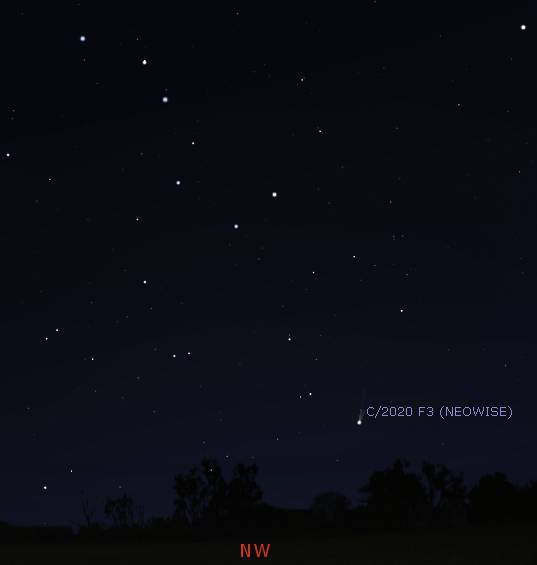
Comet 2020 F3 NEOWISE at 11 pm July 16, 2020, approximately an hour and a half after sunset. Created using Stellarium.
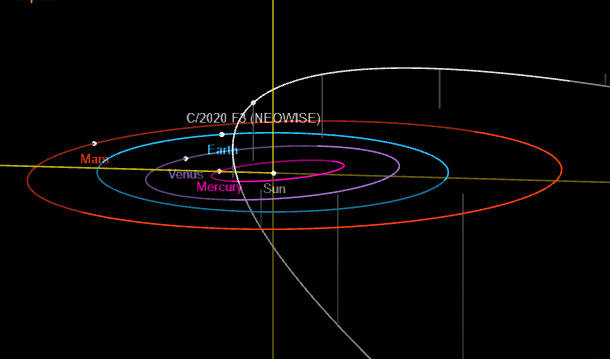
C/2020 F3 (NEOWISE) orbit. Comet position at July 16 at 8 pm EDT: Earth distance 0.765 au, Sun distance 0.479 au. Credit JPL Small-Body Browser
07/14/2020 – Ephemeris – Comet NEOWISE is now visible in the evening sky
This is Ephemeris for Tuesday, July 14th. Today the Sun will be up for 15 hours and 14 minutes, setting at 9:25, and it will rise tomorrow at 6:11. The Moon, 2 days past last quarter, will rise at 2:19 tomorrow morning.
Comet C/2020 F3 also known as NEOWISE a NASA acronym was discovered in late March by the Wide-Field Infrared Survey Explorer or WISE spacecraft on its add-on mission. It was looking for Near Earth Objects or NEOs, hence the name NEOWISE. The comet passed its closest to the Sun on July 3rd and is now outbound on its nearly 7,000 year orbit. It’s now visible in the evening sky seen generally below the Big Dipper in the northwestern sky but much closer to the horizon as soon as it gets sufficiently dark. Binoculars will help you locate the comet which should be of naked-eye brightness for the rest of the month, though it will be fading all the way, though it now appears brighter than predicted. Also photographs make the comet appear brighter than it is to the eye.
The event times given are for the Traverse City/Interlochen area of Michigan. They may be different for your location.
Addendum

My photograph of Comet NEOWISE at 4:40 am Sunday morning July 12, 2020 over the west arm of Grand Traverse Bay south of the Discovery Pier off M22. (For non-Michigander astronomers M22 is not the globular star cluster in Sagittarius, but a very scenic Michigan state road.) Click on the image to enlarge.
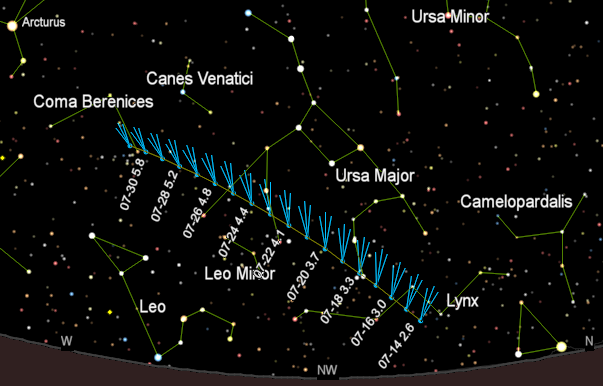
Comet NEOWISE in the evening for July 14, 2020 to July 31, 2020. The horizon is for July 14th at 11 p.m. Click on the image to enlarge. Created using Cartes du Ciel (Sky Chart).
07/07/2020 – Ephemeris – New Comet NEOWISE (C/2020 F3) is visible in the morning
This is Ephemeris for Tuesday, July 7th. Today the Sun will be up for 15 hours and 24 minutes, setting at 9:29, and it will rise tomorrow at 6:06. The Moon, 2 days past full, will rise at 11:37 this evening.
Comet C/2020 F3 (NEOWISE) is visible in the morning now, and quite bright. At 5 am in twilight it will be very low in the northeast tomorrow morning, below the bright star Capella. I’ve seen a photograph of it showing a tail. Over the next week it will be moving northward along the horizon at 5 am and fading as it goes. Then it will become visible in the evening sky next week. It is best seen in binoculars, though it can be spotted with the naked eye. One needs a low northeastern horizon. That’s the problem with comets: they’re brightest when close to the Sun, and can be seen best only when the Sun isn’t up. So that leaves morning or evening twilight, unless they are a huge comet like Hale-Bopp of 23 years ago that doesn’t get close to the Sun.
The event times given are for the Traverse City/Interlochen area of Michigan. They may be different for your location.
Addendum
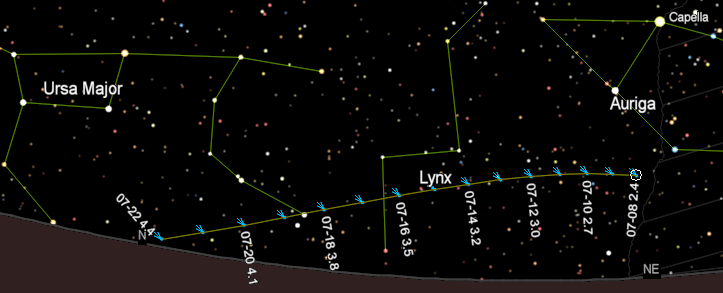
Comet NEOWISE starting at 5 am February 8, 2020. Every second date has month-day and predicted magnitude. The sky will be a bit higher each morning. Created using Cartes du Ciel (Sky Charts)
05/25/2020 – Ephemeris – Comet SWAN is in our skies in evening twilight
When I recorded this program on the evening of the17th there was hope that Comet SWAN would have achieved naked-eye visibility. It did earlier this month when it was too far south for us to see from 45° North latitude. Predictions now are for it to be 7th magnitude, 2.5 times dimmer than the faintest star visible to the unaided eye.
This is Ephemeris for Memorial Day, Monday, May 25th. Today the Sun will be up for 15 hours and 10 minutes, setting at 9:15, and it will rise tomorrow at 6:03. The Moon, 3 days past new, will set at 12:18 tomorrow morning.
Comet SWAN just might be visible in binoculars tonight by about 10:30 p.m. with binoculars or a small telescope low in the northwestern sky. A pointer to it is the bright star Capella also in that direction. Comet SWAN will be located in the direction of 4 o’clock (to the right and a bit down) by 10 degrees angle, the width of your fist held at arms length. It will be a small fuzzy spot. I doubt you would spot the comet’s tail. It is a thin ion or gaseous tail that is revealed in photographs only. Over the next week it will be moving toward Capella and on June 1st will be just below Capella but half as bright as it is now. There’s another comet coming. Comet NeoWISE will be visible in our skies by late July if it holds up.
The event times given are for the Traverse City/Interlochen area of Michigan. They may be different for your location.
Addenda
Comet SWAN
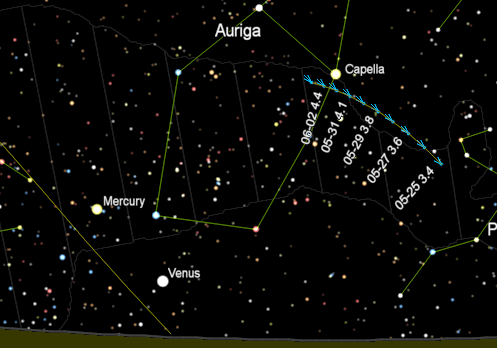
Comet SWAN track against the stars for 10 pm May 25 to June 3, 2020 with Mercury and Venus for the 25th They will be moving too. Comet labels show month-day and magnitude. However add 4 to the magnitude to get the approximate actual magnitude. The comet would be hard to spot in binoculars even in a dark sky. But who knows, the comet might flare up and be visible. Created using Cartes du Ciel (Sky Charts).
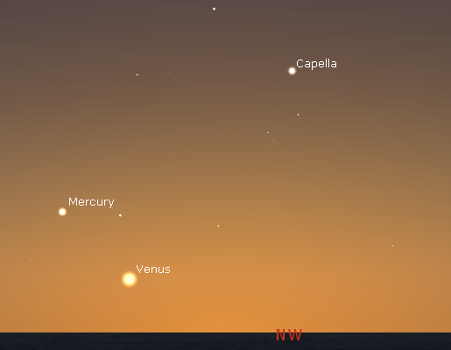
Northwestern horizon tonight at 10 pm May 25, 2020 with a scale that’s close to that of the image above. The comet is not bright enough to show here. Created using Stellarium.
In Memoriam
Today as we prepare to send humans into space from American soil for the first time in 9 years we pause to remember those who gave their lives for our country. For purposes of this program that includes those courageous enough to sit on top of or beside a million pounds of explosives to be launched into space. From the three astronauts who died in the Apollo one file in 1967, the explosion of the Space Shuttle Challenger in 1986, to the disintegration of the Columbia in 2003, 17 Americans and other nationals have died in NASA space accidents. The Russians too have lost cosmonauts in the exploration of space. Brothers and sisters in the quest for knowledge and to expand the horizons of human habitation. Per aspera, ad astra, Through difficulties to the stars!
A listing of Astronaut and Cosmonaut deaths: http://www.aerospaceweb.org/question/history/q0114.shtml
The Vatican Observatory Calendar
Being Catholic, I occasionally check the Vatican Observatory Foundation website. Besides the director of the Vatican Observatory is Brother Guy Consolmagno SJ, a fellow Michigander, born in Detroit. There were a couple of items on the May calendar that caught my eye.
Today, was marked as Memorial Day, but also Towel Day. Towel Day? It’s the 42nd anniversary of the first BBC Radio broadcast of Douglas Adams’ Hitchhiker’s Guide to the Galaxy. And if you don’t know the significance of a towel or the number 42, I won’t spoil it for you.
Also May 15th was the 300th birthday of Maximilian Hell SJ, first director of the Vienna Observatory, who also observed the transit of Venus in1769 from northern Norway. The crater on the Moon Hell is named for him. I’ve always had fun showing the crater a day or two after first quarter and mentioning that the crater Hell is named after a priest.
05/18/2020 – Ephemeris – Comets are fragile, especially this month’s crop
This is Ephemeris for Monday, May 18th. Today the Sun will be up for 14 hours and 57 minutes, setting at 9:08, and it will rise tomorrow at 6:09. The Moon, half way from last quarter to new, will rise at 5:04 tomorrow morning.
Last month most of us astronomers were looking forward to seeing at least two naked-eye comets this month, with another just below naked-eye visibility. Our hopes have been dashed with the first two, Comet ATLAS is disintegrating and Comet SWAN has stopped brightening, and at its brightest, which would be barely visible in a dark sky, would be invisible in bright twilight, where it will be located. Comets are unpredictable. Each is their own beast. They are small bodies of ices dust and bits of rock. When they come inside the orbit of Jupiter the Sun’s heat sublimates their frozen gasses which shoot out along with dust and build a huge tenuous head called a coma that can be larger than Jupiter and a tail that extends millions of miles (kilometers).
The event times given are for the Traverse City/Interlochen area of Michigan. They may be different for your location.
Addendum
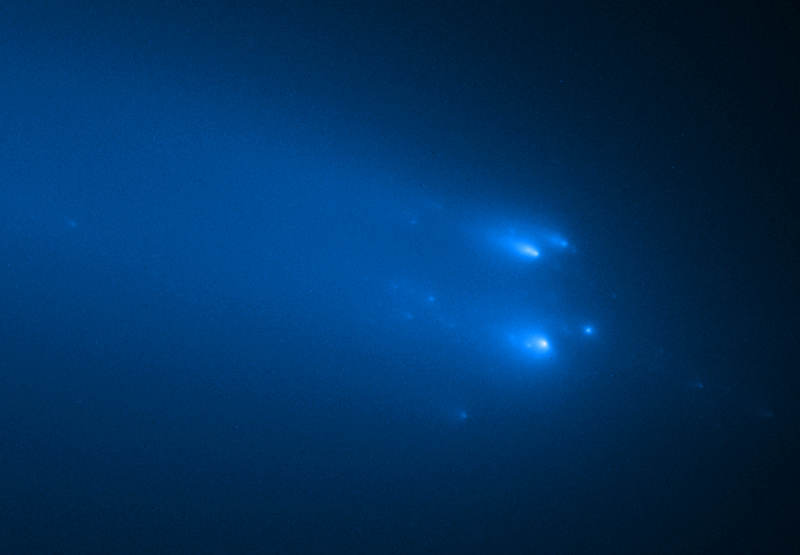
Comet ATLAS disintegrates as witnessed by the Hubble Space Telescope. Currently there are 5 nuclear fragments being separately tracked. The color here is most not likely the true visual color. Click on the image to enlarge. Credit: NASA/ESA Hubble Space Telescope.
04/23/2020 – Ephemeris – New Comet SWAN
This is Ephemeris for Thursday, April 23rd. Today the Sun will be up for 13 hours and 54 minutes, setting at 8:38, and it will rise tomorrow at 6:42. The Moon, 1 day past new, will set at 9:18 this evening.
Let’s get a preview of the newly discovered Comet SWAN. It was discovered using the Solar Wind Anisotropies or SWAN camera on the SOHO spacecraft hanging out a million miles (1.5 million km) sunward of the Earth. The SWAN instrument is the only one on the spacecraft not pointed at the Sun. Its to study where the solar wind interacts with the interstellar medium of hydrogen. The comet must have been producing an extraordinary amount of hydrogen to be noticed, so the comet may have had an outburst, and it may fade to its normally dim self after a while. That means it may not be naked-eye by the middle of next month. Assuming this was no outburst, the comet will make its naked-eye debut low in the northwest near the end of twilight in late May. I’ll have updates as we go.
The event times given are for the Traverse City/Interlochen area of Michigan. They may be different for your location.
Addendum
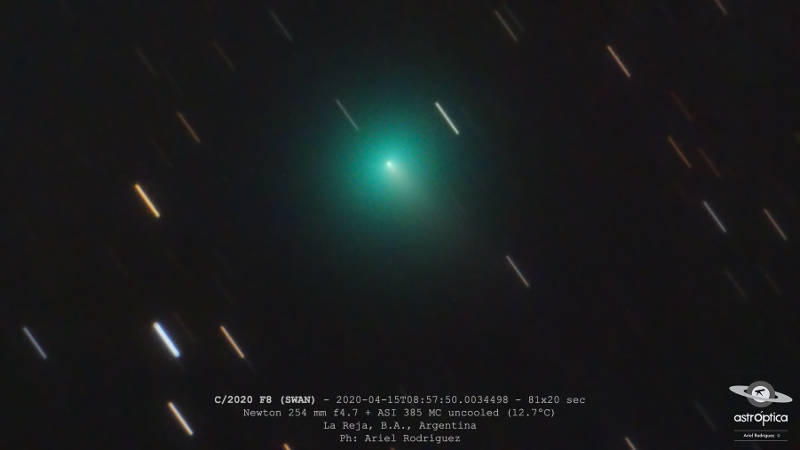
Comet C/2020 F8 (SWAN) photographed by Ariel Rodriguez, La Reja, Argentina. Click on the image to enlarge. Retrieved from Seiichi Yoshida’s web site. See link below.
04/17/2020 – Ephemeris – More on Comet ATLAS
One of the problems that can happen when you record programs several days before they are aired is that events can get ahead of you. Comet ATLAS is disintegrating and won’t get any brighter than it already is. This program was written after I read reports that the comet had faded but the full ramifications of the fading were not known.
This is Bob Moler with Ephemeris for Friday, April 17th. Today the Sun will be up for 13 hours and 36 minutes, setting at 8:31, and it will rise tomorrow at 6:52. The Moon, 3 days past last quarter, will rise at 5:32 tomorrow morning.
Lets talk more about Comet C/2019 Y4 (ATLAS). For this program I talk about celestial sights visible to the naked-eye or are easily found in binoculars. Each program script is posted on this blog usually with images and charts. The blog postings are generally illustrated. Anyway, it seems that Comet ATLAS is breaking up. With the Neil Sedaka’s 1960 song “Breakin up is hard to do” to the contrary, for comets breaking up is quite easy. They are porous assemblages of bits of dust, pebbles and frozen gasses. It is already most likely a chip off the old block.. er comet. It follows the same orbit as the Great Comet of 1844. Both of these could be parts of an even larger comet passing the Sun 6 or maybe even 12 thousand years ago.
The event times given are for the Traverse City/Interlochen area of Michigan. They may be different for your location.
Addendum
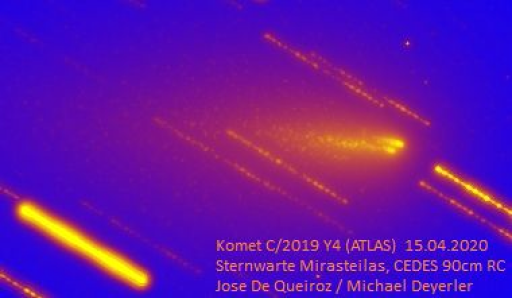
Comet ATLAS C/2019 Y4 showing two nuclei on April 15, 2020. Credit: Jose De Queiroz and Michael Deyerler from Switzerland’s public Mirasteilas Observatory. Copied from Spaceweather.com. The streaks are stars as the telescope was tracking the comet during the exposure.
An even newer discovered comet may make it to naked-eye visibility late next month, if it holds together. I’ll talk about Comet C/2020 F8 (SWAN) next Tuesday.
04/16/2020 – Ephemeris – Comet C/2019 Y4 (ATLAS)
One of the problems that can happen when you record programs several days before they are aired is that events can get ahead of you. Comet ATLAS is disintegrating and won’t get any brighter than it already is. This program was written and recorded before I realized that it was falling apart.
This is Bob Moler with Ephemeris for Thursday, April 16th. Today the Sun will be up for 13 hours and 33 minutes, setting at 8:29, and it will rise tomorrow at 6:54. The Moon, 2 days past last quarter, will rise at 5:05 tomorrow morning.
There’s a new comet about, which may reach naked-eye visibility next month. It is comet C/2019 Y4 (ATLAS). It was discovered three days after Christmas last year by the apocalyptic sounding Asteroid Terrestrial-Impact Last Alert System (ATLAS), run out of the University of Hawai’i. Despite the name of the search system the comet they snagged will not come close to the Earth, contrary to some misleading posts on social media. Comet ATLAS, yes it’s an acronym, could reach first magnitude when it’s close to the Sun at the end of May, but will be in the bright evening twilight by then. I don’t think that it can be picked up in binoculars yet. I’ll have more about it tomorrow.
The event times given are for the Traverse City/Interlochen area of Michigan. They may be different for your location.
Addendum
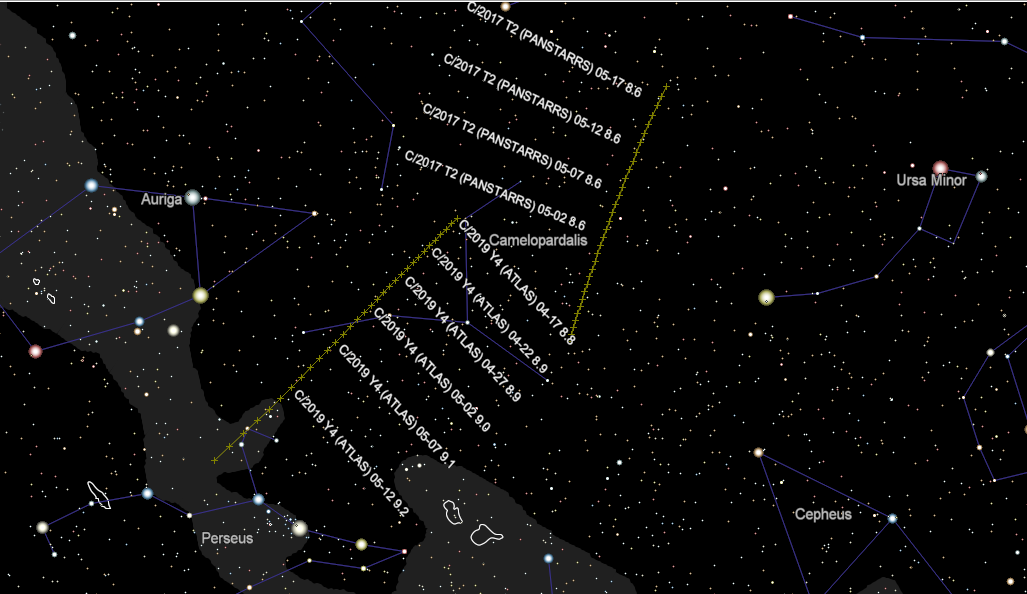
This image starts at 10 p.p. looking north-northwest. Also plotted was Comet PANSTARRS. I removed some of its labels that plotted over the ATLAS labels. The labels have the comet name, month-day and magnitude. Any magnitude value greater than 6.0 is invisible to the naked-eye. We were hoping that ATLAS would get a lot brighter. Click on the image to enlarge. Created using Cartes du Ciel (Sky Charts).
10/11/2019 – Ephemeris – Interstellar comet 2I/Borisov ejects the same gas like ordinary solar system comets
Ephemeris for Friday, October 11th. Today the Sun will be up for 11 hours and 12 minutes, setting at 7:05, and it will rise tomorrow at 7:54. The Moon, 2 days before full, will set at 6:24 tomorrow morning.
The interstellar comet 2I/Borisov, which was discovered August 30th by the Crimean amateur astronomer Gennady Borisov has given its first clues of its makeup. With data collected from the William Herschel Telescope in the Canary Islands the comet was discovered to give off cyanogen, a cyanide gas. This is just like what is given off by comets that belong to the solar system. As the comet comes closer to the Sun and warms up further more and different gasses will be liberated. It was the discovery of cyanogen in Halley’s Comet back in 1910 caused a panic because on that pass the comet’s tail swept past the Earth. However a comet’s tail is so tenuous that no cyanogen was detected in the Earth’s atmosphere.
The times given are for the Traverse City/Interlochen area of Michigan. They may be different for your location.
Addendum
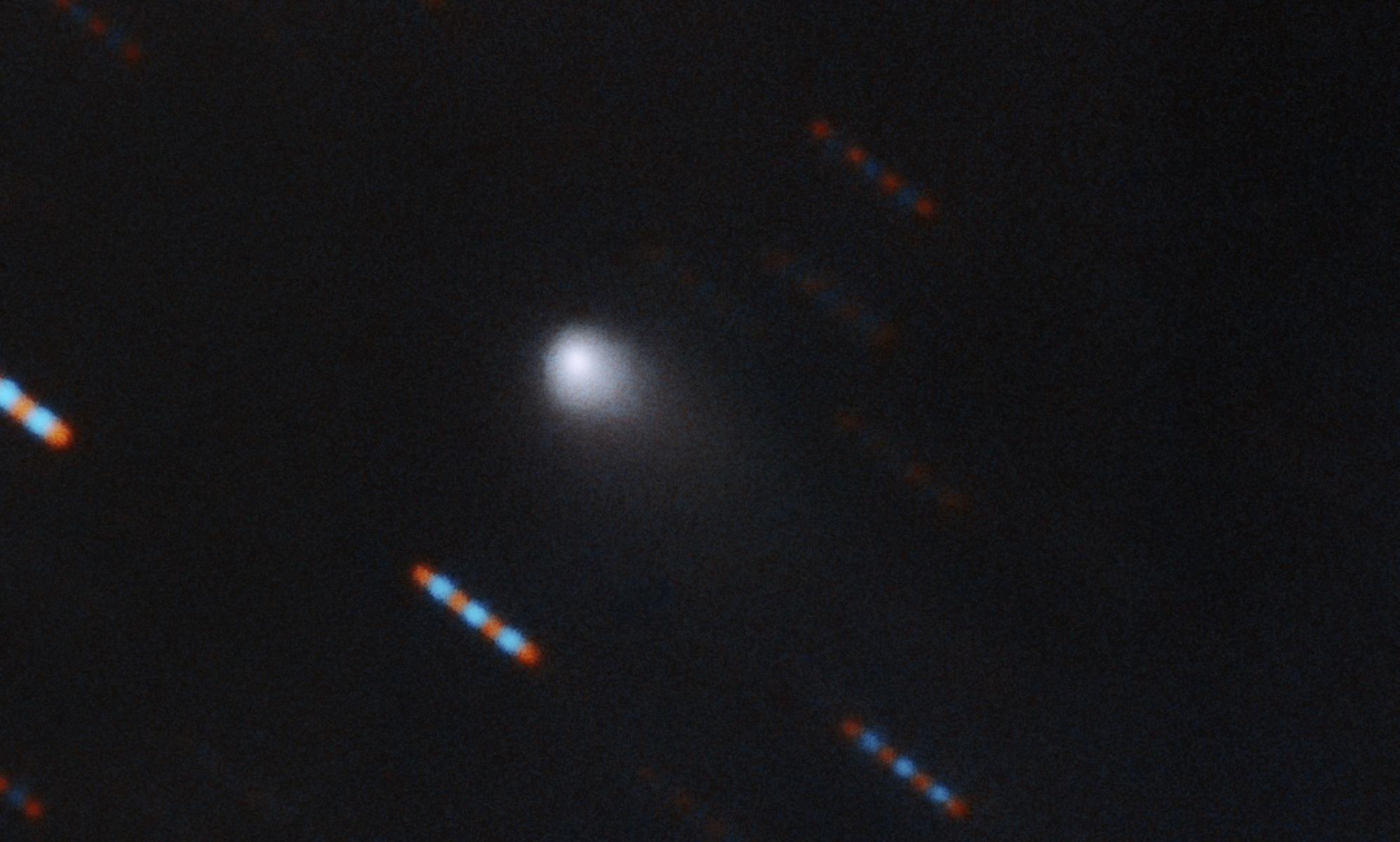
Color photograph of 2I/Borisov. Image Credit: Gemini Observatory/NSF/AURA
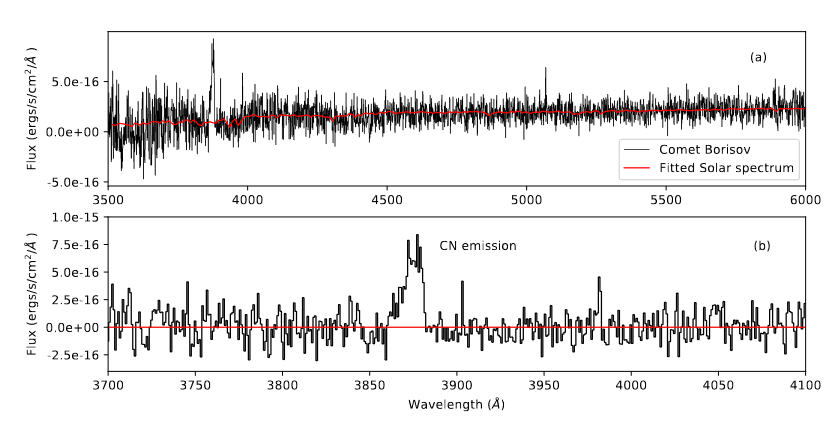
Spectrum of 2I/Borisov. Top covers part of the visible and ultraviolet spectrum. The bottom zooms in on the CN emission. Credit https://arxiv.org/abs/1909.12144
10/09/2019 – Received word that C2 has also been discovered. This is also normal and can color the coma green. (I recorded the program on 10/06 illustrated this post on 10/07 due to being away due to my daughter’s surgery.)
09/17/2019 – Ephemeris – It looks like another interstellar object has been found passing through the solar system
Ephemeris for Tuesday, September 17th. Today the Sun will be up for 12 hours and 26 minutes, setting at 7:50, and it will rise tomorrow at 7:24. The Moon, 3 days past full, will rise at 9:45 this evening.
Last week Monday I talked about a project to detect interstellar meteoroids that hit the Moon. It turns out we don’t have to wait that long. This past August 30th, Gennady Borisov of the Crimean Astrophysical Observatory discovered apparent comet since designated C/2019 Q4 (Borisov). It will approach the Sun just outside Mars orbit in December. It’s moving at over 25 miles per second (41 km/s) or nearly 92 thousand miles an hour (150,000 km/hr). In 2017 the first interstellar body discovered to enter our solar system was spotted, ‘Oumuamua. It was already past its closest to the Sun when found. This one is still approaching and visibly out gassing, so we’ll find out much more of its composition.
Addendum
Color photograph of C/2019 Q4. Image Credit: Gemini Observatory/NSF/AURA
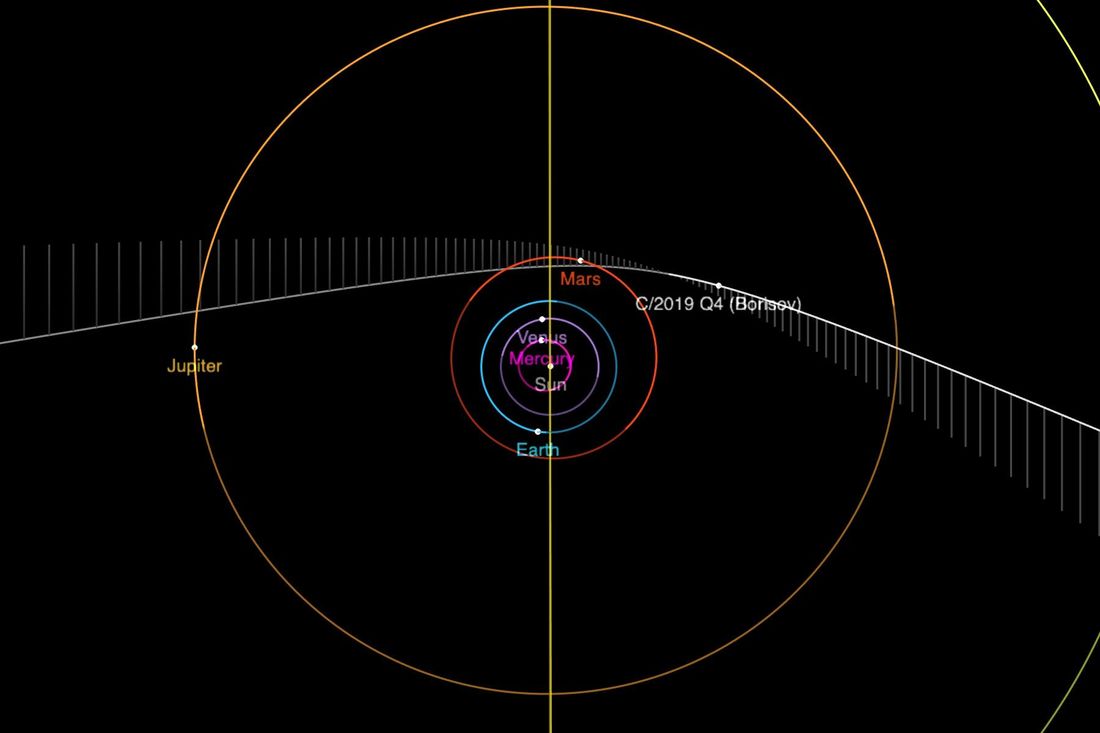
Orbit of C/2019 Q4 (Borisov). Credit: NASA/JPL-Caltech
Check out these links:
https://www.syfy.com/syfywire/wait-another-interstellar-object-is-passing-through-the-solar-system
 Bob Moler's Ephemeris Blog