Archive
Ephemeris: 10/27/2025 – Most of the mass in the universe is unseen
This is Ephemeris for Monday, October 27th. Today the Sun will be up for 10 hours and 23 minutes, setting at 6:38, and it will rise tomorrow at 8:15. The Moon, 2 days before first quarter, will set at 10:31 this evening.
There is much more matter in the universe than we can see with our telescopes. This began to be apparent back in the 1930s when Fritz Zwicky discovered that galaxies in clusters were moving too rapidly. They should be flying apart, but they were not. Later, Vera Rubin found that stars moved around the center of galaxies at pretty much uniform speeds. One would expect stars farther from the center of a galaxy to move slower. So there must be some matter out there creating gravity by its mass that was invisible. This became what we call dark matter. No one knows exactly what it is, though there have been several hypotheses put forth. It can be detected by its warping of space-time, due to its mass, to distort the shapes of the galaxies beyond it.
The astronomical event times given in this blog are for the Traverse City/Interlochen area of Michigan (Lat 44.7° N, Long 85.7° W; EDT, UT – 4 hours) unless stated otherwise. Times will be different for other locations.
Addendum
Ephemeris: 08/16/2024 – WIMPs and MACHOs
This is Ephemeris for Friday, August 16th. Today the Sun will be up for 13 hours and 58 minutes, setting at 8:46, and it will rise tomorrow at 6:48. The Moon, 3 days before full, will set at 3:34 tomorrow morning.
The dark matter that holds the clusters of galaxies together in the universe may be made of weakly interacting massive particles which astronomers have dubbed WIMPs. These particles would be more massive than the particles that ordinary matter is made of, but do not interact with ordinary matter or give off or absorb light. They are detected by the influence of their gravitational force alone. An alternative idea is Massive Compact Halo Objects or MACHOs. These may be made-up of ordinary matter. Since there are many more low mass stars, like red dwarfs, than there are high mass stars, perhaps there’s the creation of planet sized bodies like brown dwarfs. These are planets more massive than Jupiter, but not massive enough to become stars. As such, they should be practicably invisible.
The astronomical event times given are for the Traverse City/Interlochen area of Michigan (EDT, UT–4 hours). Times will be different for other locations.
Addendum
For more information on Dark Matter search for it on the internet. One Article I found is here: https://sciencenotes.org/what-is-dark-matter/. They dismiss MACHOs by not mentioning them at all, concentrating on the much more likely WIMPs.
08/27/2020 – Ephemeris – Unsolved mysteries: Dark Matter
This is Ephemeris for Thursday, August 27th. Today the Sun will be up for 13 hours and 27 minutes, setting at 8:27, and it will rise tomorrow at 7:01. The Moon, 2 days past first quarter, will set at 1:58 tomorrow morning.
It was in the 1930s that some astronomer concluded by measuring the velocities of individual galaxies that galaxy clusters contain more mass that can be explained by the size and brightness of the galaxies within. Fritz Zwicky coined the term dark matter for it after his study in 1933. Vera Rubin and others discovered the effect of dark matter on the rotation rates of galaxies in the 1960s and 70s. Nobody knows what dark matter is. There are two leading theories that they are made of particles coined WIMPs and objects called MACHOs that don’t interact with normal matter except gravitationally. Astronomers do have fun with their acronyms. Dark matter is detected by their gravity and how it distorts the light from the galaxies behind it.
The event times given are for the Traverse City/Interlochen area of Michigan. They may be different for your location.
Addendum
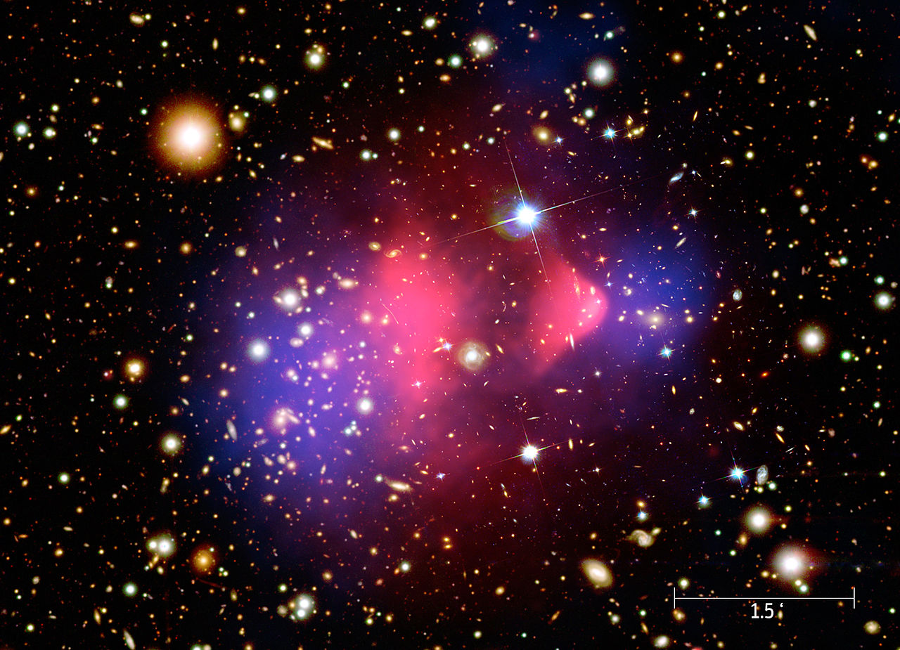
This is called the Bullet Cluster. It’s two galaxy clusters that collided. The pink is hot gas visible in x-rays. The blue is added to show where dark matter resides. It is detected by studying the far distant galaxies beyond for distortion caused by the gravitational lensing of the dark matter. Most of the mass of the galaxy clusters is dark matter, which also contain hot gas and, of course the galaxies. When galaxy clusters collide the gas of the two clusters interact and are stripped out and the dark matter and galaxies go merrily on. Image Credit: NASA, ESA, CXC, M. Bradac (University of California, Santa Barbara), and S. Allen (Stanford University)
FYI: WIMPs = Weakly Interacting Massive Particles, MACHOs = MAssive Compact Halo Objects.
03/26/2013 – Ephemeris – The universe is slightly older than we thought
Ephemeris for Tuesday, March 26th. The sun will rise at 7:34. It’ll be up for 12 hours and 28 minutes, setting at 8:02. The moon, 1 day before full, will set at 7:20 tomorrow morning.
Last week NASA and the European Space Agency announced the findings from the Planck satellite. Along with a sharper map of the Cosmic Microwave Background, created at the moment the Universe became transparent some 380,000 years after the Big Bang, Planck data revealed a slightly older universe of 13.82 billion years. This is with the error thought to be in the last measurement. So it’s a refinement. Also the universe appears to be expanding at a slightly lower rate that had been. Of the three main constituents of the universe, ordinary matter out of which you, me and the stars are made of is 4.9 percent, dark matter that holds galaxy clusters together is at 26 percent, while dark energy is at 68.3 percent, a decrease for it.
Times are for the Traverse City/Interlochen area of Michigan. They may be different for your location.
Addendum
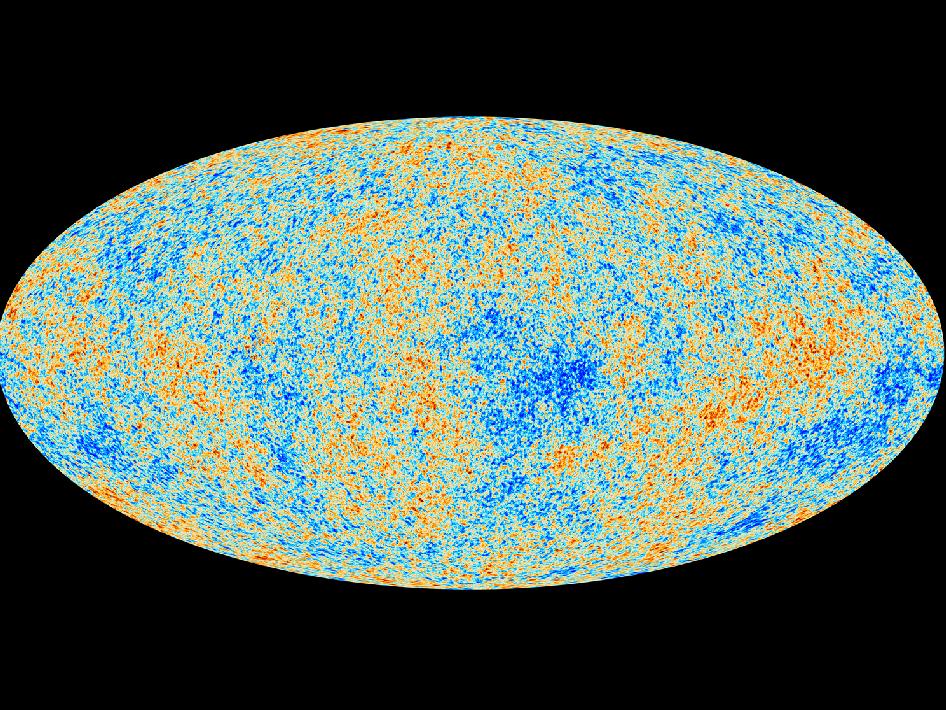
The Cosmic Microwave Background as determined by the Planck satellite. Image credit: ESA and the Planck Collaboration.
04/05/2012 – Ephemeris – Seeing Dark Matter
Ephemeris for Thursday, April 5th. The sun will rise at 7:15. It’ll be up for 13 hours exactly, setting at 8:15. The moon, 1 day before full, will set at 6:44 tomorrow morning.
Astronomers have come to the realization that what we see in the universe as normal matter is only four percent of the universe’s mass and energy. Dark matter makes up about 23 percent, while the totally mysterious dark energy makes up the rest. We do have some clues about what dark matter is. We still can’t see it. However we can detect its presence in distant galaxy clusters. Since whatever it is has mass, it can distort space-time, and the path of light that passes through it. We can detect it because it distorts the shapes of more distant galaxies we see through it. The amount and shape of the distortions point to the location and densest of the dark matter. Whatever this stuff is it has mass, and has and is affected by gravity, but apparently doesn’t interact with ordinary matter of itself for that matter.
* Times are for the Traverse City/Interlochen area of Michigan. They may be different for your location.
 Bob Moler's Ephemeris Blog