Archive
Ephemeris: 09/18/2025 – A fine example of different star colors
This is Bob Moler with Ephemeris for Thursday, September 18th. Today the Sun will be up for 12 hours and 21 minutes, setting at 7:47, and it will rise tomorrow at 7:26. The Moon, 3 days before new, will rise at 4:56 tomorrow morning.
Alberio is the name of the star that is in the head of the constellation of Cygnus the swan, which is almost overhead these evenings. It is also at the foot of the asterism or informal constellation of the Northern Cross. To the naked eye Alberio looks like a single star, however even in small telescopes its true nature is revealed. It’s a double star whose individual star colors are strikingly different Its brightest star is yellow, and the dimmer star is blue. While star colors are subtle, these two, due to their apparent closeness, make an obvious color contrast. Unlike what your interior decorator says: In stars, blue is hot, yellow, orange and red are cool. The two stars are too far apart to be considered a binary star system, but appear to move together in space. It is what is called an optical double, though they’re both around 430 light years away.
The astronomical event times given in this blog are for the Traverse City/Interlochen area of Michigan (Lat 44.7° N, Long 85.7° W; EDT, UT – 4 hours) unless stated otherwise. Times will be different for other locations.
Addendum


Ephemeris: 06/17/2025 – Finding the naked-eye double star Mizar and Alcor
This is Ephemeris for Tuesday, June 17th. Today the Sun will be up for 15 hours and 34 minutes, setting at 9:31, and it will rise tomorrow at 5:56. The Moon, 1 day before last quarter, will rise at 1:36 tomorrow morning.
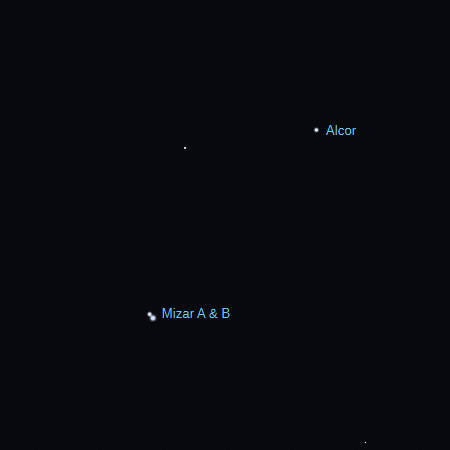
In tonight’s sky, the Big Dipper is high in the northwest hanging from its handle. In its handle is a star or two that are fascinating. It’s the star at the bend in the handle. It’s called Mizar. Next to it, for those with good eyesight, is a dimmer star, called Alcor. The name Mizar is from the Arabic, meaning apron or cover, while Alcor means the forgotten one. In ancient times the ability to actually see both stars was a test for good eyesight, especially for Arabic warriors. The pair is also known as the “Horse and the Rider”. Some Native American tribes saw the handle stars as hunters tracking the Great Bear, Ursa Major, of which the Big Dipper is a part, rather than its very unnatural tail. Dim Alcor became a hunting dog.
The astronomical event times given in this blog are for the Traverse City/Interlochen area of Michigan (Lat 44.7° N, Long 85.7° W; EDT, UT – 4 hours) unless stated otherwise. Times will be different for other locations.
Addendum


Ephemeris: 07/23/2024 – Albireo, a blue and gold double star
This is Bob Moler with Ephemeris for Tuesday, July 23rd. Today the Sun will be up for 14 hours and 58 minutes, setting at 9:18, and it will rise tomorrow at 6:20. The Moon, 2 days past full, will rise at 11:01 this evening.
Alberio is the name given to the star that is in the head of the constellation of Cygnus the swan, which is in the east these evenings, flying south along the Milky Way. It is also at the foot of the asterism or informal constellation of the Northern Cross. To the naked eye and binoculars Albireo looks like a single star. However, even in small telescopes its true nature is revealed. It’s a double star whose individual star colors are strikingly different Its brightest star is yellow, and the dimmer star is blue. While star colors are subtle, these two, due to their apparent closeness, make an obvious color contrast. Unlike what your interior decorator says: In stars, blue is hot, yellow, orange and red are cool. The two stars are too far apart to be considered a binary star system that are gravitationally bound, but appear to move together in space. It is what is called an optical double, though they’re both around 430 light years away.
The astronomical event times given are for the Traverse City/Interlochen area of Michigan (EDT, UT–4 hours). They may be different for your location.
Addendum


 Bob Moler's Ephemeris Blog