Archive
10/06/2014 – Ephemeris – Previewing Wednesday’s lunar eclipse
Ephemeris for Monday, October 6th. The sun will rise at 7:46. It’ll be up for 11 hours and 27 minutes, setting at 7:13. The moon, 2 days before full, will set at 6:42 tomorrow morning.
Wednesday’s Total Lunar Eclipse will be visible without losing too much sleep. Just set the alarm clock for about 5 a.m. The partial phase starts at 5:15 a.m. when the upper left edge of the moon enters the Earth’s inner shadow called the umbra. The total phase or totality starts at 6:25 with morning twilight just beginning. The middle of the eclipse will occur at 6:54. Totality will end at 7:24 when twilight will be bright. The ending partial phase will not be completely visible from northern Michigan. From the Dakotas and westward the entire ending partial phase will be visible. Amazingly, in the next eclipse season another lunar eclipse will be visible, though not as favorable as this one. That one is April 4th 2015 with a totality duration of only 5 minutes.
Times are for the Traverse City/Interlochen area of Michigan. They may be different for your location.
Addendum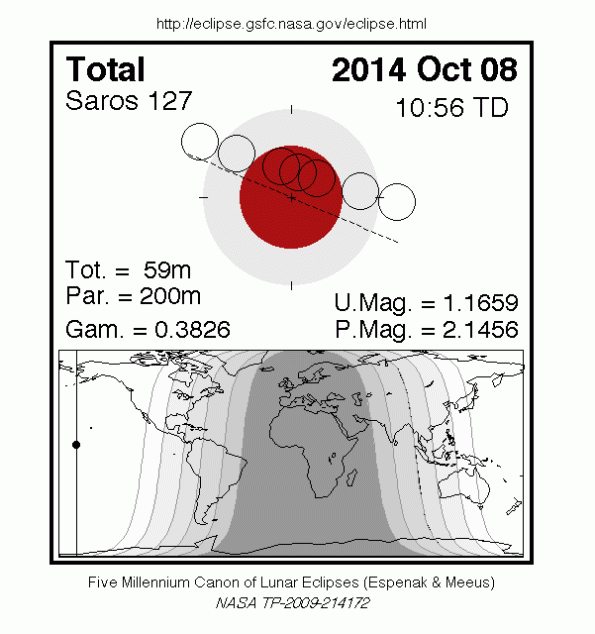 Click on the image above to display or download a more detailed Adobe Acrobat (PDF) image showing more information about the eclipse. The time shown will be Universal Time (UT). Subtract 4 hours for EDT, 5 hours for CDT, etc.
In the Grand Traverse area there are two locations the Grand Traverse Astronomical Society (GTAS) will be set up to view the eclipse if it is clear enough. Opens at 5 a.m.
- Northwestern Michigan College’s Joseph H. Rogers Observatory. located south of Traverse City on Birmley Road, between Garfield and Keystone roads. (One road south of Hammond)
- Sleeping Bear Dunes National Lakeshore at Platte River Point. It’s in several miles from the Platte River Campground off M22 on Lake Michigan Rd. Park in the big parking lot to the left. The GTAS will have their scopes in the small parking lot to the right.
10/03/2014 – Ephemeris – Sundials and Fall Astronomy Day on tap tomorrow at the NMC Observatory
Ephemeris for Friday, October 3rd. The sun will rise at 7:42. It’ll be up for 11 hours and 36 minutes, setting at 7:19. The moon, 2 days past first quarter, will set at 3:01 tomorrow morning.
Tomorrow is Fall Astronomy Day. To celebrate the Grand Traverse Astronomical Society will move its first Friday of the month meeting and star party to Saturday the 4th. At 8 p.m local landscape architect and sundial expert Dean Connors will talk about, of course, sundials and the myriad of forms they take. Starting at 9 p.m. the star party portion of the night will begin with the moon as the featured celestial object. Members of the society will also provide information on this month’s two eclipses and how to observe a solar eclipse safely. The meeting and star party will be held at Northwestern Michigan College’s Rogers Observatory located south of Traverse City on Birmley Road. Between Garfield and Keystone roads.
Times are for the Traverse City/Interlochen area of Michigan. They may be different for your location.
08/28/2014 – Ephemeris – The evening Moon will stay low in the sky for the next couple of weeks.
Ephemeris for Thursday, August 28th. The sun will rise at 7:00. It’ll be up for 13 hours and 25 minutes, setting at 8:26. The moon, 3 days past new, will set at 9:40 this evening.
Since we’re within a month of the autumnal equinox, coming up on September 22nd, something funny is happening with the Moon rise and set times near both new and full moon. That is they aren’t changing very much. Here we are with the Moon three days old, and it still sets before the end of astronomical twilight. You may notice that for the next two weeks, that the Moon doesn’t get very high in the sky in the early evening. It’s path stays close to the horizon. Around first quarter next Tuesday the Moon will get to be just a little higher in the sky than the sun does on the first day of winter. The next full moon is the Harvest Moon, being the full moon closest to the first day of autumn. Then the day-to-day succession of rise times again will slow.
Times are for the Traverse City/Interlochen area of Michigan. They may be different for your location.
Addendum
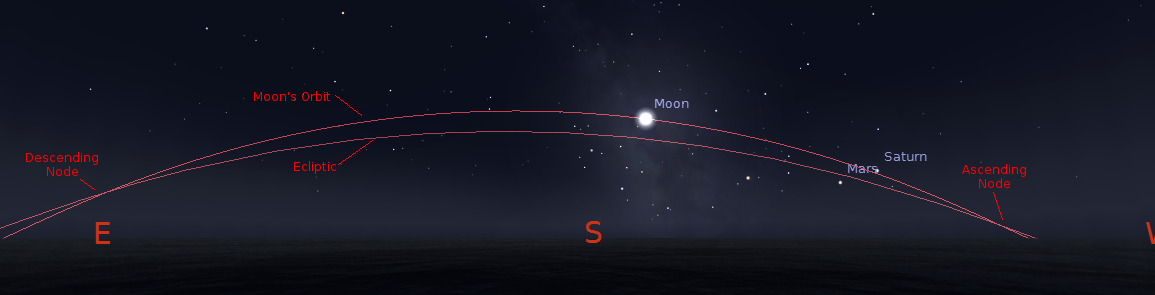
The Moon on September 3, 2014 a day after first quarter. It will rise higher after that if one stays up long enough. Created using Stellarium. Click on image to enlarge.
In the image above the Moon’s orbit is compared to the ecliptic, the plane of the Earth’s orbit to which it’s inclined by about 5º. Note the two points where these lines cross. The point where the Moon’s orbit crosses the ecliptic heading northward is called the ascending node. The crossing point heading southward is the descending node. The important thing about that is the when the moon passes a node while at new or full, an eclipse will occur, which they will do in October. There will be a total lunar eclipse on the morning of October 8th, then a partial solar eclipse on October 23rd as the sun is setting here in northern Michigan. I’ll have more information as the events gets closer.
04/29/2014 – Ephemeris – Today’s weird annular eclipse
Ephemeris for Tuesday, April 29th. The sun rises at 6:35. It’ll be up for 14 hours and 9 minutes, setting at 8:44. The moon is new today, and won’t be visible.
This event has already happened, and there was now way to be able to get to a spot too see its maximum effect. What I’m talking about was this morning’s weird annular eclipse of the sun. Australia saw the partial phase. An annular eclipse is one in which the moon is too far away to completely fill the face of the sun at maximum eclipse, leaving a bright ring of the uneclipsed sun around the moon. The path of annularity will just graze the earth over a spot in Antarctica. The center of this annular shadow called an antumbra, a new word I learned from descriptions of this eclipse, will just miss the earth. As far as I know no one had gone to the spot where the annular effect can be seen, so remote is its location. It kind of reminds one that the earth is a ball in space.
Times are for the Traverse City/Interlochen area of Michigan. They may be different for your location.
Addendum
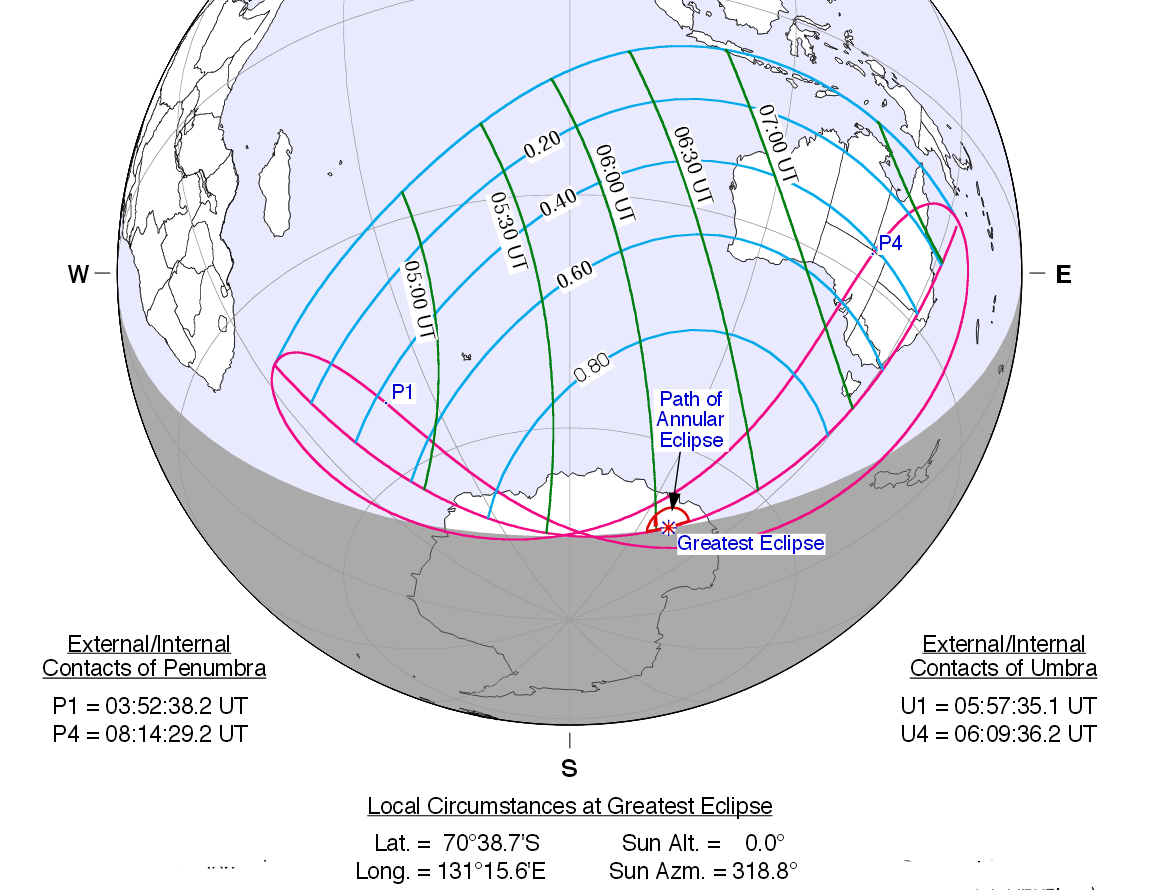
Area on the Earth where the eclipse can be seen. Credit: “Eclipses During 2014”, F. Espenak, Observer’s Handbook – 2014, Royal Astronomical Society of Canada, NASA eclipse website
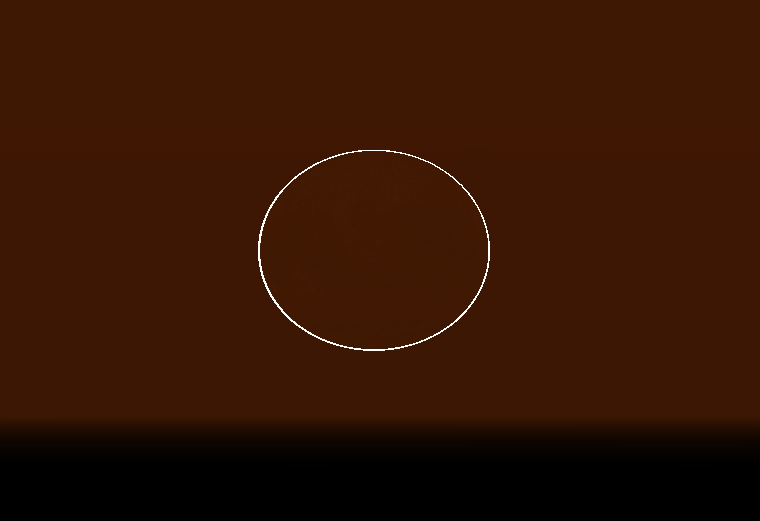
Annularity as simulated in Stellarium.
For more information on this eclipse check here: http://eclipse.gsfc.nasa.gov/OH/OH2014.html#SE2014Apr29A
04/15/2014 – Ephemeris – One eclipse down, what’s next?
Ephemeris for Tuesday, April 15th, Tax Deadline Day. The sun rises at 6:58. It’ll be up for 13 hours and 29 minutes, setting at 8:27. The moon, at full today, will rise at 9:08 this evening.
Since I’m recording this before this morning’s eclipse, I don’t know if it was visible from the northern Lower Peninsula. However we do have a shot at another total lunar eclipse this year. That one is on October 8th. Though it’s in the morning, it’s closer to dawn. One which one can catch by going to bed early and getting up early to enjoy. The weather prospects are somewhat better in October than they are in April. That eclipse we’ll miss a bit of the ending partial phase as the moon sets during that time. As a bonus, 15 days later we will see half of a partial solar eclipse, because the sun will set around mid eclipse. That eclipse will not be total anywhere as the core of the moon’s shadow misses to the north of the Earth.
Times are for the Traverse City/Interlochen area of Michigan. They may be different for your location.
Addendum
There’s another eclipse I didn’t mention due to time. It follows this one by 14 days, on April 29th. It is an odd partial eclipse visible from the Indian Ocean, Australia and a bit of Antarctica. It is an annular eclipse, where the moon is too far away to completely cover the bright ball of the sun. The annular shadow touches the earth in Antarctica, but not the central part, which just misses the earth. It’s truly an odd eclipse. Next year will provide us with two more lunar eclipses. The first one we’ll see a part of before the moon sets, and the second will be an evening eclipse well placed for viewing. None of next years solar eclipses will be visible from North America.
Check out this and next year’s eclipses on the NASA Eclipse website.
03/31/2014 – Ephemeris – Previewing April skies
Ephemeris for Monday, March 31st. The sun will rise at 7:25. It’ll be up for 12 hours and 43 minutes, setting at 8:08. The moon, 1 day past new, will set at 9:30 this evening.
The 4th month of the year begins tomorrow. Daylight hours in the Interlochen/Traverse City area and will increase from 12 hours and 46 minutes tomorrow to 14 hours 11 minutes on April 30th. The altitude, or angle, of the sun above the southern horizon at local noon will be 50 degrees tomorrow and will ascend to 60 degrees on April 30th. The altitude of the sun in the Straits area will be a degree lower. The actual time of local apparent noon this month for the Interlochen/Traverse City area, when the sun passes due south, will be about 1:43 p.m. The big event for this month will be a total lunar eclipse visible from our area in the wee hours of the morning on April 15th. It’s the first or two lunar eclipses visible from here this year. The other is in October.
Times are for the Traverse City/Interlochen area of Michigan. They may be different for your location.
Addendum
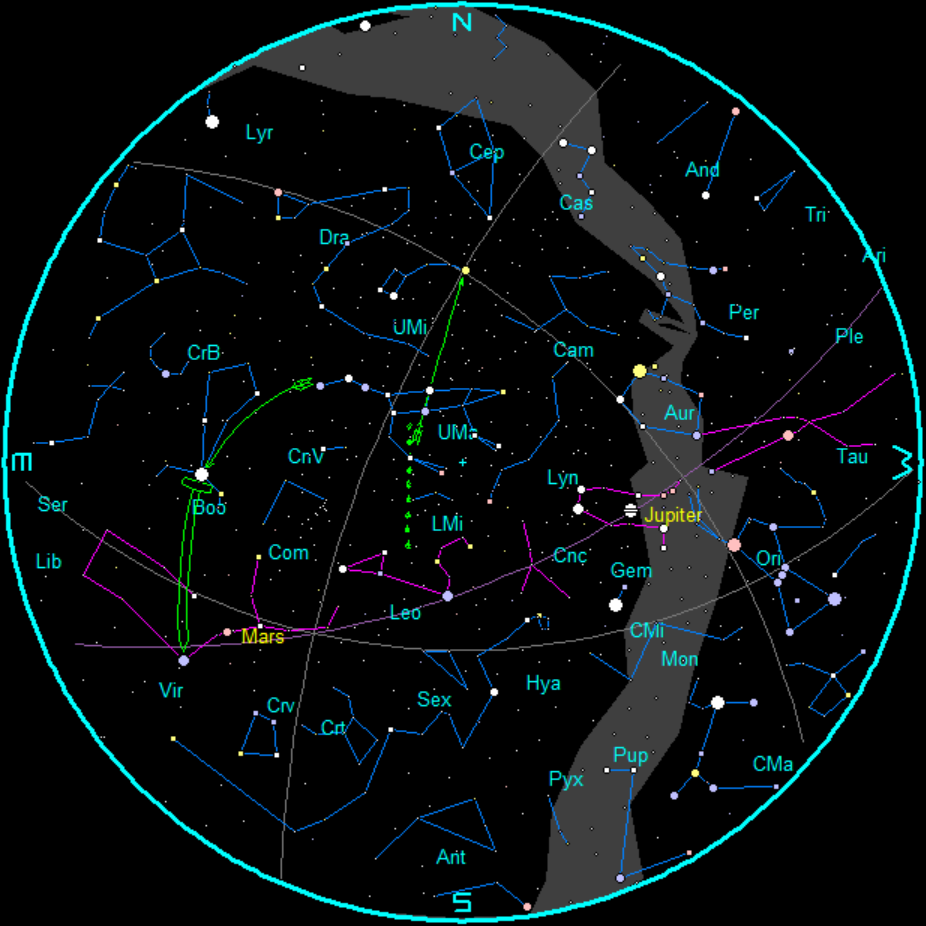
Star Chart for mid-month for April 2014 at 10 p.m. Credit: Bob Moler.
Add a half hour to every week before the 15th and subtract and hour for every week after the 15th.
For a list of constellation names to go with the abbreviations click here.
01/06/2014 – Ephemeris – It will be a year of eclipses for northern Michigan!
Ephemeris for Monday, January 6th. The sun will rise at 8:19. It’ll be up for 8 hours and 58 minutes, setting at 5:18. The moon, 1 day before first quarter, will set at 12:07 tomorrow morning.
The year 2014 will be a year of eclipses. World wide it will have the minimal number of eclipses possible, four. However, lucky us, we will see three of them if it’s clear, that is. The first is a total eclipse of the moon in the wee morning of Tax Day, April 15th. It will be the best of the three because we will see it from beginning to end. On October 8th we will have another lunar eclipse is the morning. This one will start closer to dawn, so the kids can see this one by getting up early. The total phase will be visible, but the moon will set as the moon is leaving the earth’s shadow. The last will be a partial solar eclipse on October 23rd. when the eclipse will be interrupted by sunset.
Times are for the Traverse City/Interlochen area of Michigan. They may be different for your location.
Addendum
My Article in January’s Stellar Sentinel, the newsletter of the Grand Traverse Astronomical Society.
After a drought in visible eclipses seen from our part of the planet last year and a single partial solar eclipse the year before, we have a chance, weather permitting, to view two total lunar eclipses and the first half of a partial solar eclipse this year. OK, we did have a penumbral lunar eclipse last year, but I usually don’t count penumbral eclipses, since the casual observer may look at the moon and not know they are occurring. They’re what I call a 5 o’clock shadow eclipse, where parts of the moon are illuminated by a partially blocked sun. There is no obvious dragon or Cookie Monster nibbling at the moon.
Eclipse Seasons
In 2014 the two eclipse seasons are in April and again in October. These are about six months apart centered around the moon’s ascending and descending nodes, where the plane of the Moon’s orbit crosses the Earth’s orbital plane when the new moon’s shadow can fall upon the earth and the earth’s shadow can fall on the full moon.
The line of nodes regresses westward or clockwise slowly in an 18.6 year period. That means that the eclipse seasons slowly move backward through the calendar. Every time the sun passes a node there are either two or rarely, three eclipses. Either one each of lunar and solar separated by two weeks from the other. Or, rarely, a central eclipse with 2 weeks before and two weeks later a very partial eclipse near the poles in the case of solar eclipses or penumbral eclipses in the case of lunar eclipses. 2014 is a year of two total lunar eclipses and two partial solar eclipses near the poles.
Saros
A means of predicting eclipses was developed by the Chaldeans in what is now Iraq some centuries before the common era (BC or BCE). The Greeks learned of it. Hipparchus and Ptolemy knew of it. Solar and lunar eclipses repeat every 18 years 11 1/3 days. This cycle was called the Saros by Sir Edmund Halley of Halley’s Comet fame, then Astronomer Royal in England.
The saros is the near coincidence of 3 lunar “months”: the Synodic Month, or lunation the period between new moons; the Draconic Month, the period between the moon’s passage of the ascending node of its orbit as explained above; and the Anomalistic Month, the period between passages of the moon through perigee, the closest point in its orbit to the earth.
The synodic month is on average 29.530589 days, and the basis for the Jewish and Islamic lunar calendars.
The draconic month is 27.212220 days long on average. The ascending node regresses westward, so meets the moon, traveling eastward than the synodic month, where it has to catch up with the eastward moving sun. Remember the dragon eating the sun image from above. The ancients thought a dragon lived at the nodes to devour the Sun or Moon in eclipses. The symbol for the ascending node: is called the Dragon’s Head. For the descending node the symbol is inverted and called the Dragon’s Tail. These symbols may be seen on orbital diagrams.
The anomalistic month is 27.554551 days. In celestial mechanics an anomaly doesn’t means anything is wrong, it’s the angle between, in the case of the moon, the perigee of its orbit and the position of the moon as seen from the earth. It has to do with the perigee and that’s why it’s used.
It turns out that:
223 Synodic Months = 6585.322 days
242 Draconic Months = 6585.8 days
239 Anomalistic months = 6585.5 days
Thus the Saros cycle is 6585.322 days long, or 18 years 11 1/3 days, meaning that the next eclipse of that Saros occurs a third of the earth in longitude west of the previous eclipse. It takes three saros cycles for an eclipse to repeat near the same longitude. For instance, my first total solar eclipse was viewed from Quebec on July 20, 1963. The third Saros of that eclipse will occur on August 21, 2017. I expect to be around to see that, my 5th total solar eclipse. The path will shift southward and be seen across the continental United States.
There are something like 40 Saros cycles active at one time. Eclipses at the descending node head southward each eclipse, while those at the ascending node move northward.
The Eclipses of 2014
Here are the dates of the eclipses:
Total Lunar Eclipse April 15, 2014
Total Lunar Eclipse October 8, 2014
Partial Solar Eclipse October 23, 2014
Interestingly, all these eclipses will occur in the western part of the sky for us in northern Michigan. Both October eclipses will end with the eclipsed body setting before the official end of the eclipse. This means that both lunar eclipses are early morning eclipses and the solar eclipse will be a late afternoon eclipse.
Lunar eclipses start and end with the moon traveling through the earth’s penumbral shadow. It’s been my experience that this shadow only becomes visible in the half hour before and after the partial phases of the eclipse. The partial phase of the Tuesday April 15th lunar eclipse will start at 1:58 a.m., totality starts at 3:06 and ends at 4:24; with the partial phase ending at 5:33 as twilight begins to brighten.
The Wednesday October 8th lunar eclipse will start later in the morning. The partial phase will start at 5:14 a.m. Totality will run from 6:25 to 7:24 a.m. all in the growing morning twilight. Sunrise and moonset will interrupt the eclipse by 7:57.
The partial solar eclipse is on Thursday October 23. The eclipse will begin around 5:33 p.m. for Traverse City with sunset at 6:44. Times and whether the eclipse is visible at all depend on the location of the observer.
NASA diagrams, maps, and more information on these eclipses can be found here.
Time change for us and an eclipse for others
Tomorrow, November 3rd in the US most states will get an extra hour by falling back to relive the 1 a.m. to 2 a.m. hour, when we reach 2 a.m. daylight time. We now spend most of our time in daylight “saving” savings time than in standard time. My locating in the western lower peninsula of Michigan are in the eastern time zone, whose time meridian runs through Philadelphia near the east coast. We are 43 minutes behind our time meridian in standard time. It’s even worse in the western part of the U.P. (Upper Peninsula). It’s bad enough up there so the western counties have defected to the central time zone. Daylight “Savings” Time or “Crazy time” as coined by one G. Michael Ross puts my location at one hour 43 minutes behind the time meridian, which at this moment is somewhere in the Atlantic Ocean.
Tomorrow morning also there will be a hybrid solar eclipse, one that starts and ends as an annular or ring eclipse and who’s central path becomes a total eclipse. Here’s the eclipse map and description from NASA.
05/09/2013 – Ephemeris – There’s an annular eclipse in the Pacific Ocean today
Ephemeris for Thursday, May 9th. The sun rises at 6:21. It’ll be up for 14 hours and 35 minutes, setting at 8:57. The moon is new today, and won’t be visible.
Solar eclipse in Pacific. Later this afternoon our time there will be an annular eclipse of the sun. However it will only be visible from parts of the Pacific Ocean including Australia. Since the shadow crosses the International Date Line and the moon’s shadow moves west to east, it start in Australia on the morning of the 10th, and end far southeast of Hawai’i on evening of the 9th. An annular eclipse is one in which the moon is farther than average from the earth and cannot cover the whole face of the moon for observers on the earth. He moon’s farthest distance from the earth this month is called apogee at 252,000 miles next Monday. The lunar eclipse paired with this is a very slight penumbral eclipse on the 25th, too slight to be noticeable.
Times are for the Traverse City/Interlochen area of Michigan. They may be different for your location.
Addendum
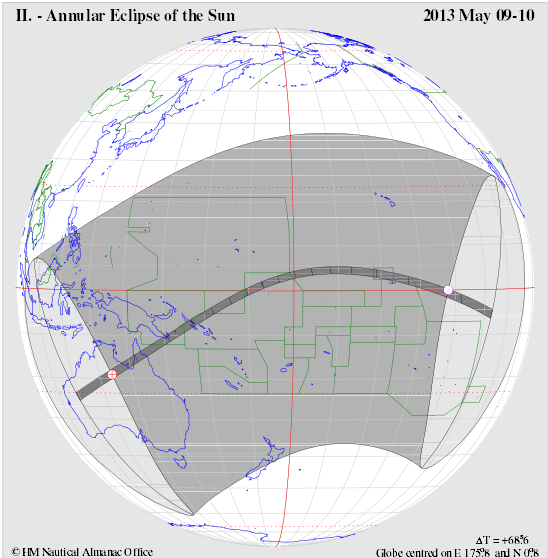
Annular eclipse path May 9-10, 2013.
From the Astronomical Almanac Online (USNO, HMNO).
The PDF version of the above image and eclipse times click here.
01/04/11 – Ephemeris – Solar eclipse for the Old World today
Tuesday, January 4th. The sun will rise at 8:19. It’ll be up for 8 hours and 56 minutes, setting at 5:15. The moon is new today, and won’t be visible.
There is a partial solar eclipse in progress for Europe, North Africa and as far a China. This is the companion to the lunar eclipse we had December 21st. Since the lunar eclipse was total, this solar eclipse is not centrally aligned. Eclipses occur in seasons with an interval of a bit less than 6 months[, making a complete eclipse year of 346 days]. Eclipses generally occur in pairs in each eclipse season, one lunar eclipse followed two weeks later by a solar eclipse or vice versa. On rare occasions three eclipse cam occur at two week intervals: A partial solar eclipse , a very central lunar eclipse and another partial solar eclipse. Such a triad will occur this year. A partial solar eclipse on June 1st., a total lunar eclipse June 15th and another partial solar eclipse July 1st. Non will be visible from here.
*Text in brackets was omitted due to time constraints
* Times are for the Traverse City/Interlochen area of Michigan. They may be different for your location.
Check out the NASA Eclipse web site for 2011.
 Bob Moler's Ephemeris Blog