Archive
09/07/2017 – Ephemeris Extra – The Earth is currently under a G4 Geomagnetic Storm – Aurora’s may be visible
Aurora Alert
At this time (0300 UT September 8, 2017) the Earth is experiencing a strong geomagnetic storm see Spaceweather.com.
Also check out the NOAA Space Weather Prediction Center. Check the Aurora Forecast.
Ephemeris Extra: My report of the total solar eclipse August 21, 2017
In planning for this eclipse my main goal was to keep away from crowds and traffic as much as possible. I originally wanted to stay in Springfield, IL, so I could go west or south. Earlier in the previous week I talked with the University of Missouri Extension service, and offered my services, so I felt kind of was obligated if the weather was half way decent. They were set up at the Howard County Fairgrounds in Fayette, MO. It turned out that we couldn’t get a room in Springfield, but could 60 miles north in Bloomington. One of the enticements to placate my granddaughter about the trip, was to visit some Lincoln sites in Springfield, which we did on Sunday the 20th. On Saturday and Sunday the 19th & 20th the weather forecast for Fayette looked bad with clouds and rain in the afternoon. So I made plans and checked routes in the direction of Paducah, KY.

Traffic heading south on I-55 by Springfield. Photo by Stephany Farrell.
I decided, after seeing the traffic heading down to south Illinois on I-55, that if the weather forecast improved for Fayette, MO I’d head there instead. By 11 p.m. the forecast for Fayette improved markedly. It was for partly cloudy skies, and the rain forecast for the afternoon was moved to Tuesday.
We headed out from our Bloomington, IL motel at 3 a.m. The sun came out just before we entered Missouri. The sky was mostly clear with cirrus and some stratus clouds, mostly in the south and west. There was no unusual traffic all the way there.
We were the first to arrive at 8 a.m. About a half hour later we were joined by folks in two cars from Ottumwa, IA. We all stuck pretty much together for the day, away from the building where most of the people, and entertainment was. All in all there were no more than a hundred people there.
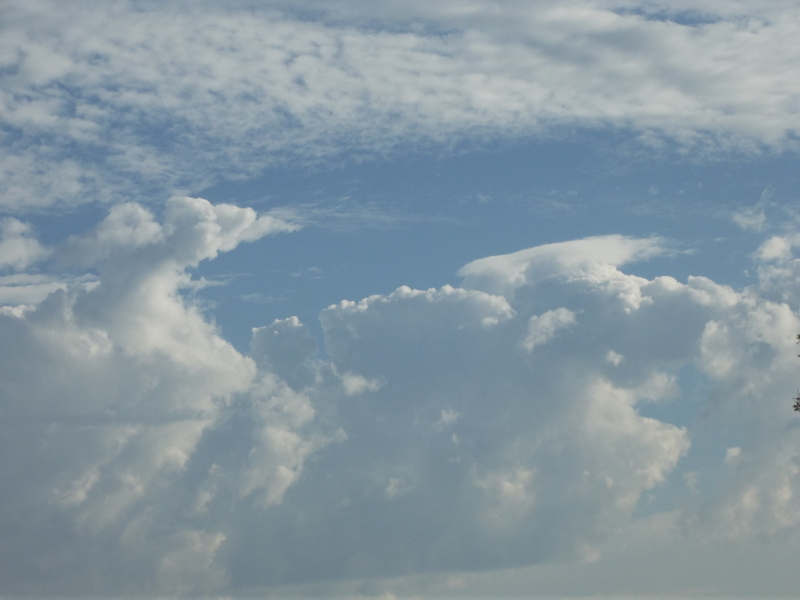
Beautiful, but not so friendly clouds. Photo by Stephany Farrell.
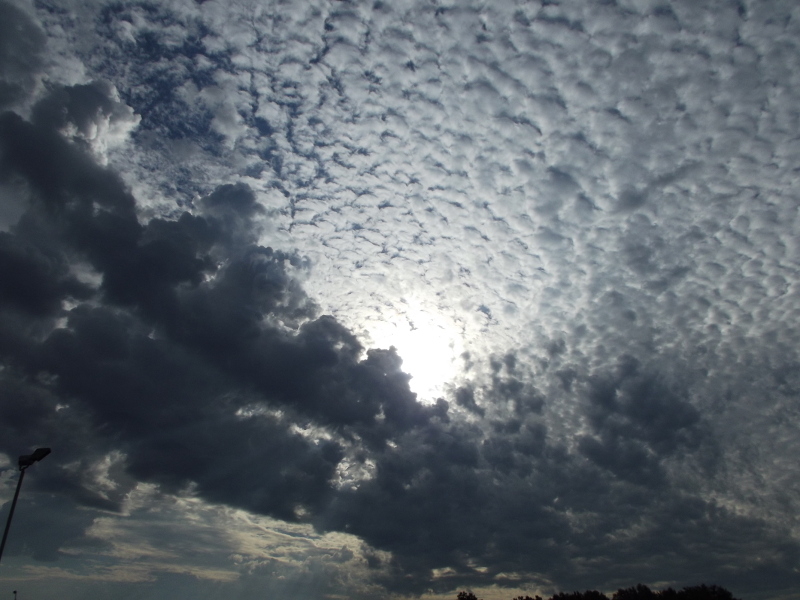
Definitely unfriendly clouds. Photo by Stephany Farrell.
As first contact approached it got progressively cloudier. After first contact I went over to the big shed where the entertainment was and some vendors, and gave a short talk on what to expect as totality approached. We had a $5 hamburger lunch provided by the Howard County Cattlemen’s Association. And bought $10 eclipse T-shirts. For the most part the Sun was visible through the clouds, if hazily. After first contact the skies worsened, eventually losing the Sun at one point, but then the Sun’s image improved, and continually so up to 4th contact. At totality the Sun’s inner corona was visible, but nothing beyond that. So my grand photographic plans were for naught.
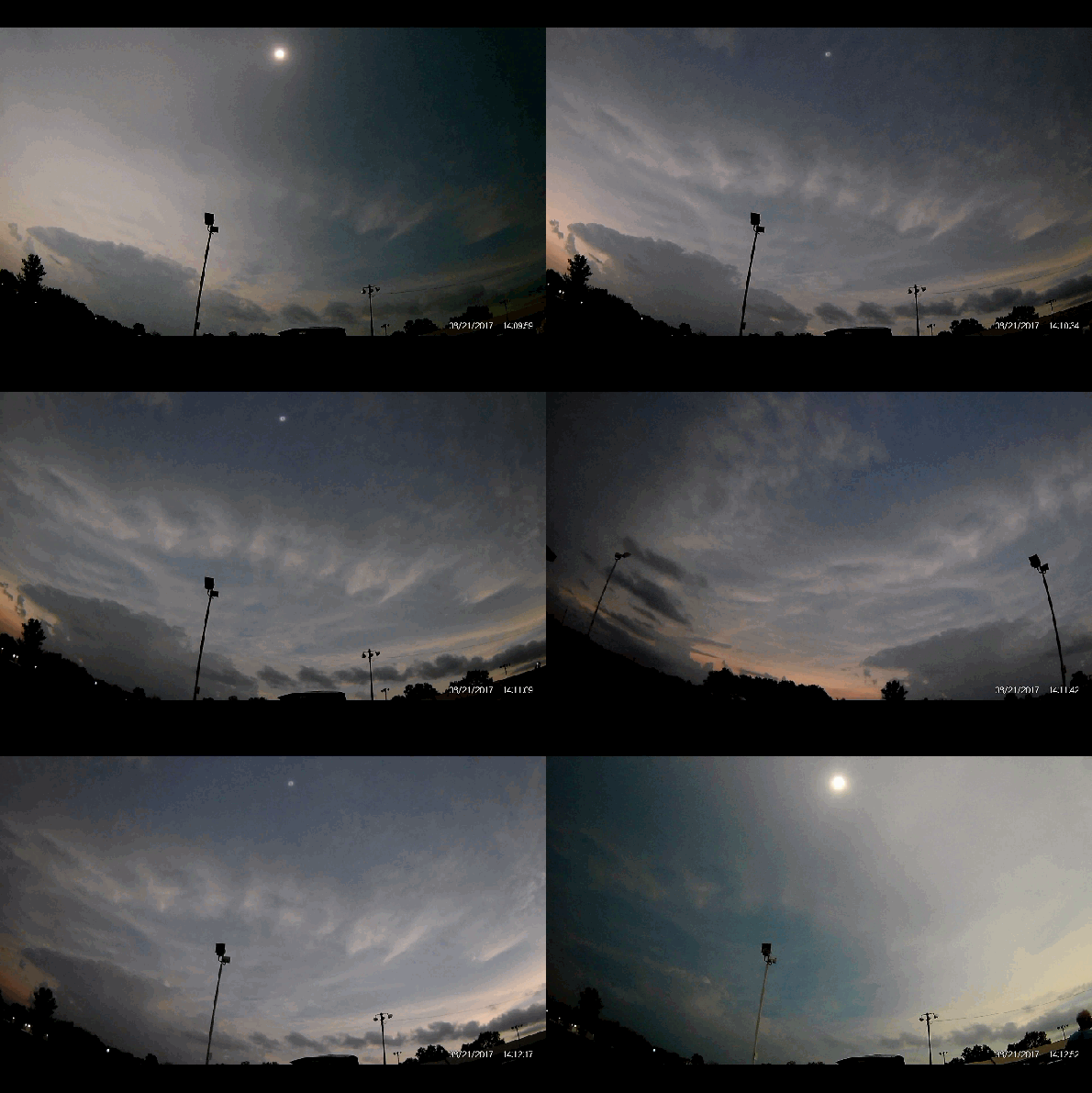
However, my little action camera recorded the sky for 45 minutes or so around the time of totality. And with playing it back yesterday, found that it recorded the Moon’s shadow going over very well. From it I’ve created 2 videos, one showing totality in real time, the other a time-lapse 2-minute video of 20 minutes centered on totality, in which the shadow of the Moon can be seen passing over us, darkening the translucent clouds from west to east. See the update below.
I gave my granddaughter, Bernadette (Bea) the job of recording the temperatures as the eclipse progressed. Here is a chart made from her data:
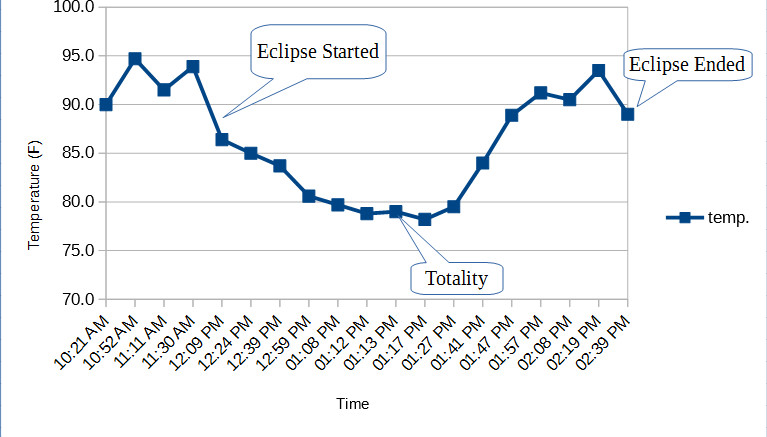
Bea’s temperature chart. From data taken by Bernadette Farrell.
The high temperature going in was 94.7 degrees, and the lowest was 78.2 degrees just after totality ended. It was stinking hot going in. But around totality there was a cool breeze coming from the southwest. It was refreshing.
I was going to spend more time soaking up the ambiance of the surreal world of totality this time, instead of staring at the Sun and sky. Well, I got it.
My videos of the eclipse are here: http://ephemeris.bjmoler.org/EclipseVideos_08-21-17.html.
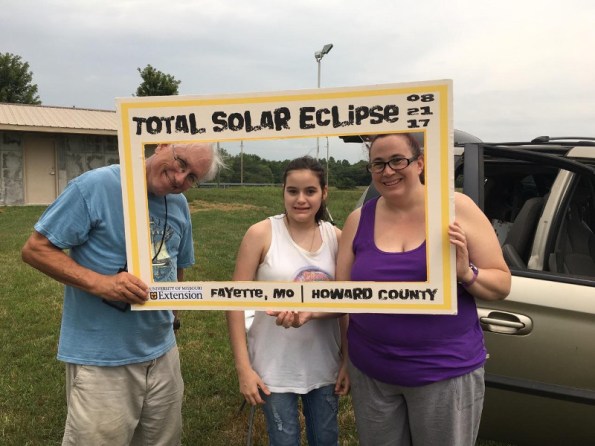
The eclipse crew: Left to Right – Bob, Bea and Stef.
Update: Below is an 11 MB animated GIF file of totality with the action camera mentioned above Starts at 14:09:59 and loops to 14:12:59. The eclipsed sun is the donut at the top of the image. Around mid-eclipse I pivot the camera up the eclipse path to the northwest, then pivot down the eclipse path to the southeast, before returning it to the sunward view.
Updated for spelling and grammar, 02/21/2024.
Ephemeris Extra – Some easy summertime deep sky objects
The finder charts were created using Cartes du Ciel (Sky Charts). This post is based on my article in the July 2017 Stellar Sentinel, the newsletter of the Grand Traverse Astronomical Society. It’s part of the Extras section for those receiving the emailed version.
What are Deep Sky Objects? These are objects, other than individual stars, beyond the solar system generally visible in binoculars or telescopes rather than the naked eye such as galaxies, nebulae and star clusters.
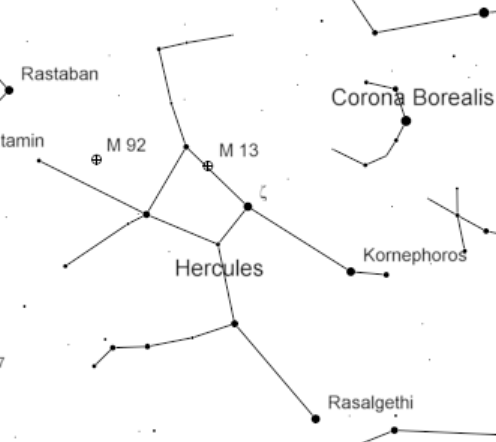 The Great Hercules Globular Star Cluster, M13 is the finest globular star cluster in the northern hemisphere of the sky. It is visible from late spring to early autumn. Globular star clusters have populations of hundreds of thousands of stars. They date back to the origin of the Milky Way of ten or a bit more billion of years old. There are only about 150 of these that belong to the Milky Way Galaxy. M13 is visible in binoculars on the western side of the Keystone pattern of stars, about one-third the distance from the north star on that side to the south side. It takes a much larger telescope to see individual stars. The star cluster will be a large circular glow. M92 is another star cluster which is dimmer and will be quite a challenge to find.
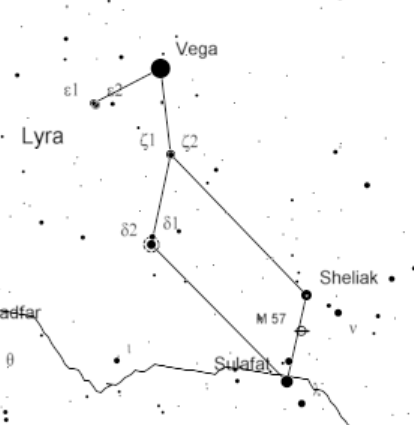 The Ring Nebula, M57 is small and cannot be seen with the naked eye or with binoculars, but it is still reasonably easy to find. A nebula is a cloud of gas and/or dust. M57 is in the constellation of Lyra the harp, a constellation visible in summer and early autumn. Point the telescope’s finder about half way between the two southern stars of the parallelogram of stars that’s the harp’s body, Sulafat and Sheliak. Move the telescope in a small spiral enlarging the search pattern by half the field of view at a time. The Ring Nebula will appear a ghostly small circular glow. Once centered, more magnification may be used. The center will be darker than the edge. Inside is a very faint invisible star that blew out its outer layers of gas into a smoke ring near the end of its life.
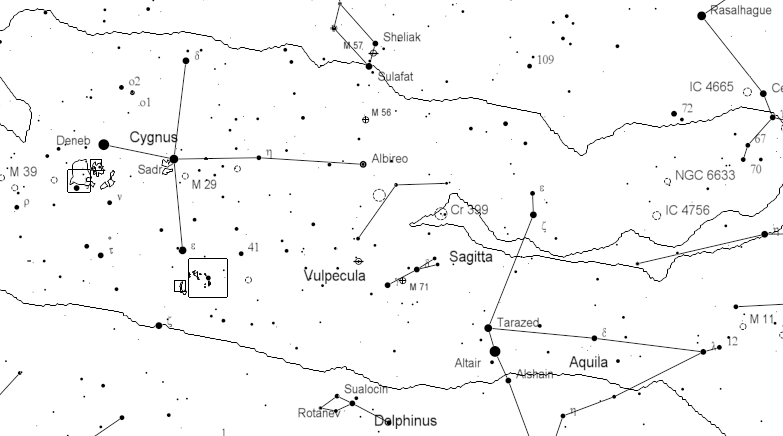
The Southern Milky Way contains lots of star clusters and nebulae. The chart below can be used to find the many Messier objects. Or just sweep through this gold mine of objects with binoculars or a low power telescope, most of which are in the next spiral arm in toward the center of the Milky Way. As far as the symbols go, open dotted circles are open or galactic star clusters. Crossed circles are globular star clusters. Squares are nebulae. M8, the Lagoon nebula, and M16 the Eagle nebula also contain star clusters. M8 and its associated star cluster appear as a horizontal spash of light in binoculars. As far as popular names go: M11 is the Wild Duck Cluster, M17 is the Omega or Swan Nebula, and M20 is the Trifid Nebula. An easy binocular star cluster is M7.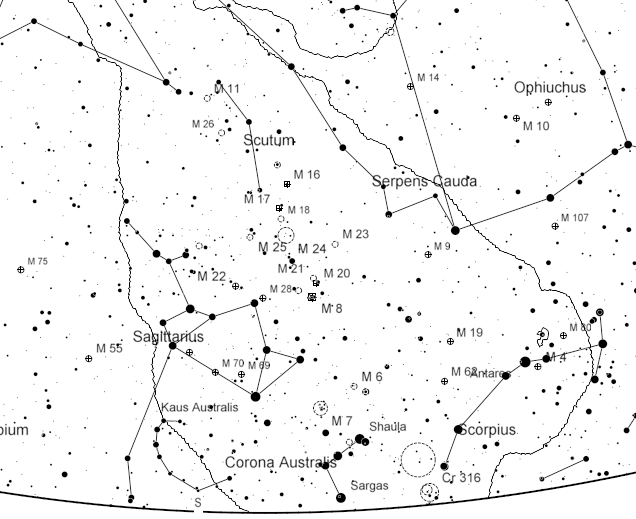
The Milky Way Overhead contains some notable deep sky objects. Note that the Milky Band splits here, though closer to the star Sadr in Cygnus than it shows here. The Dark expanse that runs through Aquila is called the Great Rift, and is caused by a cloud of dust and gas. Its edges can be probed with binoculars, especially in Aquila by watching star density drop off as one pans through the area. Don’t forget the blue and gold binary star Alberio. There’s another fainter blue and gold binary about a degree directly north of the Ring Nebula, M57. It’s 8th magnitude. The unmarked planetary nebula just above the second ‘l’ in Vulpecula is M27, the Dumbbell nebula. The other Messier (M) numbers are relatively easy to find. The large nebula below Deneb is the North American Nebula which can actually be seen with the naked eye or with binoculars on a moonless night away from city lights. The three-part nebula below Cygni is the Veil Nebula, a supernova remnant and very hard to spot but doable. The cluster Cr 399 (Collinder 399 or Brocchi’s Cluster) is better known as the Coathanger and is best seen in binoculars or a telescope finder, which inverts it, making it a properly oriented hanger.
Ephemeris Extra – Amateur astronomers produce a “Journey to Jupiter” video from 1,000 images
This is impressive! This is on YouTube, but read the explanation from Peter Rosén’s Planetary Society post which also has the video.
NASA requests the assistance of amateur astronomers to observe and record Mars, Jupiter and Saturn to help in observing these planets. Usually satellites are too close to see the planetary big picture. And besides amateur astronomers outnumber planetary scientists about a gazillion to one. They’re the ones to discover storms on these worlds and communicate heads up to either view them from satellites or hunker down as in the case of the solar-powered Opportunity rover.
Thanks to the Planetary Society for the heads up.
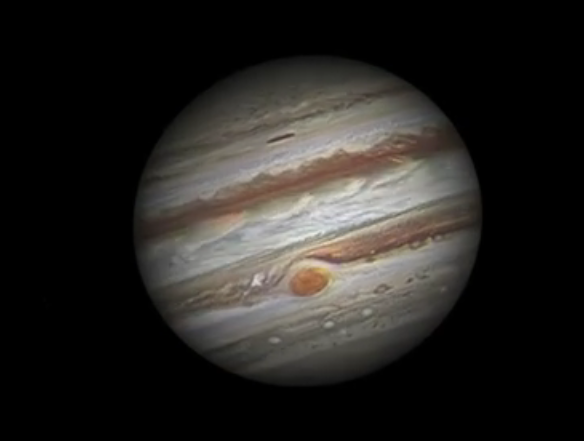
A frame from A Journey to Jupiter showing a time-lapse of Jupiter’s rotation and how the belts and zones move at different rates. Credit: The 91 amateur astronomers provided the over 1,000 images to make this video.
04/04/2017 – Ephemeris – First relaunch and recovery of a rocket booster
Ephemeris for Tuesday, April 4th. The Sun will rise at 7:17. It’ll be up for 12 hours and 56 minutes, setting at 8:14. The Moon, 1 day past first quarter, will set at 4:24 tomorrow morning.
Last Thursday SpaceX launched a communications satellite, SES-10 toward geostationary orbit using a used Falcon 9 first stage booster, that landed last April. To them it’s not a used rocket but a flight proven booster. Elon Musk, SpaceX CEO is not going to try launch this booster a third time, but will give it to the Cape Kennedy Visitors Center. Re-usability is the key, according to Musk to his plans to get to Mars and to possibly reduce the cost of getting payloads into orbit by as much as 30% than his already lowest prices in the industry. Besides landing the booster on their automated drone ship, they were able to recover the two halves of the fairing that protects a satellite as it ascends through the atmosphere.
Times are for the Traverse City/Interlochen area of Michigan. They may be different for your location.
Addendum
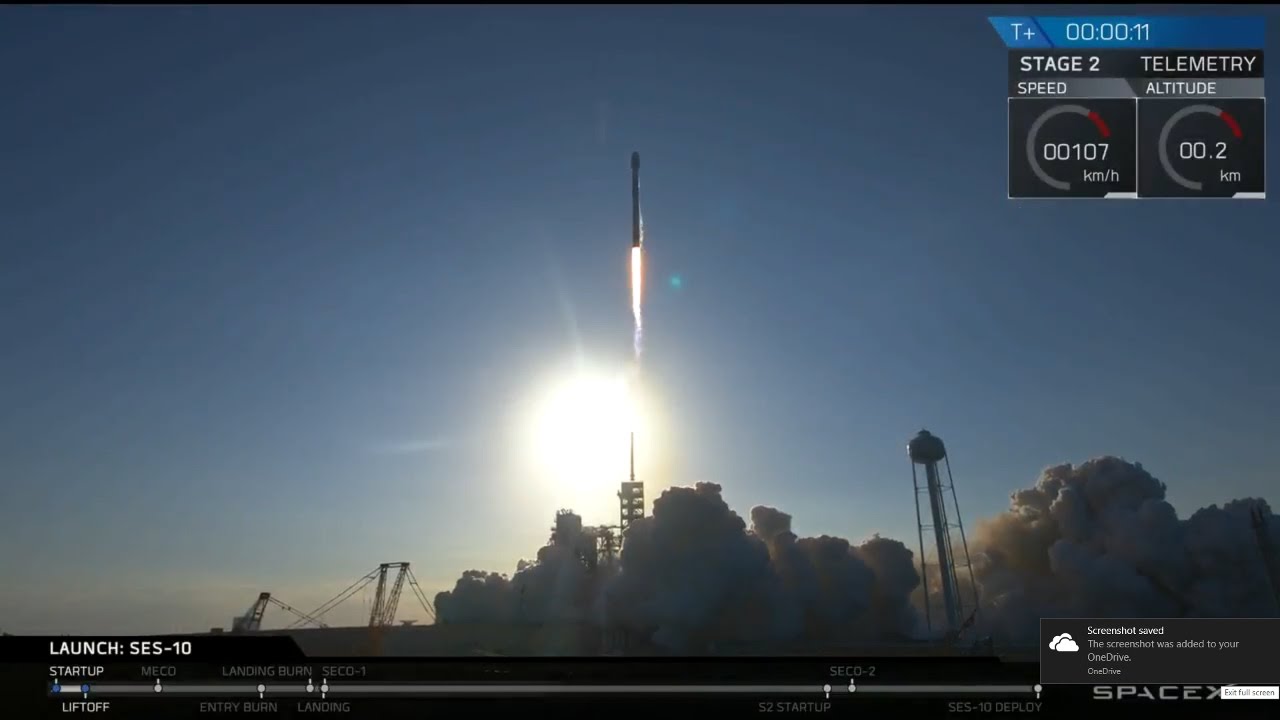
The second launching of this particular booster with the SES-10 satellite. Credit SpaceX video feed.
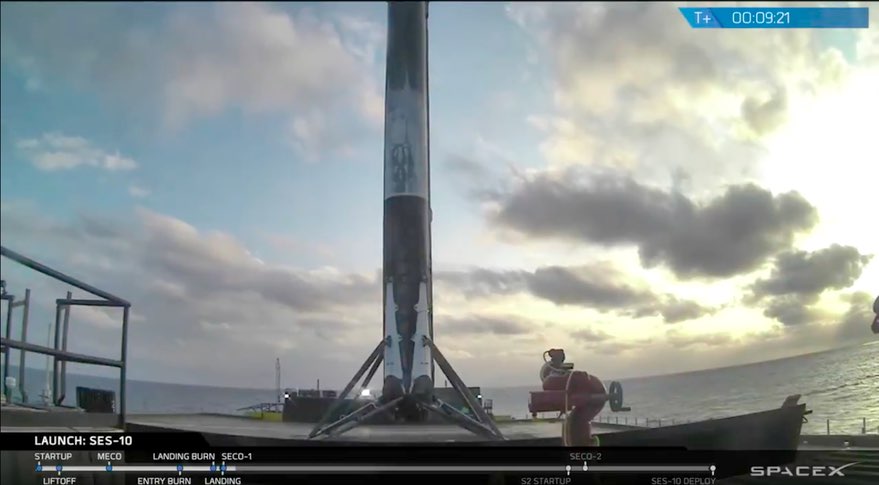
The video feed cut out during the landing of the booster, but the next shot was of the booster standing upright on the drone ship. Credit SpaceX video feed.
01/01/2017 – Happy Ephemeris New Year
Since the month and year starts on a Sunday, and the Ephemeris program is not broadcast on the weekend I will give you some information that will be part of the January preview program that will run on Monday.
NASA Calendar of Planetary Events
Credit: Sky Events Calendar by Fred Espenak and Sumit Dutta (NASA’s GSFC)
To generate your own calendar go to http://eclipse.gsfc.nasa.gov/SKYCAL/SKYCAL.html
Times are Eastern Time and follow the time change dates.
    Date   Time  Event
Jan 01  Su       Venus: 46.8° E
    02  Mo 04:20 Moon-Venus: 2° S
    02  Mo 13:14 Moon Descending Node
    03  Tu 01:47 Moon-Mars: 0.3° S
    03  Tu 09:10 Quadrantid Meteor Shower: ZHR = 120
    04  We 05:59 Perihelion: 0.9833 AU
    05  Th 14:47 First Quarter
    09  Mo 04:03 Mercury-Saturn: 6.7° N
    09  Mo 09:07 Moon-Aldebaran: 0.4° S
    10  Tu 01:07 Moon Perigee: 363200 km
    11  We 04:32 Moon North Dec.: 18.9° N
    12  Th 06:34 Full Moon
    12  Th 07:59 Venus Greatest Elongation: 47.1° East
    14  Sa 23:07 Moon-Regulus: 0.9° N
    15  Su 05:45 Moon Ascending Node
    19  Th 00:26 Moon-Jupiter: 3° S
    19  Th 04:59 Mercury Greatest Elongation: 24.1° West
    19  Th 17:14 Last Quarter
    21  Sa 19:14 Moon Apogee: 404900 km
    24  Tu 05:37 Moon-Saturn: 4° S
    25  We 06:59 Moon South Dec.: 18.9° S
    25  We 19:46 Moon-Mercury: 4° S
    27  Fr 19:07 New Moon
    29  Su 17:21 Moon Descending Node
    31  Tu 01:12 Jupiter-Spica: 3.5° N
    31  Tu 09:34 Moon-Venus: 4.2° N
    31  Tu 20:09 Moon-Mars: 2.4° N
Feb 01  We       Venus: 45.5° E
January 2017 Calendar
LU                  Ephemeris of Sky Events for Interlochen/TC
January, 2017    Local time zone: EST
+-----------------------------------------------------------------------+
| DATE |  SUN     SUN  DAYLIGHT|   TWILIGHT*    |MOON  RISE OR    ILLUM |
|      |  RISE    SET    HOURS |  END    START  |PHASE SET** TIME FRACTN|
+=======================================================================+
|Sun  1| 08:20a  05:13p  08:53 | 06:23p  07:09a |      Set  08:55p   13%|
|Mon  2| 08:20a  05:14p  08:54 | 06:24p  07:09a |      Set  10:00p   21%|
|Tue  3| 08:20a  05:15p  08:55 | 06:25p  07:10a |      Set  11:06p   31%|
|Wed  4| 08:20a  05:16p  08:56 | 06:26p  07:10a |      Set  12:14a   41%|
|Thu  5| 08:19a  05:17p  08:57 | 06:27p  07:10a |F Qtr Set  01:24a   52%|
|Fri  6| 08:19a  05:18p  08:58 | 06:28p  07:09a |      Set  02:35a   63%|
|Sat  7| 08:19a  05:19p  08:59 | 06:29p  07:09a |      Set  03:47a   74%|
+------+-----------------------+----------------+-----------------------+
|Sun  8| 08:19a  05:20p  09:01 | 06:30p  07:09a |      Set  04:58a   83%|
|Mon  9| 08:19a  05:21p  09:02 | 06:31p  07:09a |      Set  06:07a   91%|
|Tue 10| 08:18a  05:22p  09:04 | 06:32p  07:09a |      Set  07:11a   97%|
|Wed 11| 08:18a  05:23p  09:05 | 06:33p  07:09a |      Set  08:07a  100%|
|Thu 12| 08:17a  05:25p  09:07 | 06:34p  07:08a |Full  Rise 06:04p  100%|
|Fri 13| 08:17a  05:26p  09:08 | 06:35p  07:08a |      Rise 07:12p   97%|
|Sat 14| 08:16a  05:27p  09:10 | 06:36p  07:08a |      Rise 08:20p   92%|
+------+-----------------------+----------------+-----------------------+
|Sun 15| 08:16a  05:28p  09:12 | 06:37p  07:07a |      Rise 09:26p   85%|
|Mon 16| 08:15a  05:30p  09:14 | 06:38p  07:07a |      Rise 10:31p   77%|
|Tue 17| 08:15a  05:31p  09:16 | 06:39p  07:06a |      Rise 11:33p   68%|
|Wed 18| 08:14a  05:32p  09:18 | 06:40p  07:06a |      Rise 12:33a   59%|
|Thu 19| 08:13a  05:33p  09:20 | 06:42p  07:05a |L Qtr Rise 01:32a   49%|
|Fri 20| 08:13a  05:35p  09:22 | 06:43p  07:05a |      Rise 02:30a   40%|
|Sat 21| 08:12a  05:36p  09:24 | 06:44p  07:04a |      Rise 03:27a   31%|
+------+-----------------------+----------------+-----------------------+
|Sun 22| 08:11a  05:37p  09:26 | 06:45p  07:03a |      Rise 04:23a   23%|
|Mon 23| 08:10a  05:39p  09:28 | 06:46p  07:03a |      Rise 05:18a   15%|
|Tue 24| 08:09a  05:40p  09:30 | 06:47p  07:02a |      Rise 06:09a    9%|
|Wed 25| 08:08a  05:42p  09:33 | 06:49p  07:01a |      Rise 06:57a    4%|
|Thu 26| 08:07a  05:43p  09:35 | 06:50p  07:00a |      Rise 07:41a    1%|
|Fri 27| 08:06a  05:44p  09:37 | 06:51p  07:00a |New   Set  05:43p    0%|
|Sat 28| 08:05a  05:46p  09:40 | 06:52p  06:59a |      Set  06:45p    1%|
+------+-----------------------+----------------+-----------------------+
|Sun 29| 08:04a  05:47p  09:42 | 06:54p  06:58a |      Set  07:51p    4%|
|Mon 30| 08:03a  05:49p  09:45 | 06:55p  06:57a |      Set  08:58p   10%|
|Tue 31| 08:02a  05:50p  09:47 | 06:56p  06:56a |      Set  10:06p   17%|
+-----------------------------------------------------------------------+
* Nautical Twilight
** Moonrise or moonset, whichever occurs between sunset and sunrise
12/31/2016 – Ephemeris year end
No radio program today, being the weekend, so at the end of the calendar page below are the stats for today, the 31st. This is the form of the calendar that I have on my Ephemeris website, which I update monthly. It was created with the same data that the first portion of my program is generated from. I have yearly calendars for 6 communities in the Interlochen Public Radio area in northwestern lower Michigan, and 1 in the U.P. (That’s the Upper Peninsula, if you’re not from around here.)
You will have to hold off your New Years festivities for a bit tonight. Not long, just one second. Today, December 31st, 2016 will be 24 hours and 1 second long. This “leap second” will be added as the 61st second of the minute 6:59 p.m. EST (23:59 UT). The reason is that the Earth’s rotation is slowing down ever so slightly, compared to the atomic clocks at the Bureau of Time. There is some discussion of eliminating this leap second. Most scientists want to use a constant time stream, and don’t give a hang about the rotation of the Earth. The positions of the Earth, Moon and the other planets would be incorrect if we used time strictly based on the Earth’s rotation. Atomic time which is also affected by special and general relativity is used by GPS navigation satellites. A one second jump in time, at our latitude (45° north) is equivalent of the earth’s rotation of about two tenths of a mile. I hope everyone’s coordinated on this.
Ephemeris of Sky Events for Interlochen/TC |
||||||||||
| December, 2016 – Local time zone: EST | ||||||||||
|---|---|---|---|---|---|---|---|---|---|---|
| Date | Sun | Twilight* | Moon | Illum | ||||||
| Rise | Set | Hours | End | Start | Phase | R/S** | Time | Fractn | ||
| Thu | 1 | 08:00a | 05:03p | 09:03 | 06:48p | 06:15a | Set | 07:10p | 6% | |
| Fri | 2 | 08:01a | 05:03p | 09:01 | 06:47p | 06:16a | Set | 08:02p | 11% | |
| Sat | 3 | 08:02a | 05:02p | 09:00 | 06:47p | 06:17a | Set | 08:59p | 18% | |
| Sun | 4 | 08:03a | 05:02p | 08:58 | 06:47p | 06:18a | Set | 09:59p | 26% | |
| Mon | 5 | 08:04a | 05:02p | 08:57 | 06:47p | 06:19a | Set | 11:02p | 36% | |
| Tue | 6 | 08:05a | 05:02p | 08:56 | 06:47p | 06:20a | Set | 12:08a | 46% | |
| Wed | 7 | 08:06a | 05:02p | 08:55 | 06:47p | 06:21a | F Qtr | Set | 01:16a | 57% |
| Thu | 8 | 08:07a | 05:02p | 08:54 | 06:47p | 06:22a | Set | 02:26a | 68% | |
| Fri | 9 | 08:08a | 05:02p | 08:53 | 06:47p | 06:22a | Set | 03:39a | 78% | |
| Sat | 10 | 08:09a | 05:02p | 08:52 | 06:47p | 06:23a | Set | 04:53a | 87% | |
| Sun | 11 | 08:10a | 05:02p | 08:51 | 06:48p | 06:24a | Set | 06:08a | 94% | |
| Mon | 12 | 08:11a | 05:02p | 08:51 | 06:48p | 06:25a | Set | 07:21a | 98% | |
| Tue | 13 | 08:12a | 05:02p | 08:50 | 06:48p | 06:26a | Full | Rise | 05:18p | 100% |
| Wed | 14 | 08:12a | 05:02p | 08:49 | 06:48p | 06:26a | Rise | 06:17p | 98% | |
| Thu | 15 | 08:13a | 05:02p | 08:49 | 06:49p | 06:27a | Rise | 07:21p | 94% | |
| Fri | 16 | 08:14a | 05:03p | 08:48 | 06:49p | 06:28a | Rise | 08:28p | 88% | |
| Sat | 17 | 08:14a | 05:03p | 08:48 | 06:49p | 06:28a | Rise | 09:35p | 80% | |
| Sun | 18 | 08:15a | 05:03p | 08:48 | 06:50p | 06:29a | Rise | 10:41p | 70% | |
| Mon | 19 | 08:16a | 05:04p | 08:48 | 06:50p | 06:29a | Rise | 11:44p | 61% | |
| Tue | 20 | 08:16a | 05:04p | 08:48 | 06:51p | 06:30a | L Qtr | Rise | 12:46a | 51% |
| Wed | 21 | 08:17a | 05:05p | 08:48 | 06:51p | 06:30a | Rise | 01:46a | 41% | |
| Thu | 22 | 08:17a | 05:05p | 08:48 | 06:52p | 06:31a | Rise | 02:45a | 32% | |
| Fri | 23 | 08:18a | 05:06p | 08:48 | 06:52p | 06:31a | Rise | 03:43a | 24% | |
| Sat | 24 | 08:18a | 05:07p | 08:48 | 06:53p | 06:32a | Rise | 04:40a | 16% | |
| Sun | 25 | 08:18a | 05:07p | 08:48 | 06:53p | 06:32a | Rise | 05:37a | 10% | |
| Mon | 26 | 08:19a | 05:08p | 08:49 | 06:54p | 06:32a | Rise | 06:33a | 5% | |
| Tue | 27 | 08:19a | 05:09p | 08:49 | 06:55p | 06:33a | Rise | 07:26a | 2% | |
| Wed | 28 | 08:19a | 05:09p | 08:50 | 06:55p | 06:33a | Rise | 08:16a | 0% | |
| Thu | 29 | 08:19a | 05:10p | 08:50 | 06:56p | 06:33a | New | Set | 05:57p | 1% |
| Fri | 30 | 08:19a | 05:11p | 08:51 | 06:57p | 06:34a | Set | 06:53p | 3% | |
| Sat | 31 | 08:20a | 05:12p | 08:52 | 06:58p | 06:34a | Set | 07:52p | 7% | |
| * Astronomical Twilight | ||||||||||
| ** Moonrise or moonset, whichever occurs between sunset and sunrise | ||||||||||
The far right column of the table, the Moon’s illuminated fraction, may or may not appear in the calendar above depending on you browser or screen size. It is correct on the Ephemeris website.
 Bob Moler's Ephemeris Blog