Archive
11/27/2017 – Ephemeris – Ross 128b the second closest known exoplanet
Ephemeris for Monday, November 27th. The Sun will rise at 7:54. It’ll be up for 9 hours and 10 minutes, setting at 5:05. The Moon, 1 day past first quarter, will set at 1:37 tomorrow morning.
The second closest exoplanet to the solar system has been discovered. That was earlier this year around a star named Ross 128. It’s name is Ross 128 small letter b. The star Ross 128 is a nearby red dwarf star, whose distance is a shade under 11 light years away, The star is thought to be twice the age of the Sun, We’d be in big trouble if the Sun were that old, but Ross 128 is just getting started. The exoplanet is about 35% more massive than the Earth. It’s distance from the star averages 4.6 million miles and its year is a bit under 10 Earth days. At that rate I’d be over 28 hundred years old. Astronomers don’t know the size or the density of the planet since it doesn’t pass in front of its star. These measurements will have to wait on larger telescopes.
The times given are for the Traverse City/Interlochen area of Michigan. They may be different for your location.
Addendum
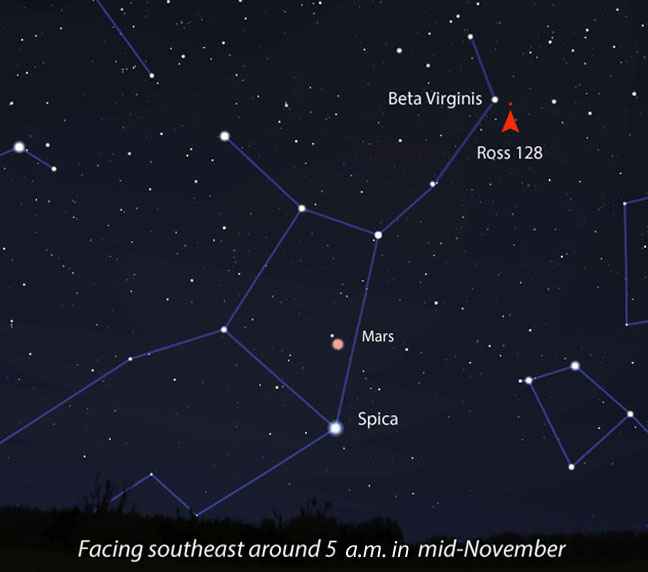
The star Ross 128. It’s actually much fainter than is suggested here in the diagram from Sky and Telescope magazine’s website.. Mars’ position is for November 2017.
11/24/2017 – Ephemeris – Fomalhaut, the loneliest star, has a little buddy
Ephemeris for Friday, November 24th. The Sun will rise at 7:51. It’ll be up for 9 hours and 15 minutes, setting at 5:07. The Moon, 2 days before first quarter, will set at 10:30 this evening.
The lonely bright star low in the south at 8 p.m. these evenings is Fomalhaut the harbinger of autumn in my book, and about to leave as winter approaches. Fomalhaut means fishes mouth and is located at the head of Piscis Austrinus, a very dim constellation. Fomalhaut is a young white star only about 400 million years old with a disk of dust surrounding it. Near an outer dust ring, 15 years ago the Hubble Space Telescope discovered a spot. Four years later astronomers discovered that the spot moved along the dust lane and announced the first direct discovery of an exoplanet. In 2010 and 2012 the planet now dubbed Fomalhaut b or Dagon was observed again and it really does orbit Fomalhaut in a very eccentric orbit.
The times given are for the Traverse City/Interlochen area of Michigan. They may be different for your location.
Addendum
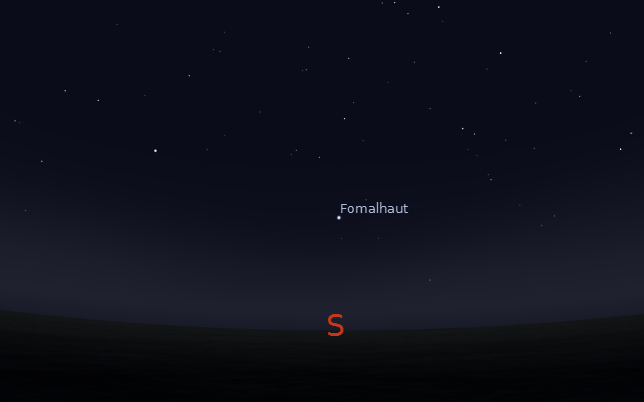
Fomalhaut in the south at 8 p.m. on November evenings. Created using Stellarium.
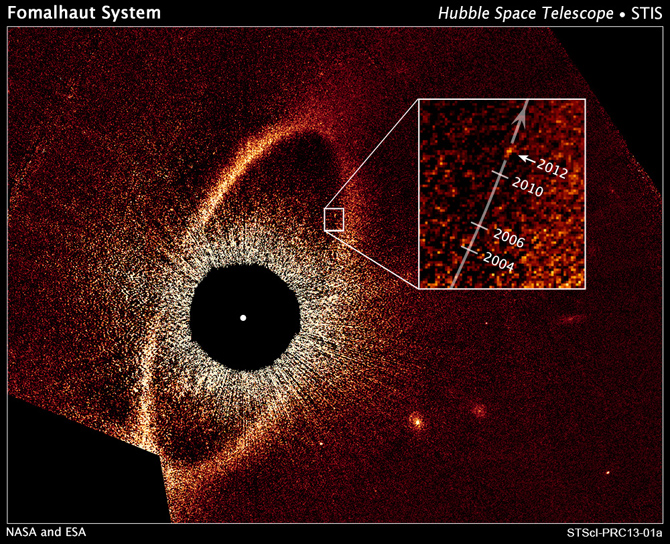
Fomalhaut b and it’s path around its star. Credit: NASA, ESA, and P. Kalas (University of California, Berkeley and SETI Institute)
03/06/2017 – Ephemeris – TRAPPIST-1 The star with seven earth-sized planets
Ephemeris for Monday, March 6th. The Sun will rise at 7:10. It’ll be up for 11 hours and 26 minutes, setting at 6:37. The Moon, 1 day past first quarter, will set at 3:47 tomorrow morning.
The big astronomical news of two weeks ago was the announcement of a star system that had at least 7 earth-sized planets. And that three of them were in the habitable zone of their dim red dwarf star. The designation of the star is TRAPPIST-1, a Belgian telescope in South America that has nothing to do with monks. TRAPPIST is the acronym for the telescope’s rather long name. Confirmation of all the planets, their sizes and mass was carried out by NASA’s Spitzer Infrared Telescope trailing the Earth in solar orbit. Needless to say this star system will be the object of intense study as larger and more sophisticated ground and space based telescopes come on line in the next few years.
Times are for the Traverse City/Interlochen area of Michigan. They may be different for your location.
Addendum
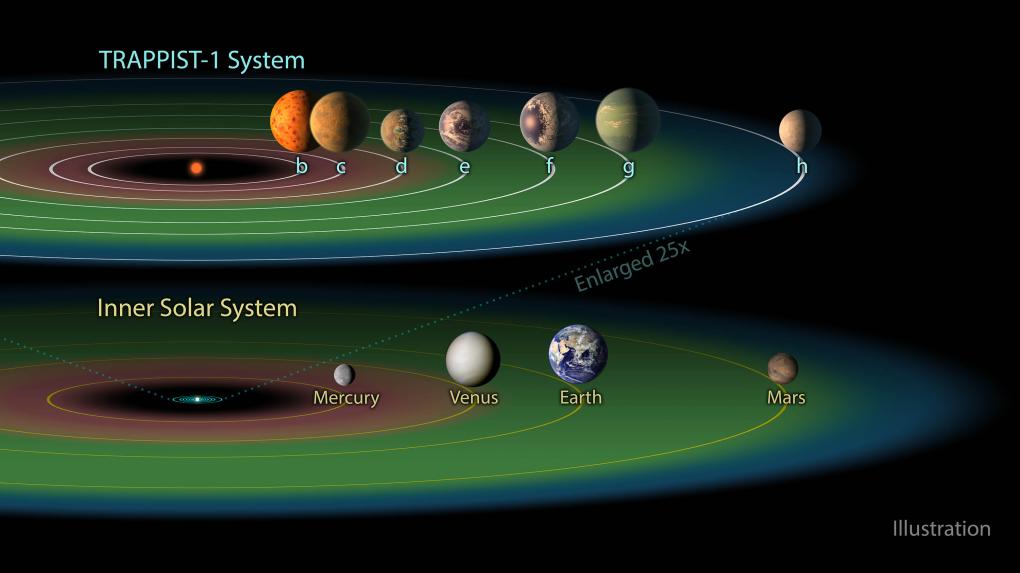
Comparison of the TRAPPIST-1 planetary system with our own inner solar system. The green zone is the habitable or Goldilocks zone Credit: NASA/JPL-Caltech/R. Hurt, T. Pyle (IPAC)
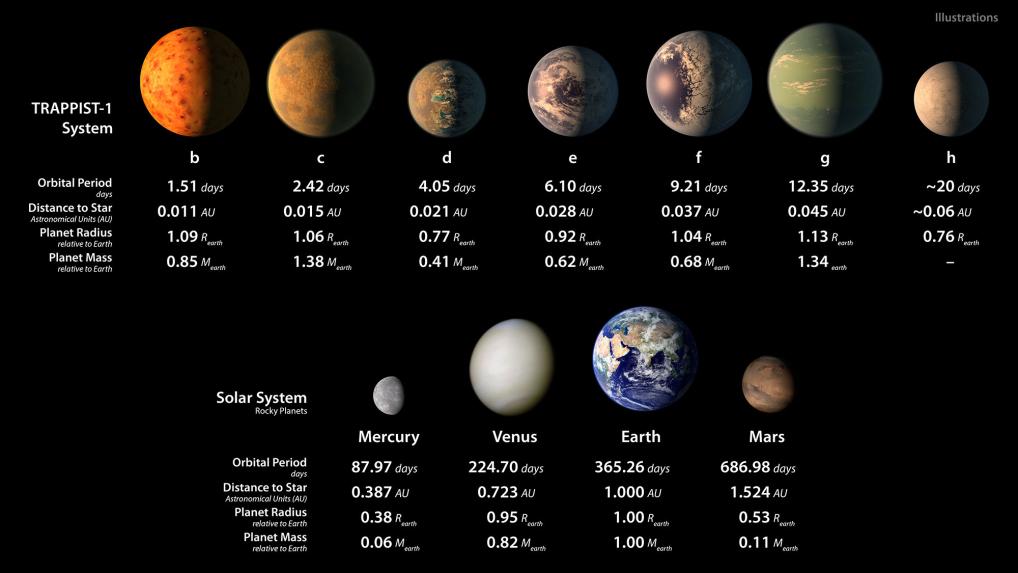
What is currently known about the TRAPPIST-1 Planets. Comparison of the TRAPPIST-1 planetary system with our own inner solar system. Credit: NASA/JPL-Caltech/R. Hurt, T. Pyle (IPAC)
Note that the surface features of these planets are in the eye of the illustrator. They are currently black shadows seen on the face of the star that they cross.
Planet g looks closest to the Earth’s density of the habitable zone planets. The problem I’d have is if I lived there at 12.35 days per year I’d be 2220 years old.
Entice your great-great-great-great grandkids with this travel poster:
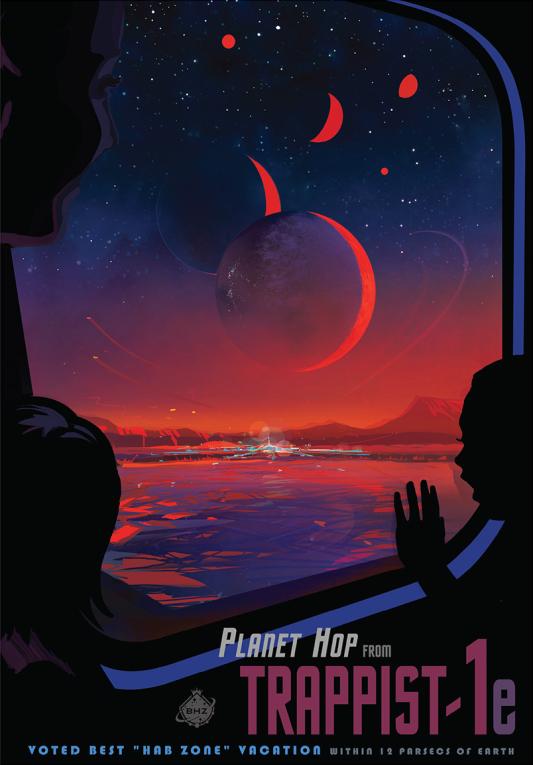
Planet Hop from TRAPPIST-1e. Maybe not next door like Proxima b, but just down the block. only 39 light years away.
For more information:
On the Spitzer site you can find:
Images
Videos (b-roll and annotated/narrated)
Planet surface maps and starfield backdrop image
http://www.spitzer.caltech.edu/trappist-1
On the JPL site you can also find:
Exoplanet Travel Poster
VR tour of TRAPPIST-1d surface
Additional videos
https://exoplanets.nasa.gov/trappist1/
On the ESO site you can also find:
Even more videos and graphics
http://www.eso.org/public/news/eso1706
Play around with the TRAPPIST-1 and other extra solar planetary systems with NASA’s Eyes: https://eyes.nasa.gov/eyes-on-exoplanets.htm.
Replay the news conference announcing the TRAPPIST-1 discovery from February 22, 2017:
http://www.ustream.tv/recorded/100200725.
12/05/2016 – Ephemeris – The planet’s name is Dagon
Ephemeris for Monday, December 5th. The Sun will rise at 8:04. It’ll be up for 8 hours and 57 minutes, setting at 5:02. The Moon, 2 days before first quarter, will set at 11:02 this evening.
The lonely bright star low in the south-southwest at 8 p.m. these evenings is Fomalhaut the harbinger of autumn in my book, and about to leave as winter approaches. Fomalhaut means fishes mouth and is located at the head of Piscis Austrinus, a very dim constellation. Fomalhaut is a young white star only about 400 million years old with a disk of dust surrounding it. Near an outer dust ring, 14 years ago the Hubble Space Telescope discovered a spot. Four years later astronomers discovered that the spot moved along the dust lane and announced the first direct discovery of an exoplanet. In 2010 and 2012 the planet now dubbed Fomalhaut b or Dagon was observed again and it really does orbit Fomalhaut in a very eccentric orbit.
Times are for the Traverse City/Interlochen area of Michigan. They may be different for your location.
Addendum
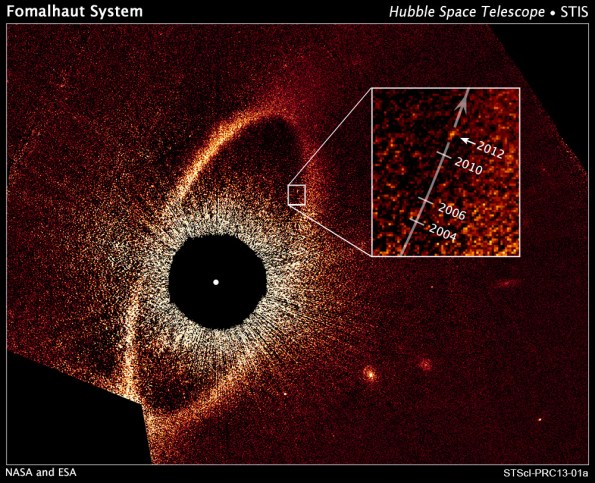
The track of observations of Fomalhaut b or Dagon in 2004, 2006, 2010 and 2012. Credit: NASA and ESA.
11/15/2016 – Ephemeris – Imaging exoplanets from the ground
Ephemeris for Tuesday, November 15th. The Sun will rise at 7:40. It’ll be up for 9 hours and 33 minutes, setting at 5:14. The Moon, 1 day past full, will rise at 6:43 this evening.
There’s something I never thought I’d see in my lifetime was a telescope on the ground that could image planets around other stars. Remember that planets shine by reflecting the light of their host stars, and due to their distance of many trillion of miles away, that there would be no hope of separating the planet from the star which is billions of times brighter. My lifetime includes the launch of Sputnik, the first artificial satellite when I was in the 11th grade. However with huge telescopes with adaptive optics that take the wiggle out of the atmosphere. Added to that is the CHARIS instrument on the 8.2 meter Subaru telescope on Mauna Kea in Hawai’i, which not only can see exoplanets around stars, but take their spectra, to analyze chemical compounds in their atmospheres.
Times are for the Traverse City/Interlochen area of Michigan. They may be different for your location.
Addendum
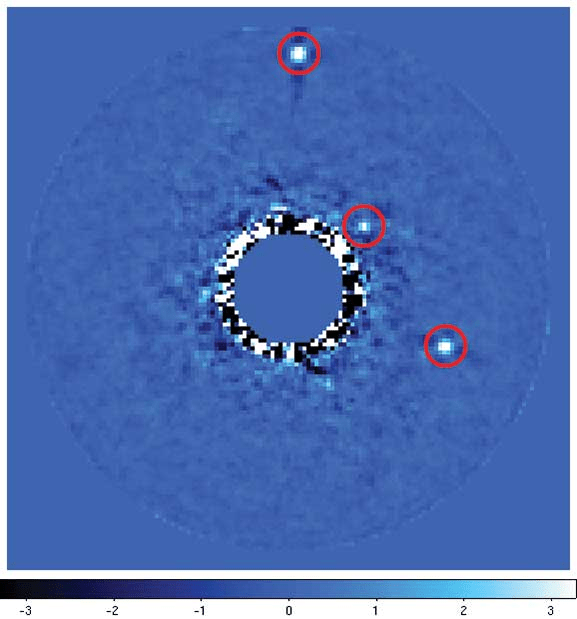
A plot of data from CHARIS shows planets located around a star in the planetary system HR8799. (Images courtesy of N. Jeremy Kasdin and the research team)
The story is here:
http://www.princeton.edu/main/news/archive/S47/82/89C62/?section=topstories
08/16/2016 – Ephemeris – Does Proxima Centauri have a planet? Also some information for southern observers about Mercury
Ephemeris for Tuesday, August 16th. The Sun rises at 6:46. It’ll be up for 13 hours and 59 minutes, setting at 8:46. The Moon, 2 days before full, will set at 5:53 tomorrow morning.
Proxima Centauri is the closest star to our solar system. It is a red dwarf star, and a distant third member of the Alpha Centauri star system. Recently the German weekly Der Spiegel announced that astronomers at the La Silla Observatory in Chile have detected a possible Earth-like planet at a distance that water may be liquid on its surface around this tiny star. Other than this one leak, no one is talking, and the European Southern Observatory is mum on the subject. There may be some kind of announcement at the end of the month. If true, this means that the closest earth-like planet orbits the closest star, only four and a quarter light years away. That’s nearly 25 trillion miles, and hundreds of years travel time with our current technology.
Times are for the Traverse City/Interlochen area of Michigan. They may be different for your location.
Addendum
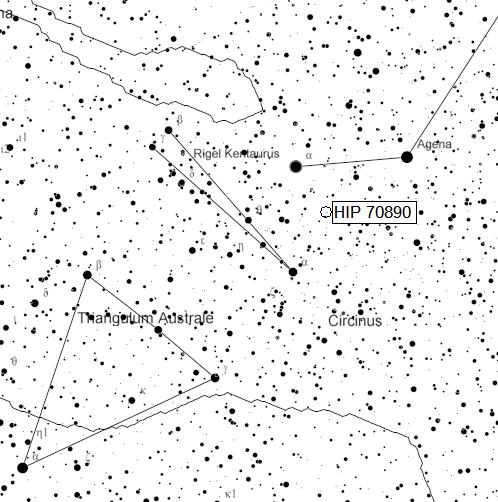
Chart showing the location of Proxima Centauri, labeled here HIP 70890. Alpha Centauri is labeled Rigel Kentaurus. Alpha Centauri is actually a catalog name in the style of Johann Bayer’s 1603 star atlas. Note also the alpha (α) Greek letter next to the star. Created using Cartes du Ciel (Sky Charts).
Note also the star labeled Agena. That is the more distant Beta (β) Centauri also known as Hadar.
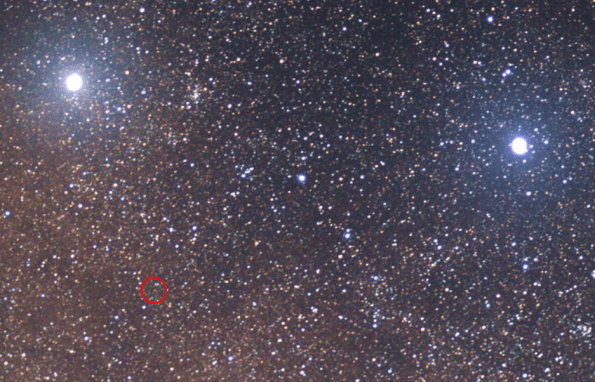
A section of a photograph of part of the field of view of the chart above. Credit: Wikipedia user Skatebiker.
Extra
For our southern observers: Today Mercury reaches its greatest eastern elongation of 27 degrees. So it’s visible in the west with Venus and Jupiter.
05/20/2013 – Ephemeris – Silicon rings around old stars in the Hyades
Ephemeris for Monday, May 20th. Today the sun will be up for 15 hours and 0 minutes, setting at 9:09. The moon, 2 days past first quarter, will set at 3:45 tomorrow morning. Tomorrow the sun will rise at 6:08. | I found this item at Universe Today, an astronomical news website, universetoday.com. The Hubble Space telescope has found evidence of rings of mainly silicon around two white dwarf stars in the Hyades star cluster. The Hyades is the V-shaped star cluster just below the setting Jupiter these nights. White dwarf stars are old stars in their last stage of life and usually don’t show the absorption of heavy elements in their spectrum. These two stars must have pulverized rings of silicon plus a little carbon orbiting them, suggesting the formation of earth-like planets. Astronomers usually don’t see this in cluster stars, which are generally young and too active to show planet forming material close to them.
Times are for the Traverse City/Interlochen area of Michigan. They may be different for your location.
04/25/2013 – Ephemeris – Two new exoplanets in the same star’s habitable zone discovered
Ephemeris for Thursday, April 25th. The sun rises at 6:41. It’ll be up for 13 hours and 58 minutes, setting at 8:40. The moon, at full today, will rise at 8:52 this evening.
Last week came the announcement that an international team, analyzing data from the Kepler satellite had found a star system with two near earth sized planets in the habitable zone for that star. The two planets around the star Kepler-62 The planets e and f are in the habitable zone for the star and are in the class called super earths 1.6 and 1.4 time the diameter of the earth. They will require more study to determine their densities, and the composition of their atmospheres. Exoplanet discoveries continue to mount up, but so far a planet the size of the earth, in the habitable zone of its star has eluded astronomers. Closer to home, but visible on the other side of the earth there will be a slight partial eclipse of the moon this afternoon our time.
Times are for the Traverse City/Interlochen area of Michigan. They may be different for your location.
Addendum
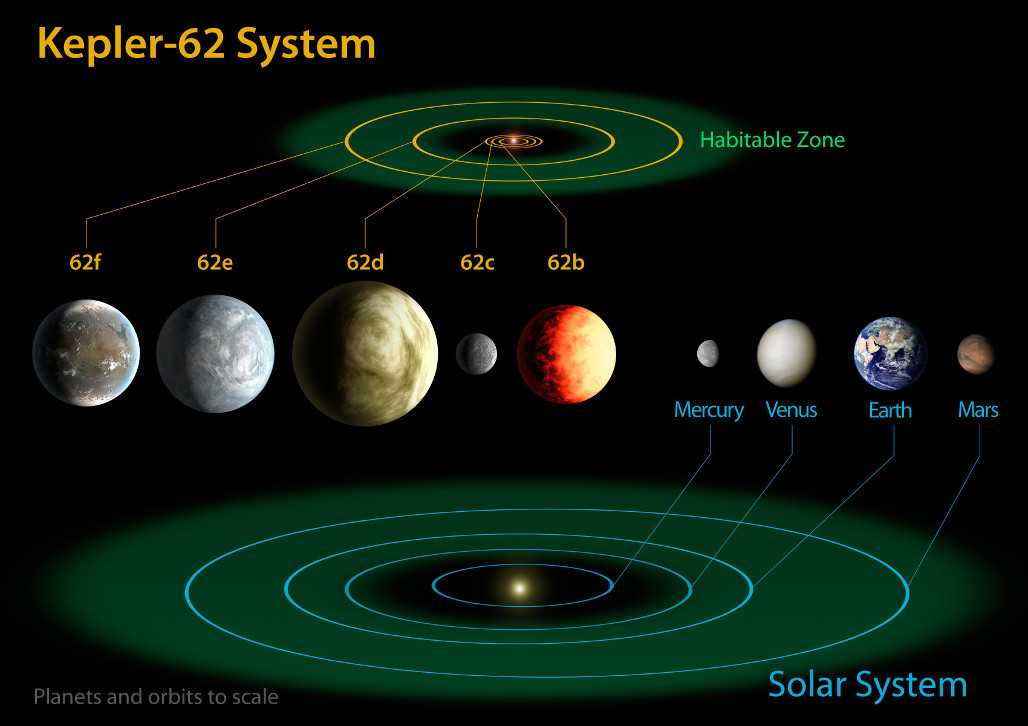
The Kepler-62 stellar system. Credit: JPL/NASA.
11/23/2012 – Emphemeris – Think Tatooine is special? How about a planet in a 4 star system.
Ephemeris for Friday, November 23rd. The sun will rise at 7:50. It’ll be up for 9 hours and 17 minutes, setting at 5:07. The moon, 3 days past first quarter, will set at 3:59 tomorrow morning.
The satellite named Kepler, which is attempting to detect planets around other stars has been up there for over 3 years and has received a mission extension. It is looking at a single patch of the sky in the constellation Cygnus. The count of confirmed and unconfirmed planets has risen to 23 hundred. Confirmations have to be done by ground based telescopes, so it will take a while to investigate all the finds for planets. The public can help sift through the Kepler data at www.planethunters.org. In fact the first planet hunters discovery was announced last month: A planet orbiting a pair of stars in the 4 star system. That’s a real feat considering they all look like a single point of light to Kepler.
Times are for the Traverse City/Interlochen area of Michigan. They may be different for your location.
Addendum
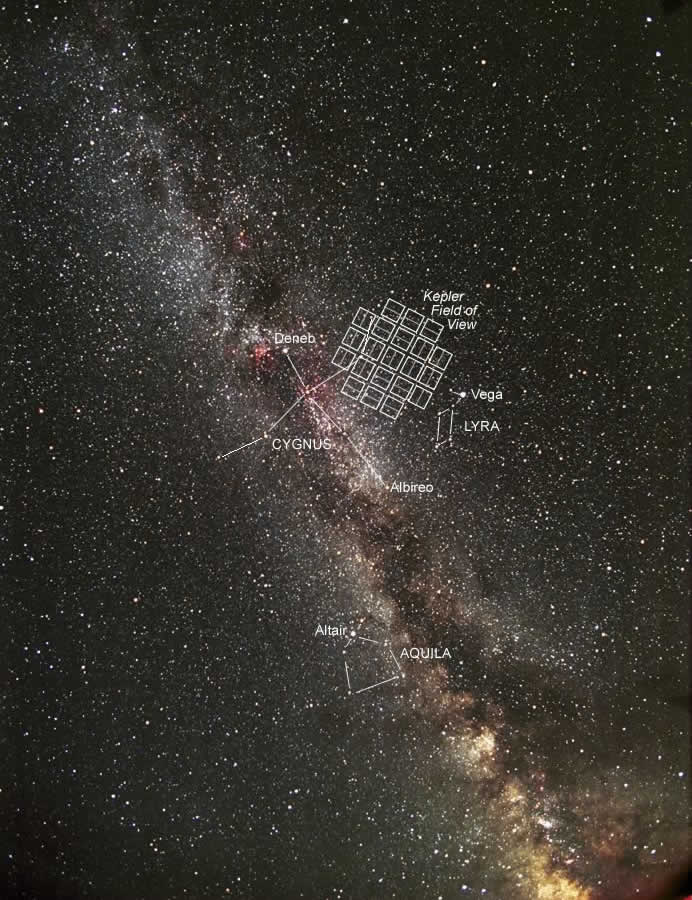
Kepler field of view. Credit C. Roberts, NASA.
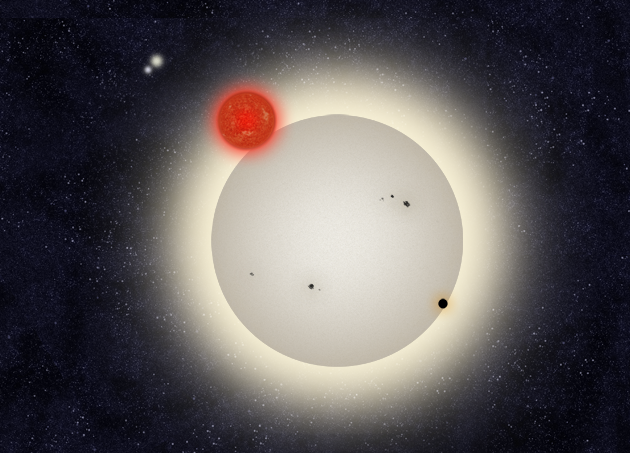
Artist’s rendition of PH1 (Planet Hunters 1) a planet in a 4 star system. Image credit: Haven Giguere/Yale.
Here’s the post from the Planet Hunters blog.
11/15/2012 – Ephemeris – Fomalhaut the lonely star has a companion planet
Ephemeris for Thursday, November 15th. The sun will rise at 7:39. It’ll be up for 9 hours and 34 minutes, setting at 5:14. The moon, 2 days past new, will set at 7:03 this evening.
The lonely bright star low in the south at 8 p.m. these evenings is Fomalhaut the harbinger of autumn in my book. Fomalhaut means fishes mouth and is located at the head of Piscis Austrinus, a very dim constellation. Fomalhaut is a young white star only 400 million years old with a disk of dust surrounding it. In an outer dust ring, 10 years ago the Hubble Space Telescope discovered a spot. Four years later astronomers discovered that the spot moved along the dust lane and announced the first direct discovery of an exoplanet. There’s been some controversy ever since, about is it really a planet or just a clump of material. It seems at this time that there is a planet there but it is shrouded by a cloud of dust, so that the planet cannot be detected.
Times are for the Traverse City/Interlochen area of Michigan. They may be different for your location.
Addendum
Fomalhaut in the south at 8 p.m. on November 15, 2012. Created using Stellarium.
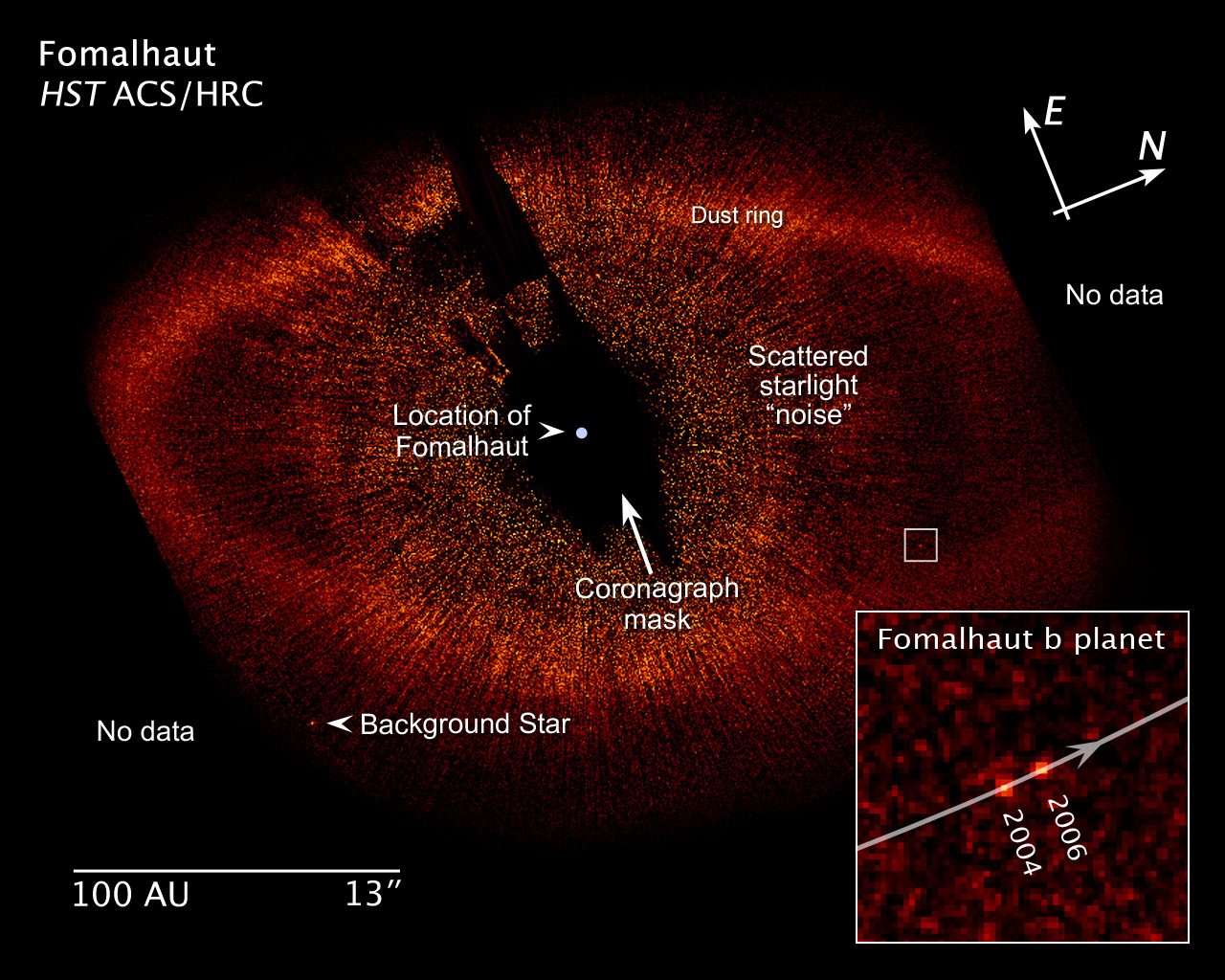
Fomalhaut and possible planet via the Hubble Space Telescope. Courtesy NASA
Click on above image to enlarge.
 Bob Moler's Ephemeris Blog