Archive
11/13/2014 – Ephemeris – The Great Andromeda Galaxy
Ephemeris for Thursday, November 13th. The sun will rise at 7:36. It’ll be up for 9 hours and 40 minutes, setting at 5:16. The moon, 1 day before last quarter, will rise at 11:36 this evening.
The Great Andromeda Galaxy that we amateur astronomers usually call M31 is the closest spiral galaxy to our own Milky Way Galaxy. It is actually visible to keen-eyed observers to the naked eye. To locate it, first find the Great Square of Pegasus, 4 stars high in the south that make a pretty good square. From the top left star, Alpheratz, direct your gaze to the first two stars in a slightly curved line to the left to Mirach. Then go two stars up. The last one is a bit dim. But just to the upper right of that last star is a little fuzzy spot. That is the core of the Great Andromeda Galaxy. In binoculars it looks elongated. Photographs show the galaxy to span 6 Moon widths. It is somewhat larger than our galaxy and will collide with the Milky Way in about 4 billion years.
Times are for the Traverse City/Interlochen area of Michigan. They may be different for your location.
Addendum
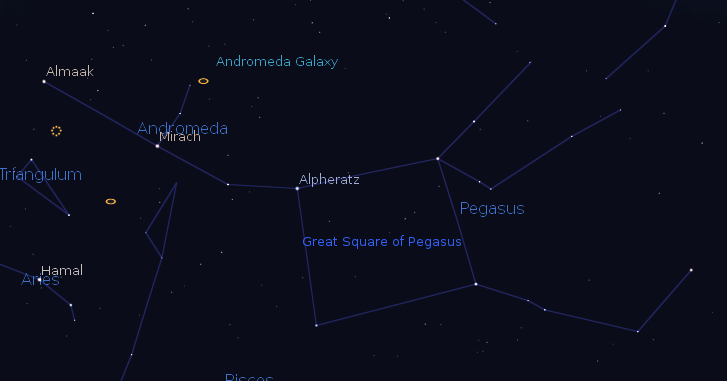
Great Andromeda Galaxy finder chart. Created using Stellarium and GIMP.
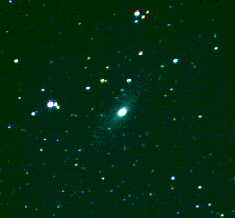
The Great Andromeda Galaxy (M31) as seen in binoculars. Visually even in a telescope the hub of this galaxy is all that is seen. However it also can be seen with the naked eye. My photograph.
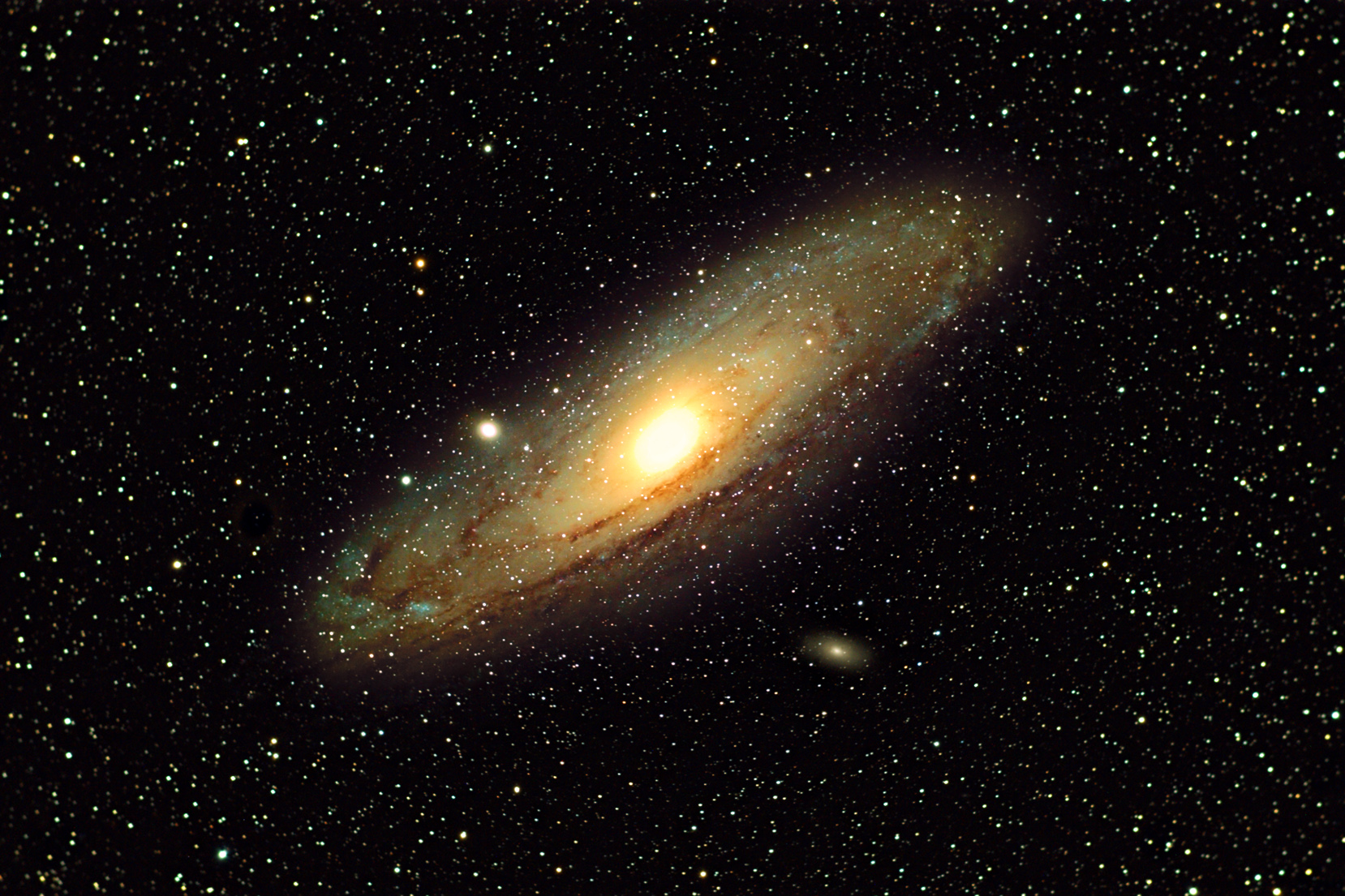
The Great Andromeda Galaxy (M31). Satellite galaxy M32 is located at the edge of the disk at 9 o’clock, and another, M110 is located at 5 o’clock. Both can be seen in telescopes, but some distance from the core of M31 and seen visually. Image taken by Scott Anttila.
10/17/2014 – Ephmeris – There’s a star party Saturday at the NMC Rogers Observatory
Ephemeris for Friday, October 17th. The sun will rise at 8:00. It’ll be up for 10 hours and 54 minutes, setting at 6:54. The moon, 2 days past last quarter, will rise at 2:47 tomorrow morning.
Tomorrow night the Grand Traverse Astronomical Society will host a Star Party at Northwestern Michigan College’s Rogers Observatory from 9 p.m. to 11 p.m. On tap, if it’s clear will be the wonders of both the summer and the autumn skies, The summer Milky Way is still visible moving off to the southwest with its star clusters and nebulae. The autumn sky has star clusters too, including the famous Pleiades, best seen in binoculars or telescope finders, and the wonderful Double Cluster. The autumn sky is also host to the closest spiral galaxy to us the Great Andromeda Galaxy, which will get a whole lot closer in 4 billion years. Come on out to the observatory on Birmley Road, about 2 miles south of South Airport Road.
Times are for the Traverse City/Interlochen area of Michigan. They may be different for your location.
Addendum
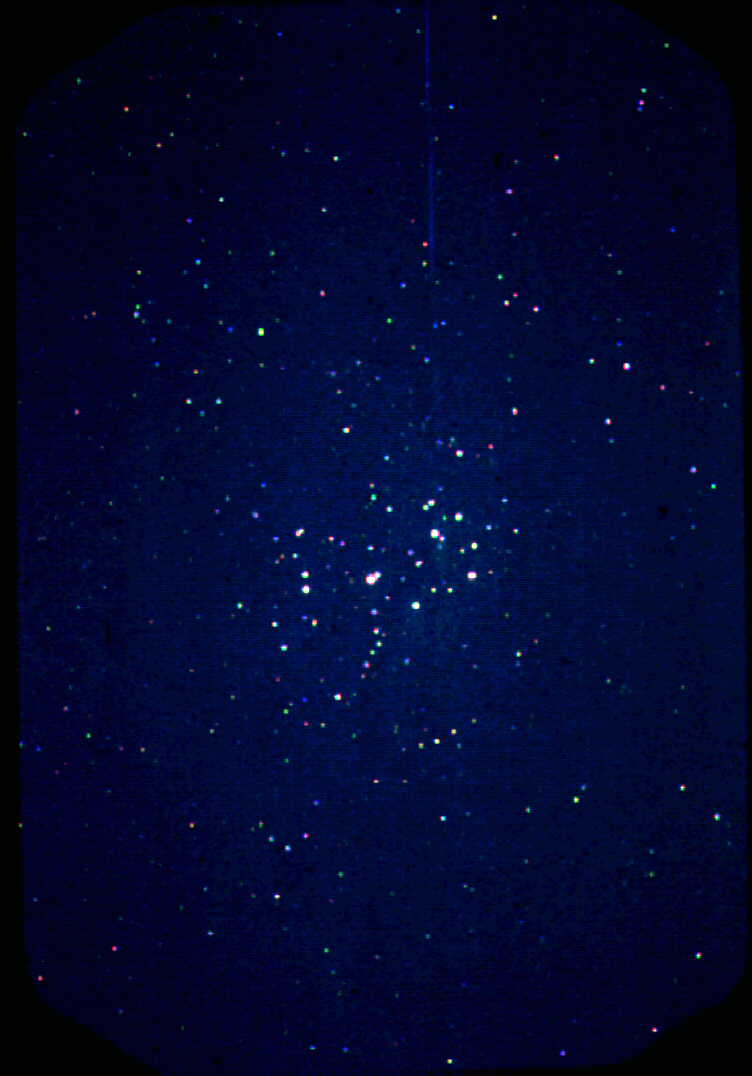
The Pleiades, about what you’d see in binoculars.
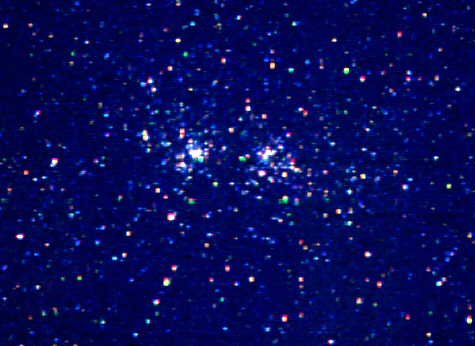
Double Cluster as it would be seen in a small telescope.
The Great Andromeda Galaxy (M31) as seen in binoculars. Visually even in a telescope the hub of this galaxy is all that is seen. However it also can be seen with the naked eye. However a telescope can also show its two satellite galaxies.
09/09/2014 – Ephemeris – Our address in the universe just changed
Ephemeris for Tuesday, September 9th. The sun will rise at 7:14. It’ll be up for 12 hours and 49 minutes, setting at 8:04. The moon, 1 day past full, will rise at 8:19 this evening.
Two and a half years ago my wife and I took a week-long cruise around the Hawaiian Islands. I always said I’d go back in a minute. Well, now maybe I and you are already there… in spirit, anyway. Astronomers at the National Radio Astronomy Observatory and the University of Hawai’i announced the pinning down the dimensions of the local supercluster of galaxies containing over 100 quadrillion stars spread over a diameter of more than 500 million light years that they have dubbed Laniakea which in Hawaiian means “immense heaven”. The lead researcher was R. Brent Tully of the University of Hawai’i. Also participating were two astronomers from France and one from Hebrew University. So your ultimate address is: your address, City, State, Country, Earth, Solar System, Orion spiral arm, Milky Way Galaxy, Local Group, Laniakea supercluster, Universe, and maybe Multiverse.
Times are for the Traverse City/Interlochen area of Michigan. They may be different for your location.
Addendum
The Bad Astronomer’s take on Laniakea.
Some videos illustrating Laniakea supercluster:
A 3D view
06/04/2013 – Ephemeris – A cluster of not stars but galaxies
Ephemeris for Tuesday, June 4th. Today the sun will be up for 15 hours and 24 minutes, setting at 9:23. The moon, half way from last quarter to new, will rise at 4:08 tomorrow morning. Tomorrow the sun will rise at 5:58.
The constellation Virgo which contains the bright star Spica and for this and the last two years the planet Saturn is in a sparse region of the sky as far as stars go. We are almost directly looking out the side of our Milky Way Galaxy. That milky band has been banished to the northern horizon. But while the stars may be few, we are also looking out past a gulf of 50 million light years to a great cluster of galaxies we call the Virgo Cluster. The galaxies here count into the thousands and overflow Virgo itself into adjacent constellations. I found that an 8 inch diameter telescope can easily pick up the brightest of them. In its heart is a giant elliptical galaxy M87 which has a black hole of 6.6 billion sun masses.
Times are for the Traverse City/Interlochen area of Michigan. They may be different for your location.
Addendum
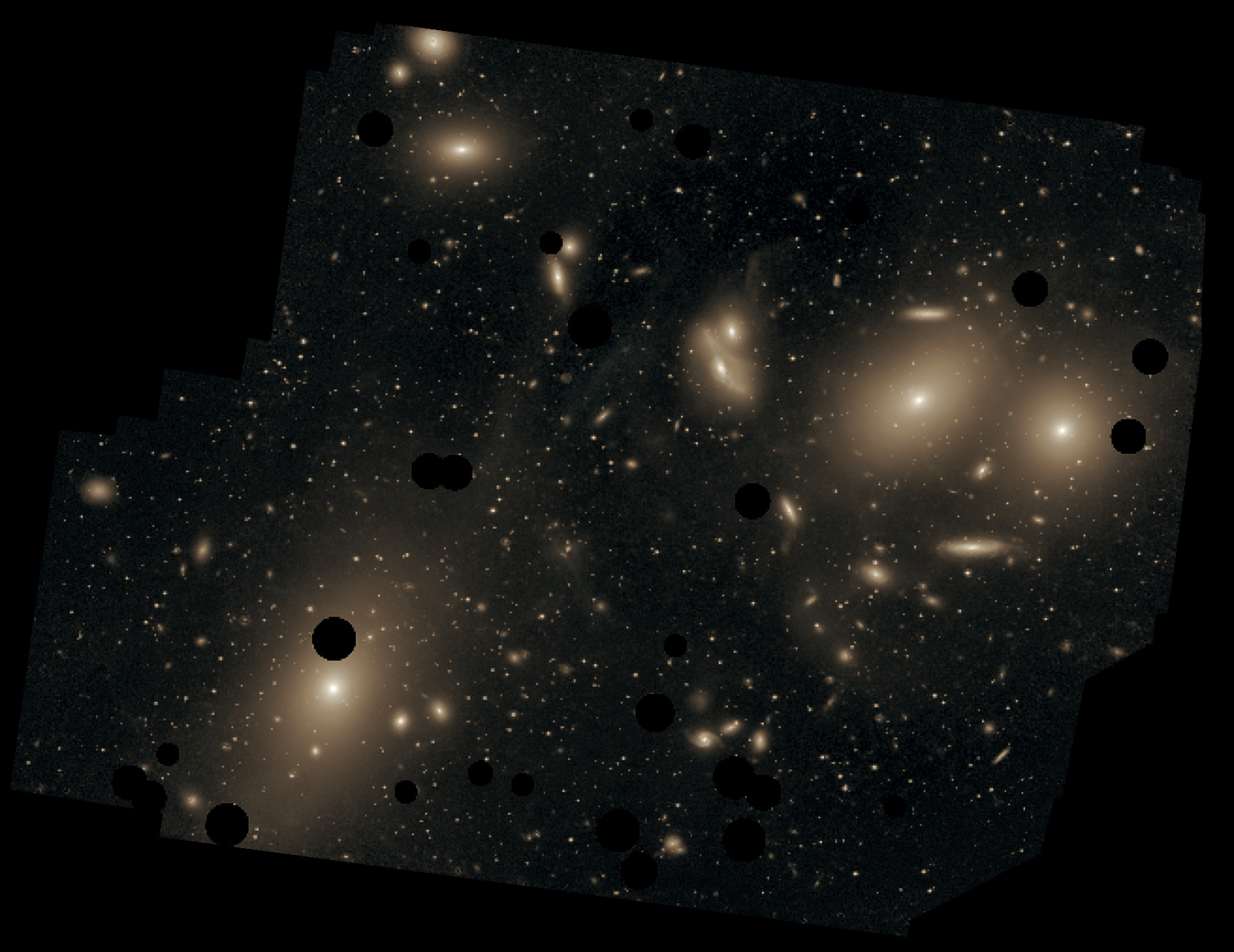
This deep image of the Virgo Cluster obtained by Chris Mihos and his colleagues using the Burrell Schmidt telescope shows the diffuse light between the galaxies belonging to the cluster. North is up, east to the left. The dark spots indicate where bright foreground stars were removed from the image. Messier 87 is the largest galaxy in the picture (lower left).
05/10/2012 – Ephemeris – The Virgo Cluster (of galaxies)
Ephemeris for Thursday, May 10th. The sun rises at 6:19. It’ll be up for 14 hours and 38 minutes, setting at 8:58. The moon, 2 days before last quarter, will rise at 1:36 tomorrow morning.
The constellation Virgo which contains the bright star Spica and for last and this year the planet Saturn is in a sparse region of the sky as far as stars go. We are almost directly looking out the side of our Milky Way Galaxy. That milky band has been banished to the northern horizon. But while the stars may be few, we are also looking out past a gulf of 50 million light years to a great cluster of galaxies we call the Virgo Cluster. The galaxies here count into the thousands and overflow Virgo itself into Leo to the west, Coma Berenices to the north and Corvus to the south. I found that an 8 inch diameter telescope can pick up the brightest, but that may be my eyesight. Charles Messier spotted them over 200 years ago with a telescope less than three inches in diameter.
Times are for the Traverse City/Interlochen area of Michigan. They may be different for your location.
Addendum
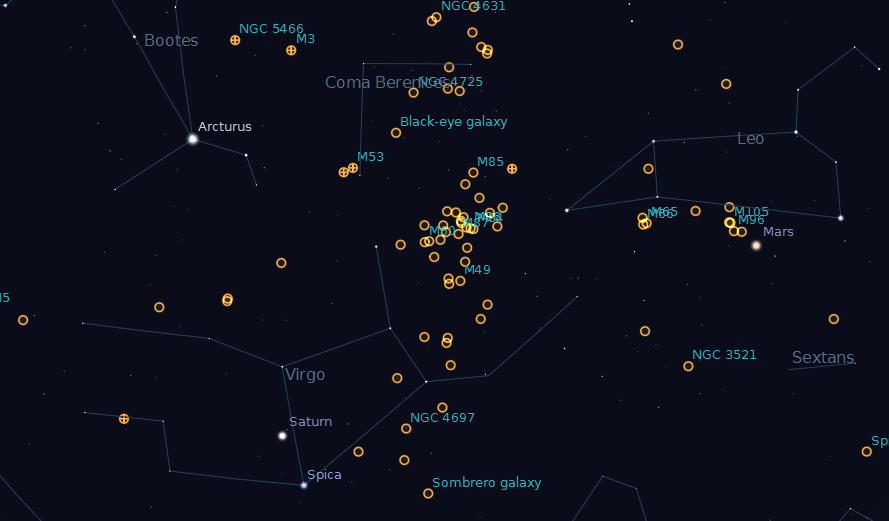
Brighter members of the Virgo Cluster. Created using Stellarium. Open circles are galaxies, circles with crosses are globular star clusters, outlying members of our Milky Way galaxy.
Click on image to enlarge.
 Bob Moler's Ephemeris Blog