Archive
01/15/2019 – Ephemeris – Welcome 8:19 a.m. listeners
Ephemeris for Tuesday, January 15th. Today the Sun will be up for 9 hours and 11 minutes, setting at 5:28, and it will rise tomorrow at 8:16. The Moon, 1 day past first quarter, will set at 3:11 tomorrow morning.
Welcome to the 8:19 a.m. listeners to this program. Due to the two-hour span from the 6:19 and 8:19 airings it was thought to always give you event times in advance, which is why I’m giving tomorrow’s sunrise times. Don’t worry tomorrow’s sunrise time will never be more than 2 minutes before or after today’s. Right now, sunrise times are retreating by a half-minute a day. It’s faster in spring and fall. For more information see my blog: bobmoler.wordpress.com. Transcripts of the program are there with illustrations and additional information. And today a way to create your own sunrise and sunset calendar.
The times given are for the Traverse City/Interlochen area of Michigan. They may be different for your location.
Addendum
The times of rising and setting of celestial objects is accurate for only one spot on the Earth. In the case of the times I give, it’s for my house. There’s a good reason for it. I live approximately half way between Interlochen and Traverse City. In the early days I interpolated from astronomical tables in the Royal Astronomical Society of Canada’s Observers Handbook. I preferred it to the Naval Observatory’s Astronomical Almanac, which was more expensive. Anyway I had a relatively flat horizon everywhere but north, so if I climbed on the roof I could check out and verify the rising and setting times. Note that the times assume a flat sea horizon.
About accurate times: At my latitude celestial objects rise and set one minute later for each 12 1/3 miles (19.85 km) you are west of me, or a good landmark would be Traverse City West Senior High School. For every 12 1/3 miles east of there rising and setting events would be earlier by a minute. The correction for latitude or north and south isn’t that simple. See the illustration below:
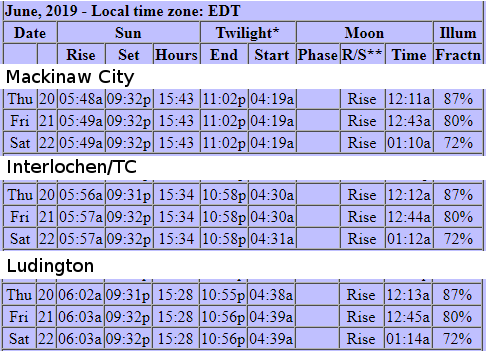
These are snippets of calendars for three locations that are in a straight line from south-southwest to north-northeast in the IPR listening area. A line drawn perpendicular to it to the west-northwest is to the Sun’s setting point. Thus the setting times for all three locations are the same. However their rising times are the most divergent, as are the daylight hours.
On my Ephemeris website, not to be confused with the blog that you are now reading, I have rise and set calendars for: Cadillac, Interlochen/Traverse City (Source for times on the Ephemeris program), Ludington, Mackinaw City, Petoskey, Eagle Harbor – Keweenaw Peninsula, Houghton Lake, and Earth’s Equator at the Prime Meridian. Go Here: http://ephemeris.bjmoler.org/calendar.htm.
If you’d like these times for a different location go to the Complete Sun and Moon Data for One Day, or Sun or Moon Rise/Set Table for One Year from the United States Naval Observatory (USNO). It calculates sunrise, sunset, moonrise, moonset, and twilight for locations in the US and other locations world-wide. Note that these do not follow the changes to and from Daylight Saving Time.
11/07/2016 – Ephemeris – Standard time returns for a few months
Ephemeris for Monday, November 7th. The Sun will rise at 7:29. It’ll be up for 9 hours and 53 minutes, setting at 5:22. The Moon, at first quarter today, will set at 12:09 tomorrow morning.
In these programs I usually talk about the evening sky. Now with the Sun rising later the morning sky is also accessible. Of course I have to mention it a day after sunrise was jerked back an hour by falling back to standard time, However sunrise will advance back to near what it was last week by Christmas time. The sky we’re seeing in the morning now is what we would see in the evening in late March or early April. In the morning we seen nearly in the opposite direction as in the evening, which is why we would see the stars as the will look nearly six months from now, as we orbit the Sun. In the morning, as we orbit the Sun we are looking to where we’re going on this nearly circular race track. We see Jupiter move away from the Sun as we start to overtake it. So in the evening sky we’re looking to where we’ve been, seeing Saturn falling behind, and Venus slowly overtaking us from the rear.
Times are for the Traverse City/Interlochen area of Michigan. They may be different for your location.
Addendum
Check out my November 1st post for the morning star chart.
Also check out my Ephemeris Calendar for how the time change affects the rising and setting events of the Sun and Moon.
 Bob Moler's Ephemeris Blog