Archive
07/27/2017 – Ephemeris – Two meteor showers, one peaking another ramping up
Ephemeris for Thursday, July 27th. The Sun rises at 6:23. It’ll be up for 14 hours and 49 minutes, setting at 9:13. The Moon, 3 days before first quarter, will set at 11:50 this evening.
We are in the season for meteor showers. Today the South Delta Aquariid Meteor Shower will reach peak. This is a not very active shower where the meteors will seem to come from low in the southeastern sky after midnight. The radiant will rotate to the south by 5 a.m. The moon won’t bother it for the next few days. The number of meteors seen will be under 20 per hour. This long-lasting shower will still add a few meteors when the famous Perseid meteor shower begin to appear, which is around now. These meteors will seem to come from the northeastern part of the sky, and will reach peak for us in the evening hours of August 12th. On that night the Moon will brighten the sky after 11:30 p.m. So for the next two weeks both shower meteors can be seen.
The times given are for the Traverse City/Interlochen area of Michigan. They may be different for your location.
Addendum
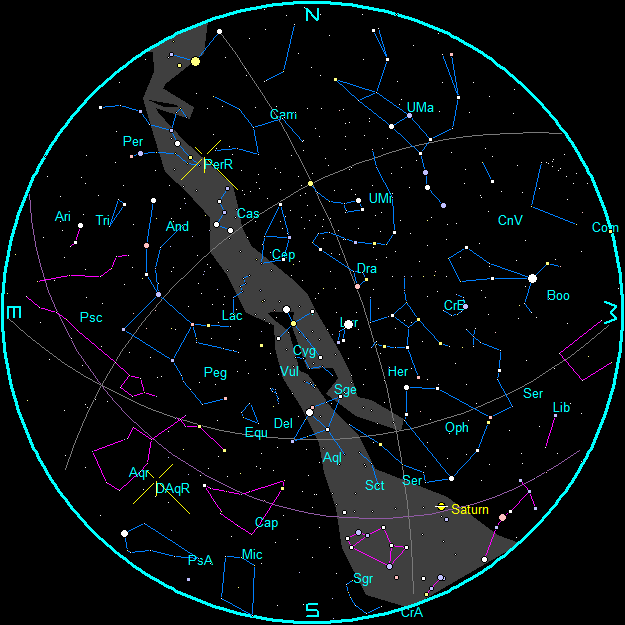
The sky at 1 a.m. tomorrow morning, July 28, 2017 showing the South Delta Aquariid (DAqR) and Perseid (PerR) meteor radiants. Created using my LookingUp program.
05/01/2017 – Ephemeris – Previewing May 2017 Skies
Ephemeris for Monday, May 1st. The Sun rises at 6:32. It’ll be up for 14 hours and 15 minutes, setting at 8:47. The Moon, 1 day before first quarter, will set at 2:24 tomorrow morning.
Today starts the month of May when the promise of spring is finally fulfilled. Daylight hours in the Interlochen/Traverse City area will increase from 14 hours and 15 minutes today to 15 hours 19 minutes on the 31st. The altitude, or angle, of the Sun above the southern horizon at local noon will ascend from 61 degrees now to 67 degrees at month’s end. The altitude of the sun in the Straits area will be a degree lower than that but your daylight hours will be a few minutes longer. Local apparent noon this month, when the sun passes due south, will be about 1:38 p.m.
This is the month of the Eta Aquariid meteor shower which will reach its peak this Thursday and Friday. There will be dark skies around 5 a.m. to see the meteors coming from the southeast.
The times given are for the Traverse City/Interlochen area of Michigan. They may be different for your location.
Addenda
May Evening Star Chart
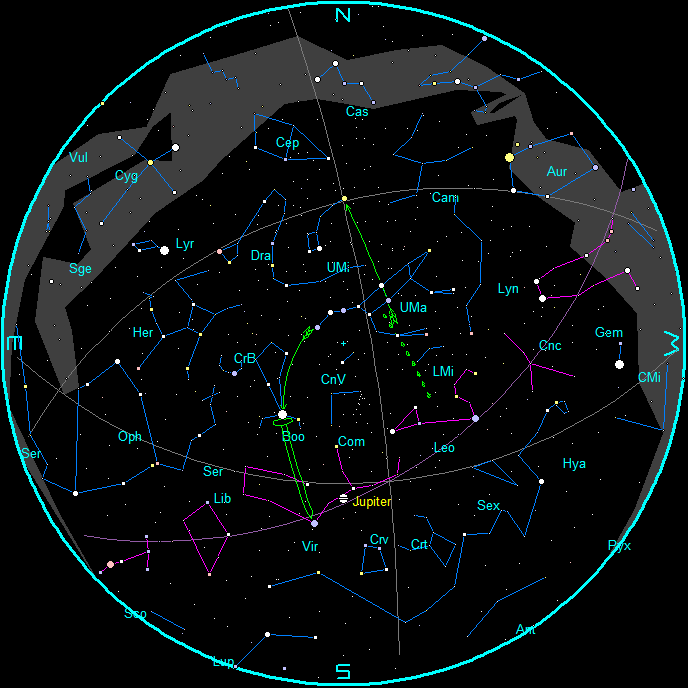
Evening Star Chart for May 2017 (11 p.m. May 15, 2017). Created using my LookingUp program. Click on image to enlarge.
The planets and stars are plotted for the 15th at 11 p.m. EDT in the evening and 5 a.m. for the morning chart. These are the chart times. Note that Traverse City is located approximately 45 minutes behind our time meridian. (An hour 45 minutes behind our daylight saving time meridian. during EDT and 45 minutes behind our daylight standard time meridian. during EST). To duplicate the star positions on a planisphere you may have to set it to 1 hour 45 minutes (Daylight Time) or 45 minutes (Standard Time) earlier than the current time if you are near your time meridian.
Note the chart times of 11 p.m. and 5 a.m. are for the 15th. For each week before the 15th add ½ hour. For each week after the 15th subtract ½ hour. The planet positions are updated each Wednesday on this blog.
May Morning Star Chart
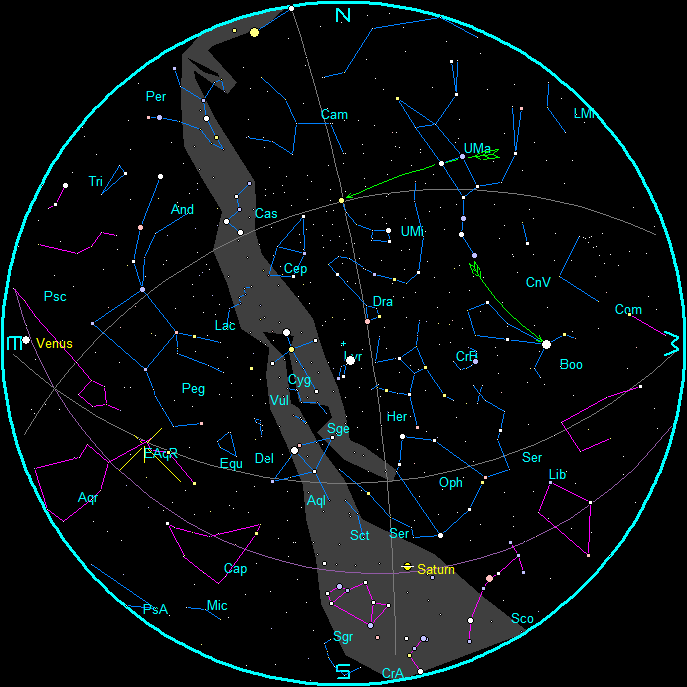
Star Chart for May 2017 mornings based on 5 a.m. May 15th. Created using my LookingUp program. Click on image to enlarge.
For a list of constellation names to go with the abbreviations click here.
- Pointer stars at the front of the bowl of the Big Dipper point to Polaris the North Star
- Follow the arc of the handle of the Big Dipper to the star Arcturus
- The Summer Triangle is in red
- The Eta Aquariid meteor shower radiant is in yellow and marked EAqR is active from April 19th to May 28th and peaks May 6th. Zenithal Hourly Rate at peak is expected to be 50, though considerably less than that is expected due to its radiant’s low position in our skies. Data from the International Meteor Organization 2017 calendar.
Evening nautical twilight ends at 10:02 p.m. EDT on the 1st, increasing to 10:46 p.m. EDT on the 31st.
Evening astronomical twilight ends at 10:47 p.m. EDT on the 1st, increasing to 11:44 p.m. EDT on the 31st.
Morning astronomical twilight starts at 4:40 a.m. EDT on the 1st, and increasing to 3:44 a.m. EDT on the 31st.
Morning nautical twilight starts at 5:24 a.m. EDT on the 1st, and Increasing to 4:42 a.m. EDT on the 31st.
NASA Calendar of Planetary Events
Credit: Sky Events Calendar by Fred Espenak and Sumit Dutta (NASA’s GSFC)
To generate your own calendar go to http://eclipse.gsfc.nasa.gov/SKYCAL/SKYCAL.html
Times are Eastern Time and follow the time change dates for Michigan, US
Date        Time    Event
May 01  Mo          Venus: 39.9° W
    02  Tu  2:23 pm Moon-Beehive: 3.7° N
    02  Tu 10:47 pm First Quarter
    04  Th  5:49 am Moon-Regulus: 0.6° N
    04  Th  6:42 am Moon Ascending Node
    04  Th 10:54 pm Eta Aquariid Shower: ZHR = 60
    05  Fr  9:51 am Mars-Aldebaran: 6.2° N
    07  Su  5:24 pm Moon-Jupiter: 2.3° S
    10  We  5:43 pm Full Moon
    12  Fr  3:51 pm Moon Apogee: 406200 km
    13  Sa  7:07 pm Moon-Saturn: 3.4° S
    14  Su  4:29 pm Moon South Dec.: 19.3° S
    17  We  6:59 pm Mercury Elongation: 25.8° W
    18  Th  8:33 pm Last Quarter
    18  Th  9:30 pm Moon Descending Node
    22  Mo  8:32 am Moon-Venus: 2.4° N
    23  Tu  9:20 pm Moon-Mercury: 1.6° N
    25  Th  3:44 pm New Moon
    25  Th  9:23 pm Moon Perigee: 357200 km
    27  Sa  7:36 pm Moon North Dec.: 19.4° N
    29  Mo  9:50 pm Moon-Beehive: 3.4° N
    31  We  7:56 am Moon Ascending Node
    31  We 12:08 pm Moon-Regulus: 0.3° N
Jun 01  Th          Venus: 45.8° W
May 2017 Calendar
LU                  Ephemeris of Sky Events for Interlochen/TC
May, 2017    Local time zone: EDT
+-----------------------------------------------------------------------+
| DATE |  SUN     SUN  DAYLIGHT|   TWILIGHT*    |MOON  RISE OR    ILLUM |
|      |  RISE    SET    HOURS |  END    START  |PHASE SET** TIME FRACTN|
+=======================================================================+
|Mon  1| 06:32a  08:48p  14:15 | 10:00p  05:20a |      Set  02:24a   38%|
|Tue  2| 06:30a  08:49p  14:18 | 10:02p  05:18a |F Qtr Set  03:07a   49%|
|Wed  3| 06:29a  08:50p  14:21 | 10:03p  05:16a |      Set  03:43a   59%|
|Thu  4| 06:28a  08:51p  14:23 | 10:05p  05:15a |      Set  04:16a   70%|
|Fri  5| 06:26a  08:52p  14:26 | 10:06p  05:13a |      Set  04:45a   78%|
|Sat  6| 06:25a  08:54p  14:28 | 10:08p  05:11a |      Set  05:12a   86%|
+------+-----------------------+----------------+-----------------------+
|Sun  7| 06:24a  08:55p  14:31 | 10:09p  05:09a |      Set  05:39a   92%|
|Mon  8| 06:22a  08:56p  14:33 | 10:11p  05:08a |      Set  06:07a   97%|
|Tue  9| 06:21a  08:57p  14:36 | 10:13p  05:06a |      Set  06:36a   99%|
|Wed 10| 06:20a  08:58p  14:38 | 10:14p  05:04a |Full  Rise 08:45p  100%|
|Thu 11| 06:18a  09:00p  14:41 | 10:16p  05:03a |      Rise 09:42p   99%|
|Fri 12| 06:17a  09:01p  14:43 | 10:17p  05:01a |      Rise 10:38p   96%|
|Sat 13| 06:16a  09:02p  14:45 | 10:19p  05:00a |      Rise 11:30p   91%|
+------+-----------------------+----------------+-----------------------+
|Sun 14| 06:15a  09:03p  14:48 | 10:20p  04:58a |      Rise 12:19a   85%|
|Mon 15| 06:14a  09:04p  14:50 | 10:22p  04:57a |      Rise 01:03a   78%|
|Tue 16| 06:13a  09:05p  14:52 | 10:23p  04:55a |      Rise 01:44a   70%|
|Wed 17| 06:12a  09:06p  14:54 | 10:25p  04:54a |      Rise 02:21a   60%|
|Thu 18| 06:11a  09:08p  14:56 | 10:26p  04:52a |L Qtr Rise 02:54a   50%|
|Fri 19| 06:10a  09:09p  14:58 | 10:28p  04:51a |      Rise 03:26a   40%|
|Sat 20| 06:09a  09:10p  15:00 | 10:29p  04:50a |      Rise 03:57a   30%|
+------+-----------------------+----------------+-----------------------+
|Sun 21| 06:08a  09:11p  15:02 | 10:30p  04:48a |      Rise 04:28a   20%|
|Mon 22| 06:07a  09:12p  15:04 | 10:32p  04:47a |      Rise 05:02a   12%|
|Tue 23| 06:06a  09:13p  15:06 | 10:33p  04:46a |      Rise 05:38a    5%|
|Wed 24| 06:05a  09:14p  15:08 | 10:35p  04:45a |      Rise 06:20a    1%|
|Thu 25| 06:04a  09:15p  15:10 | 10:36p  04:44a |New   Set  09:04p    0%|
|Fri 26| 06:04a  09:16p  15:12 | 10:37p  04:42a |      Set  10:16p    2%|
|Sat 27| 06:03a  09:17p  15:13 | 10:39p  04:41a |      Set  11:21p    7%|
+------+-----------------------+----------------+-----------------------+
|Sun 28| 06:02a  09:18p  15:15 | 10:40p  04:40a |      Set  12:18a   15%|
|Mon 29| 06:02a  09:19p  15:17 | 10:41p  04:39a |      Set  01:05a   24%|
|Tue 30| 06:01a  09:19p  15:18 | 10:42p  04:38a |      Set  01:45a   34%|
|Wed 31| 06:00a  09:20p  15:19 | 10:43p  04:38a |      Set  02:19a   44%|
+-----------------------------------------------------------------------+
* Nautical Twilight
** Moonrise or moonset, whichever occurs between sunset and sunrise
12/13/2016 – Ephemeris – The Geminid meteor shower will reach its peak tonight
Ephemeris for Tuesday, December 13th. The Sun will rise at 8:12. It’ll be up for 8 hours and 50 minutes, setting at 5:02. The Moon, at full today, will rise at 5:18 this evening.
The great meteor shower of December will reach its peak 7 p.m. The shower is called the Geminids because they seem to come from the constellation of Gemini the twins. Unlike most meteor showers which have their highest numbers just before dawn, the normal highest numbers of meteors, when the radiant point is highest in the sky is between 2 and 3 a.m. The radiant point, near the star Castor, the higher of the twin’s namesake stars will rise before 8 p.m. tonight. In the last few years the Geminids have bested the Perseid shower of August for numbers of meteors. The Geminids are caused by bits of rock that orbit the sun in a rather small but elongated orbit. Unfortunately this year the Moon is full, so all but the brightest meteors will be drowned out by moonlight.
Times are for the Traverse City/Interlochen area of Michigan. They may be different for your location.
Addendum
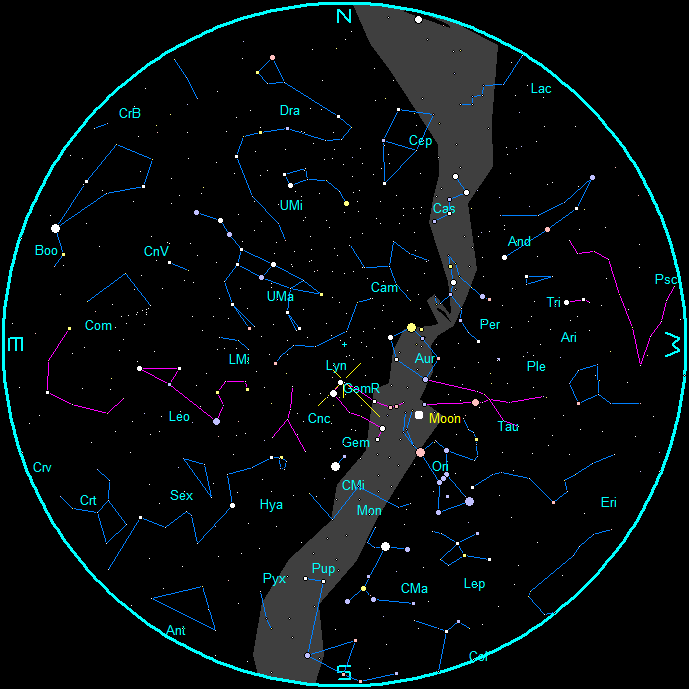
The entire sky at the time the radiant (GemR) is at its highest. That’s actually 2:37 a.m. December 14th, 2016. The radiant’s altitude is 78º. Also shown is the Moon’s position. Created using my LookingUp program. Click on the image to enlarge.
11/17/2016 – Ephemeris – The Leonid meteor shower will be hampered by the Moon tomorrow morning
Ephemeris for Thursday, November 17th. The Sun will rise at 7:43. It’ll be up for 9 hours and 29 minutes, setting at 5:12. The Moon, 3 days past full, will rise at 8:39 this evening.
The Leonid meteor shower, which reaches peak activity today is going to be washed out by the bright Moon. The International Meteor Organization doesn’t have anything specific on it this year. On most years, it produces only 15 meteors an hour tops. However about every 33 years or so all heaven breaks loose. From the predictions I’ve seen the fun starts in 2034 and lasts a few years. The reason for the spectacular meteor storms, as they call them, is that the responsible comet, 55P Tempel-Tuttle, has a debris clump that hasn’t fanned out much along its orbit, so we get intense meteor activity when the comet again enters the inner solar system. It’s expected back in 2031 with its main cloud of meteoroids a couple of years later.
Times are for the Traverse City/Interlochen area of Michigan. They may be different for your location.
Addendum
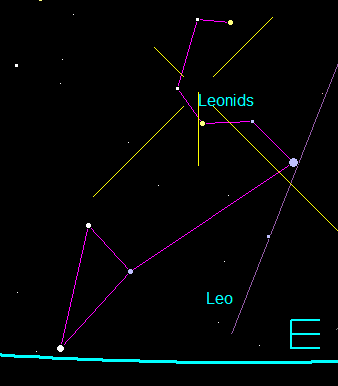
Leonid meteor radiant at about 2 a.m. from Traverse City. Credit: My LookingUp program.
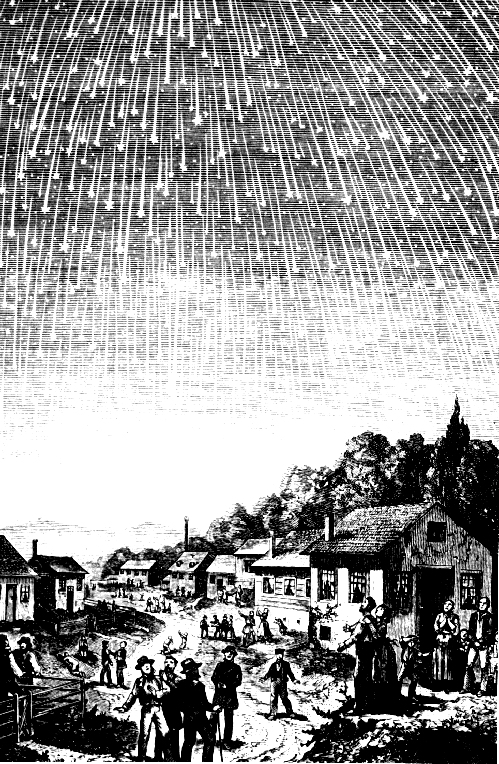
A famous woodcut of the 1833 Leonid meteor storm.
11/11/2016 – Ephemeris – Two Taurid meteor showers active now
Ephemeris for Veteran’s Day, Friday, November 11th. The Sun will rise at 7:35. It’ll be up for 9 hours and 43 minutes, setting at 5:18. The Moon, 3 days before full, will set at 4:49 tomorrow morning.
We are situated between two supposed peaks of two meteor showers, the South Taurids and the Northern Taurids. Their radiant points are roughly north and south of the face of Taurus the bull, which looks like the letter V of stars lying on its side. Both meteoroid streams belong to Encke’s Comet, the comet with the shortest known period of 3.3 years. The far end of the streams end up near Jupiter’s orbit, which allow the giant planet to split and broaden the meteoroid streams. Another feature of these streams is that they seem to be made of small pebbles rather than grains. When these pebbles hit our atmosphere at 17 miles (28 km) per second they will appear very bright. Really bright meteors are called Fireballs.
Times are for the Traverse City/Interlochen area of Michigan. They may be different for your location.
Addendum
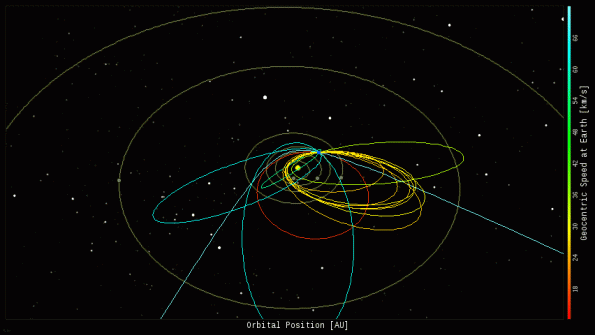
Fireball orbits traced back from November 9, 2016. The orbits marked in yellow sticking out o the right toward Jupiter’s orbit are the Taurids. Credit NASA All-sky Fireball Network via spaceweather.com.
NASA has three widely spaced sets of all-sky cameras which allow it to get 3-D views of fireballs entering the Earth’s atmosphere. which allow the measurement of velocity of the object and the determination of the meteoroid’s orbit before it hit Earth’s atmosphere. For more information go to: http://fireballs.ndc.nasa.gov/
08/11/2016 – Ephemeris – The Perseid meteors will peak tonight!
Ephemeris for Thursday, August 11th. The Sun rises at 6:41. It’ll be up for 14 hours and 12 minutes, setting at 8:53. The Moon, 1 day past first quarter, will set at 1:31 tomorrow morning.
This evening and tomorrow morning we should see the peak of the Perseid Meteor Shower. There is the expected broad peak of the shower which for us is after sunrise. However the meteoroid stream isn’t monolithic. Each pass of the comet in the inner solar system superimposes its debris on the general stream, so we will have increased activity all night tonight and even into Saturday morning. In general Perseid meteors will be seen to come from the northeast. The evening view will be hampered by the Moon which will drown out the dimmer meteors. The best time to view is after the Moon sets at 1:31 tomorrow morning until morning twilight becomes noticeable around 5 a.m. when over 100 meteors might be spotted an hour.
Times are for the Traverse City/Interlochen area of Michigan. They may be different for your location.
Addendum
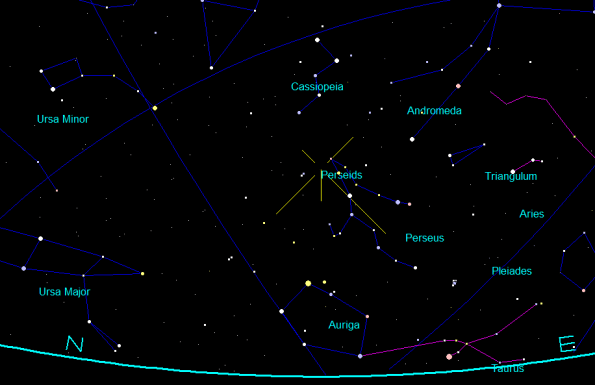
The Perseid meteor shower radiant a about 2 a,m, during the period of the shower. Created using my LookingUp program.
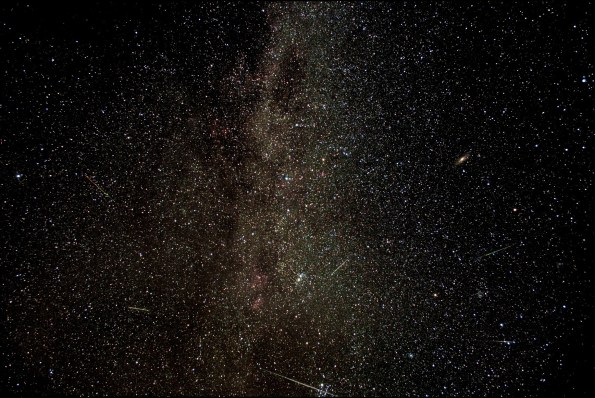
Here are some meteors seen in the 2007 Perseid meteor shower taken by Scott Anttila. The image is centered on Cassiopeia. The radiant is low and a bit left of center in the image. The Double Cluster is seen below center and the Great Andromeda Galaxy is seen on the right just above center.
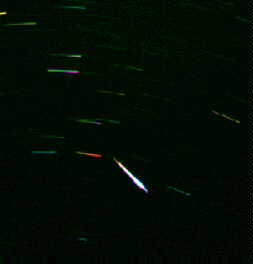
My best Perseid photo. From the 70’s.
08/09/2016 – Ephemeris – A look at the Perseids progenitor
Ephemeris for Tuesday, August 9th. The Sun rises at 6:38. It’ll be up for 14 hours and 18 minutes, setting at 8:56. The Moon, 1 day before first quarter, will set at 12:23 tomorrow morning.
Comet Swift-Tuttle is the comet responsible for the Perseid Meteor Shower which is now ramping up and will reach its peak Thursday night and Friday morning. The comet was independently discovered by Swift and Tuttle in the summer of 1862. Based on three months of observations it was predicted to return after 120 years in 1982. After it failed to appear more work was done to refine the orbit, and to check for past appearances of the comet. Sure enough comets appearing to fit the orbit were found in 188 CE and 69 BCE, so a new prediction for the comet to reappear was made for 1992 by the late Dr. Brian Marsden of the Smithsonian Astrophysical Observatory. His revised prediction was only off by 17 days.
Times are for the Traverse City/Interlochen area of Michigan. They may be different for your location.
Addendum
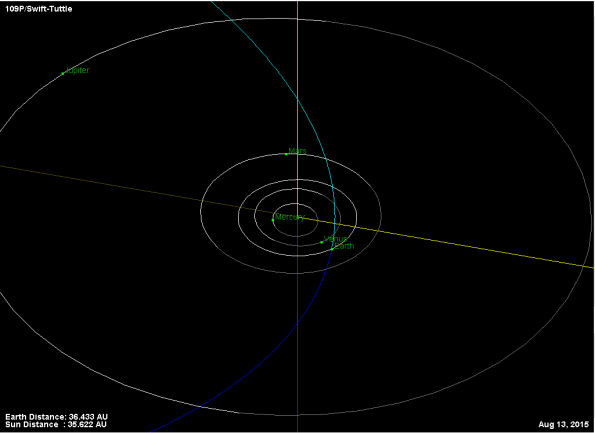
Orbit of Comet 109P/Swift-Tuttle. Blue line is the comet’s orbit, coming from above (North). Credit NASA / JPL / Applet by Osamu Ajiki (AstroArts), and further modified by Ron Baalke (JPL).
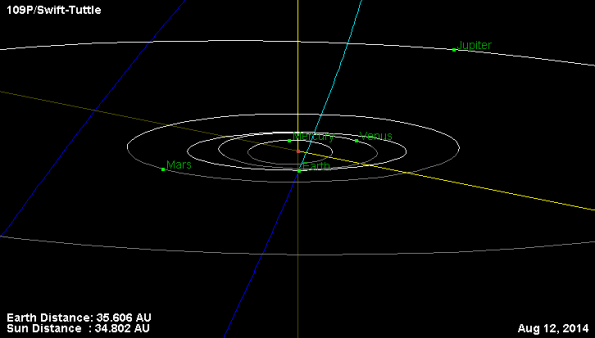
Orbit of Comet 109P/Swift-Tuttle. Blue line is the comet’s orbit, coming from above. That’s why the radiant is so far north. See yesterday’s post for the radiant point. Credit NASA / JPL / Applet by Osamu Ajiki (AstroArts), and further modified by Ron Baalke (JPL).
These were generated a couple of years ago. However the comet won’t be back until 2122 give or take.
08/08/2016 – Ephemeris – This week the Perseid meteors ramp up
Ephemeris for Monday, August 8th. The Sun rises at 6:37. It’ll be up for 14 hours and 20 minutes, setting at 8:58. The Moon, 2 days before first quarter, will set at 11:54 this evening.
The Perseid meteor shower will reach its peak for this year between 9 and 11:30 a.m. Friday morning, the 12th. There is some expectation that there will be an enhancement of meteor numbers on Thursday evening before midnight. Our problem is that the Moon will be out and bright Thursday evening and will set at 1:31 a.m. Friday morning. The bright Moon doesn’t preclude seeing meteors, but only the brightest ones will be visible. Also we have been seeing precursor meteors for the last three weeks, slowly ramping up to Friday morning’s peak. You’ll see them every night this week. The meteors are caused by the debris from Comet Swift-Tuttle whose 130 year orbit of the Sun over the millennia, has strewn meteoroids along its orbit.
Times are for the Traverse City/Interlochen area of Michigan. They may be different for your location.
Addendum
The Perseid meteor shower radiant is circumpolar for northern Michigan, so the meteors will be visible all night.
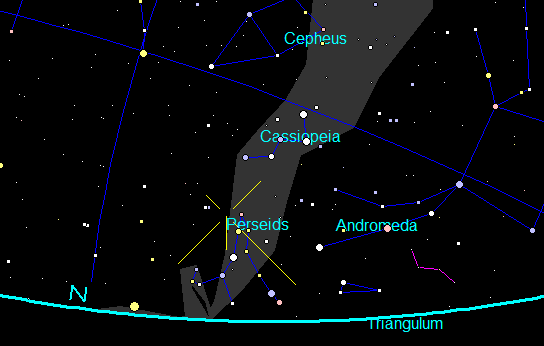
Perseid radiant at 10:30 p.m.
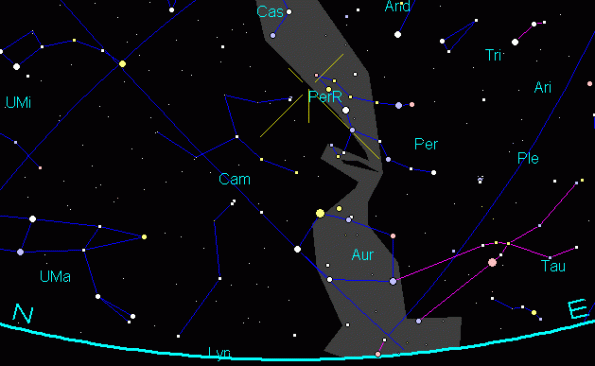
Perseid Meteor Shower radiant after midnight
07/28/2016 – Ephemeris – Two upcoming meteor showers plus an occultation tomorrow morning
Ephemeris for Thursday, July 28th. The Sun rises at 6:25. It’ll be up for 14 hours and 47 minutes, setting at 9:12. The Moon, 2 days past last quarter, will rise at 2:31 tomorrow morning.
We have a couple of meteor showers of note coming up. The first is the Southern Delta Aquariids which will peak on the 30th. The radiant point for these meteors will rise around midnight in the southeast. Their numbers and their brightness are not very great. The Perseid meteor shower peak will have interference from the waxing gibbous moon drowning out all but the brightest meteors on the evening of August 11 and morning of he 12th. However the Perseids have a long run up to their peak, so their numbers will grow after the moon sets. The Perseid radiant is circumpolar for Northern Michigan, meaning it never sets, so some Perseid meteors can always be seen at night. Their radiant will be low in the northeastern sky in the evening and much higher in the northeast just before dawn.
Times are for the Traverse City/Interlochen area of Michigan. They may be different for your location.
Addenda
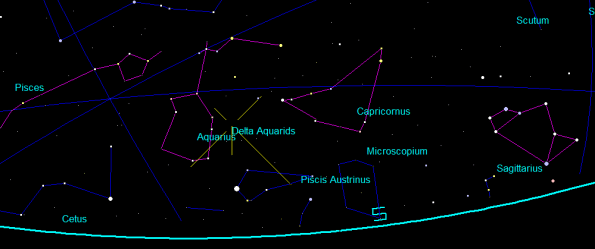
Approximate Radiant of the South Delta Aquariid meteor shower. The radiant does move over the several weeks of the shower to the east. Created using my LookingUp program.
Perseid Meteor Shower radiant after midnight. Created using my LookingUp program.
Update: Occultation of Aldebaran tomorrow morning
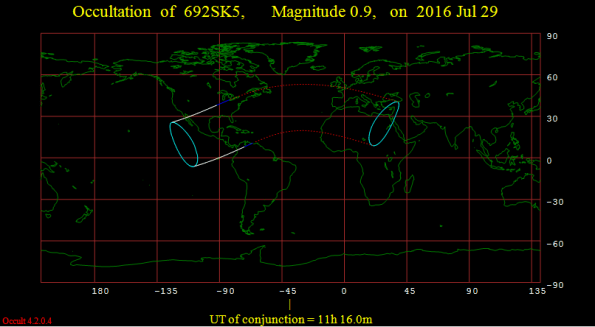
The area where the occultation of Aldebaran will be visible. The area bordered by the white lines is where the occultation will occur with the Sun below the horizon. Credit IOTA’s Occult 4 program.
There will be an occultation of Aldebaran by the Moon centered on 11:16 UT (7:16 a.m. EDT) July 29, 2016. Our area (Michigan) cannot see the event, being too far north. It will be visible south of a line containing the state of Maine down through Texas. Universe Today has information on grazing occultation possibilities: http://www.universetoday.com/129841/spectacular-aldebaran-graze-july-29/
12/14/2015 – Ephemeris – The Geminids reach peak today – See ’em morning or evening
Ephemeris for Monday, December 14th. The Sun will rise at 8:12. It’ll be up for 8 hours and 50 minutes, setting at 5:02. The Moon, 3 days past new, will set at 8:42 this evening.
The Geminid meteor shower is ongoing right now. The peak is expected to be near 1 p.m. today. So the numbers seen this morning while it’s still dark should be about the same as will be seen this evening. Not peak numbers, but it should be a good show nonetheless if it’s clear tonight. The radiant is in the constellation of Gemini above Orion. The source of this shower is an asteroid rather than a comet. It may be a burnt out comet which lost all its frozen gasses. It has a definite highly elliptical orbit of a comet and comes very close to the Sun, where one of the STEREO Sun monitoring spacecraft saw it ejecting a cloud of dust. It may be classed as a rock comet for that reason, blurring the line between comets and asteroids.
Times are for the Traverse City/Interlochen area of Michigan. They may be different for your location.
Addendum
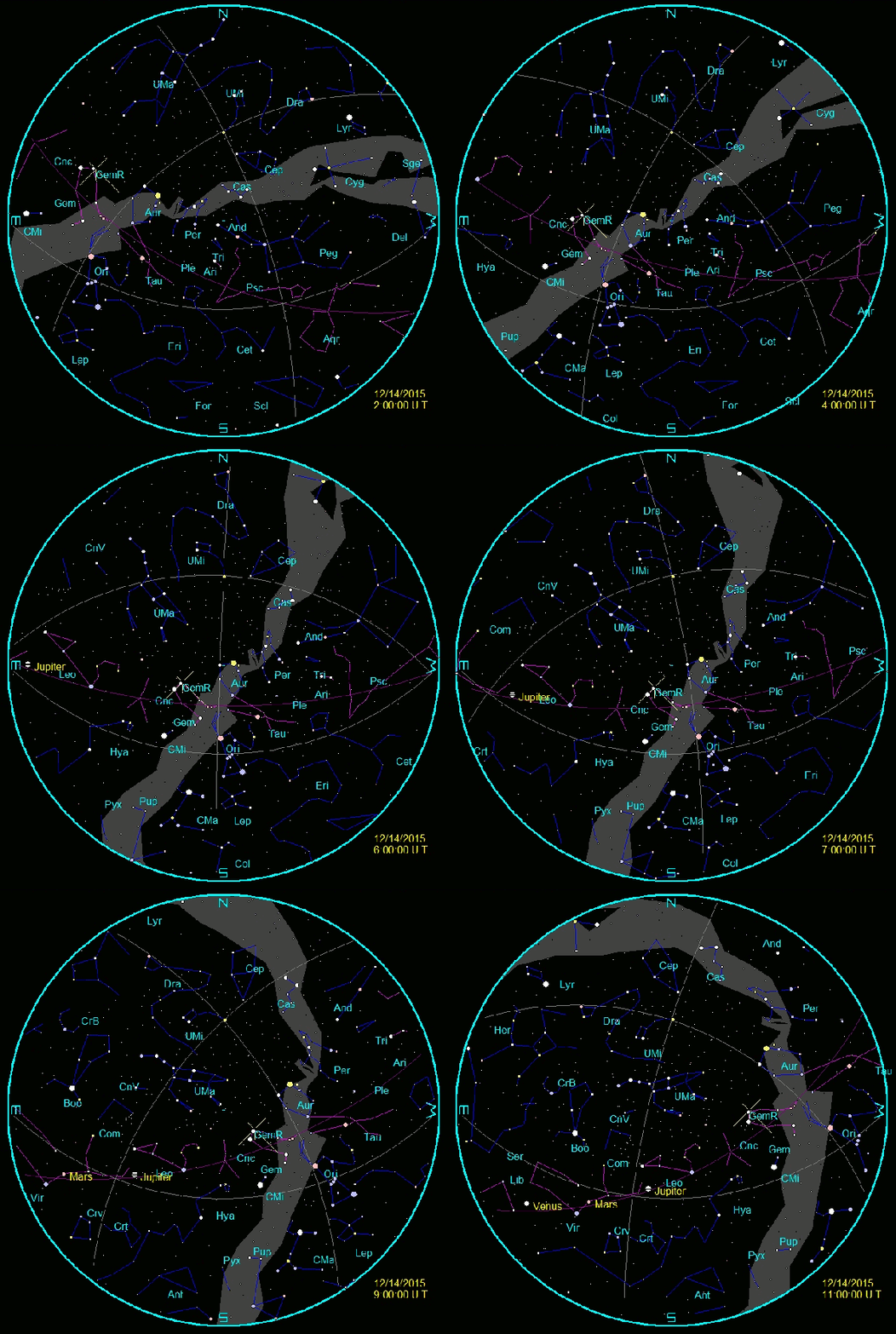
All Sky view one hour intervals for The Geminid meteor shower the night of December 13-14, 2015.. Note the radiant “GemR”. Created with my LookingUp program and GIMP.
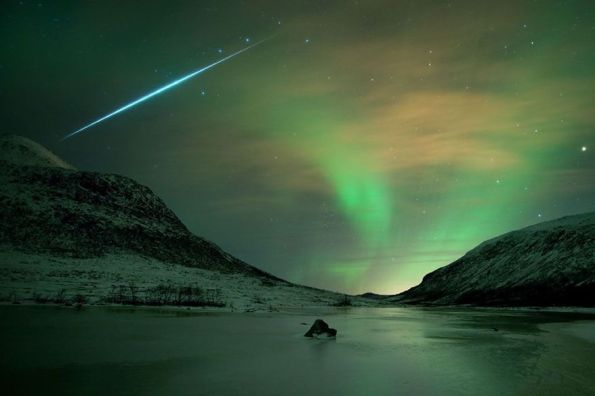
A Geminid and the aurora borealis from Norway. Found this in a NASA blog (link below) uncredited). However I was able to find the credit: Image Credit & Copyright: Bjørnar G. Hansen.
The image above was also an Astronomy Picture of the Day. Here’s a link to the NASA blog dated December 9, 2015 about live tweeting the Geminids.
 Bob Moler's Ephemeris Blog