Archive
05/30/2022 – Ephemeris – There might be a spectacular meteor shower/storm tonight after midnight!
This is Ephemeris for Memorial Day, Monday, May 30th. Today the Sun will be up for 15 hours and 18 minutes, setting at 9:19, and it will rise tomorrow at 6:00. The Moon is new today, and won’t be visible.
Comet Schwassmann-Wachmann 3, SW3 for short began to breakup in 1995, 27 years ago. Two large chunks of the comet’s nucleus and dozens of smaller pieces have been seen. We expect a vast debris field to be expanding from the remnants of the comet, unseen. Astronomers, calculating what happened to that unseen debris cloud, expect the Earth to run into a part of it around 1 am (EDT, 5 hours UT), give or take, tomorrow morning. Causing, if we’re lucky, a meteor shower or meteor storm. The radiant point from which the meteors seem to come is from between the Big Dipper’s handle and the bright star Arcturus. They will appear all over the sky. I’m crossing my fingers on this one, it could be great, or it could be nothing.
The astronomical event times given are for the Traverse City/Interlochen area of Michigan (EDT, UT – 4 hours). They may be different for your location.
Addendum
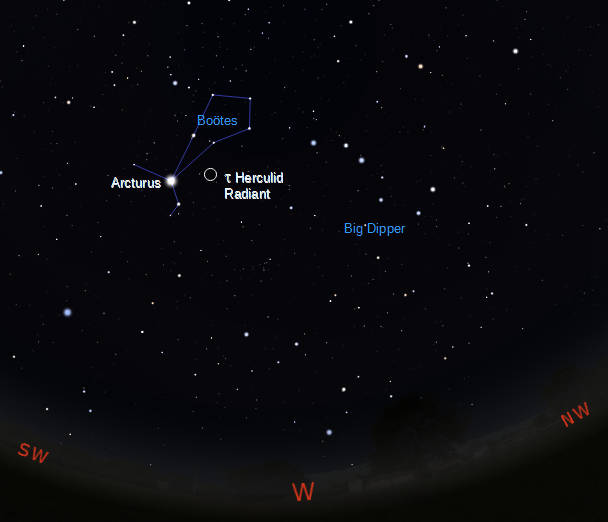
Position of the Tau Herculid radiant at 1 am, May 31, 2022. However, meteors will appear all over the sky, but could be traced back to the radiant. These meteors will appear to travel a lot slower than the Perseid meteors of August. Created using Stellarium for the star field and LibreOffice for annotations.
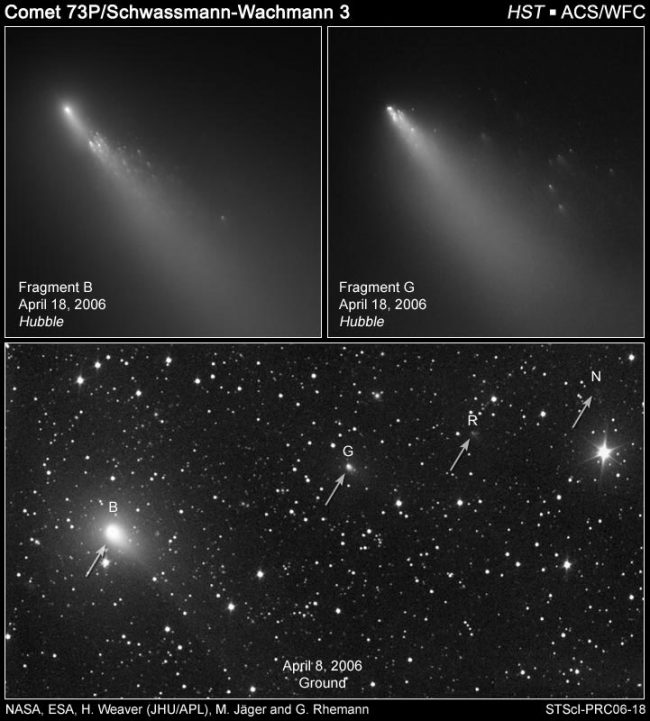
Comet Schwassmann-Wachmann 3 Hubble Space Telescope images from 2006 showing the breakup of the comet. Credit: NASA.
05/27/2022 – Ephemeris – There could be a spectacular meteor display Tuesday early morning, or nothing!
This is Bob Moler with Ephemeris for Friday, May 27th. Today the Sun will be up for 15 hours and 13 minutes, setting at 9:16, and it will rise tomorrow at 6:02. The Moon, 3 days before new, will rise at 5:03 tomorrow morning.
Comet Schwassmann-Wachmann 3, SW3 for short began to breakup in 1995, 27 years ago. Two large chunks of the comet’s nucleus and dozens of smaller pieces have been seen. A vast, unseen debris field is expected to be expanding from the remnants of the comet. Astronomers, calculating what happened to that unseen debris cloud, expect the Earth to run into a part of it around 1 am (EDT, 5 hours UT), give or take, on Tuesday, May 31st (That’s late Memorial Day night). Causing, if we’re lucky, a meteor shower or meteor storm. The radiant point from which the meteors seem to come is from between the Big Dipper’s handle and the bright star Arcturus. They will appear all over the sky. I’m crossing my fingers on this one, it could be great, or it could be nothing.
The astronomical event times given are for the Traverse City/Interlochen area of Michigan (EDT, UT – 4 hours). They may be different for your location.
Addendum
Position of the Tau Herculid radiant at 1 am, May 31, 2022. However, meteors will appear all over the sky, but could be traced back to the radiant. These meteors will appear to travel a lot slower than the Perseid meteors of August. Created using Stellarium for the star field and LibreOffice for annotations.
Comet Schwassmann-Wachmann 3 Hubble Space Telescope images from 2006 showing the breakup of the comet. Credit: NASA.
05/26/2022 – Ephemeris – There may be a spectacular meteor storm Tuesday am or nothing!
This is Ephemeris for Thursday, May 26th. Today the Sun will be up for 15 hours and 11 minutes, setting at 9:16, and it will rise tomorrow at 6:03. The Moon, halfway from last quarter to new, will rise at 4:42 tomorrow morning.
Early risers tomorrow morning should be able to see, if it’s clear, the planet Venus just above and right of the waning crescent Moon. The last of the visible Moon-planet encounters this month. Another event this month may be the Tau Herculid meteor shower. This may be a spectacular meteor shower, or nothing. It would be the result of the breakup of Comet Schwassmann-Wachmann 3 that started back in 1995. SW3, as it’s known for short, has a 5.44 year orbit of the Sun, so we only get a good look at it about every 11 years currently. As the nucleus breaks up, the debris field widens, with time. The comet will pass close to the orbit of the Earth in a few months. The comet’s orbit comes closest to the Earth’s orbit on May 31st. If the debris cloud has widened enough by now, the Earth should intercept it around 1 am our time that morning.
The astronomical event times given are for the Traverse City/Interlochen area of Michigan (EDT, UT – 4 hours). They may be different for your location.
Addendum
Position of the Tau Herculid radiant at 1 am, May 31, 2022. However, meteors will appear all over the sky, but could be traced back to the radiant. These meteors will appear to travel a lot slower than the Perseid meteors of August. The meteor storm, if it occurs, should peak around 1 am. However, there is an uncertainty with the time or if the meteor will show up. Created using Stellarium for the star field and LibreOffice for annotations.
Comet Schwassmann-Wachmann 3 Hubble Space Telescope images from 2006 showing the breakup of the comet. Credit: NASA.
11/21/2019 – Ephemeris – There may be a chance to see a meteor storm late tonight
Ephemeris for Thursday, November 21st. Today the Sun will be up for 9 hours and 22 minutes, setting at 5:09, and it will rise tomorrow at 7:48. The Moon, 2 days past last quarter, will rise at 2:39 tomorrow morning.
Tonight we might be in for a treat it it is clear: a meteor storm. It comes from a very minor meteoroid stream called the Alpha Monocerotids. That means the meteors will appear to come from the constellation of Monoceros the unicorn, just east of Orion. Don’t worry about that. At the predicted peak time 11:50 p.m. (04:50 UTC November 22) the meteors will appear to come from the east, but appear all over the sky. Predictions of this sort are tricky since members of the meteor stream can only be tracked as they burn up in Earth’s atmosphere. This shower had meteor storms in 1925, 1935, 1985, and 1995. In 1985 there was an outburst at a rate of 700 meteors an hour. The storm is expected to last less than an hour.
The times given are for the Traverse City/Interlochen area of Michigan. They may be different for your location.
Addendum
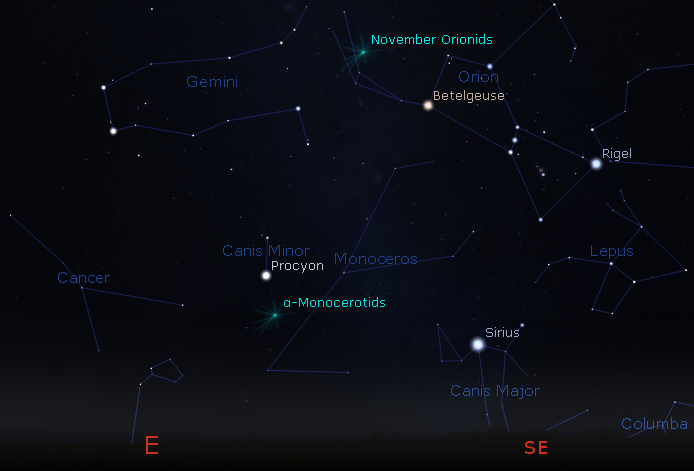
Alpha Monocerotis radiant at 11:30 p.m. November 21, 2019. Note the word alpha is replaced by the Greek letter α. The other shower radiant the seen, the November Orionids is another minor shower which will reach peak on the 28th with an estimated 3 meteors an hour. The normal rate for the α-Monocerotids is 5 an hour. Click on the image to enlarge. Created using Stellarium.
Online sources: Bad Astronomer Phil Plait – https://www.syfy.com/syfywire/will-the-unicorn-give-us-a-meteor-storm-on-november-22; here’s another source: https://www.meteornews.net/2019/11/06/likely-alpha-monocerotids-amo246-outburst-on-the-morning-of-november-22-2019/.
11/15/2019 – Ephemeris – The Leonids in the moonlight
Ephemeris for Friday, November 15th. Today the Sun will be up for 9 hours and 35 minutes, setting at 5:14, and it will rise tomorrow at 7:40. The Moon, 3 days past full, will rise at 7:45 this evening.
We are coming into a period where the Leonid meteor shower will be at its peak, as the Earth passes through the debris left by Comet Tempel-Tuttle on past trips through the inner solar system. We are having a bright Moon now which will diminish their numbers. The Leonids are only visible after midnight, and that’s when the Moon is highest in the sky. The meteors will appear to come from the top of a backward question mark that is the head of the constellation Leo the lion. They will be seen all over the sky, but can be traced back to that point. The Leonids are most numerous about every 33 years, which is about 13 years from now. Otherwise we get about 15 meteors an hour at peak when the Moon isn’t out.
The times given are for the Traverse City/Interlochen area of Michigan. They may be different for your location.
Addendum
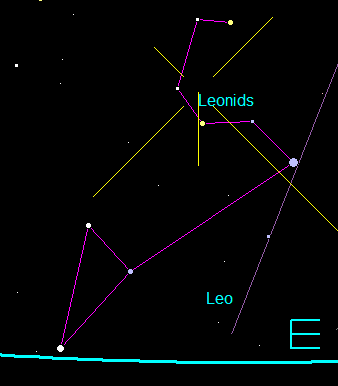
Leo rising at around 2 a.m. on the morning of November 18. Note the radiant in the sickle asterism of Leo. Created using Looking Up, my own program.
New Meteor News!
I’ll have more next week, but we may be able to witness a meteor storm on the evening of the 21st and morning of the 22nd. It is the Alpha Monocerotids. They will seem to come from the constellation of Monoceros the unicorn. That constellation lies in the blank spot in the triangle between Orion, Canis Major and Canis Minor. The radiant will rise at 10:30 p.m.
Check this out: https://www.syfy.com/syfywire/will-the-unicorn-give-us-a-meteor-storm-on-november-22
11/19/2018 – Ephemeris – The Leonids’ comet 55P/Tempel-Tuttle
Ephemeris for Monday, November 19th. The Sun will rise at 7:45. It’ll be up for 9 hours and 25 minutes, setting at 5:10. The Moon, half way from first quarter to full, will set at 4:29 tomorrow morning.
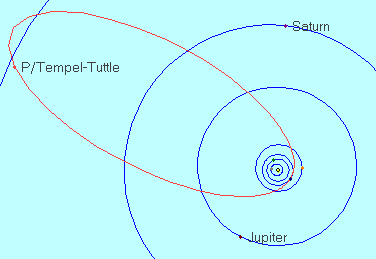
We have another day in this year’s extended Leonid meteor peak. In past years, usually every 33 years the Leonid meteors have a super peak, called a meteor storm, where thousands of meteors streak through the skies. These appear for a brief period over a rather small geographic area. In 1966 it occurred principally over the Rocky Mountains. The comet responsible is Comet Tempel Tuttle, independently discovered by two astronomers Tempel and Tuttle in 1865 & 1866. The comet had a 33 year orbit of the Sun, and its orbit crosses very close to the Earth’s orbit. Comets are notorious litter bugs, shedding gas, dust and pebble sized debris as they come close to the warming rays of the Sun.
The times given are for the Traverse City/Interlochen area of Michigan. They may be different for your location.
Addendum
11/17/2016 – Ephemeris – The Leonid meteor shower will be hampered by the Moon tomorrow morning
Ephemeris for Thursday, November 17th. The Sun will rise at 7:43. It’ll be up for 9 hours and 29 minutes, setting at 5:12. The Moon, 3 days past full, will rise at 8:39 this evening.
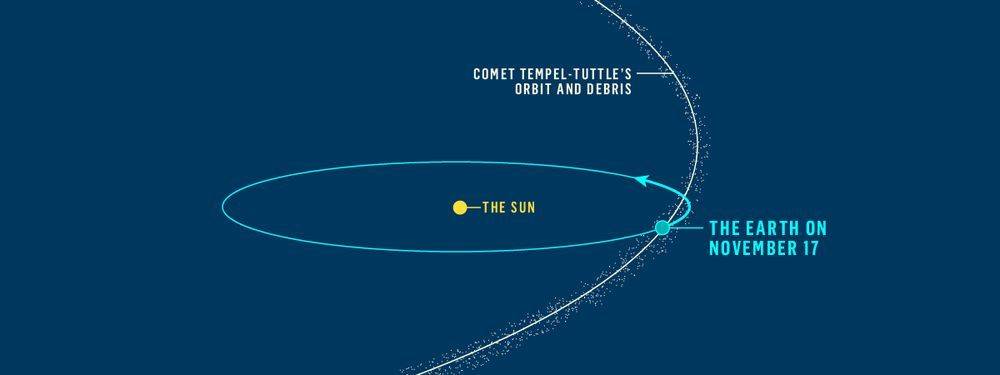
The Leonid meteor shower, which reaches peak activity today is going to be washed out by the bright Moon. The International Meteor Organization doesn’t have anything specific on it this year. On most years, it produces only 15 meteors an hour tops. However about every 33 years or so all heaven breaks loose. From the predictions I’ve seen the fun starts in 2034 and lasts a few years. The reason for the spectacular meteor storms, as they call them, is that the responsible comet, 55P Tempel-Tuttle, has a debris clump that hasn’t fanned out much along its orbit, so we get intense meteor activity when the comet again enters the inner solar system. It’s expected back in 2031 with its main cloud of meteoroids a couple of years later.
Times are for the Traverse City/Interlochen area of Michigan. They may be different for your location.
Addendum
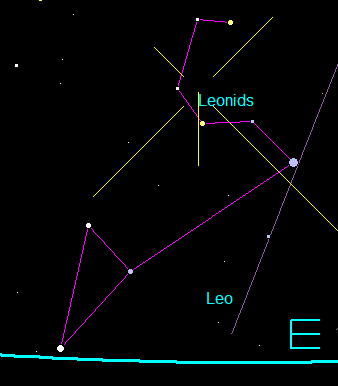
Leonid meteor radiant at about 2 a.m. from Traverse City. Credit: My LookingUp program.
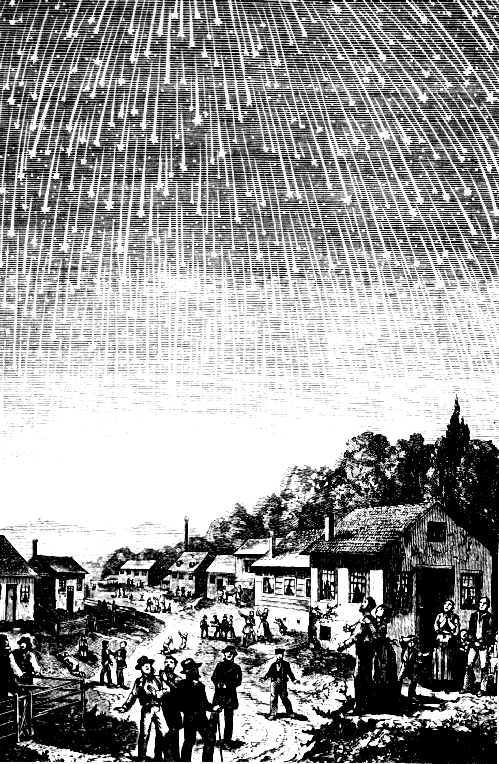
A famous woodcut of the 1833 Leonid meteor storm.
Meteor Watch cloud and meteor status May 23/24, 2014
May 24, 5;33 a.m. EDT
Just got back from the Dune Climb. Yes Virginia there are Camelopardalids. Just not many of them. I saw about 10 meteors overnight with just over half Camelopardalids. Now I was busy with other things, running the star party. However it seemed that of the ones I saw, there were a better an average, compared to the Perseids, number of bright ones. One also left a smokey train that was visible for a few seconds. I didn’t have my binoculars with me to view it longer. But it was impressive. We had maybe 40-50 folks come out, coming and going over the night, with about 11 sticking it out to the bitter end at 4 a.m.
May 23, 5:32 p.m. EDT
Weather is still great. Picked up a tweet saying the the Camelopardalids are being picked up via the radio reflection of their ionized trains.
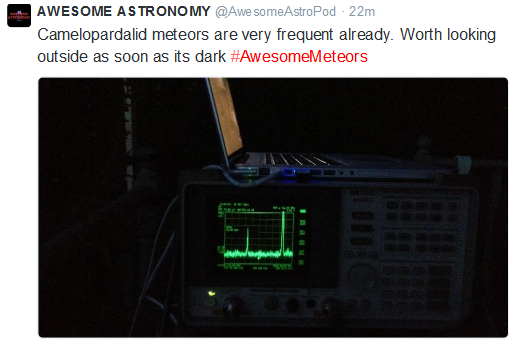 I’m going to head out in a half hour to the Visitors Center (see below) for the talk and to pick up some traffic cones.
May 23, 12:45 p.m. EDT
The weather is holding. The forecast is for clear skies through Sunday daytime. It should be a great Memorial Day weekend. For those venturing out to observe the meteor storm (we hope) dress warmly. The temperatures in northern Michigan will drop to the mid 40s. I plan to bring a light coat and my winter coat. For those who wish to lie on the ground to see the sky show bring two blankets one under you and one over you. It will get dewy. Hat, gloves and a thermos of warm drinks will also be welcome. Winter boots might be welcome for those who tend to get cold feet. Meteor watching is not an active pursuit, so you may want to walk around or climb up the dune a ways to keep warm. Remember there’s a talk by astronomer Tyler Nordgren at the Sleeping Bear Dunes National Lakeshore Philip A. Hart Visitor Center near the corner of M72 and M22 in Empire at 7 p.m. Sunset will be at 9:15 p.m.. The Grand Traverse Astronomical Society (GTAS) will be ready to observe the planets at the Dune Climb by 10 p.m.
May 22, 11:00 p.m. EDT
This is a pre-post entry. The blog will be published at noon on the 23rd and be updated as necessary. New updates will appear above older ones. I may also tweet. My twitter handle is @robertcmoler. The hashtag for the meteor shower appears to be #Camelopardalids. I hope you’re a good speller. The National Weather Service for tomorrow (Friday) and tomorrow night is for decreasing clouds during the day and mostly clear tomorrow night. Anttilla Danko’s Clear Sky Chart for the Leelanau School’s Lanphier Observatory also shows clear skies for the night of the 23rd/24th at this time. The observatory is located a few miles northeast of the Dune Climb area. New to the Sleeping Bear Dunes National Lakeshore? Here’s their website: http://www.nps.gov/slbe/index.htm Here’s a link to the map of the park. The Dune Climb is at points 7 & 8 on highway M109 just south of Glen Haven.
05/23/2014 – Ephemeris – Possible Meteor Storm overnight tonight
Ephemeris for Friday, May 23rd. Today the sun will be up for 15 hours and 5 minutes, setting at 9:12. The moon, 2 days past last quarter, will rise at 3:45 tomorrow morning. Tomorrow the sun will rise at 6:05.
If you want to see a possible meteor storm, go out tomorrow morning and find a dark location. The meteors will be seen all over the sky, but will seem to come from the north. The Grand Traverse Astronomical Society will be at Sleeping Bear Dunes National Lakeshore at the Dune Climb with telescopes starting at 10 p.m. tonight, weather permitting, to enjoy the other wonders of the sky while we wait for the meteor storm to start. Dress warmly, bring a blanket or lounge chair so you can comfortably look up. The first meteors may show by 1:40 a.m. but the peak activity is expected about 3 a.m., but that estimate may be off by an hour or more. Check bobmoler.wordpress.com for cloud and meteor status from noon through 4 a.m. if it’s clear. The latter part depends on getting a decent data signal. The dunes seem to be the end of the world as far as cell phone service goes. I might have to climb the dune to get a good signal.
Times are for the Traverse City/Interlochen area of Michigan. They may be different for your location.
Addendum
Remember these meteors should be visible from anywhere in the continental United States. Convert the times to your location. 3 a.m. EDT is 7 hours UT.
Start the evening tonight with a talk by Dr. Tyler Nordgren, astronomer, artist and dark sky advocate at the Sleeping Bear Dunes National Lakeshore Philip A. Hart Visitor Center in Empire at 7 p.m. Afterward he will be signing copies of his beautiful new poster See the Stars from Sleeping Bear Dunes National Lakeshore featuring the Great and Little Bear constellations and the bluffs of the Sleeping Bear Dunes and the Manitou Islands. After that, weather permitting see the sunset from many of the park’s locations, then, for the hardy, settle down for an all night vigil for the possible meteor storm with the Grand Traverse Astronomical Society at the Dune Climb. We’ll be viewing out the planets and the other wonders of the spring and summer skies as we wait for the meteors to appear.
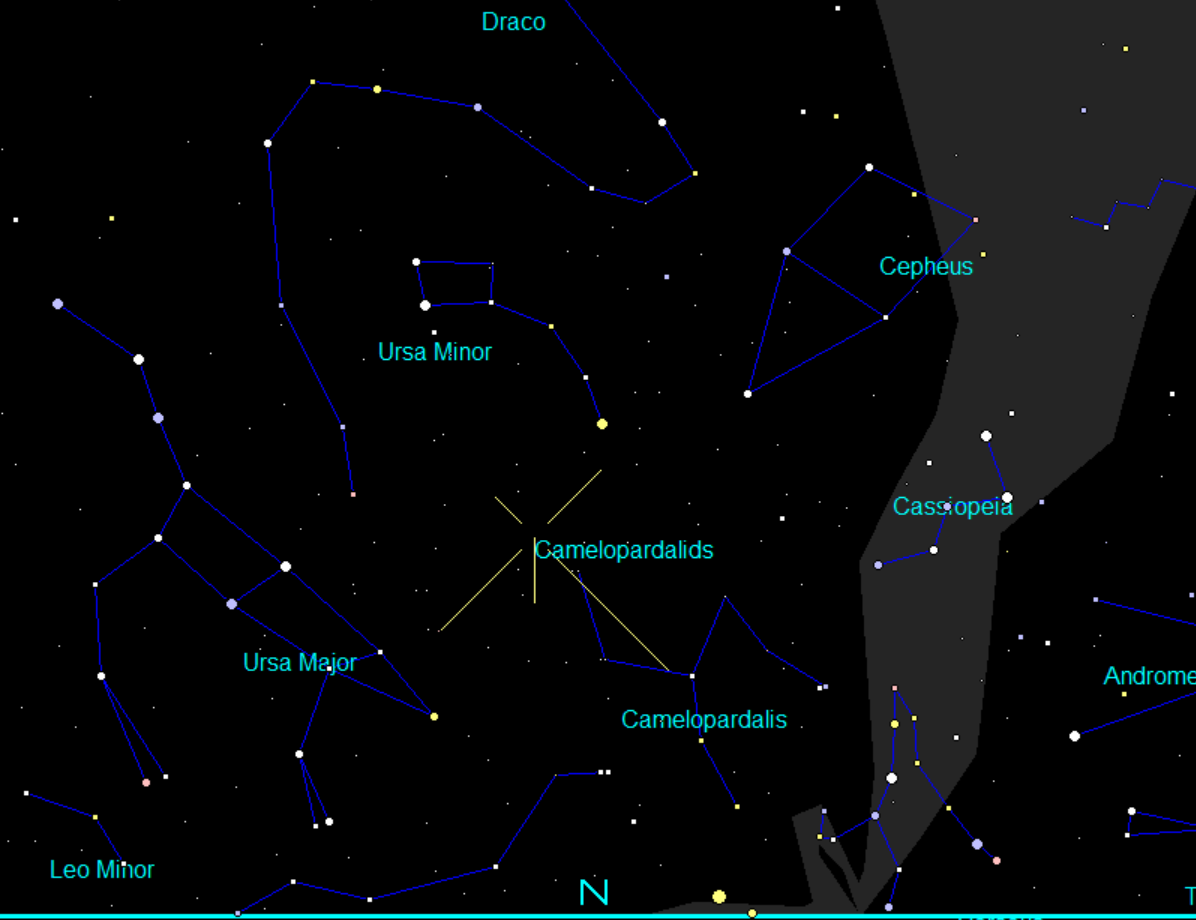
The expected radiant for the meteors of the May Camelopardalids, the meteors from the comet 209P/LINEAR at 3 a.m. on May 24, 2014. Credit: My LookingUp program.
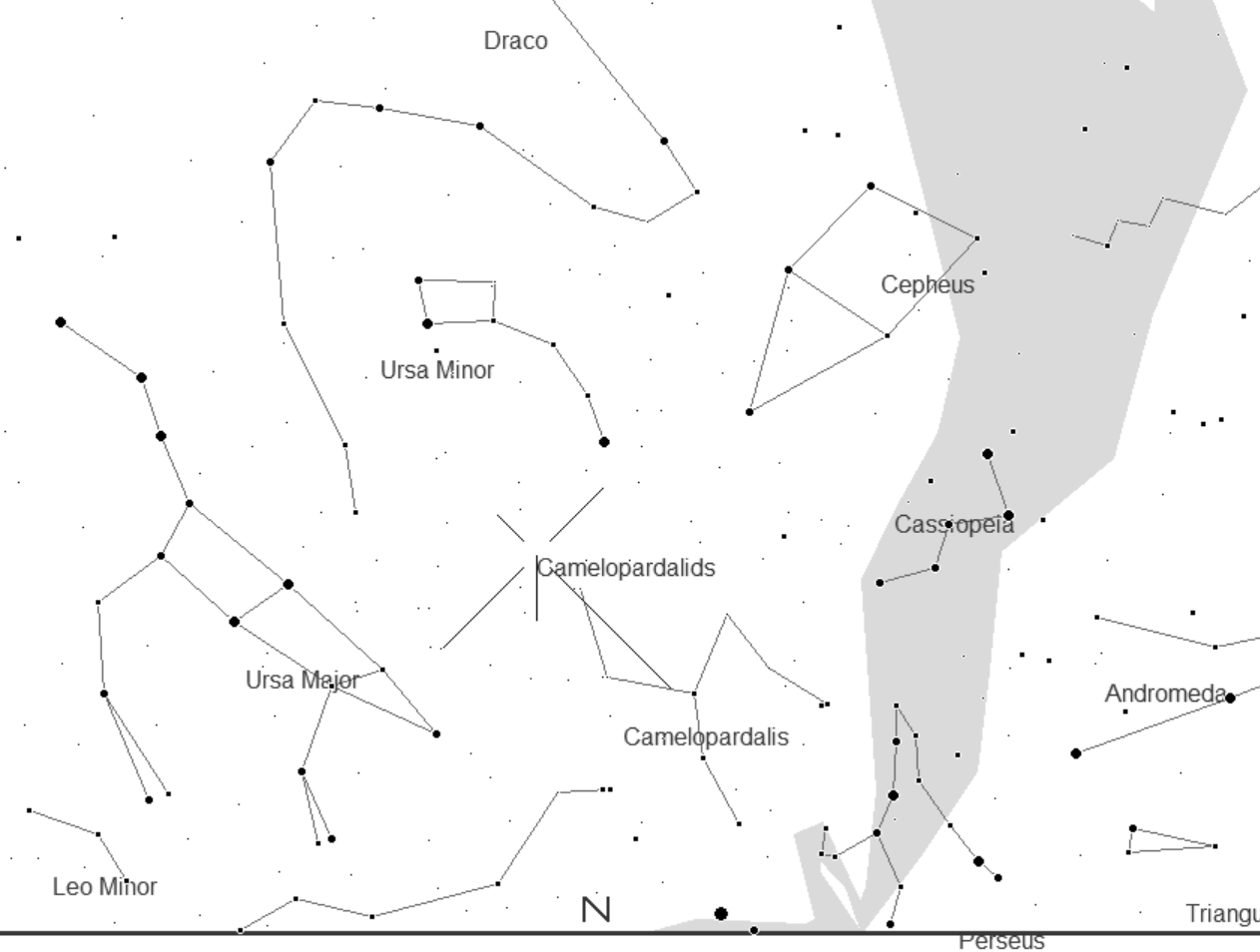
Same chart as above but black on white to save ink if you print it.
Here’s the culprit: Comet 209P/LINEAR

This May 17, 2014 image of Comet 209/LINEAR is the average of 5, 180-second exposures, taken remotely with the PlaneWave 17″+ Paramount ME+STL-6303E robotic unit of the Virtual Telescope Project. The telescope tracked the comet, so stars are trailing. This comet has the potential to generate an exceptional meteor shower (Camelopardalids) on May 24, 2014. Gianluca Masi / Virtual Telescope Project
Image and caption above from the Planetary Society blog from Bruce Betts: http://www.planetary.org/blogs/bruce-betts/20140522-one-night-only-a-new-meteor.html.
Want to find the comet?
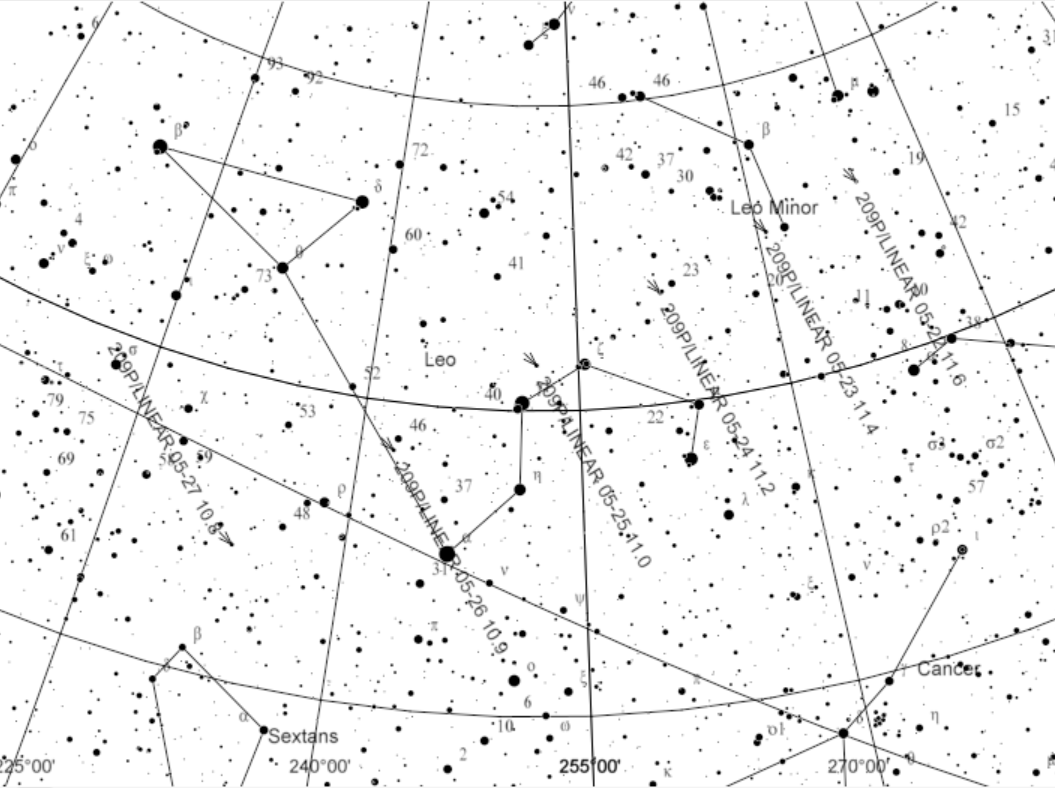
Finder chart for Comet 209P/LINEAR for 11 p.m. Note the dates are UT, 11 p.m. the 23rd is 3 a.m. UT on the 24th. Created using Cartes du Ciel (Sky Charts).
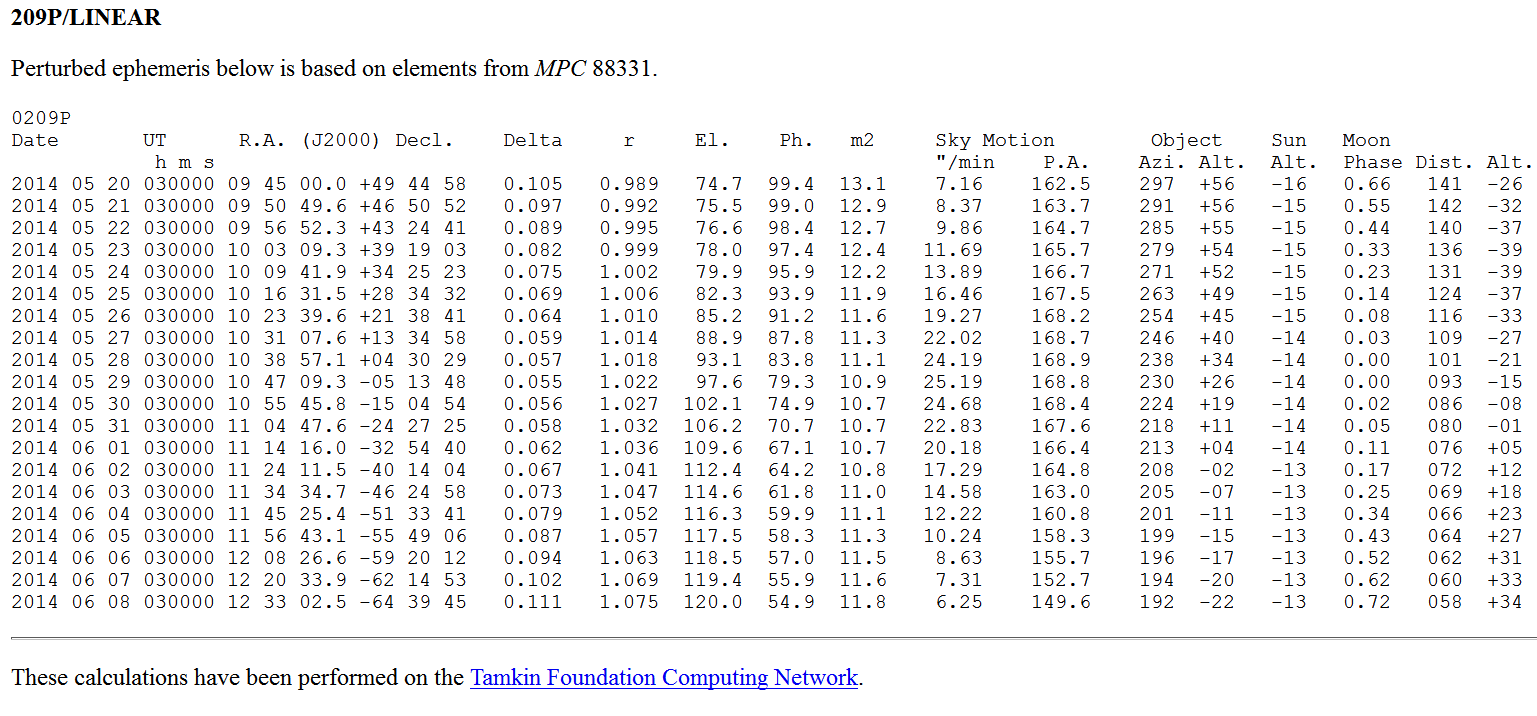
Ephemeris of positions for Comet 209P/LINEAR for May 20, 2014 to June 8, 2014 from the Minor Planet Center.
Got to http://www.minorplanetcenter.net/iau/MPEph/MPEph.html to print your own ephemeris for this or any comet. For purposes of this comet the comet name is: 209P/LINEAR.
All these images may be enlarged by clicking on them.
Note that:
Delta is the distance from Earth in Astronomical Units (AU)
r is the comet’s distance from the sun in AU.
El is the elongation in degrees from the sun
Ph. is the phase angle, not a big deal for comets.
m2 is the magnitude of the comet’s coma. Comets appear dimmer than their magnitude suggests.
05/22/2014 – Ephemeris – Meteor storms past and maybe this Saturday morning
Ephemeris for Thursday, May 22nd. Today the sun will be up for 15 hours and 3 minutes, setting at 9:11. The moon, 1 day past last quarter, will rise at 3:14 tomorrow morning. Tomorrow the sun will rise at 6:06.
The meteors from Comet 209P/LINEAR have not been completely unseen in the past, but their occurrence had never piqued the interest of meteor observers before. So the comet has left debris in its orbit. Some astronomers have been doing calculations on the orbital dynamics of a hypothetical meteor sward that may have developed near the comet. These swarms are not unprecedented. There’s the Leonid meteor storms that come every 33 years around November 17th that occur when its comet is near the Earth. Another is the less dramatic Draconids of early October, when its comet Giacobini-Zinner is in the neighborhood. The meteor storm is expected to peak around 3 a.m. this Saturday morning the 24th.
Times are for the Traverse City/Interlochen area of Michigan. They may be different for your location.
Addendum
A famous woodcut of the 1833 Leonid meteor storm.
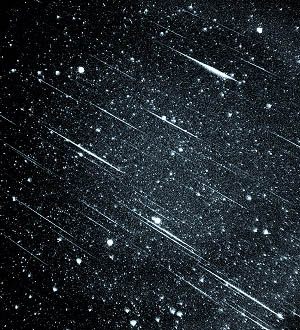
A photograph of the 1966 Leonid meteor storm by A. Scott Murrell. 40 meteors can be counted in the 10-12 minute exposure. Credit: P. Jenniskens/NASA-ARC http://leonid.arc.nasa.gov/.
 Bob Moler's Ephemeris Blog