Archive
Ephemeris: 12/12/2025 – The most active meteor shower of the year will peak Sunday morning
This is Ephemeris for Friday, December 12th. Today the Sun will be up for 8 hours and 51 minutes, setting at 5:02, and it will rise tomorrow at 8:11. The Moon, 1 day past last quarter, will rise at 1:58 tomorrow morning.
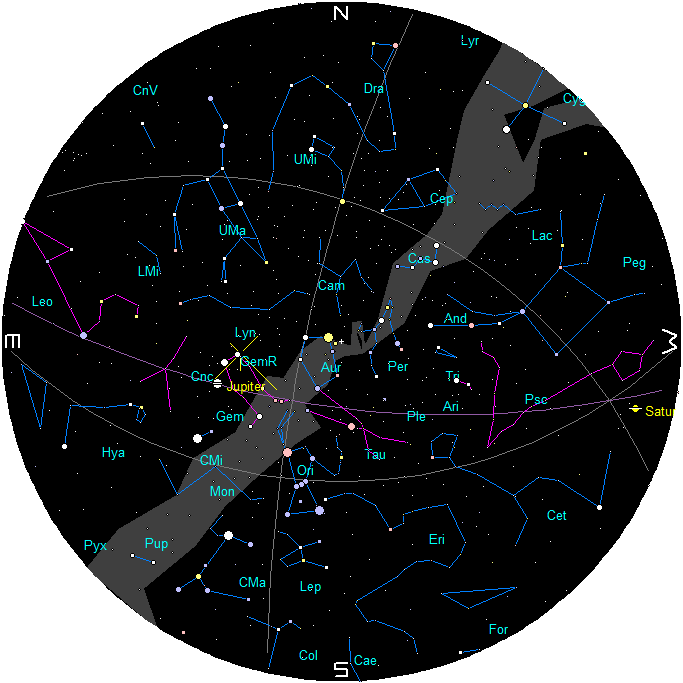
We are ramping up to the most active meteor shower of the year, the Geminid meteor shower. And it has been getting more active over the years. The peak will be about 2 AM Sunday morning with a 30% Moon rising shortly after 3. The radiant is the point in space where the meteors seem to come from, which is near the star Castor in the constellation Gemini from which the shower gets its name. Unlike most meteor showers, the Geminids will be visible all night. The meteors will be seen all over the sky, but they all can be traced back to the radiant. The body responsible for this meteor shower is an asteroid rather than a comet with the name 3200 Phaethon, which comes very close to the Sun.
The astronomical event times given in this blog are for the Traverse City/Interlochen area of Michigan (Lat 44.7° N, Long 85.7° W; EST, UT – 5 hours) unless stated otherwise. Times will be different for other locations.
Addendum
Ephemeris: 11/14/2025 – The Leonid meteor shower peaks Monday morning
This is Ephemeris for Friday, November 14th. Today the Sun will be up for 9 hours and 36 minutes, setting at 5:15, and it will rise tomorrow at 7:40. The Moon, 2 days past last quarter, will rise at 3:02 tomorrow morning.
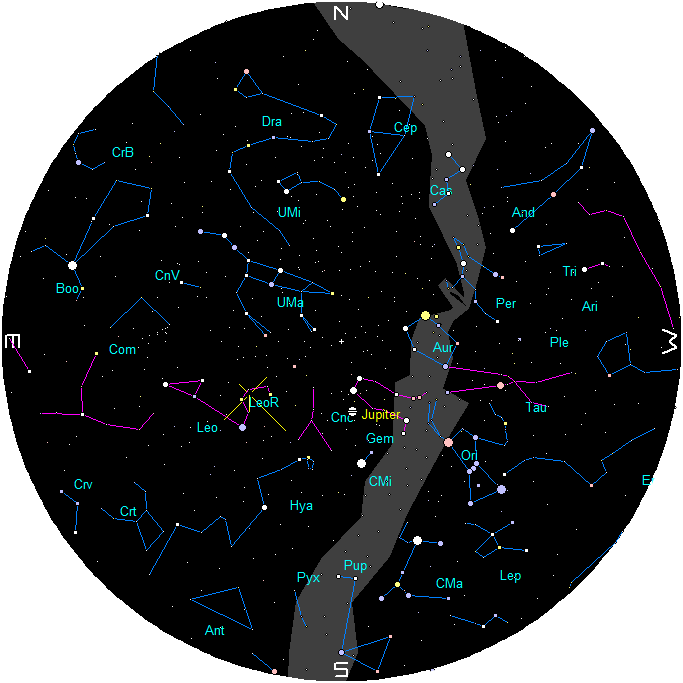
This coming Monday morning after midnight we’ll see the peak of the Leonid meteor shower. It is called the Leonids because the meteors appear to come from the head of Leo the lion, which will rise about midnight. This meteor shower is mediocre most years. However, every 33 or so years it can be spectacular with thousands of meteors per hour appearing in the sky for a short time. The meteoroid particles that produce the shower come from the comet 55P/Tempel-Tuttle which comes into the vicinity of the Sun in the inner solar system every approximately 33 years. The next peak year is predicted to be 2031, though it is expected to be not as active as recent peak years.
The astronomical event times given in this blog are for the Traverse City/Interlochen area of Michigan (Lat 44.7° N, Long 85.7° W; EDT, UT – 4 hours) unless stated otherwise. Times will be different for other locations.
Addendum
Ephemeris: 08/12/2025 – A brief shot at viewing the Perseid meteors under darkened, but not dark skies
This is Ephemeris for Tuesday, August 12th. Today the Sun will be up for 14 hours and 10 minutes, setting at 8:52, and it will rise tomorrow at 6:43. The Moon, 3 days past full, will rise at 10:26 this evening.
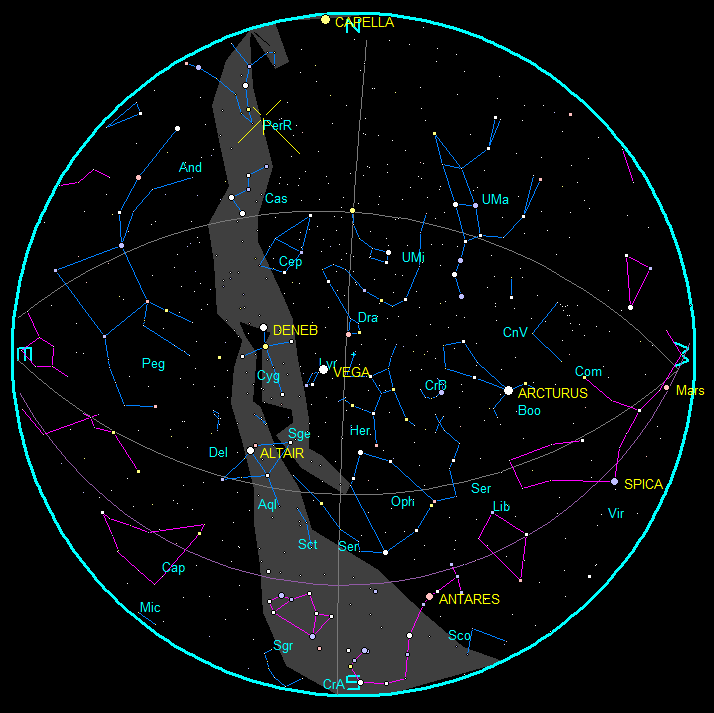
Tonight we get a second chance to see some of the Perseid meteor shower. As I said yesterday, the Moon is going to interfere with this year’s display. But, there is a small interval during twilight this evening, before the moon rises, where the sky could be dark enough to see more than a few Perseids. For nearly half an hour after 10 PM, it might be dark enough to see the Perseids under reasonably dark skies. The radiant where the meteors appear to come from will be low in the north northeast, about 17° above the horizon which means the expected number of meteors one would see in a half hour would be about 15 and with a not quite dark skies probably be a little less than that. But it is a chance to see the Perseids this year.
The astronomical event times given in this blog are for the Traverse City/Interlochen area of Michigan (Lat 44.7° N, Long 85.7° W; EDT, UT – 4 hours) unless stated otherwise. Times will be different for other locations.
Addendum
Ephemeris: 08/11/2025 – The best times to see the Perseid meteor shower
This is Ephemeris for Monday, August 11th. Today the Sun will be up for 14 hours and 13 minutes, setting at 8:54, and it will rise tomorrow at 6:42. The Moon, 2 days past full, will rise at 10:06 this evening.
Tonight’s most interesting astronomical events will occur tomorrow morning. The Perseid meteor shower will reach its peak tomorrow afternoon, so tomorrow morning and Wednesday morning will be about the best times to see the meteors, except that the bright Moon is going to interfere. So only the brightest meteors will be visible. Bonus: in morning twilight tomorrow the planets Venus and Jupiter will be in conjunction, meaning they’ll be at their closest appearance to each other by a little bit less than twice the width of the Moon apart. Early risers may have been noticing that Venus and Jupiter will have been slowly approaching each other, with Jupiter below and left of Venus. Tomorrow morning, Jupiter will pass just above Venus.
The astronomical event times given in this blog are for the Traverse City/Interlochen area of Michigan (Lat 44.7° N, Long 85.7° W; EDT, UT – 4 hours) unless stated otherwise. Times will be different for other locations.
Addendum
Ephemeris: 07/31/2025 – The Perseids are coming
This is Bob Moler with Ephemeris for Thursday, July 31st. Today the Sun will be up for 14 hours and 41 minutes, setting at 9:09, and it will rise tomorrow at 6:29. The Moon, 1 day before first quarter, will set at 11:59 this evening.
Over the past couple of weeks folks who are outdoors after the Moon sets in the morning might have been seeing some shooting stars or meteors appearing to zip through the sky. The ones I’m talking about seem to come from the northeast. These are the precursors of the Perseid meteor shower which will reach its peak on the mornings of August 12 and 13 this year with the interference of a bright Moon. Over the millennia the meteoroid stream that feeds the meteors to our skies has spread out to last over a month from the latter half of July to three-quarters of August. I try to use the proper terminology for all this. A meteoroid is the tiny body in space. In the Perseid’s case the size of a grain of sand to a pea. Meteor is the streak we see in the sky as it burns up. A meteorite is the body that makes it to the ground. To my knowledge no Perseid has made it that far.
The astronomical event times given in this blog are for the Traverse City/Interlochen area of Michigan (Lat 44.7° N, Long 85.7° W; EDT, UT – 4 hours) unless stated otherwise. Times will be different for other locations.
Addendum
Ephemeris: 05/05/2025 – A brief early morning meteor shower
This is Bob Moler with Ephemeris for Cinco de Mayo, Monday, May 5th. Today the Sun will be up for 14 hours and 26 minutes, setting at 8:53, and it will rise tomorrow at 6:25. The Moon, 1 day past first quarter, will set at 4:03 tomorrow morning.
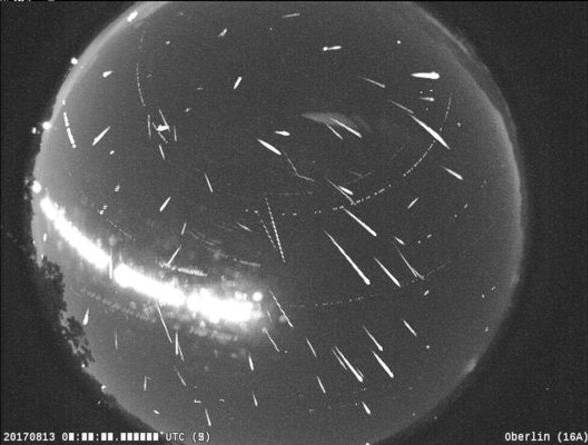
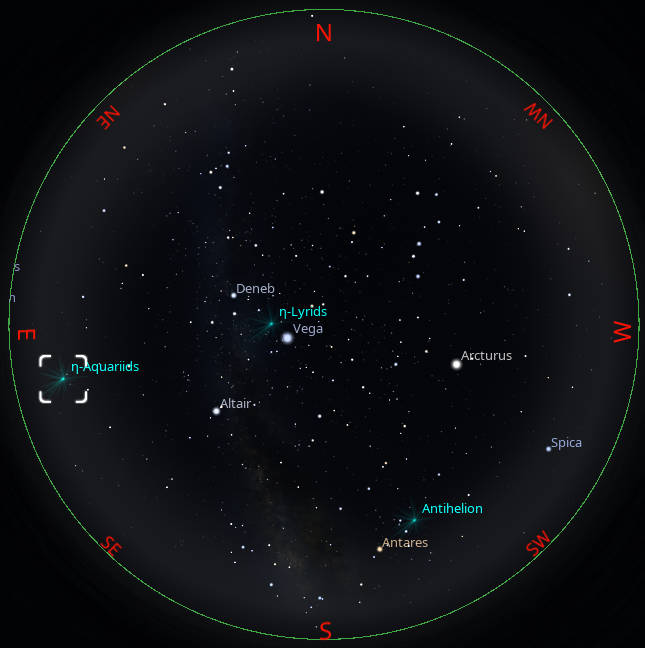
The Earth is now passing through a stream of bits of rock that were shed from Halley’s Comet on its many previous passes through the inner solar system. The Earth gets to pass through this stream twice a year, Once in late October as the stream passes the Earth’s orbit heading in, and in early May as the stream is departing. The peak of this meteor shower, the Eta Aquariids, is this afternoon. Since the meteoroids are coming from nearer the direction of the Sun, there is only a short period when these meteors are visible. Actually less than an hour between moonset at 4:03 AM and nearly 5 AM around here as twilight begins to interfere with the display. The meteors will seem to come from low in the east-southeast, but they will be seen all over the sky.
The astronomical event times given in this blog are for the Traverse City/Interlochen area of Michigan (Lat 44.7° N, Long 85.7° W; EDT, UT – 4 hours) unless stated otherwise. Times will be different for other locations.
Addendum
Ephemeris: 12/13/2024 – The Geminid meteor shower peaks tonight
This is Bob Moler with Ephemeris for Friday, December 13th. Today the Sun will be up for 8 hours and 50 minutes, setting at 5:02, and it will rise tomorrow at 8:12. The Moon, 2 days before full, will set at 7:45 tomorrow morning.
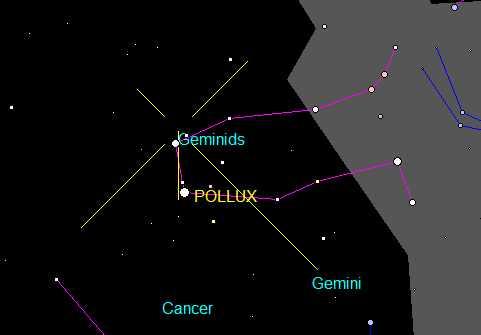
Tonight is the peak of the Geminid meteor shower. Unfortunately this year we’re two days before a full moon so it will cut down their numbers, so only the brightest Geminids will be visible. The radiant for the meteor shower is a point near the star Castor at the head of constellation Gemini, the twins, which is why they’re called the Geminids. This is the most active annual shower of the year right now. The source of the Geminids is the asteroid Phaethon which is probably the core of a dead comet. It is the closest asteroid to the sun at its perihelion in its markedly elliptical orbit like a comet. One of the Stereo Sun observation satellites saw Phaethon shedding material as it moved around at its closest approach to the Sun.
The astronomical event times given are for the Traverse City/Interlochen area of Michigan (EST, UT – 5 hours). Times will be different for other locations.
Addendum
Ephemeris: 08/08/2024 – The source of the Perseid Meteor Shower
This is Ephemeris for Thursday, August 8th. Today the Sun will be up for 14 hours and 20 minutes, setting at 8:58, and it will rise tomorrow at 6:38. The Moon, halfway from new to first quarter, will set at 10:47 this evening.
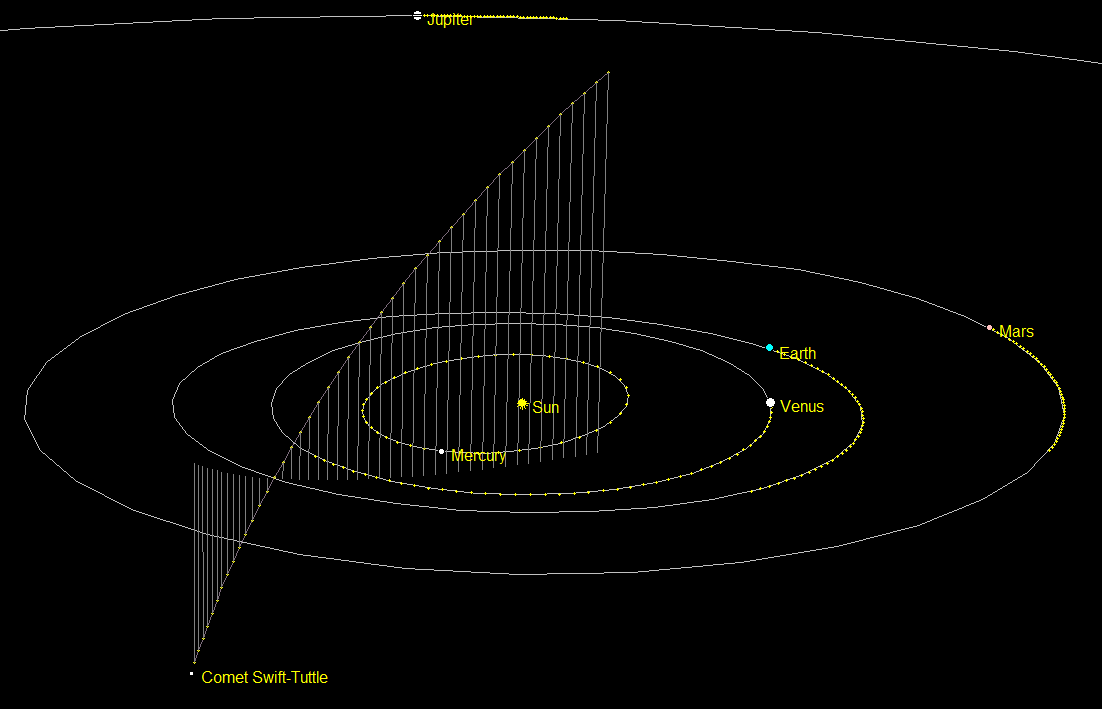
The source of the Perseid meteor shower is Comet Swift-Tuttle, first discovered in 1862 buy Lewis Swift and Horace Parnell Tuttle. The comet was expected back around 1982, but it didn’t show. Its orbit was recalculated and was expected around 1992, when it indeed showed up. The comet has a 130 or so year orbit of the Sun which does vary from appearance to appearance. The comet appears to be in resonance with Jupiter’s orbit of the Sun, going around once in the same time Jupiter goes around the Sun 11 times. Its next appearance in the inner solar system will be in the year 2126, when it is expected to be quite bright then, coming relatively close to the Earth.
The astronomical event times given are for the Traverse City/Interlochen area of Michigan (EDT, UT–4 hours). Times will be different for other locations.
Addendum
Ephemeris: 08/06/2024 – Looking toward the Perseid Meteor Shower
This is Ephemeris for Tuesday, August 6th. Today the Sun will be up for 14 hours and 25 minutes, setting at 9:01, and it will rise tomorrow at 6:36. The Moon, 2 days past new, will set at 10:15 this evening.
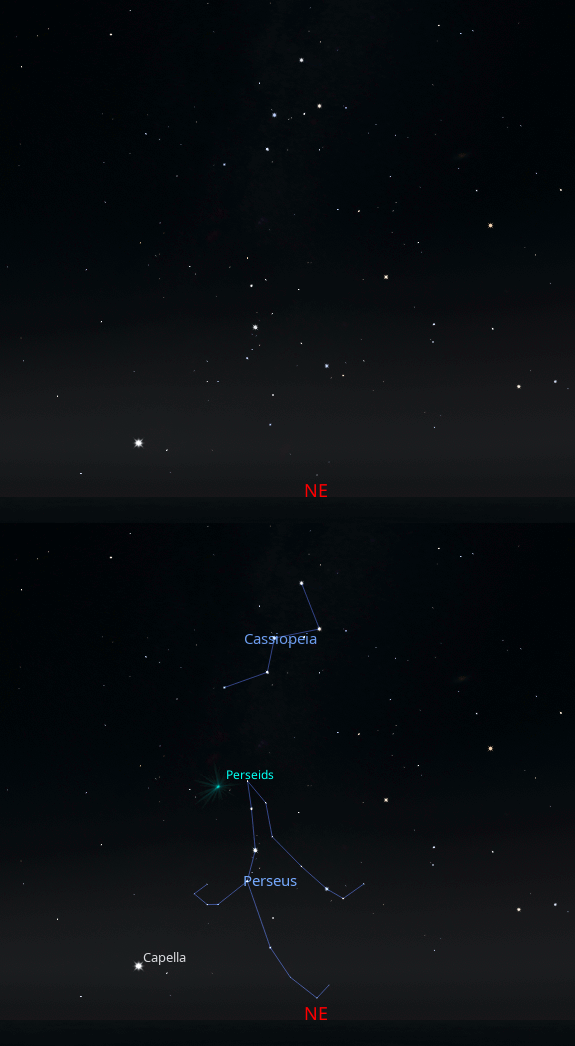
Next Monday morning we’ll see the peak of the Perseid meteor shower. They’re called the Perseids because they seem to come from the constellation of Perseus the hero which is below the W shaped constellation of Cassiopeia in the northeast in the evenings now. The reason they appear to come from the same direction is that they were shed by a comet whose name is Swift-Tuttle discovered in 1862 it’s been around many times before that, though not recognized as such. The first mention of the Perseids in history comes from the year 36 CE, though they were assuredly visible but unrecognized before that. In the past they’ve been known as the Tears of Saint Lawrence because their peak is near the feast date of that martyr. Perseids can be seen now, though not in peak numbers.
The astronomical event times given are for the Traverse City/Interlochen area of Michigan (EDT, UT–4 hours). Times will be different for other locations.
Addendum
Ephemeris: 07/29/2024 – Late July’s meteor shower
This is Ephemeris for Monday, July 29th. Today the Sun will be up for 14 hours and 45 minutes, setting at 9:11, and it will rise tomorrow at 6:27. The Moon, 2 days past last quarter, will rise at 1:26 tomorrow morning.
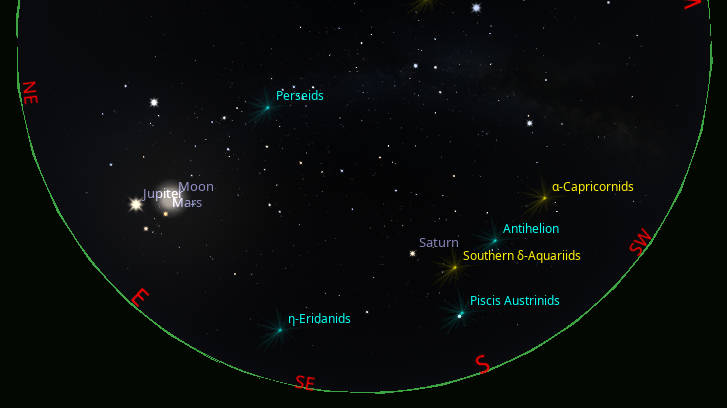
There are more meteor showers that occur in the second-half of the year than there are in the first six months of the year. I don’t know why that is. The first of these major showers is the Southern Delta Aquariid meteor shower. There happens to be a few meteor showers at appear to emanate from the constellation of Aquarius so they named them after the closest star to the direction they appear to come from at their maximum. The star Delta in the southern part of Aquarius is associated with two meteor showers. This one appears to be coming from south of that star. And are only an eighth as active as the Perseids that we’re going to have next month partly because the radiant point doesn’t get very high in the sky.
The astronomical event times given are for the Traverse City/Interlochen area of Michigan (EDT, UT–4 hours). They may be different for your location.
Addendum
 Bob Moler's Ephemeris Blog