Archive
12/11/2020 – Ephemeris – More on the Geminid meteor shower peaking this weekend
This is Ephemeris for Friday, December 11th. Today the Sun will be up for 8 hours and 51 minutes, setting at 5:02, and it will rise tomorrow at 8:11. The Moon, 3 days before new, will rise at 5:33 tomorrow morning.
This weekend and specifically Sunday evening to Monday morning the Geminid meteor shower will be at its peak, with up to 120 meteors appearing an hour in the early morning hours of Monday. The meteors will appear to come from near the star Castor, the northernmost star of the constellation of Gemini the twins. Castor and Pollux are the namesake stars at the head of Gemini. While they will seem to come from a specific point in the sky, they will be seen all over the sky, and be traced back to the point. They are coming in on parallel trajectories, just as straight railroad tracks recede to a point in the distance. Let’s hope for clear skies. The meteor shower lasts all night.
The event times given are for the Traverse City/Interlochen area of Michigan. They may be different for your location.
Addendum
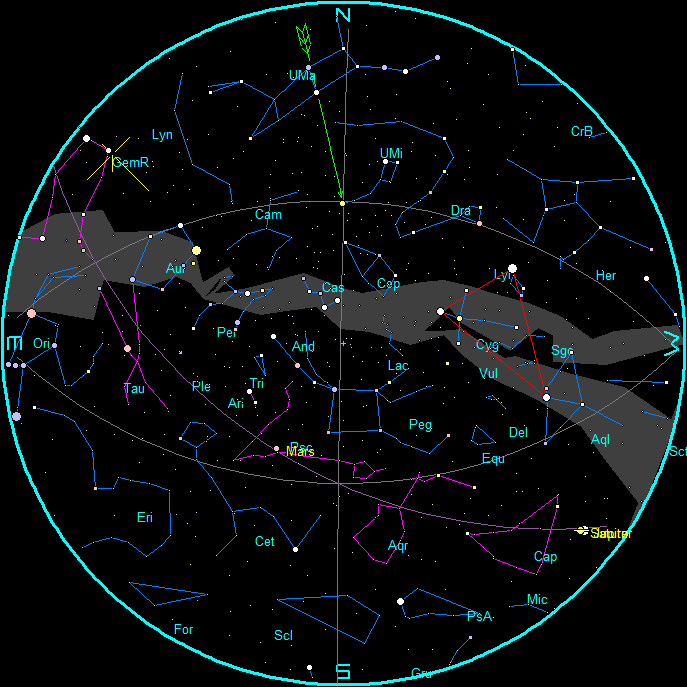
Star Chart for 7 pm, or about 2 hours after sunset. December 13, 2020. Click on image to enlarge. GemR is the location of the Geminid radiant low in the northeast. Click on image to enlarge. Created using my LookingUp program.
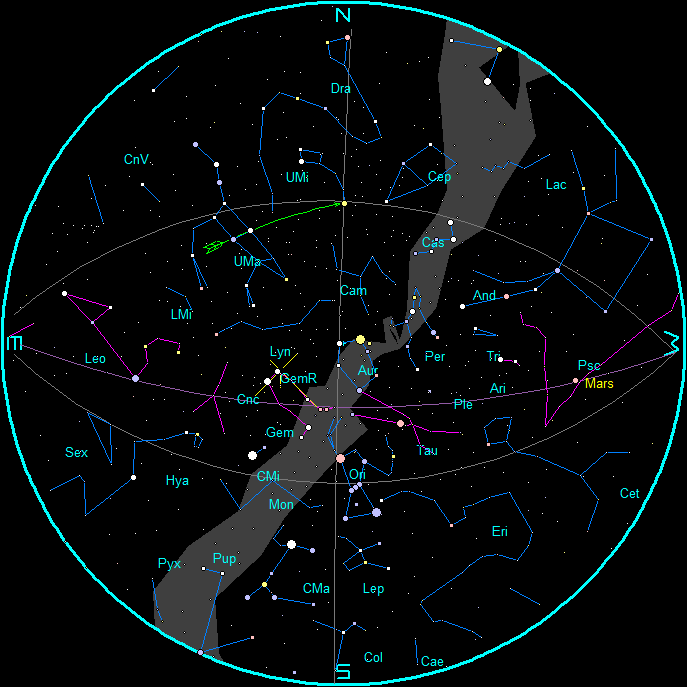
All sky chart of the Geminid Radiant 1 am Dec 14, 2020. GemR is the location of the Geminid radiant nearly overhead in the southeast.
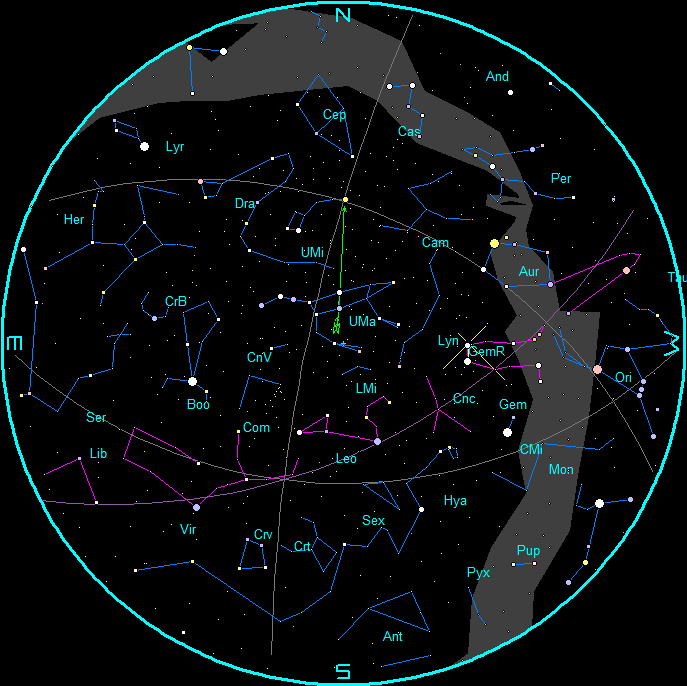
All sky chart of the Geminid Radiant 6 am Dec 14, 2020. GemR is the location of the Geminid radiant in the west.
12/10/2020 – Ephemeris – The Geminid meteor shower will reach its peak Sunday evening and Monday Morning December 13/14, 2020
This is Bob Moler with Ephemeris for Thursday, December 10th. Today the Sun will be up for 8 hours and 52 minutes, setting at 5:02 pm which will signal the beginning of the Jewish feast of Chanukah. Sunrise tomorrow will be at 8:10 am. The Moon, 3 days past last quarter, will rise at 4:13 tomorrow morning.
The Geminid meteor shower, the most active meteor shower of the year will be at its most active Sunday night and Monday morning. This year the Moon will be new on Monday and won’t interfere. Our problem is that it’s December, one of the cloudiest months of the year. The Geminid meteors will seem to come from near the star Castor, the second brightest star in Gemini. The actual source of the meteors is the asteroid or rock comet Phaethon. If it is an asteroid it comes closest to the Sun of any asteroid. It has been observed by spacecraft shedding dust when it’s heated near the Sun. It is probably a dead comet.
The event times given are for the Traverse City/Interlochen area of Michigan. They may be different for your location.
Addendum
Star Chart for 7 pm, or about 2 hours after sunset. December 13, 2020. Click on image to enlarge. Click on image to enlarge. Created using my LookingUp program.
All sky chart of the Geminid Radiant 1 am, or about 7 hours after sunset, Dec 14, 2020. Click on image to enlarge.
All sky chart of the Geminid Radiant 6 am, or about 2 hours before sunrise, Dec 14, 2020. Click on image to enlarge.
11/12/2020 – Ephemeris – The Northern Taurid meteor shower is at its peak
This is Ephemeris for Thursday, November 12th. Today the Sun will be up for 9 hours and 40 minutes, setting at 5:17, and it will rise tomorrow at 7:37. The Moon, 3 days before new, will rise at 5:19 tomorrow morning.
The official peak of the North Taurid meteor shower is here. It’s a broad peak with a low per hour count that appears to be estimated from 5 to 15 meteors per hour. As such it doesn’t hold a candle to the Perseid meteor shower of August or the Geminids of December. However the Northern Taurid shower appears to have quite a few fireballs or really bright meteors. They seem to be most numerous at seven year intervals and the next peak year for fireballs is 2022. The Taurids will appear to come from Taurus the bull near the Pleiades star cluster low in the east in the early evening. Meteors are the streaks in the sky caused by tiny bits of rock hitting the atmosphere at interplanetary speeds and disintegrating.
The event times given are for the Traverse City/Interlochen area of Michigan. They may be different for your location.
Addendum
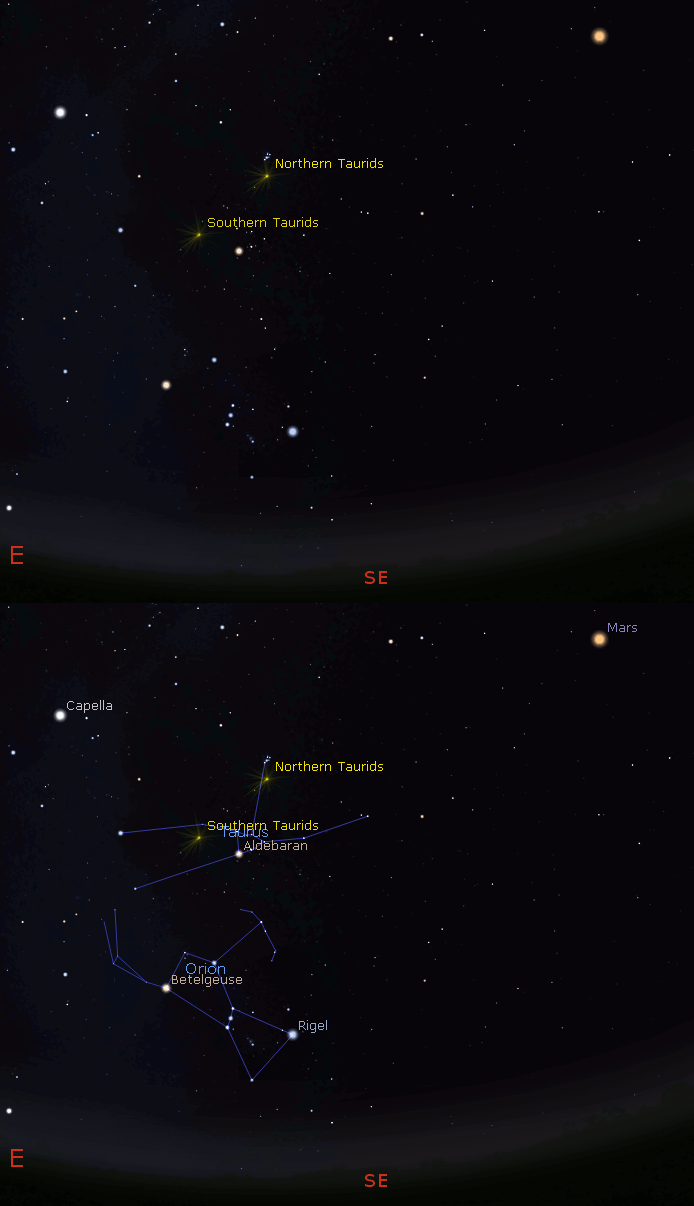
Finder chart for the radiants of the two Taurid meteor shower for about 11 pm for mid November. The Southern Taurids are ending, but a few may be spotted, while the Northern Taurids are near peak. The peak rate for the Northern Taurids has been estimated by various sources as being 5 to 15 meteors per hour. The Pleiades appears just above the Northern Taurid radiant. Compared to other meteor showers the Taurids appear to be a lot slower. Created using Stellarium and GIMP.
08/11/2020 – Ephemeris – Tonight is the peak of the Perseid Meteor shower
This is Bob Moler with Ephemeris for Tuesday, August 11th. Today the Sun will be up for 14 hours and 12 minutes, setting at 8:53, and it will rise tomorrow at 6:42. The Moon, at last quarter today, will rise at 12:46 tomorrow morning.
This evening and tomorrow morning we should see the peak of the Perseid Meteor Shower. There is the expected broad peak of the shower which for us is after sunrise. However the meteoroid stream isn’t monolithic. Each pass of the comet in the inner solar system superimposes its debris on the general stream, so we will have increased activity all night tonight and even into the next few mornings. In general Perseid meteors will be seen to come from the northeast. The evening view will be not hampered by the Moon until it rises at 12:46 am which will drown out the dimmer meteors. The best time to view is from about 10 or 10:30 pm to 12:46 am. The Perseids are the most active meteor shower visible in warm weather, with a possible over 50 meteors per hour.
The event times given are for the Traverse City/Interlochen area of Michigan. They may be different for your location.
Addendum
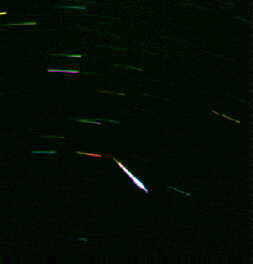
My best Perseid photo. From the 1970’s.
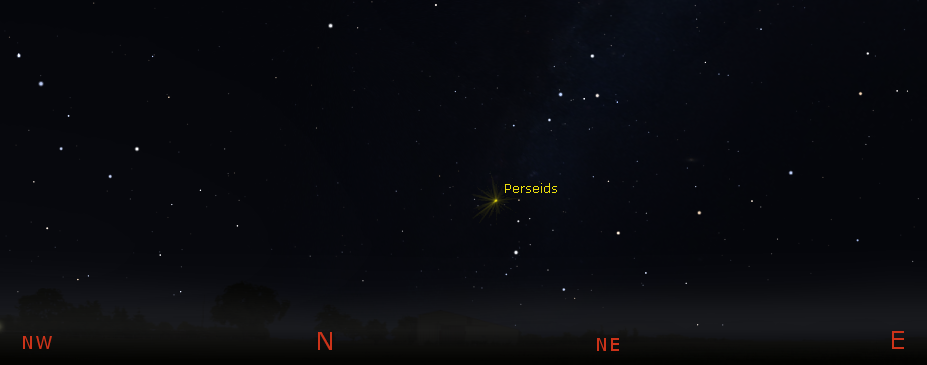
Perseid radiant at 11 pm, August 11th at the top of the constellation of Perseus, below the W shaped constellation of Cassiopeia. Click on the image to enlarge. Created using Stellarium.
07/27/2020 – Ephemeris – Two meteor showers, one near peak, another just starting
This is Ephemeris for Monday, July 27th. Today the Sun will be up for 14 hours and 49 minutes, setting at 9:13, and it will rise tomorrow at 6:25. The Moon, at first quarter today, will set at 1:18 tomorrow morning. | Tonight’s first quarter Moon will hinder the viewing of Comet NEOWISE and the Southern Delta Aquariid meteor shower until after moonset at 1:18 am. The meteor shower radiant will start out low southeastern sky and end up in the south as twilight brightens. It is usually during this meteor shower that the first Perseid meteors show up. The Perseid meteor shower is the most watched meteor shower of the year. It’s great every year except when there’s a bright Moon. This year the Perseids will reach their peak hourly numbers on the morning of August 12th after sunrise, unfortunately. The Moon will interfere after it rises at 12:46 am, which leaves two hours of moonless meteor viewing earlier on the evening of the 11th.
The event times given are for the Traverse City/Interlochen area of Michigan. They may be different for your location.
Addendum
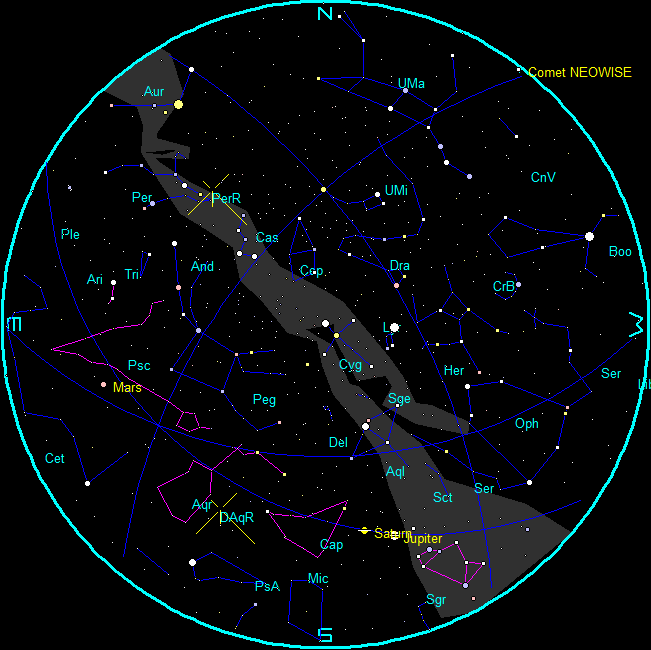
The Sky Dome at 2 am tomorrow morning July 28, 2020 at 2 am. DAqr is the approximate location of the Southern Delta Aquariid meteor shower and PerR is the approximate location of the Perseid radiant. Created using my LookingUp program.
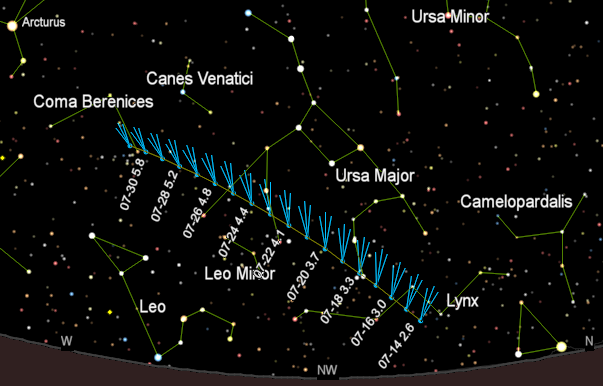
Comet NEOWISE in the evening for July 14, 2020 to July 31, 2020. The horizon is for July 14th at 11 p.m. Click on the image to enlarge. Created using Cartes du Ciel (Sky Chart).
04/21/2020 – Ephemeris – The Lyrid Meteor Shower will reach its peak after midnight tonight
This is Ephemeris for Tuesday, April 21st. Today the Sun will be up for 13 hours and 48 minutes, setting at 8:36, and it will rise tomorrow at 6:45. The Moon, 1 day before new, will rise at 6:58 tomorrow morning.
The Lyrid meteor shower will reach its peak tomorrow morning at around 2 a.m. The Moon will be new tomorrow so it won’t interfere. The radiant point, from which the meteor seem to come is between the constellation Lyra the harp for which they are named with its bright star Vega and Hercules. The numbers of meteors seen in an hour could be between 12 and 20. The Lyrids are caused by the debris left when a comet last seen in 1861, crossed Earth’s orbit as Comet Thacher. Speaking of comets, a new comet named SWAN was discovered a month ago. It was detected by with the Solar Wind An-iso-tropies camera or SWAN aboard the Solar and Heliospheric Observatory or (SOHO) spacecraft. We’ll follow Comet SWAN as it approaches the Sun next month.
The event times given are for the Traverse City/Interlochen area of Michigan. They may be different for your location.
Addendum
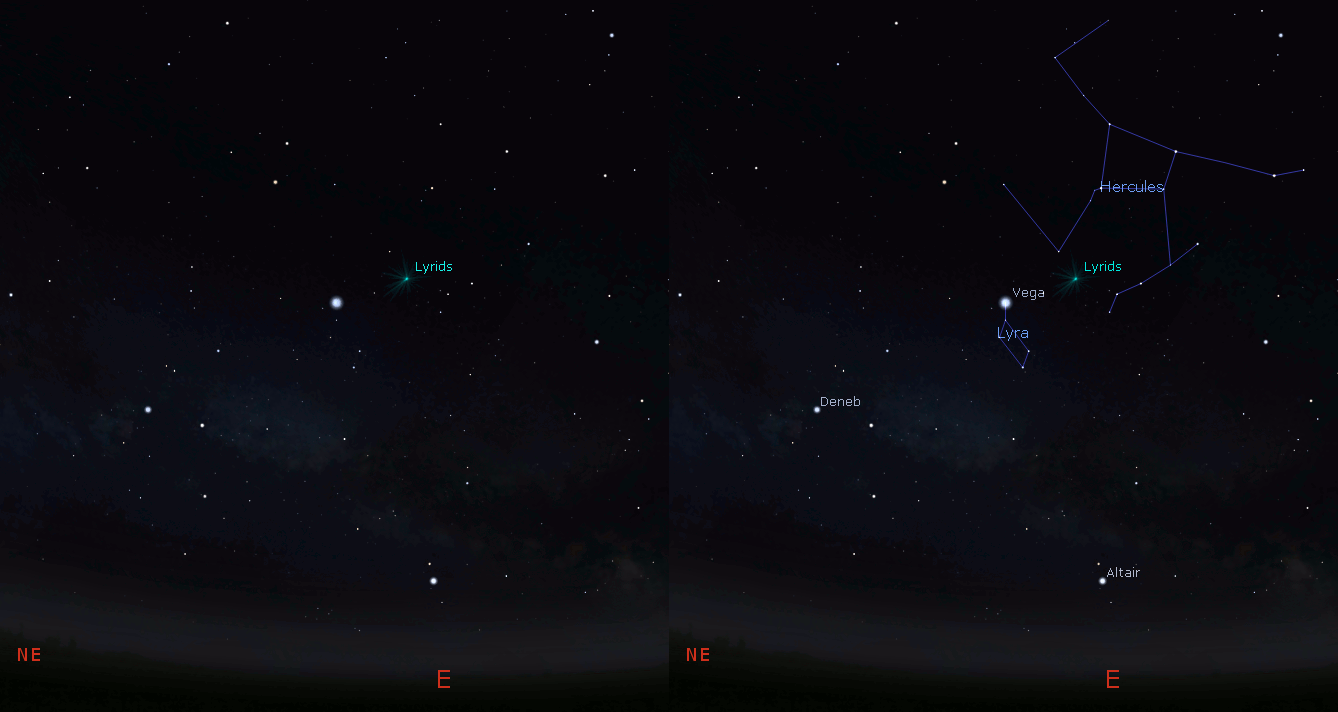
An animation Looking east at 2 a.m. April 22, 2020 toward Lyra, and Hercules with the Lyrid meteor radiant. The named stars are the stars of the Summer Triangle. Click on the image to enlarge. The meteors will appear all over the sky, but Lyrid meteors can be back traced to the radiant point. Created using Stellarium and GIMP.
01/03/2020 – Ephemeris – Astronomical events this weekend
Ephemeris for Friday, January 3rd. The Sun will rise at 8:20. It’ll be up for 8 hours and 54 minutes, setting at 5:14. The Moon, 1 day past first quarter, will set at 1:49 tomorrow morning.
Tonight at 8 p.m. there will be a telescope clinic by the Grand Traverse Astronomical Society at the Rogers Observatory south of Traverse City on Birmley Road for those who have either received a telescope for Christmas or have one hidden away in an attic, to learn how to use it. Bring ‘em if you’ve got ‘em.
Tomorrow morning we’ll see the peak of the Quadrantid meteor shower after the Moon sets. The radiant for this shower is near the handle of the Big Dipper, though they will be seen all over the sky. The peak should be around 3:20 a.m. with the possibility of over a hundred meteors visible per hour.
On Sunday at 5 a.m. the Earth will be its closest to the Sun for the year of 91,394,000 miles (147,085,000 km).
The times given are for the Traverse City/Interlochen area of Michigan. They may be different for your location.
Addendum
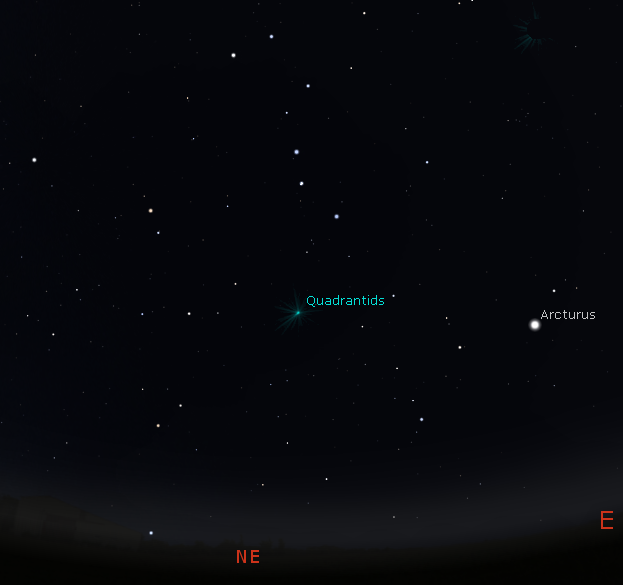
The location of the Quadrantid radiant at 3:20 a.m. January 4, 2020 for the peak of the meteor shower. Created using Stellarium.
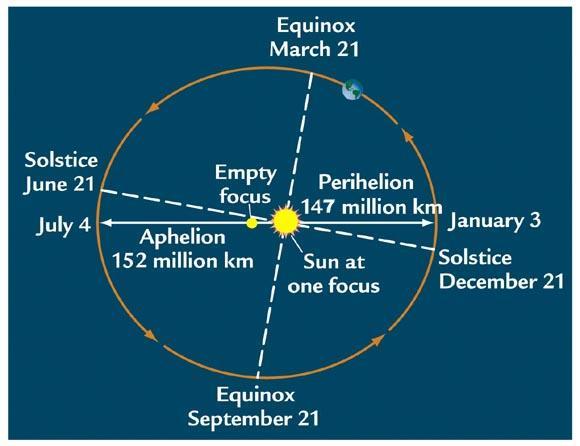
The Earth’s orbit, somewhat exaggerated, showing perihelion and the seasons. Credit “Starts with a Bang” blog by Ethan Siegel.
08/06/2019 – Ephemeris – More about viewing the Perseid meteor shower: Meteor trains
Ephemeris for Tuesday, August 6th. Today the Sun will be up for 14 hours and 27 minutes, setting at 9:02, and it will rise tomorrow at 6:35. The Moon, 1 day before first quarter, will set at 12:29 tomorrow morning.
The Perseid meteor shower has to compete this years with the bright waxing Moon, so only the brightest meteors will be visible, However even though this cuts down on the meteors visible, it happens that some of the brightest of meteors leave smokey trains, which can be seen in binoculars. Unlike aircraft contrails which are created the same altitude, meteor trains descend through the atmosphere where the winds at the different altitudes slowly bend and twist the train, tearing it up. The same occurs with any really bright meteor, Perseid or not. So remember to add binoculars to your meteor viewing kit along with a blanket, warm coat, mosquito spray and hot coffee or other beverage.
The times given are for the Traverse City/Interlochen area of Michigan. They may be different for your location.
Addendum
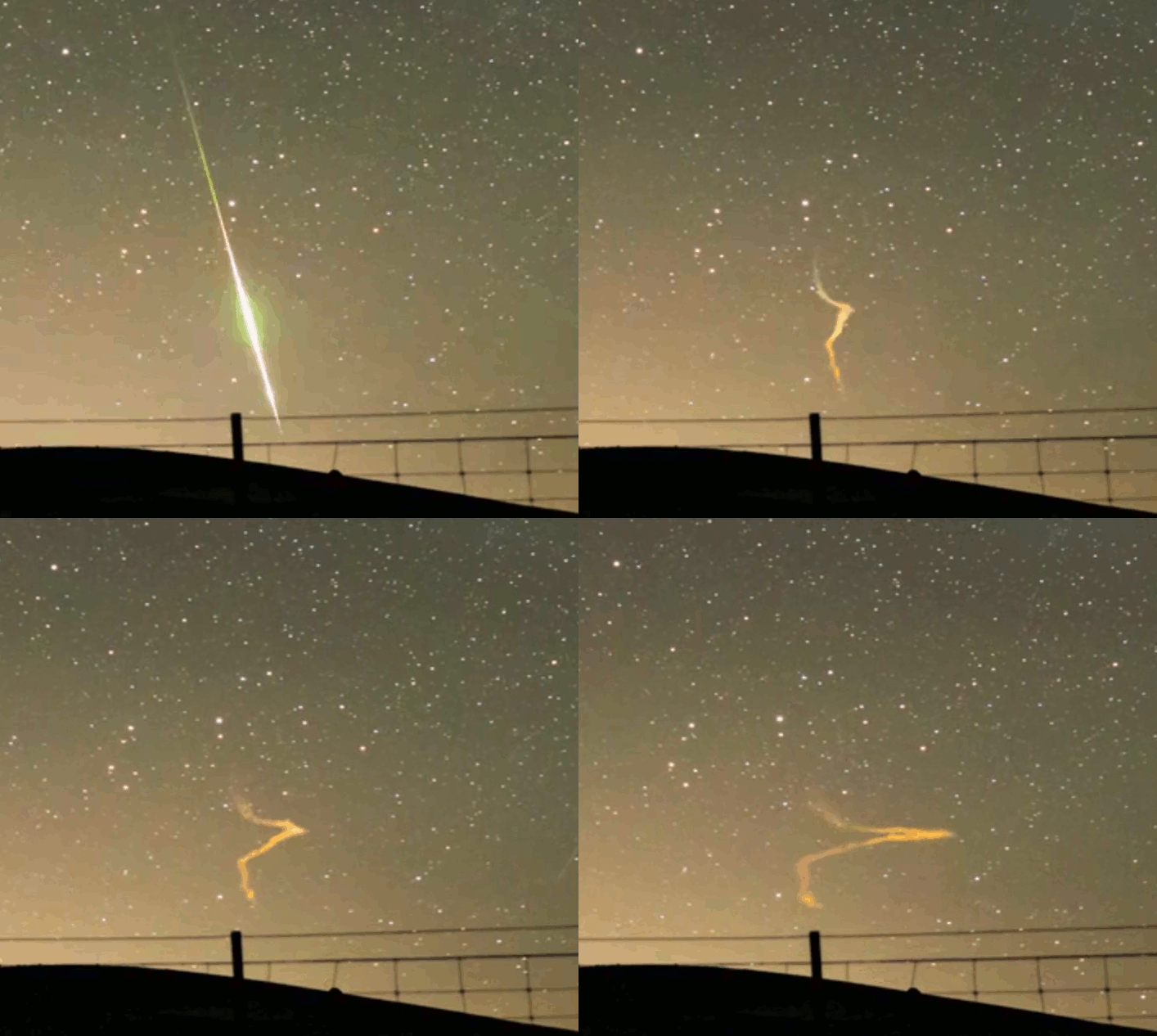
These are screen caps from a time lapse video by Australian Phil Hart of a meteor train being torn apart by upper level winds. Credit Phil Plait’s Bad Astronomy/Phil Hart. This was not a Perseid meteor.
The actual video and much more about meteor trains are located here: https://www.syfy.com/syfywire/catching-meteor-train.
08/05/2019 – Ephemeris – Previewing the Perseid meteor shower
Ephemeris for Monday, August 5th. Today the Sun will be up for 14 hours and 30 minutes, setting at 9:03, and it will rise tomorrow at 6:34. The Moon, 2 days before first quarter, will set at 12:01 tomorrow morning.
After the Moon sets in the morning hours for the next week and a half the numbers of meteors visible will increase each night. These are members of the Perseid meteor shower of August. The peak this year is expected to be during the morning of the 13th. However by then the Moon will be nearly full. These meteors are the result of debris left along the orbit of Comet 109P/Swift-Tuttle shed by innumerable visits to the inner solar system. Every year at this time the Earth passes through this trail of debris which intersects its orbit giving rise to the meteor shower. We call them the Perseids, because they appear to come from the direction of the constellation Perseus the hero, which is first seen in the early evening low in the northeast.
The times given are for the Traverse City/Interlochen area of Michigan. They may be different for your location.
Addendum
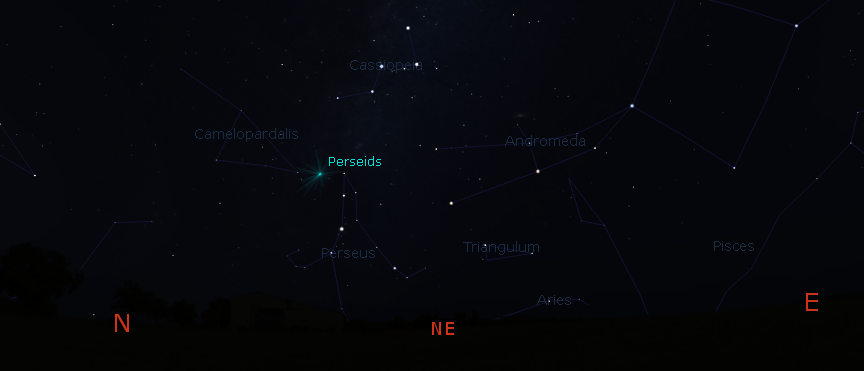
The Perseid radiant is located off the highest star in Perseus as it ascends the sky at about 10:30 p.m. The Perseid radiant is circumpolar for observers in northern Michigan. Click on the image to enlarge. Created using Stellarium.
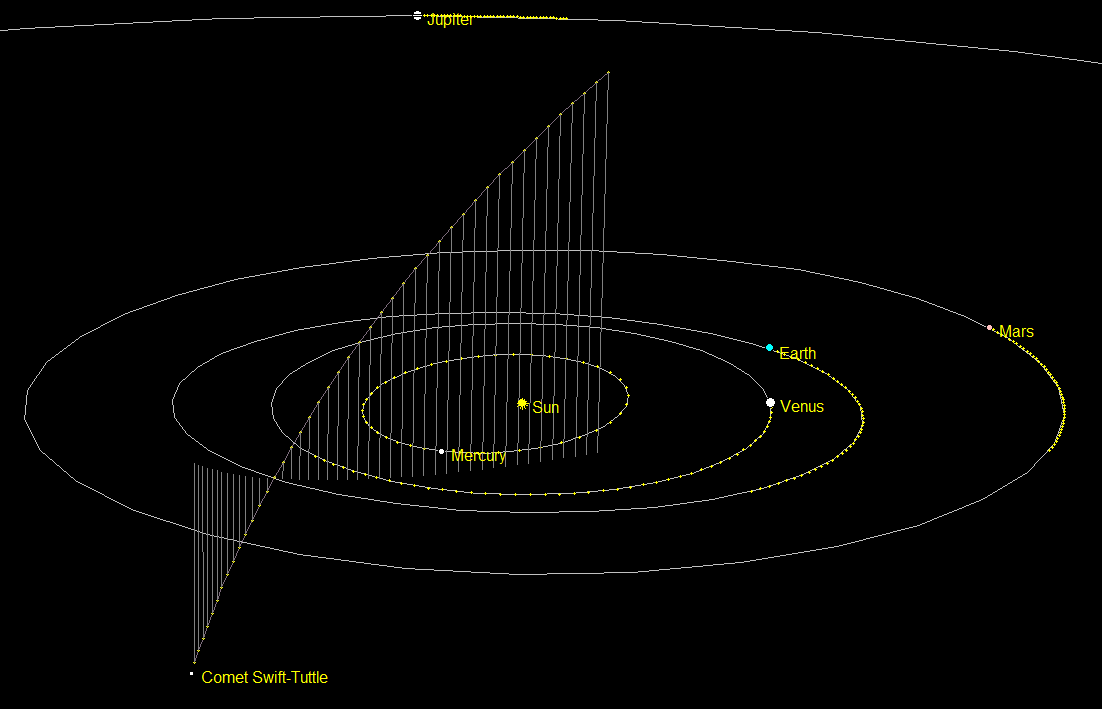
The passage of Comet 109P/Swift-Tuttle through the inner solar system November 1, 1992 to January 30, 1993. The meteoroids shed by the comet on its numerous trips close to the Sun lie close to that orbit. Note that its orbit intersects with the Earth’s orbit. That’s where the Earth will be around August 12-13 every year. Created using my LookingUp program.
05/04/2017 – Ephemeris – Bits of Halley’s Comet will fill our skies for the next few mornings
Ephemeris for Thursday, May 4th. The Sun rises at 6:28. It’ll be up for 14 hours and 23 minutes, setting at 8:51. The Moon, 2 days past first quarter, will set at 4:15 tomorrow morning.
Look out for the Eta Aquariids meteors in the early morning sky for the next few days. This is like 5 a.m. These are sand grain sized debris from “Hawley’s” Comet. That’s the same guy we pronounce “Hayley” or “Hal-ley”. The authority on the pronunciation is a contemporary of his, Samuel Pepys, who spelled his name H-a-w-l-e-y. Anyway, this is one of two meteor showers every year that are attributed to Halley’s Comet, where the Earth crosses the debris stream. The other, the Orionids of late October see the debris stream entering the inner solar system, while the Eta Aquariids, which seem to come from the southeast are the debris stream leaving the inner solar system, and heading back out toward Neptune’s orbit.
The times given are for the Traverse City/Interlochen area of Michigan. They may be different for your location.
Addendum
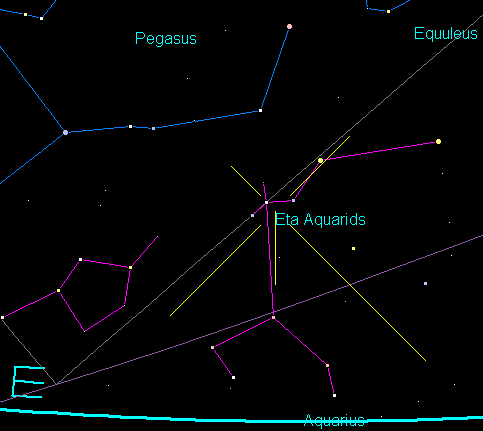
The Eta Aquariid radiant at the peak of the shower. The radiant moves slowly to the east with time. Credit: Bob Moler’s LookingUp program.
 Bob Moler's Ephemeris Blog