Archive
05/27/2014 – Ephemeris – There was a meteor sprinkle but no storm
Ephemeris for Tuesday, May 27th. Today the sun will be up for 15 hours and 12 minutes, setting at 9:16. The moon, 1 day before new, will rise at 6:11 tomorrow morning. Tomorrow the sun will rise at 6:02.
The Camelopardalid meteors straggled in last Saturday morning. No real shower and definitely not a storm, but waiting through the night I saw a few genuine Camelopardalids, moving slowly that could be traced back to the north. There was no peak of activity, but what meteors we did see appeared randomly. I and others reporting via Twitter from around the country remarked the large percentage of really bright meteors. I saw one that left a smokey train that stayed visible a few seconds. I didn’t have binoculars to follow it further. Other observers had better luck with meteor trains. So yes, the Camelopardalids were a disappointment, but at least they were not a no show. This was a newly discovered comet which had no history of meteor shower activity before.
Times are for the Traverse City/Interlochen area of Michigan. They may be different for your location.
05/20/2014 – Ephemeris – Special doings at the Sleeping Bear National Lakeshore Friday Night
Ephemeris for Tuesday, May 20th. Today the sun will be up for 14 hours and 59 minutes, setting at 9:09. The moon, 1 day before last quarter, will rise at 2:09 tomorrow morning. Tomorrow the sun will rise at 6:08.
This Friday evening Dr. Tyler Nordgren, astronomer, artist and dark sky advocate will give a presentation at the Sleeping Bear Dunes National Lakeshore Philip A. Hart Visitor Center in Empire at 7 p.m. Afterward he will be signing copies of his beautiful new poster See the Stars from Sleeping Bear Dunes National Lakeshore featuring the Great and Little Bear constellations and the bluffs of the Sleeping Bear Dunes and the Manitou Islands. After that, weather permitting see the sunset from many of the parks locations, then, for the hardy, settle down for an all night vigil for a possible meteor storm with the Grand Traverse Astronomical Society at the Dune Climb (The bottom, not the top, though you can climb up there for an all-sky view.).
Times are for the Traverse City/Interlochen area of Michigan. They may be different for your location.
Addendum

See the Stars from Sleeping Bear Dunes National Lakeshore Poster by Tyler Nordgren.
05/19/2014 – Ephemeris – The meteor storm and an all night star party to view it
Ephemeris for Monday, May 19th. Today the sun will be up for 14 hours and 57 minutes, setting at 9:08. The moon, 2 days before last quarter, will rise at 1:33 tomorrow morning. Tomorrow the sun will rise at 6:09.
This will be a first for the Grand Traverse Astronomical Society, an all night star party this Friday night and Saturday morning. The reason is the predicted meteor storm Saturday morning from Comet 209P/LINEAR, discovered in 2004. Near a I can tell no one has seen a single meteor from this comet. However several astronomers who work on cometary debris have some confidence that debris from this comet which orbits the Sun every 5 years will cross the Earth orbit on the morning of May 24th around 3 a.m. give or take. The hardiest of the GTAS members will be at the Dune Climb of the Sleeping Bear Dunes National Lakeshore all night. Join us if you can.
Times are for the Traverse City/Interlochen area of Michigan. They may be different for your location.
Addendum
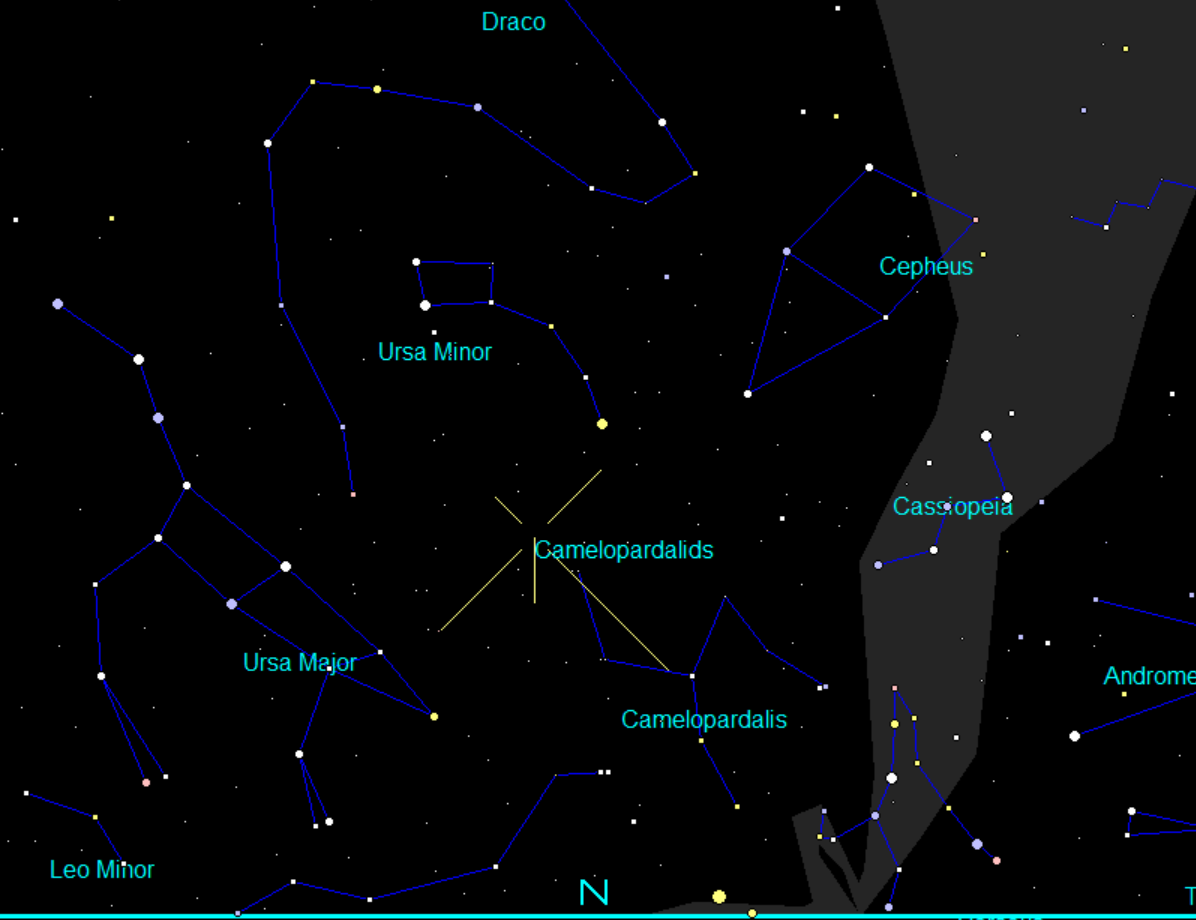
The expected radiant for the meteors of the May Camelopardids, the meteors from the comet 209P/LINEAR at 3 a.m. on May 24, 2014. Credit: My LookingUp program.
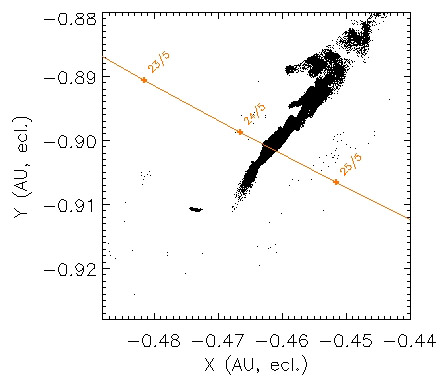
Earth’s motion in respect to the expected meteoroid stream from Comet 209P/LINEAR. Calculations by Jeremie Vaubaillon. From meteor.seti.org.
05/15/2014 – Ephemeris – Comet 209P/LINEAR and the meteor storm
Ephemeris for Thursday, May 15th. Today the sun will be up for 14 hours and 49 minutes, setting at 9:03. The moon, 1 day past full, will rise at 10:10 this evening. Tomorrow the sun will rise at 6:13. | A possible meteor storm is predicted for the morning of Saturday May 24th, between the hours of 3 and 4 a.m. with the first meteors showing up shortly after 1:30 a.m. and building after that. Meteor showers are produced by the debris of comets. The comet that will be responsible is 209P/LINEAR discovered in 2004 by Lincoln Near-Earth Asteroid Research, though the comet has been in and near its present orbit for centuries. The comet will pass closest to the Earth on May 28th, it will be very dim. The debris cloud will be ahead if it, crossing the earth’s orbit 4 days earlier. The Grand Traverse Astronomical Society is attempting to set up an all night star party/meteor watch. Stay tuned.
Times are for the Traverse City/Interlochen area of Michigan. They may be different for your location.
Addendum
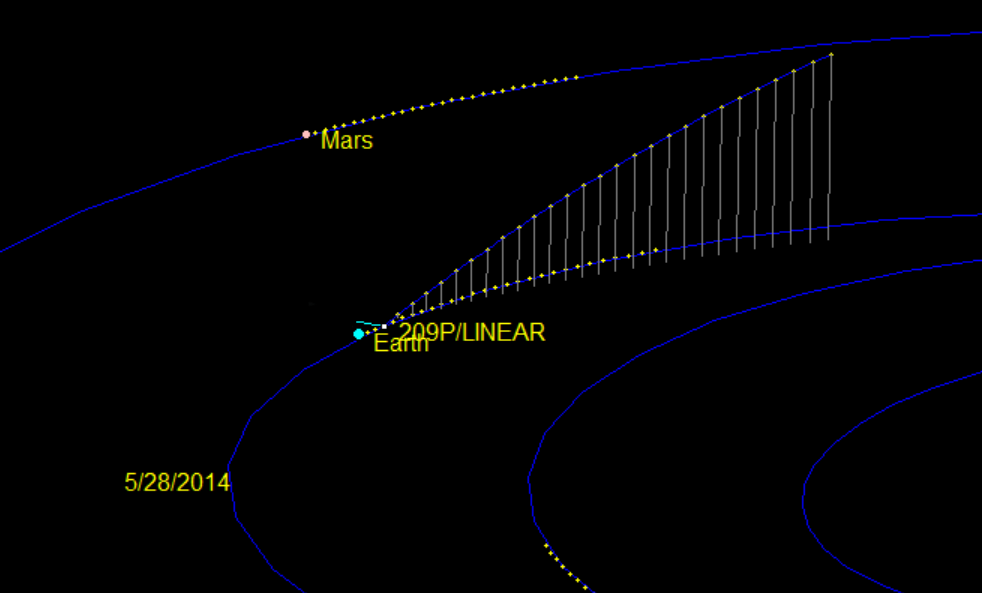
Comet 209P/LINEAR crosses the Earth’s orbit behind the Earth around May 28, 2014. The “stilts” on the comet’s orbit show that it is coming from north of the Earth’s orbital plane. Credit: Bob Moler’s LookingUp program.
The expected radiant for the meteors of the May Camelopardids, the meteors from the comet 209P/LINEAR at 3 a.m. on May 24, 2014. Credit: My LookingUp program.
05/13/2014 – Ephemeris – A possible meteor storm for the early morning hours of May 24th
Ephemeris for Tuesday, May 13th. Today the sun will be up for 14 hours and 44 minutes, setting at 9:01. The moon, 1 day before full, will set at 6:16 tomorrow morning. Tomorrow the sun will rise at 6:15.
A meteor storm is an enhanced meteor shower in terms of numbers of meteors seen over a short interval. Some astronomers predict one where no meteor shower has been seen before, on the morning of May 24th this year. In the last couple of years two astronomers have projected the orbits of the debris from the comet now known as 209P/LINEAR, discovered in 2004. These astronomers are Peter Jenniskens of the SETI Institute and NASA and Esko Lyytinen of Finland. The International Meteor Organization calendar for this year reports predictions for the peak of meteor storm to be between 3 and 4 a.m. on May 24th. But no one really knows if the meteor storm will show at all. I’ll tell you of local observing plans on Thursday.
Times are for the Traverse City/Interlochen area of Michigan. They may be different for your location.
Addendum
The expected radiant for the meteors of the May Camelopardalids, the meteors from the comet 209P/LINEAR at 3 a.m. on May 24, 2014. Credit: My LookingUp program.
Note that the meteors will appear all over the sky, but can be traced back to this radiant.
05/01/2014 – Ephemeris – Previewing May skies
Ephemeris for Thursday, May 1st. The sun rises at 6:32. It’ll be up for 14 hours and 14 minutes, setting at 8:47. The moon, 2 days past new, will set at 11:21 this evening.
Today we will start the month when the promise of spring is finally fulfilled, we hope. Daylight hours in the Interlochen/Traverse City area will increase from 14 hours and 14 minutes today to 15 hours 18 minutes on May 31st. The altitude, or angle, of the sun above the southern horizon at local noon will ascend from 60 degrees today to 67 degrees at month’s end. The altitude of the sun in the Straits area will be a degree lower than that but your length of daylight will be a few minutes longer. Local apparent noon this month, when the sun passes due south, will be about 1:38 p.m. The Eta Aquarid meteor shower will reach its peak about 2 a.m. this Sunday morning the 4th. I’ll have more on my blog bobmoler.wordpress.com today.
Times are for the Traverse City/Interlochen area of Michigan. They may be different for your location.
Addenda
The Eta Aquarid Meteor Shower
This shower is associated with Halley’s Comet. We see two meteor showers from Halley’s comet. One in October where the comet debris is crossing the earth’s orbit heading toward the sun, and again as its leaving. This shower is caused by the debris leaving the vicinity of the sun.
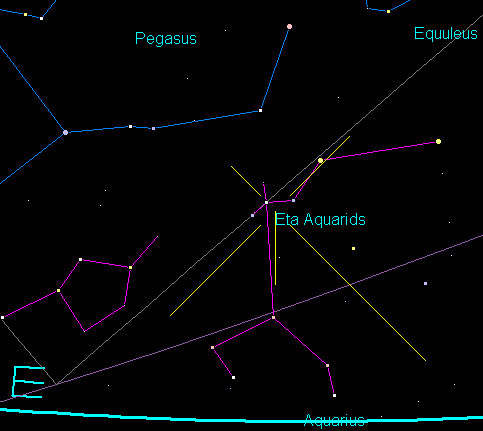
The Eta Aquarid radiant at the peak of the shower. The radiant moves slowly to the east with time. Credit: Bob Moler’s LookingUp program.
The peak of the shower will be at 7 h UT on May 6th. That’s 3 a.m. EDT, about 20 minutes before the radiant will rise. This will give about one hour before astronomical twilight starts to view the meteor shower in completely dark skies.
Possible Meteor Storm – May 24
There will be the possibility of a meteor storm on the morning of May 24th. A meteor storm differs from a meteor shower in the numbers of meteors seen and duration. There is a possibility of up to 400 meteors per hour for the hours of 7h to 8h UT (3 to 4 a.m. EDT).
The body responsible is Comet 209P/LINEAR. It was the 209th periodic comet discovered on February 3, 2004 by Lincoln Near-Earth Asteroid Research (LINEAR). Despite the recent discovery 209P has been orbiting the sun for hundreds of years, maybe longer. This year the comet will come close to the Earth and will allow the Earth to pass through debris that it shed hundreds of years ago.
Comet 209P/LINEAR crosses the Earth’s orbit around May 28, 2014. The “stilts” on the comet’s orbit show that it is coming from north of the Earth’s orbital plane. Credit: Bob Moler’s LookingUp program.
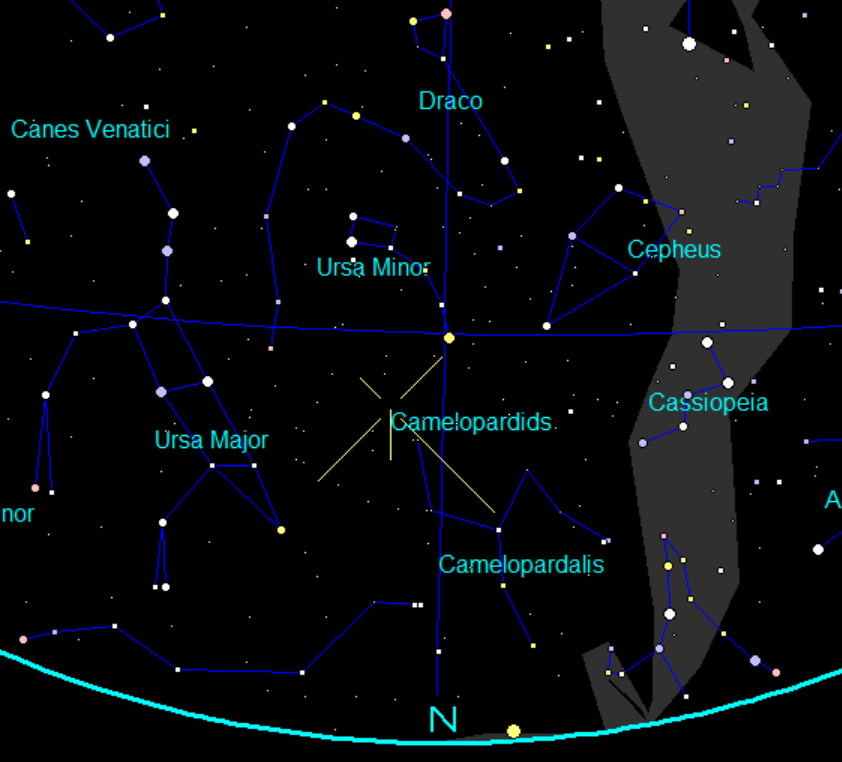
The radiant for the Comet 209P/LINEAR debris. For this purpose I’ve designated it Camelopardids (not official and probably not correct). Credit: Bob Moler’s LookingUp program. Note that the constellation of Camelopardalis is a giraffe.
Astronomical Twilight starts at 3:51 a.m., but the skies should remain dark enough. The 24% illuminated moon will rise about 2:45 or so and may not be much of an impediment in seeing the meteor storm.
May Star Chart
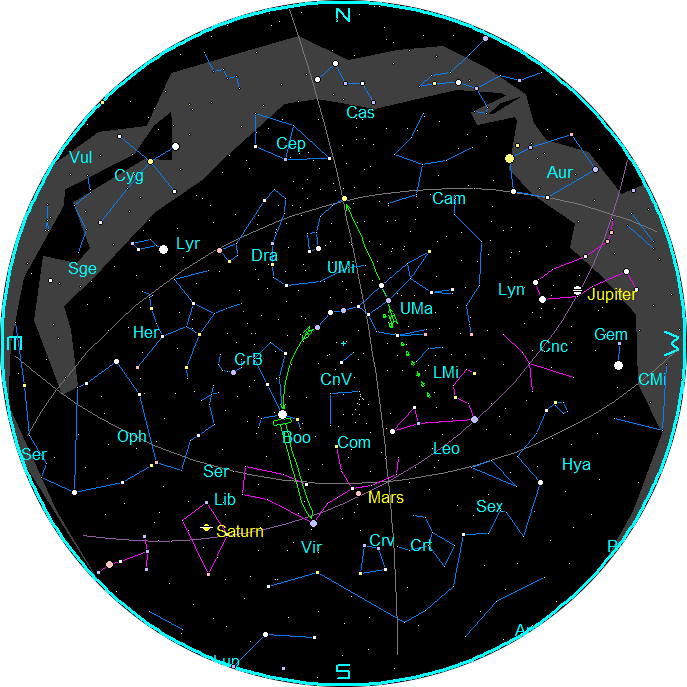
Star Chart for mid-month for May 2014 at 11 p.m. Credit: Bob Moler’s LookingUp program.
Add a half hour to every week before the 15th and subtract and hour for every week after the 15th.
For a list of constellation names to go with the abbreviations click here.
04/28/2014 – Ephemeris – The Lyrid meteor shower will reach peak tomorrow
Ephemeris for Monday, April 21st. The sun rises at 6:48. It’ll be up for 13 hours and 46 minutes, setting at 8:34. The moon, 1 day before last quarter, will rise at 2:52 tomorrow morning.
The second major meteor shower this year will reach its peak tomorrow afternoon (~18h UT). The best shot to see it will be tonight from about 10 to near 3 a.m. when the moon rises. The meteor shower is called the Lyrids, because they seem to come from near the constellation Lyra the harp and the bright star Vega. At 10 p.m. Vega is the brightest star low in the northeastern sky. By 3 a.m. Vega will be high in the east. The radiant of the meteors is to the west of Vega between Lyra and the dim constellation of Hercules. The most meteors will be visible just before the moon begins to brighten the sky before 3 a.m. Though a major shower the peak hourly rate is expected to be 18 meteors an hour. However we won’t quite get close to that rate.
Times are for the Traverse City/Interlochen area of Michigan. They may be different for your location.
Addendum
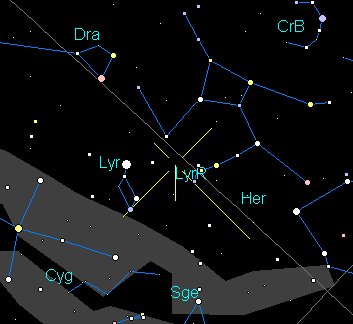
Lyrid meteor radiant. The bright star is Vega
The source of my information, the International Meteor Organization calendar can be downloaded from here.
David Dickinson’s post on this year’s Lyrid meteor shower on Universe Today is here.
01/03/2014 – Ephemeris – Astronomy events in the Grand Traverse Region tonight.
Ephemeris for Friday, January 3rd. The sun will rise at 8:19. It’ll be up for 8 hours and 55 minutes, setting at 5:14. The moon, 2 days past new, will set at 8:32 this evening.
We have a big night ahead. At 1 a.m. the Earth will be closest to the Sun at perihelion. In the morning hours the Quadrantid meteor shower will reach peak. Before that the Grand Traverse Astronomical Society will hold its monthly meeting at Northwestern Michigan College’s Rogers observatory on Birmley Road south of Traverse City starting at 8 p.m. The program will be given by Richard Kuschell, who will talk about “Aristotle’s Big Mistake”. Afterward, starting at 9 p.m. there will be a star party. If its clear the winter wonders will be visible including the planet Jupiter and the Great Orion Nebula, the closest star nursery to us. The meeting is free to the public. There will be another program given during the star party.
Times are for the Traverse City/Interlochen area of Michigan. They may be different for your location.
Addendum
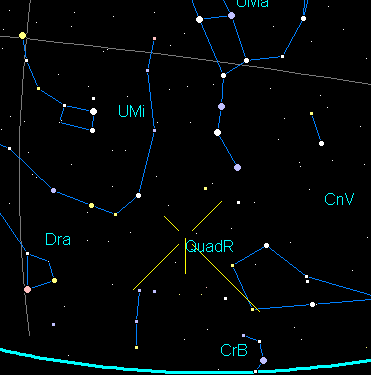
Quadrantid meteor shower radiant at 1:30 a.m.
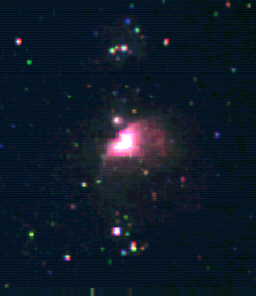
Great Orion Nebula in Orion’s sword. My old photograph. What you’ll see will actually be better than this except our eyes will not perceive the red color. It will look gray or greenish at best.
01/02/2014 – Ephemeris – Quadrantids and the Earth at Perihelion tomorrow night
Ephemeris for Thursday, January 2nd. The sun will rise at 8:19, the latest sunrise of the year. It’ll be up for 8 hours and 54 minutes, setting at 5:14. The moon, 1 day past new, will set at 7:16 this evening. | The Quadrantid meteor shower will be the best meteor shower of the year since the other showers will have to contend with the bright moon. The best time to see them will be between midnight and 6:30 in the morning Friday night through Saturday morning. They will seem to come from behind the Big Dipper’s handle. Weird though it seems. At 1 a.m. Saturday morning the Earth will be closest to the sun in it’s orbit. This is called perihelion. The earth at that instant will be 91.45 million miles away. On July 3rd it will be at its farthest, about 94 and a half million miles away. This slight distance variance doesn’t affect us much except to make winter shorter than summer by a few days. You probably won’t believe that either.
Times are for the Traverse City/Interlochen area of Michigan. They may be different for your location.
Addendum
Quadrantid meteor shower radiant low in the noirtheast at 1:30 a.m.
The Bad Astronomer’s take on perihelion is here.
Also for this and the rest of the year here is David Dickinson’s 101 Astronomical Events for 2014 on Universe Today.
12/13/2013 – Ephemeris – The Geminid meteor shower will peak overnight
Ephemeris for Friday, December 13th. The sun will rise at 8:11. It’ll be up for 8 hours and 51 minutes, setting at 5:02. The moon, half way from first quarter to full, will set at 5:27 tomorrow morning.
The Geminid meteor shower will reach maximum around 12:45 a.m. tomorrow morning. The big problem will be the bright moon, so only the brightest meteors will be visible before the moon sets tomorrow morning. The 5:27 moon-set time will give the Geminids about an hour of dark skies, plus maybe another half hour of unobjectionable morning twilight to see them at their best. The Geminids will appear to originate from near the star Castor at the head of the constellation Gemini, where Jupiter is currently located. It is said that the Geminids are year in and year our the most reliable shower. That may be true, because in 1983 the source of the meteor shower was found, a long dead comet hulk, that resembles an asteroid but with a comet’s orbit.
Times are for the Traverse City/Interlochen area of Michigan. They may be different for your location.
Addendum
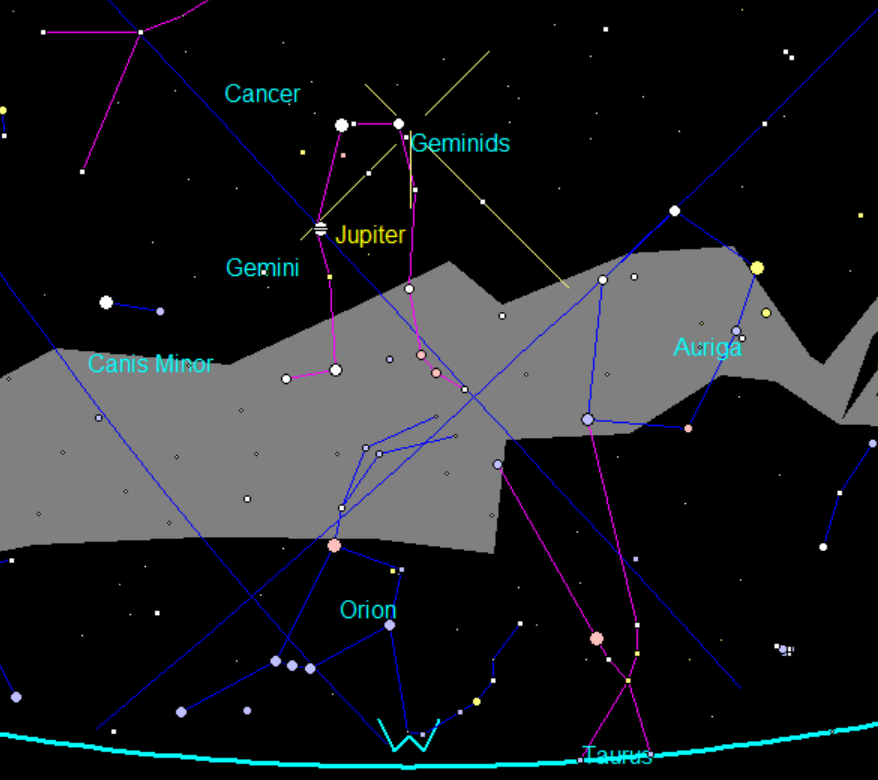
The Geminid radiant at 6 a.m. December 14, 2014 after moon set. Created using my LookingUp program for Windows
The brighter Geminids can be seen all night, but the darkest time will be just before dawn.
 Bob Moler's Ephemeris Blog