Archive
The Draconid meteor shower peaks tonight
The Draconid meteor shower is lackluster most years with a handful of meteors an hour, and this is one of those. However every once and a while all heaven breaks loose. It’s related to Comet Giacobini-Zinner, a short period comet. The radiant is overhead in the early evening, so this is a rare meteor shower best seen in the evening rather than the morning sky.
Here’s a link to my post a couple of years ago (2011) about it including a finder chart: https://bobmoler.wordpress.com/2011/10/06/100611-ephemer…-meteor-shower/
For this year check out the site EarthSky.org and their take on the Draconids.
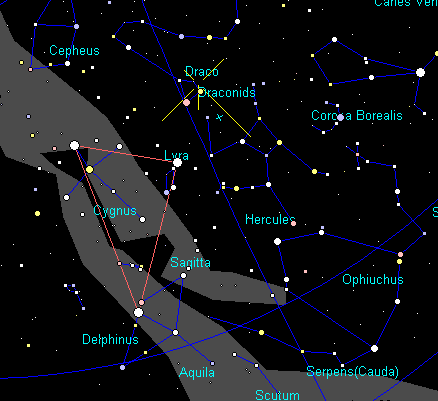
Draconid Meteor Shower Radiant
The red triangle delineates the Summer Triangle.
08/12/2013 – Ephemeris – The perseid meteors are not done yet
Ephemeris for Monday, August 12th. The sun rises at 6:41. It’ll be up for 14 hours and 10 minutes, setting at 8:52. The moon, 2 days before first quarter, will set at 11:26 this evening.
The Perseid meteor shower is still active. Their peak will be this afternoon. So starting at moon set at 11:26 or so it will be dark enough to see them. Meteor showers are caused when the earth crosses the path of a periodic comet and runs into the debris liberated by the comet’s past visits near the sun. Comet Swift-Tuttle is the comet responsible for the Perseids. It has an orbit of the sun of 130 years. Every time the comet comes close to the sun, it liberates a cloud of small gravel that’s too massive to be swept into the comet’s tail, however it is affected by the pressure of sunlight. These make the prediction of the time of the meteor shower interesting, or that a particular cloud may miss the earth this time to hit it some other passage.
Addendum
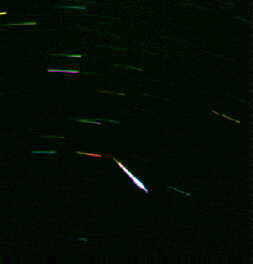
My best Perseid photo. From the 70’s.
08/09/2013 – Ephemeris – A weekend full of local astronomical events
Ephemeris for Friday, August 9th. The sun rises at 6:38. It’ll be up for 14 hours and 18 minutes, setting at 8:56. The moon, 3 days past new, will set at 9:55 this evening.
This weekend is packed with events by the Grand Traverse Astronomical Society starting tonight with Friday Night Live on Front Street in Traverse City. We’ll start by looking at the sun if it’s clear, and at Saturn as night falls. Tomorrow night its a Star Party and meteor watch at Thoreson Farm at Sleeping Bear Dunes National Lakeshore see the map at http://www.gtastro.org for location. Sunday night it’s Meteors and S’mores at Leelanau State Park. The Perseid meteor shower will reach its peak between 2 and 4 Monday afternoon, but we’re already seeing its meteors, which seem to come from the northeastern sky. The moon really won’t interfere until Monday night before midnight, so this is an excellent year for the Perseid meteor shower.
Times are for the Traverse City/Interlochen area of Michigan. They may be different for your location.
Addendum
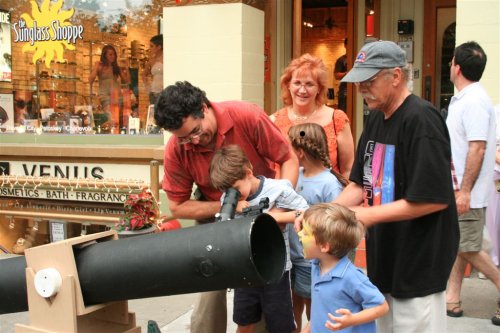
Friday Nite Live
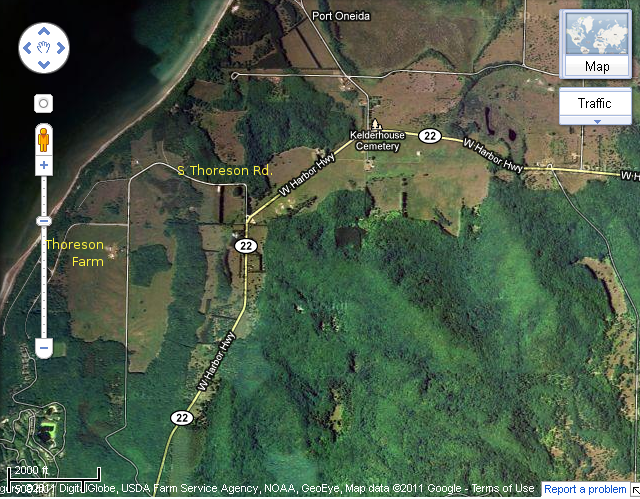
Map to Thoreson Farm, northeast of Glen Arbor.
07/26/2013 – Ephemeris – South Delta Aquarid meteors at peak, but look for the Perseids
Ephemeris for Friday, July 26th. The sun rises at 6:22. It’ll be up for 14 hours and 51 minutes, setting at 9:14. The moon, 3 days before last quarter, will rise at 11:13 this evening.
We are now reaching the peak of the South Delta Aquarid meteor shower, which is hampered by the waning gibbous moon in the morning sky, where it’s visible. This is also the time to begin to look for the Perseid meteors that will reach peak next month on the morning of the 12th. The Perseids are an all night meteor shower because the radiant point, the point from which the meteors seem to come is far enough north so it never sets. The largest number of meteors appear when the radiant is highest in the sky, before dawn. However as soon as it gets dark the low position of the radiant in the northeast will result in fewer meteors but the streaks will be longer, as the meteoroids hit the atmosphere at a low angle.
Times are for the Traverse City/Interlochen area of Michigan. They may be different for your location.
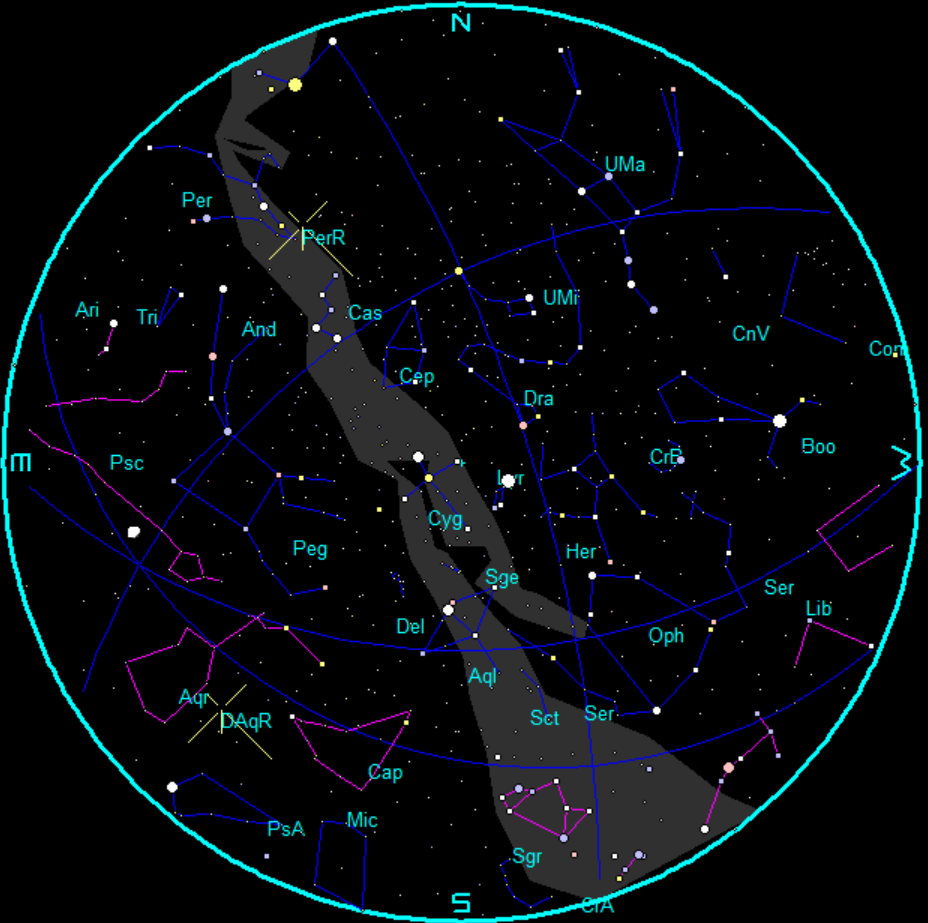
South Delta Aquarid meteor shower at peak and Persieds firing up at 1 a.m. July 27, 2013. PerR and DAqR are the radiants.
05/02/2013 – Ephemeris – The Eta Aquarid meteors will reach peak this weekend
Ephemeris for Thursday, May 2nd. The sun rises at 6:30. It’ll be up for 14 hours and 17 minutes, setting at 8:48. The moon, at last quarter today, will rise at 3:09 tomorrow morning.
Monday morning will see the expected peak of the Eta Aquarid meteor shower. The meteors will seem to come from the southeast. This shower has a very long peak and can be seen tomorrow morning. This shower’s claim to fame is that the meteoroids that produce this shower are bits shed by Halley’s Comet. The orbits of Halley’s comet and the earth nearly intersect at two points. The inbound Halley’s comet crosses the earth’s orbit where the earth is on October 20th., when we have the Orionid meteor shower. The comet’s orbit then passes between the orbits of Venus and Mercury then crosses the earth’s orbit again near where the earth is on May 6th. The shower has 12 year fluctuations of peak numbers, probably caused by Jupiter.
Times are for the Traverse City/Interlochen area of Michigan. They may be different for your location.
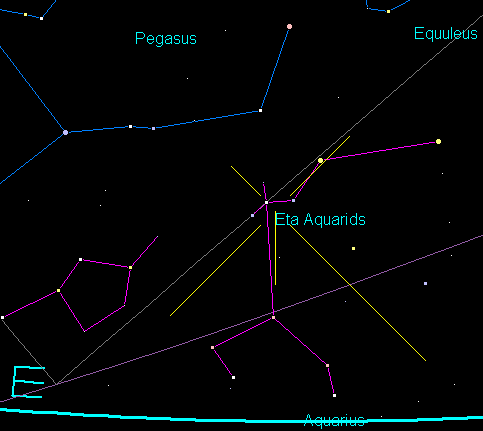
Eta Aquarid radiant
04/19/2013 – Ephemeris Plus* – Astronomy Day and the Lyrid meteor shower
Ephemeris Plus for Friday, April 19th. The sun rises at 6:51. It’ll be up for 13 hours and 41 minutes, setting at 8:32. The moon, 1 day past first quarter, will set at 3:51 tomorrow morning.
Tomorrow is Astronomy Day 2013. Astronomy Day is generally held on the Saturday closest to the first quarter moon in late April or early May. The Grand Traverse Astronomical Society will celebrate with a star party at Northwestern Michigan College. Tomorrow April 20th, from 9 p.m. to 11 p.m. There will also be activities inside the observatory, so clear or cloudy there will be something to see or do for all ages.
The Lyrid Meteor Shower will be active this weekend and reach a peak Monday morning. The meteors from this shower will seem to come from near the constellation of Lyra the harp, a northern summer constellation, with the bright star Vega with a small and narrow parallelogram of stars near it. We do have a moon problem this year, so it just might be caught by early risers in the next couple of mornings. It is not a super active shower, and has a peak rate of only 18 and hour when Vega is overhead, which it will be at 5 in the morning. With the experience of the bright meteor that broke windows in Russia, be comforted to know that meteor showers members are created with very small grains, not big boulders.
Times are for the Traverse City/Interlochen area of Michigan. They may be different for your location.
*Ephemeris Plus contains more information in the post’s body that could not fit into the time constraints of the Ephemeris program.
Addendum
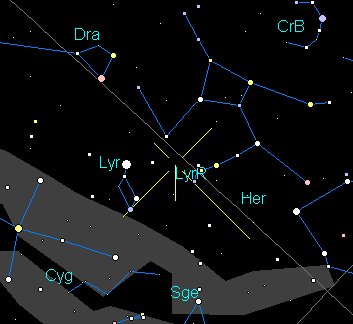
Lyrid meteor radiant. The bright star is Vega
02/19/2013 – Ephemeris – A hit and a miss
Ephemeris for Tuesday, February 19th. The sun will rise at 7:36. It’ll be up for 10 hours and 41 minutes, setting at 6:17. The moon, 2 days past first quarter, will set at 4:01 tomorrow morning.
Last Friday we had what I’d call a hit and a miss. The miss was the close passage of asteroid 2012 DA14 a rock maybe half the size of a football field. We’ll know better once radar observation of the asteroid are processed. Up to then the size was calculated by its brightness and its supposed reflectance or albedo. That last is the biggest variable. The asteroid was traveling at a slight angle to the earth’s orbit and a bit slower than the earth. It was crossing the earth’s orbit heading slightly northward, what astronomers call ascending node. That’s why the asteroid appeared heading north from our point of view. The meteoroid that exploded over Russia I think had a slight southerly trajectory. We’ll find out when the orbit is reconstructed.
Times are for the Traverse City/Interlochen area of Michigan. They may be different for your location.
Addendum
The Bad Astronomer Phil Plait has the story of the Russian Meteor with lots of videos.
http://www.slate.com/blogs/bad_astronomy/2013/02/15/breaking_huge_meteor_explodes_over_russia.html
The Planetary Society Blog has more information including a Webcast available at:
http://www.planetary.org/blogs/mat-kaplan/20130218-2012-da14-planetcast-on-demand.html
01/03/2013 – Ephemeris – The Quadrantid meteor shower will peak this morning.
Ephemeris for Thursday, January 3rd. The sun will rise at 8:19. It’ll be up for 8 hours and 55 minutes, setting at 5:15. The moon, 1 day before last quarter, will rise at 12:06 tomorrow morning.
This morning will see the peak of the Quadrantid meteor shower. There’s still time to spot them before the sky brightens too much. It’s one of the better meteor showers of the year, except it occurs in the cold and not very clear skies of January. Meteor showers are generally named for the constellation from which they seem to come. Trouble is, there’s no such constellation of the Quadrant. Now, that is. There is a sextant and an octant, but no quadrant. All these instruments were used by navigators and astronomers to measure the altitude of stars and planets. The obsolete constellation of the quadrant was located near the handle of the Big Dipper and north of the kite shaped spring constellation of Boötes. The Quadrantids will be around for the next few mornings.
Times are for the Traverse City/Interlochen area of Michigan. They may be different for your location.
Addendum
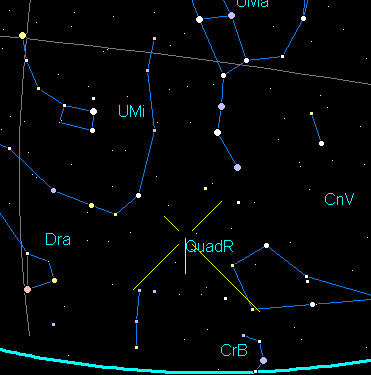
Quadrantid meteor shower radiant at 1:30 a.m.
12/13/2012 – Ephemeris – The Geminid meteor shower reaches its peak tonight.
Ephemeris for Thursday, December 13th. The sun will rise at 8:11. It’ll be up for 8 hours and 51 minutes, setting at 5:02. The moon is new today, and won’t be visible.
Tonight will be the peak of the Geminid meteor shower. This is one of the most active showers of the year. Some say it’s even more active than the Perseid meteor shower of August with up to 100 meteors or shooting stars visible an hour. They will seem to come from near the star Castor in the constellation Gemini which is rising high towards midnight. The moon will not interfere because it’s new. The radiant point is highest at 2 a.m. But will be in the sky from 8 p.m. on All you’ll need then is clear skies. If it does clear up, make sure you dress warmly. It will take up to 10 minutes or even more for your eyes to get accustomed to the darkness to be able to see the meteors. The meteors are related to a body called Phaethon, a dead comet nucleus.
Times are for the Traverse City/Interlochen area of Michigan. They may be different for your location.
Addendum
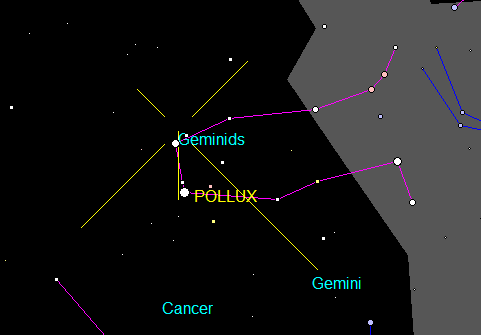
Geminid Radiant
11/19/2012 – Ephemeris – A Leonid meteor peak at 1 a/m/ EST tomorrow morning.
Ephemeris for Monday, November 19th. The sun will rise at 7:45. It’ll be up for 9 hours and 25 minutes, setting at 5:10. The moon, 1 day before first quarter, will set at 11:43 this evening.
There is expected to be a peak of the Leonid meteor shower at around 1 tomorrow morning. By then the radiant of the meteor shower will have risen in the east in the head of Leo the lion in the curve of the backwards question mark that denotes the front end of the beast. The Leonids do not have the same numbers every year. Great meteor storms occur, on average every 33 years because they are associated with a comet of the same period, Comet Tempel-Tuttle. It last came through the inner solar system in 1998, so this is not a great year for them. However astronomers are getting better at predicting where the debris streams are that were liberated by the comet in its passes of the sun, giving observers a heads up on the best times to look.
Times are for the Traverse City/Interlochen area of Michigan. They may be different for your location.
Addendum
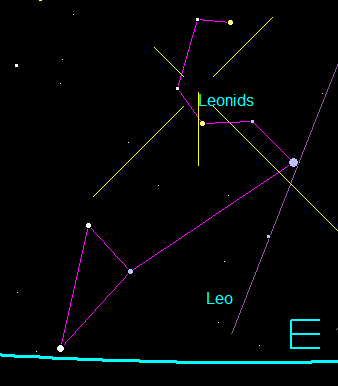
Leo rising at around 2 a.m. on the morning of November 20. Note the radiant in the sickle asterism of Leo. Created using Looking Up, my own program.
At 1 a.m. the triangle of stars at his haunches will not have risen yet. The maximum number of meteors per hour will be 10-20. However this is if the radiant is overhead. The numbers are expected to be lower. This will not be as visible west to here (Michigan).
 Bob Moler's Ephemeris Blog