Archive
11/12/2012 – Ephemeris – The North Taurid Meteor Dhower
Ephemeris for Monday, November 12th. The sun will rise at 7:35. It’ll be up for 9 hours and 41 minutes, setting at 5:17. The moon, 1 day before new, will rise at 7:15 tomorrow morning.
This is the date of the peak of the Northern Taurid Meteor Shower. This shower has a long duration, from late October to early December. Taurus is up all night, so the meteors will be seen all night, but more numerous in the morning. There won’t be many of them, maybe 5 an hour, but they are very slow moving, only 29 kilometers per second or 18 miles per second, about half the speed of other meteors. It has more than its share of very bright meteors. These meteors are thought to have their origin with Comet Encke. Encke is the comet with the shortest period known, only 3.3 years. The peak will last several days, and there’s even an expectation of a swarm, a higher number or meteors, that might be visible during this period.
Times are for the Traverse City/Interlochen area of Michigan. They may be different for your location.
Addendum
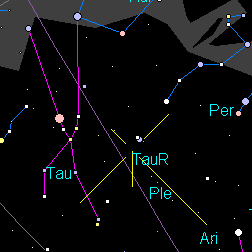
The Taurid Radiant.
10/08/2012 – Ephemeris – The Draconid Meteor Shower
Ephemeris for Columbus Day, Monday, October 8th. The sun will rise at 7:49. It’ll be up for 11 hours and 19 minutes, setting at 7:09. The moon, at last quarter today, will rise at 1:13 tomorrow morning.
The peak of the Draconid meteor shower is about now, (6-7 a.m. when the program airs) as the radiant point for these meteors is low in the north. They will be visible for the next few days seeming to radiate from the head of the constellation Draco, near the star Vega high in the west. These meteors are best about every 7 years, the last was last year. So maybe we may see 15 to 20 of these meteors per hour this time. These meteors are debris shed by Comet Giacobini-Zinner a short period comet of only 6.6 years. These meteors are very slow moving, about a third the velocity of the Perseid meteors of August. Meteors are the light given off by tiny bits of material sand grain to pea size as a rule as they burn up by friction due to their great speed.
Times are for the Traverse City/Interlochen area of Michigan. They may be different for your location.
Addendum
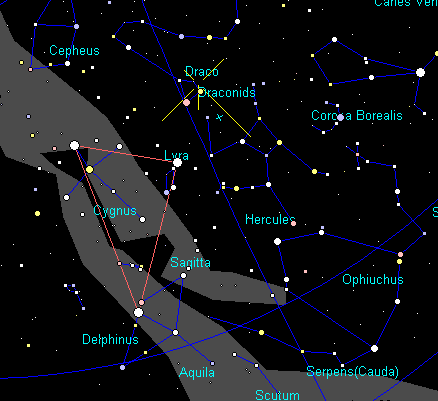
Draconid Meteor Shower Radiant
08/10/2012 – Ephemeris – Weekend Meteor Watches
Ephemeris for Friday, August 10th. The sun rises at 6:39. It’ll be up for 14 hours and 15 minutes, setting at 8:54. The moon, 1 day past last quarter, will rise at 1:04 tomorrow morning.
There are two events this weekend to view the heavens and the Perseid meteor showers. First, part of the Port Oneida Fair the Grand Traverse Astronomical Society will work with the rangers of the Sleeping Bear Dunes National Lakeshore to hold a star party and meteor watch at Thoreson Farm on South Thoreson Road of M22, a couple miles north of Glen Arbor. That will start at 9 p.m. It will be about 10:30 when it’ll be dark enough spot the meteors. Sunday evening there’s a Meteors and S’mores event at the Leelanau State Park, at the tip of the Leelanau Peninsula. That event starts at 10:30 p.m. The society will participate there also. The moon won’t interfere with the meteor shower It’s been banished into the morning sky.
Times are for the Traverse City/Interlochen area of Michigan. They may be different for your location.
08/09/2012 – Ephemeris – Viewing the Perseid meteor shower
Ephemeris for Thursday, August 9th. The sun rises at 6:38. It’ll be up for 14 hours and 17 minutes, setting at 8:56. The moon, at last quarter today, will rise at 12:24 tomorrow morning.
Lets take a look at what will happen this weekend with the Perseid meteor shower. We seem to have two meteoroid streams intercepting the earths. The earth will pass through the classic stream Saturday night, Sunday morning. The earth is expected to pass through a second stream Sunday Night, Monday morning. In the early evening the meteors are fewer, but the trails will be longer. The meteors will seem to come from the constellation of Perseus which lies below the W shaped constellation of Cassiopeia in the northeast. At two or three in the morning will see the greatest numbers of meteors, up to 60 meteors an hour. Tomorrow I’ll tell you about two events and places to go to join others in viewing the shower.
Times are for the Traverse City/Interlochen area of Michigan. They may be different for your location.
Addendum
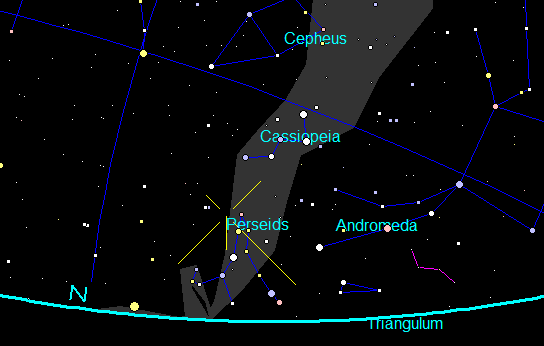
Perseid radiant at 10:30 p.m.
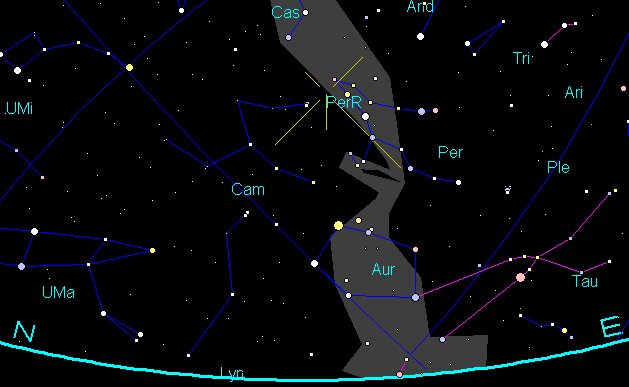
Perseid Meteor Shower radiant after midnight
08/07/2012 – Ephemeris – the comet responsible for the Perseid meteor shower
Ephemeris for Tuesday, August 7th. The sun rises at 6:36. It’ll be up for 14 hours and 22 minutes, setting at 8:59. The moon, 2 days before last quarter, will rise at 11:20 this evening.
The Perseid meteor shower is so named because the meteors seem to come from the direction of the constellation of Perseus which starts in the evening low in the northeast and rotates up throughout the night higher and higher. The comet responsible is Comet Swift-Tuttle, discovered in 1862 by Lewis Swift and Horace Tuttle. The comet has a 130 year orbit and returned in 1992. It’s orbit intersects ours at a 113 degree angle, which is why the radiant point is so far north. The Perseids have been recorded for 2,000 years so the comet has been around much longer than that. It’s nucleus is 17 miles in diameter, about twice that of Halley’s Comet. While Comet Swift-Tuttle won’t be back this century, we can see bits of it tonight.
Times are for the Traverse City/Interlochen area of Michigan. They may be different for your location.
08/06/2012 – Ephemeris – The Perseid Meteor Shower this weekend
Aug 6. This is Bob Moler with Ephemeris for Monday, August 6th. The sun rises at 6:35. It’ll be up for 14 hours and 25 minutes, setting at 9:00. The moon, 3 days before last quarter, will rise at 10:52 this evening.
Saturday night through Sunday morning will be the period of the maximum number of meteors in the Perseid meteor shower. There are many meteor showers but a few very active ones. Of these the Perseids are the most famous. Meteor showers occur the same dates during the year because meteoroid streams are debris left near the orbits of comets. If a comet passes near the earth’s orbit the debris it sheds when close to the sun will end up in orbits similar to the comet and when the earth passes the spot we experience a meteor shower. Thus in late July through mid August we pass through the meteoroid stream of debris of Comet Swift-Tuttle, whose sand to pea sized particles hit the atmosphere at 40 miles per second providing us a celestial show.
Times are for the Traverse City/Interlochen area of Michigan. They may be different for your location.
04/20/2012 – Ephemeris – The Lyrid meteor shower peaks this weekend.
Ephemeris for Friday, April 20th. The sun rises at 6:49. It’ll be up for 13 hours and 45 minutes, setting at 8:34. The moon, 1 day before new, will rise at 6:41 tomorrow morning.
The Lyrid meteor shower is reaching a peak soon. With the nearly new moon, the moon will not interfere with the display. While this a major annual shower, it usually produces only 15 meteors an hour at peak, although in some years as many as 90 an hour have been spotted. The Lyrids are so named because the seem to come from the direction of the constellation Lyra the harp, one of the more famous summer constellations. Well, they seen to come from between Lyra and Hercules to the west. The peak of the shower occurs just after midnight on Sunday morning the 22nd. The radiant point is up all night. In the evening the meteors will come from the northeast from near the bright star Vega. The numbers of meteors will increase through the night until dawn.
* Times are for the Traverse City/Interlochen area of Michigan. They may be different for your location.
Addendum
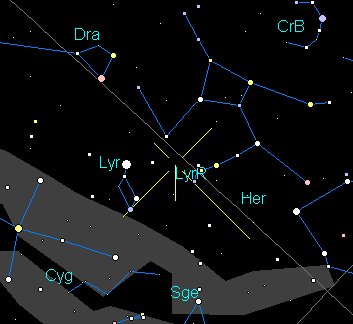
Lyrid meteor radiant. The bright star is Vega
01/03/2012 – Ephemeris – The Quadrantid meteor shower tomorrow morning
January 3rd. The sun will rise at 8:19. It’ll be up for 8 hours and 55 minutes, setting at 5:14. The moon, 2 days past first quarter, will set at 4:04 tomorrow morning.
Tomorrow morning will see the peak of the Quadrantid meteor shower. They will be best seen after 4 a.m. and before twilight starts at 6:34. The radiant will appear high in the sky then near the handle of the Big Dipper. The meteors or shooting stars will appear to come from there but will appear all over the sky. The shower is named for the constellation that they appear to come from, unfortunately the constellation didn’t survive. It was supposed to represent a mural quadrant, and old astronomical measuring tool that was built into a north-south wall to measure the altitude of stars as the crosses due south before the advent of the telescope. The Quadrantids can be a spectacular shower and viewing can be endangered by cold feet and hands.
* Times, as always are for the Traverse City/Interlochen area of Michigan.
Addendum
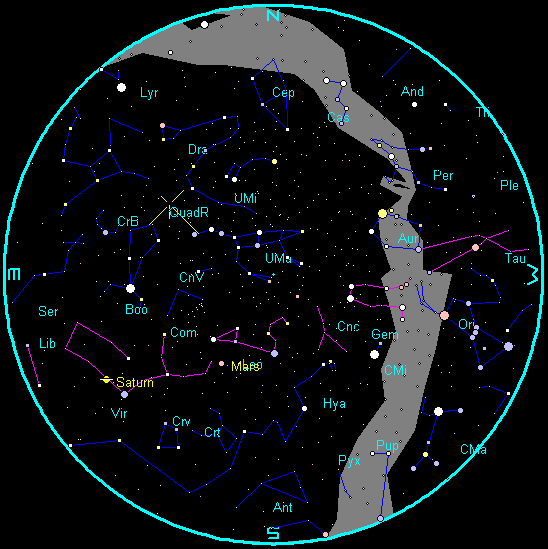
All sky Quadrantid radiant finder chart for 4 a.m.
11/15/11 – Ephemeris – Prospects for the Leonid meteor shower
Tuesday, November 15th. The sun will rise at 7:38. It’ll be up for 9 hours and 36 minutes, setting at 5:14. The moon, 3 days before last quarter, will rise at 9:22 this evening.
This is an off peak year for the Leonid meteor shower but astronomers are finding more and more Leonid dust streams. These dust streams are created when the comet, in this case Tempel-Tuttle passes its closest to the sun. They end up preceding or following the comet near its orbit but are affected by the tiny force of sunlight and end up diverging more and more from the comet itself. Three dust streams are expect to be encountered by the earth this year. The stream from the1800 passage of the comet is expected to pass the earth tomorrow afternoon to be picked up as radio echos only. Also Thursday and Friday afternoon there are also expected peaks. All invisible from here, but possibly visible from Asia.
* Times, as always are for the Traverse City/Interlochen area of Michigan.
Information gleaned from the International Meteor Organization Meteor Shower Calendar 2011: http://imo.net/calendar/2011.
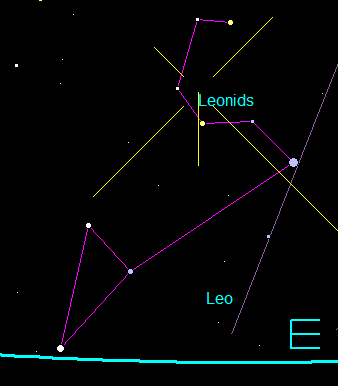
Leonid meteor radiant
10/20/11 – Ephemeris – The Orionid meteor shower
Thursday, October 20th. The sun will rise at 8:03. It’ll be up for 10 hours and 46 minutes, setting at 6:50. The moon, 1 day past last quarter, will rise at 1:40 tomorrow morning. | The Orionid meteor shower will reach its peak tomorrow morning. Like most meteor showers, this is best seen just before dawn. As the name suggests the so-called shooting stars will seem to come from the constellation Orion the hunter. They will appear to come from above the rectangular torso of the giant. These meteors actually have nothing to do with Orion, but they are the light flashes from bits of rock that were once part of Halley’s comet, as they burn up in the earth’s atmosphere. In Halley’s many passes close to the sun, much of its solid material has been liberated by the evaporating gasses, leaving a trail of litter in its orbit. The earth passes through this debris every May and now, in October.
* Times are for the Traverse City/Interlochen area of Michigan. They may be different for your location.
Addendum
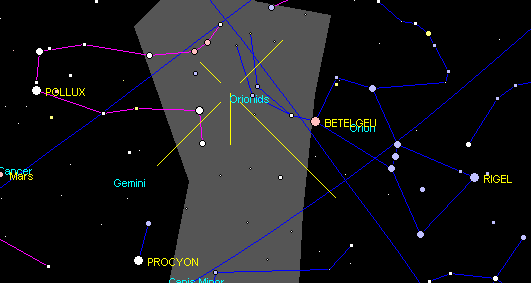
Orionid Radiant
 Bob Moler's Ephemeris Blog