Archive
10/16/2018 – Ephemeris – Soyuz failure makes for problems for the ISS
Ephemeris for Tuesday, October 16th. The Sun will rise at 7:59. It’ll be up for 10 hours and 56 minutes, setting at 6:56. The Moon, at first quarter today, will set at 12:36 tomorrow morning.
Last Thursday the 11th a cosmonaut, Alexy Ovchinin and an astronaut, Nick Hague were launched toward the International Space Station by a Russian Soyuz rocket. At about the time the four first stage boosters separated from the second stage, something happened, and the capsule containing the men was weightless instead of being boosted by the second stage of the rocket. The Soyuz has an escape system, so the descent capsule separated from the protective shroud and the orbital module on top of it and the service module below it. To make a landing downrange. The men are safe, but the three persons in the ISS must return by mid-December, whether or not they are relieved as their Soyuz capsule cannot be safely flown after that.
The times given are for the Traverse City/Interlochen area of Michigan. They may be different for your location.
Addendum
The above with the exception of the last line is what goes out on the 59 second length of my radio program. What follows is a more complete explanation of the problems in store for the International Space Station as the Russians attempt to determine the cause of the failure, fix the problem and begin flying again.
Cosmonauts and astronauts visiting the International Space Station generally use the same Soyuz that brought them up and docked to the station to return to the Earth. It happens that the reaction control thrusters used to orient the spacecraft use hydrogen peroxide (H2O2) as a monopropellant. It decomposes into oxygen and steam when in contact with a catalyst to provide thrust. However, hydrogen peroxide is unstable if left to itself, slowly decomposing. This gives the Soyuz a useful lifetime of about 200 days on orbit. The current crew of Sergey Prokopyev, Serena M. Auñón-Chancellor, and Alexander Gerst was launched from Baikonur, Kazakhstan on June 8, 2018. The 200 days runs out in late December. Their original scheduled return date was December 13th.
Scott Manley on YouTube has more information: https://www.youtube.com/watch?v=cpqq0i4w_fM
06/08/2018 – Ephemeris – A second Moon race?
Ephemeris for Monday, June 18th. Today the Sun will be up for 15 hours and 34 minutes, setting at 9:31, and it will rise tomorrow at 5:56. The Moon, 2 days before first quarter, will set at 1:30 tomorrow morning.
The Moon as a destination is becoming a hot topic among the space faring nations. Who will land humans first in this second wave since the United States landed there in the late 1960s and early 1970s: The Chinese, Russians, us? Or maybe someone else? Next year July 20th will be the 50th anniversary of Neil Armstrong’s first step onto the lunar surface. The goal this time is not to just visit, but to stay. The lunar surface is a harsh environment of extremes in temperatures and radiation from the Sun, and from the universe beyond. There is shelter beneath the surface, in lava tubes. There is one lava tube with a collapsed roof, a skylight, which could provide access in a place called the Marius Hills.
The times given are for the Traverse City/Interlochen area of Michigan. They may be different for your location.
Addendum
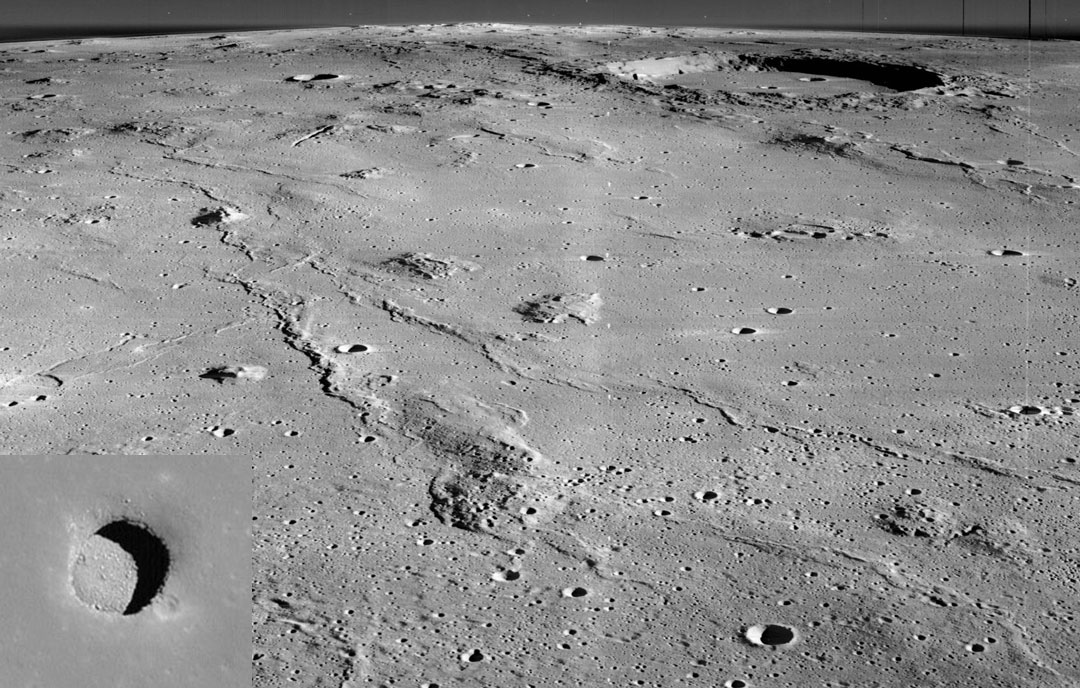
An oblique view of the Marius Hills from the Lunar Orbiter 2, with an inset look into a skylight into a lava tube from the Lunar Reconnaissance Orbiter at the lower left. Click on image to enlarge. Credit NASA, Lunar Orbiter 2, Lunar Reconnaissance Orbiter.
The picture above was posted on Astronomy Picture of the Day (APOD) 2017 October 2017: https://apod.nasa.gov/apod/ap171025.html, where there is more information.
05/29/2017 – Ephemeris – We remember too those who died reaching for the stars
Ephemeris for Memorial Day, Monday, May 29th. Today the Sun will be up for 15 hours and 16 minutes, setting at 9:18, and it will rise tomorrow at 6:01. The Moon, 3 days before first quarter, will set at 1:04 tomorrow morning.
Today we pause to remember those who gave their lives for our country. For purposes of this program that includes those courageous enough to sit on top of or beside a million pounds of explosives to be launched into space. From the three astronauts who died in the Apollo one file in 1967, the explosion of the Space Shuttle Challenger in 1986, to the disintegration of the Columbia in 2003, 17 Americans and other nationals have died in NASA space accidents. The Russians too have lost cosmonauts in the exploration of space. Brothers and sisters in the quest for knowledge and to expand the horizons of human habitation. Per aspera, ad astra, Through difficulties to the stars!
The times given are for the Traverse City/Interlochen area of Michigan. They may be different for your location.
Addendum
A listing of Astronaut and Cosmonaut deaths: http://www.aerospaceweb.org/question/history/q0114.shtml
10/17/2016 – Ephemeris – Europe’s ExoMars satellite and lander will reach Mars Tomorrow
Ephemeris for Tuesday, October 18th. The Sun will rise at 8:02. It’ll be up for 10 hours and 49 minutes, setting at 6:52. The Moon, 2 days past full, will rise at 9:07 this evening.
You’ve probably haven’t heard of the ExoMars mission before or even recently. That’s the way Mars missions go, due to their long cruise phase. It was launched by the Europeans and Russians back in March. ExoMars is an orbiter with an attached lander. The lander named Schiaparelli after the famed 19th century astronomer, separated from the Trace Gas Orbiter two days ago to land on Mars. A few hours later the orbiter made a thruster burn to miss Mars and not follow the lander into Mars’ atmosphere. The lander will hit Mars’ atmosphere at about 10:52 a.m. tomorrow, with landing 5 minutes later. The Schiaparelli lander will operate on batteries only with a lifetime of a few days. It will take a few images as it lands, but will not take images from the surface.
Times are for the Traverse City/Interlochen area of Michigan. They may be different for your location.
Addendum
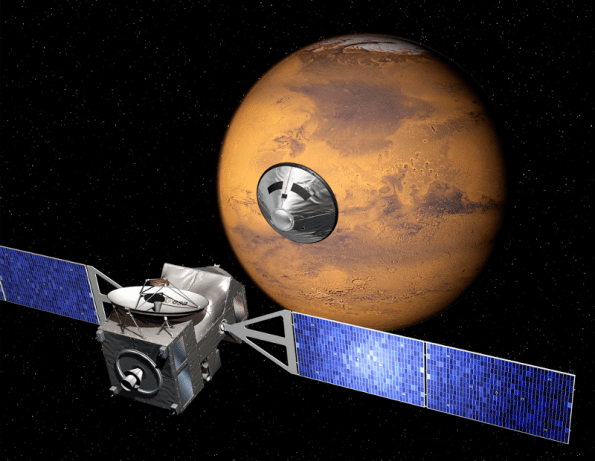
Artist’s visualization of releasing the Schiaparelli lander. Credit ESA.
Planetary Society’s Emily Lakdawalla’s blog post showing the ExoMars Mars arrival timeline: http://www.planetary.org/blogs/emily-lakdawalla/2016/10140937-exomars-timeline.html
10/17/2016 – Ephemeris – Elon Musk’s vision of how he’ll colonize Mars
Ephemeris for Monday, October 17th. The Sun will rise at 8:01. It’ll be up for 10 hours and 52 minutes, setting at 6:53. The Moon, 1 day past full, will rise at 8:21 this evening.
On September 27th Elon Musk announced his plans to send people to Mars, hopefully by 2024. He explained in detail how he would do it. He made an hour-long presentation at the International Astronautical Congress meeting in Mexico, which can be seen on the Internet at spacex.com. Also there is a shorter animation of how he expects to do it. He expects to send hundreds of people at a time into Earth orbit. The booster would return to the launch pad and another second stage with fuel loaded on top of it to be launched again on the next orbit to refuel the manned stage before sending it to Mars. Robotic missions would be sent before to set up the infrastructure for the Mars Base. I’m somewhat skeptical, but all great adventures start with a dream.
Times are for the Traverse City/Interlochen area of Michigan. They may be different for your location.
Addendum

New colonists looking out at the Martian landscape. Credit: Screen cap from SpaceX video.
Short 5 minute video: https://youtu.be/0agVZwux1Hs
Full address to the International Astronautical Congress meeting: https://youtu.be/IAZ-Xbn5hr0
04/21/2016 – Ephemeris – Up up and a way my beautiful balloon*
Ephemeris for Thursday, April 21st. The Sun rises at 6:47. It’ll be up for 13 hours and 48 minutes, setting at 8:36. The Moon, 1 day before full, will set at 7:16 tomorrow morning.
The successful launch of the SpaceX Falcon 9 spacecraft and the Dragon module marked the returned SpaceX to supplying the International Space Station after its failure last June. Besides the great achievement of landing the first stage of the Falcon on a barge, it delivered the Bigelow Aerospace BEAM inflatable module to the ISS. It’s already been attached to the station and will be inflated next month. Bigelow already has two inflatable satellites in orbit: Genesis I and II launched in 2006 and 2007 and though retired, are still in orbit. Inflatable spacecraft offer maximum volume for minimum weight. If the tests on the space station prove the concept, the Mars manned spacecraft may feature an inflatable living module.
Times are for the Traverse City/Interlochen area of Michigan. They may be different for your location.
*Apologies to the 5th Dimension and Bigelow Aerospace.
Addendum
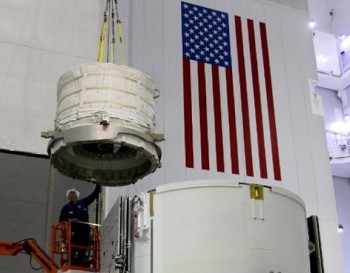
The BEAM module being loaded in the Dragon Trunk. Credit NASA / SpaceX.
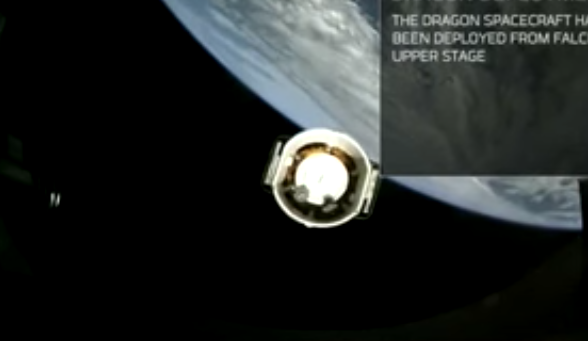
Dragon separating from the Falcon second stage with the BEAM module seen in the Dragon trunk. From a SpaceX/NASA video.
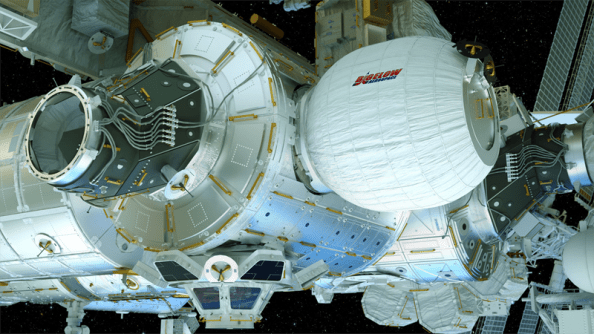
What the BEAM module will look like when attached to the ISS and inflated. Credit NASA.
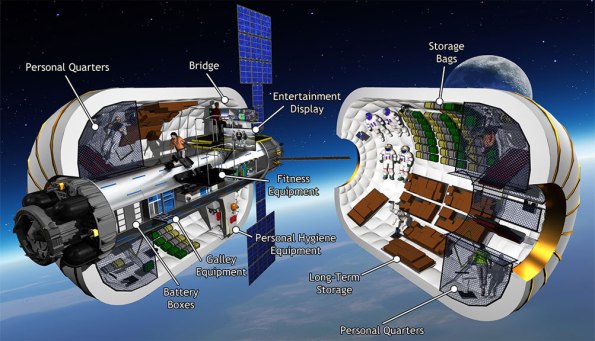
Cutaway view of the Bigelow Aerospace B330 Expandable Space Habitat. They are contracting with United Launch Alliance to send it into orbit. It will have 330 cubic meters of volume. Credit Bigelow Aerospace.
08/25/2015 – Ephemeris – Waiting for more images from New Horizons
Ephemeris for Tuesday, August 25th. The Sun rises at 6:56. It’ll be up for 13 hours and 35 minutes, setting at 8:32. The Moon, 3 days past first quarter, will set at 3:16 tomorrow morning.
The New Horizons team is downloading data now from all the instruments gathered from the encounter with Pluto, but in mid-September the pictures again will be flowing down to Earth. What was downloaded in the day and a half after close encounter with Pluto were highly compressed images of an area of Pluto and Charon’s surface showing a wider view than we will see later on and in full resolution. The team is already beginning to name the features that can be seen in sufficient detail. The International Astronomical Union has decided the types of names for Pluto, Charon and the rest of the Satellites. Pluto is set aside for explorers, both human and robotic. Charon, for mythical and fictional space and adventure heroes, vessels and authors.
Times are for the Traverse City/Interlochen area of Michigan. They may be different for your location.
Addendum
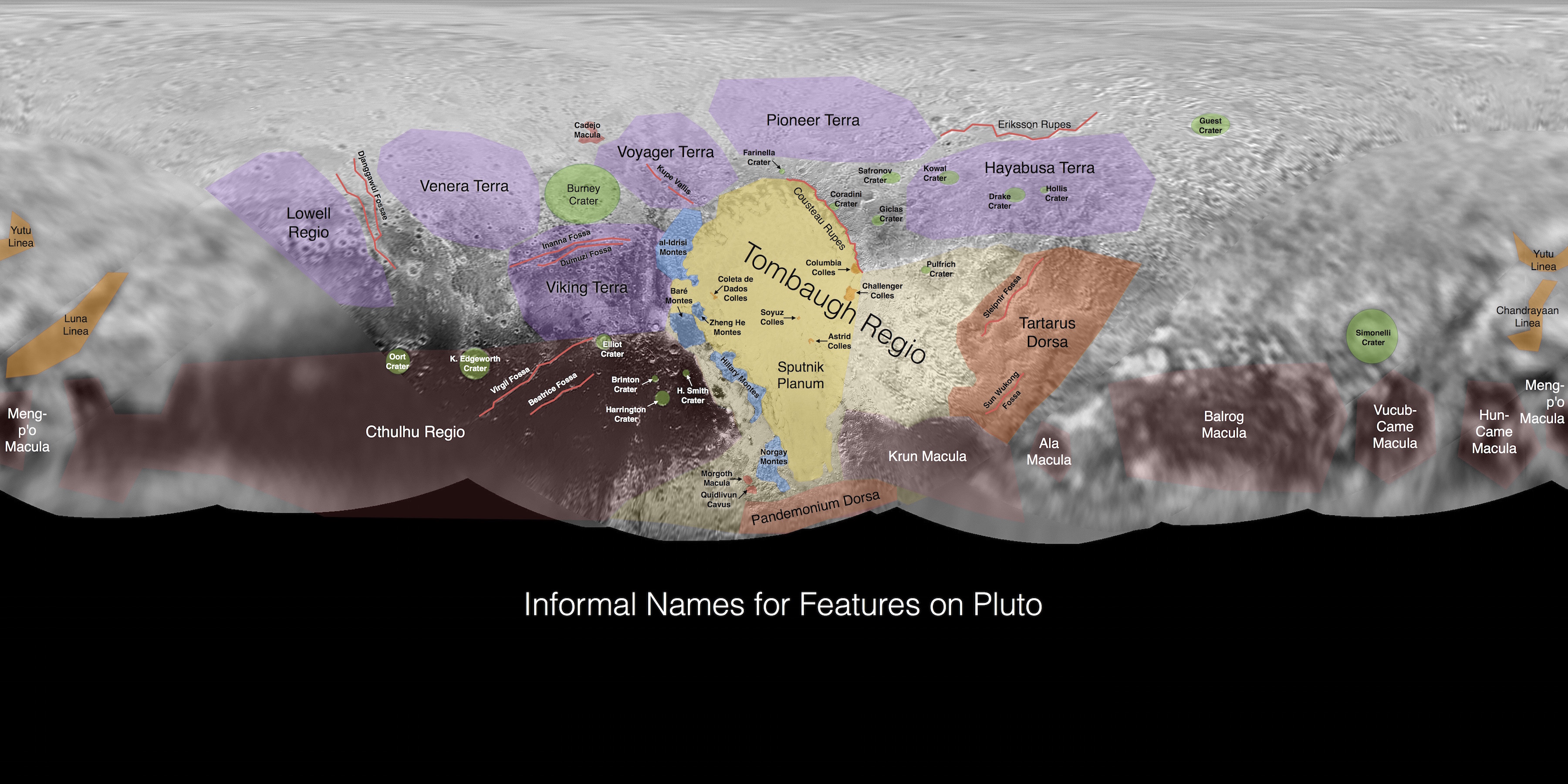
Map of Pluto with unofficial place names so far. Credit NASA/JPL. Click to enlarge.
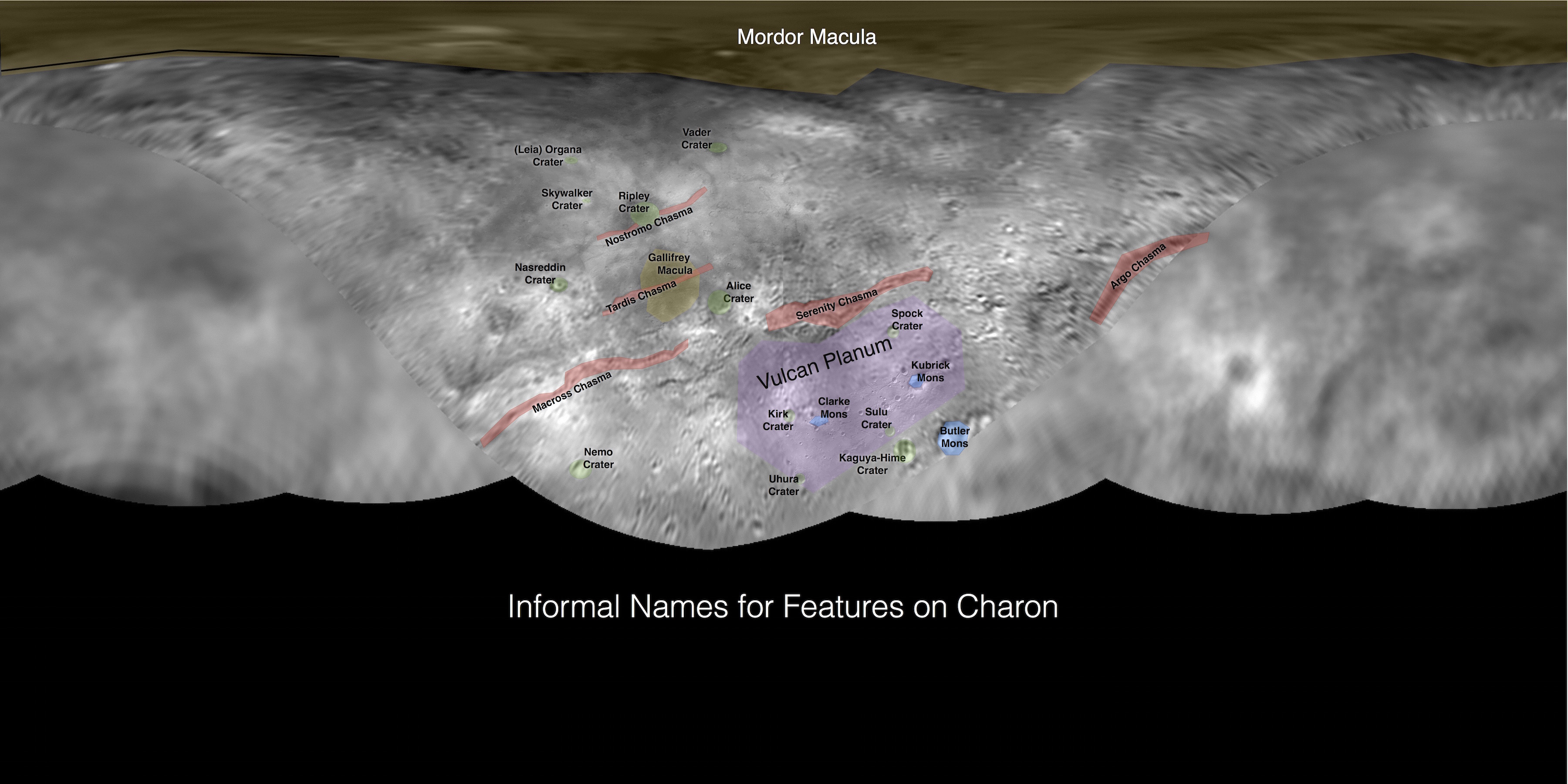
Map of Charon with unofficial place names so far. Credit NASA/JPL. Click to enlarge.
The International Astronomical Union approves all names of objects off the Earth. Go to either http://www.iau.org or more specifically http://planetarynames.wr.usgs.gov.
07/20/2015 – Ephemeris – July 20th anniversaries
Ephemeris for Monday, July 20th. Today the Sun will be up for 15 hours and 5 minutes, setting at 9:21. The Moon, 4 days before first quarter, will set at 11:34 this evening, and tomorrow the Sun will rise at 6:16.
July 20th is a special date for this country’s space program and a personal one. On July 20, 1969 Apollo 11 landed on the Moon, the greatest achievement in the history of space flight. Seven years later the robot lander Viking 1 landed on Mars. NASA wanted it to be July 4th, 1976, the Bicentennial, but couldn’t find a smooth landing site in time. My own connection to the date came in 1963, my first total solar eclipse. We traveled to Quebec province along side the St. Maurice River. To view 60 seconds of totality. It was the first of four successful total solar eclipse trips I’ve been on.. I’m looking forward to my 5th on August 21st 2017, two years from now which is related to my first, I’ll tell you about that in my blog.
Times are for the Traverse City/Interlochen area of Michigan. They may be different for your location.
Addendum
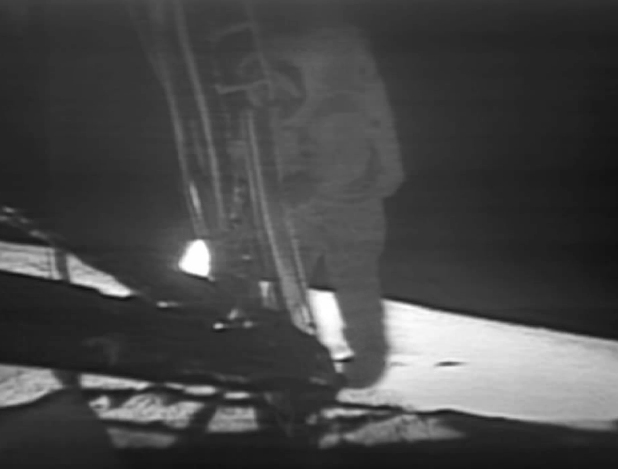
Neil Armstrong about to step off the LM onto the surface of the moon, July 20, 1969. Credit: NASA.
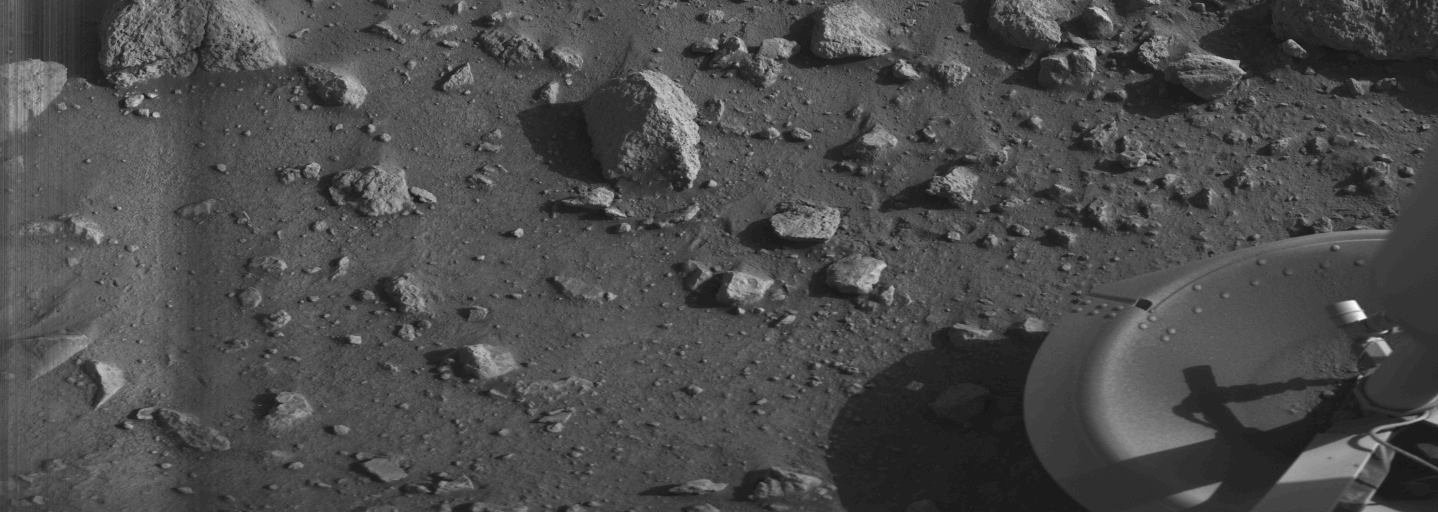
First image sent back from Viking 1 after landing on Mars, July 20, 1976. Credit: NASA/JPL. Click on image to enlarge.
Video of July 20, 1963 eclipse from the air. I got only one picture of the eclipse and it wasn’t very good. https://www.youtube.com/watch?v=OT3EW0KIjCc.
The date on the YouTube page is incorrect. It is July 20, 1963. I remember the corona being somewhat wedge-shaped, wider to one side than the other. Other than that it was a typical quiet sun corona.
In the program above I mentioned that the August 21, 2017 solar eclipse was related to my first total solar eclipse. This is the relationship: A couple of centuries BC the Chaldean astronomers of ancient Babylonia discovered that eclipses repeated in a cycle lasting 6,585 1/3 days. That’s 18 years 10 or 11 and 1/3 days depending on the number of leap years spanned. That period was called the Saros by Sir Edmund Halley or comet fame. So each eclipse would be visible 1/3 of the Earth farther west. Note that there are many Saros cycles occurring at the same time, and that eclipses of a particular Saros gradually move northward or southward. So to have an eclipse recur at the approximate same longitude one must wait 3 Saros cycles. or 54 years and one month approximately. Thus the third Saros of the July 20, 1963 total solar eclipse will be August 21, 2017. This Saros series (145) is moving southward. In 1963 it crosses the US at Alaska and Maine. Quebec was closer for us, s we went there. Good thing too. Maine was clouded and rained out. For us the clouds parted at the beginning of the eclipse. The 2015 eclipse will cross the continental US from Oregon to South Carolina.
A squished image of the July 20, 1963 eclipse path. Right click on the image and select view image to get a correct image. (works in Firefox).

A squished image of the August 21, 2017 eclipse path. Right click on the image and select view image to get a correct image. (works in Firefox).

03/02/2015 – Ephemeris – The Dawn spacecraft (The turtle wins the race)
Ephemeris for Monday, March 2nd. The sun will rise at 7:19. It’ll be up for 11 hours and 12 minutes, setting at 6:31. The moon, 3 days before full, will set at 6:00 tomorrow morning.
On Thursday March 5th NASA’s Dawn spacecraft will fall under the gravitational influence of the asteroid, or actually recently promoted dwarf planet Ceres and enter orbit. The journey took 7 years including an intermediate year-long stop at the asteroid Vesta. Dawn uses the latest in ion thrusters, or latest when it was launched. Using power generated by its solar panels it ejects xenon ions from one of its three ion thrusters to produce a thrust comparable to the weight of a piece of paper. It can accelerate the spacecraft from zero to 60 miles per hour in a few days. In the tale of the hare and the tortoise it’s in the tortoise class, at least to start. Ion engines are 10 times as efficient as chemical rockets and they can thrust for years.
Times are for the Traverse City/Interlochen area of Michigan. They may be different for your location.
Addendum
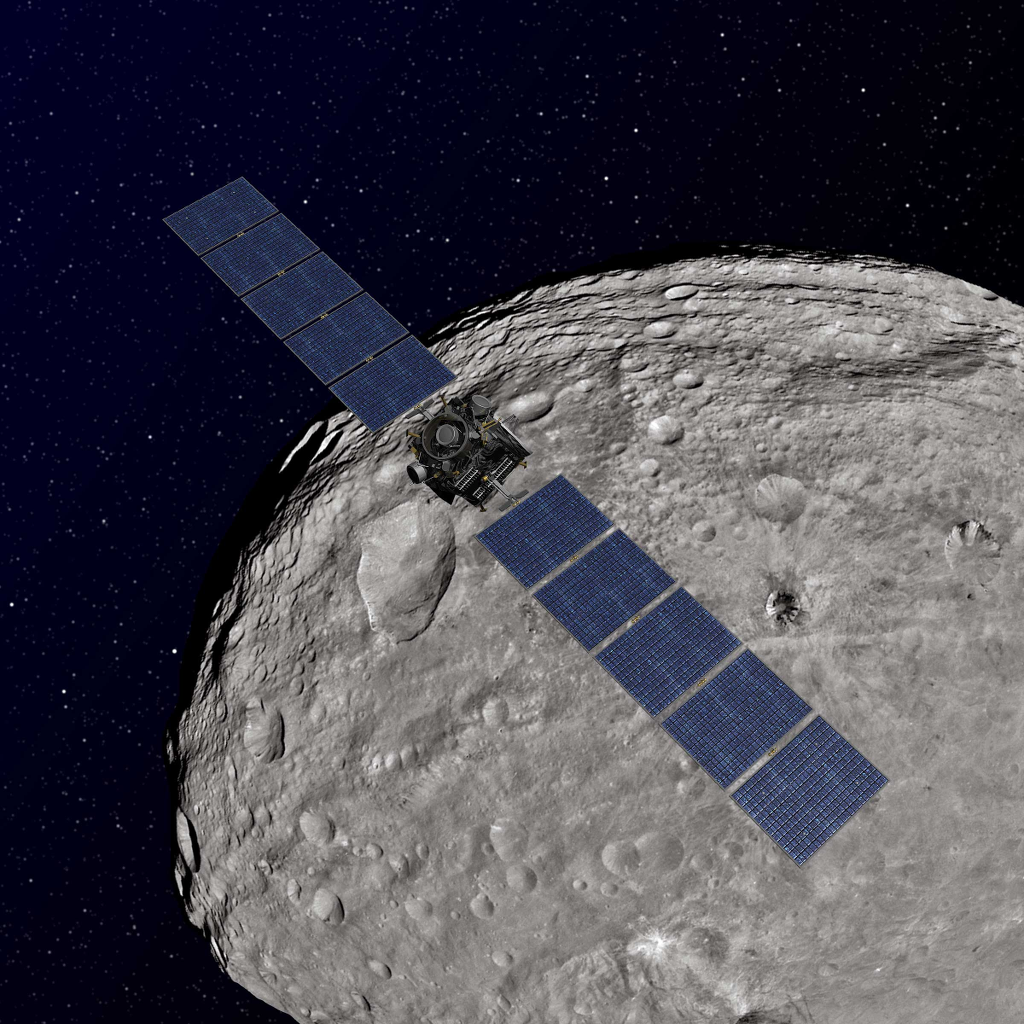
Artist’s rendition of the Dawn spacecraft at Vesta. Credit: NASA/JPL
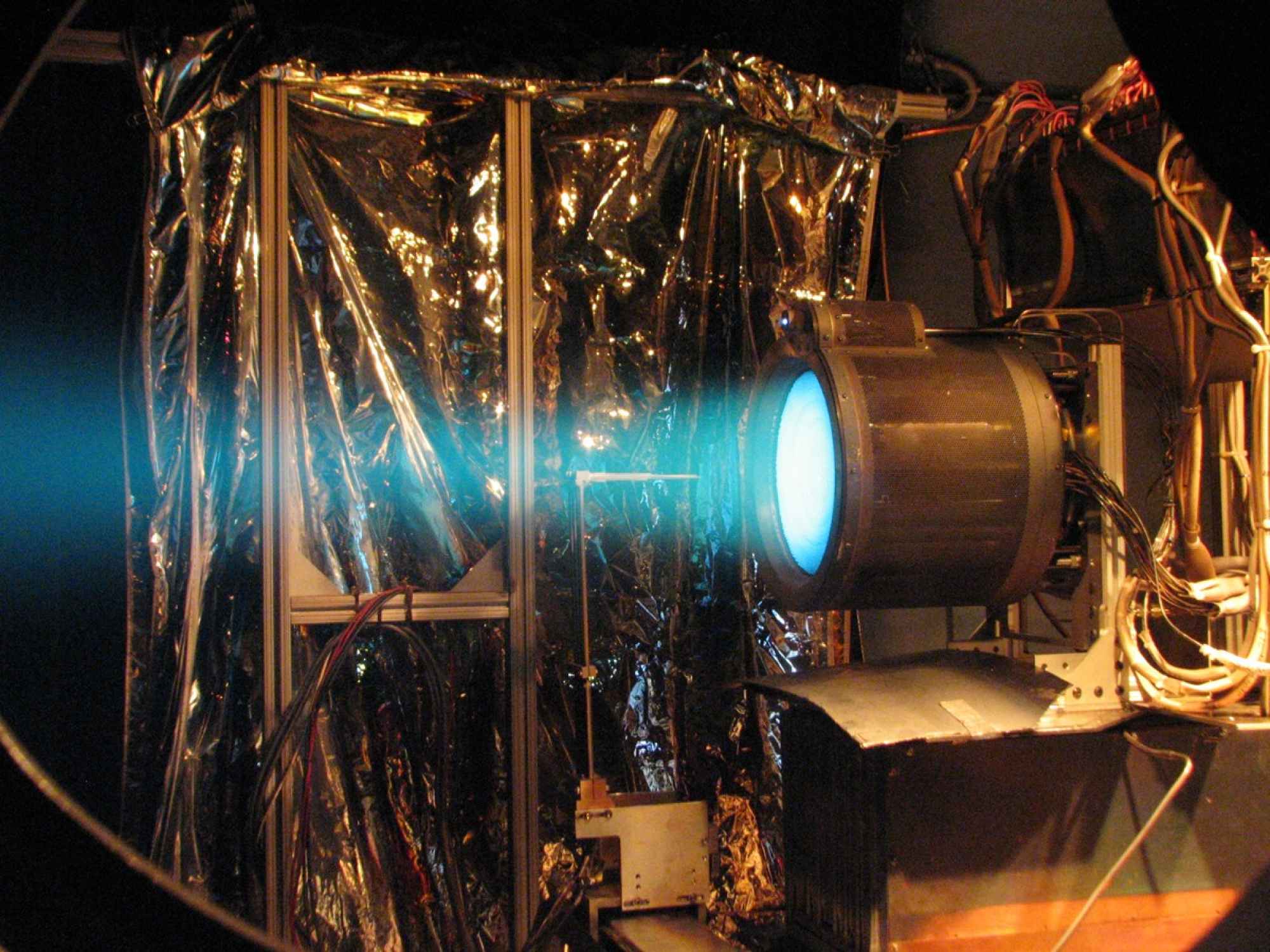
Ion engine test. Xenon ions glow blue. Credit NASA.
12/26/2014 – Ephemeris – Tragedies and triumphs of 2014
Ephemeris for Friday, December 26th. The sun will rise at 8:18. It’ll be up for 8 hours and 49 minutes, setting at 5:08. The moon, 2 days before first quarter, will set at 11:02 this evening.
2014 was a year of personal tragedy and also tragedy and triumph in space. The Space tragedies came in October with the destruction and loss of Orbital Science’s third supply mission to the International Space Station when the their Antares rocket blew up right after launch. A few days later Virgin Galactic’s SpaceShipTwo disintegrated on a test flight killing a pilot. In the Triumph department the European Space Agency’s Rosetta caught up and orbited its comet 67P, for short, in August and bounced down its lander Philae in November. It wasn’t supposed to bounce, but stick the landing. Bruised and battered Philae delivered its science before its batteries died. And this month an unmanned Orion capsule made its maiden voyage into space.
Times are for the Traverse City/Interlochen area of Michigan. They may be different for your location.
Addendum

Orbital Sciences Antares rocket explodes seconds after liftoff on October 28, 2014. Credit NASA.
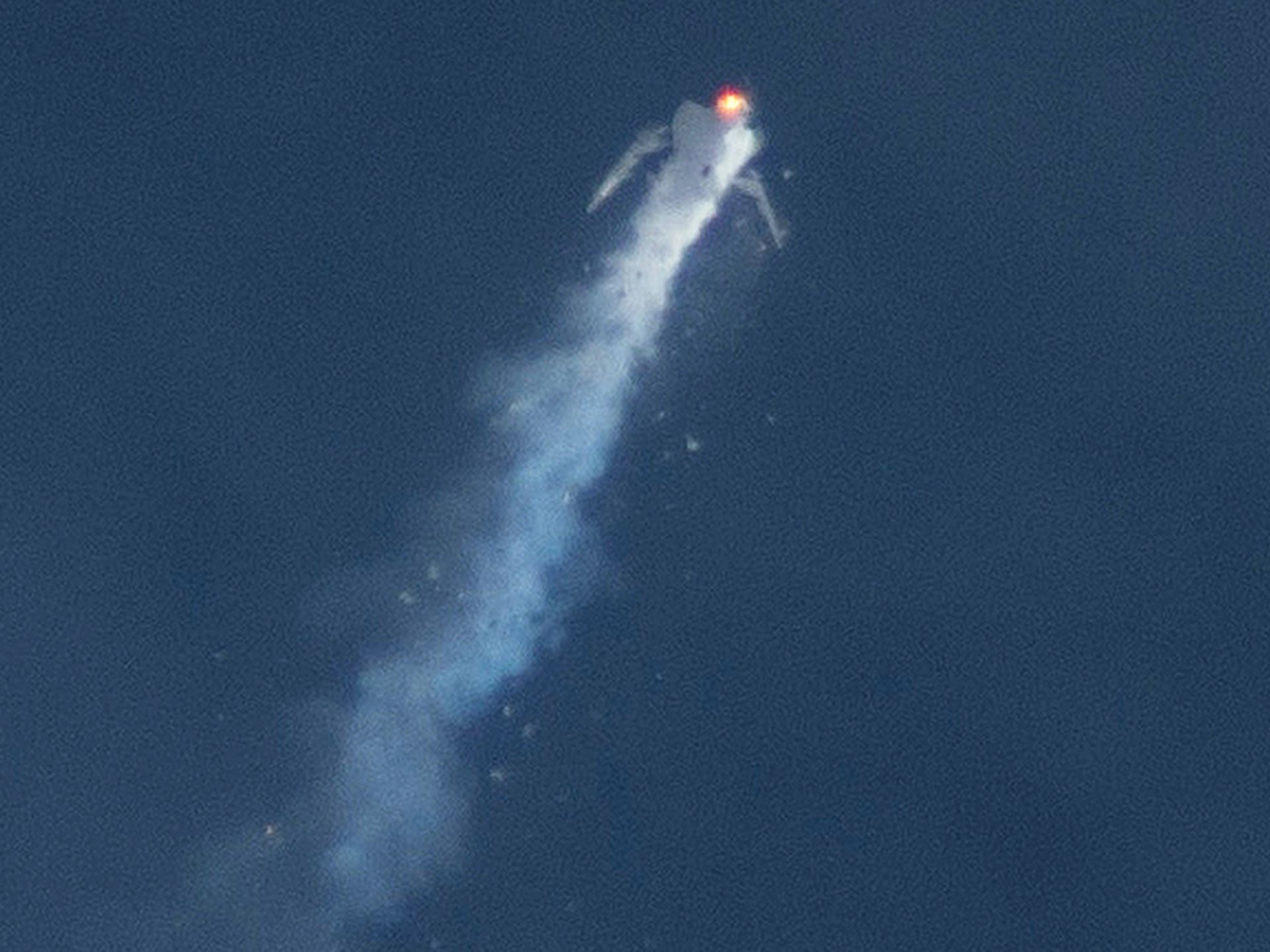
SpaceShipTwo disintegrates October 31, 2014 killing a pilot. Credit USA Today.
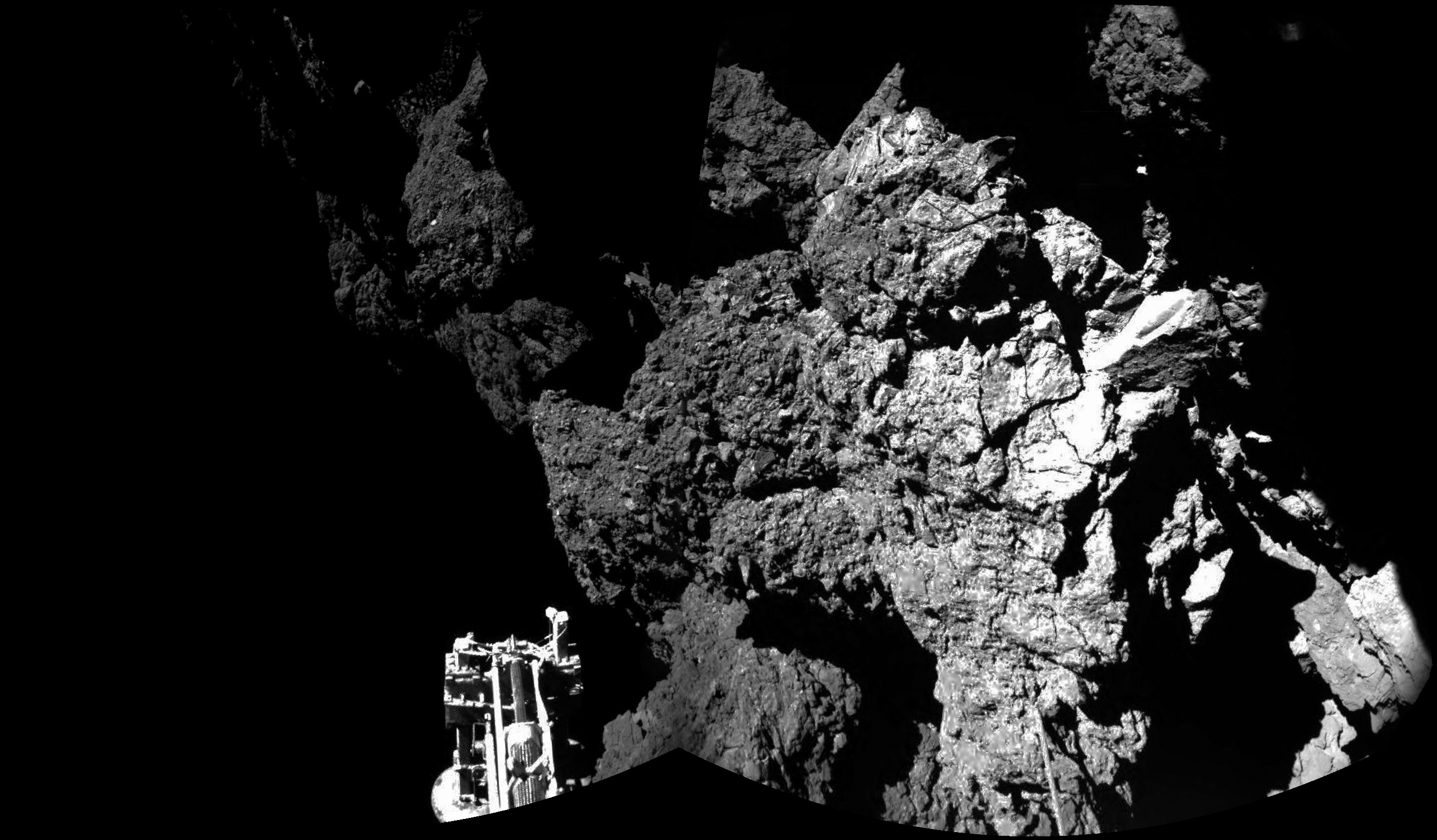
After a second bounce on the Comet 67P the Philae lander ended up sideways apparently on the base of a cliff. Researchers were able to get data from just about all the instruments before the battery discharged. The team hopes and the comet gets closer to the sun and the sun angle changes they can revive Philae. Credit: ESA.
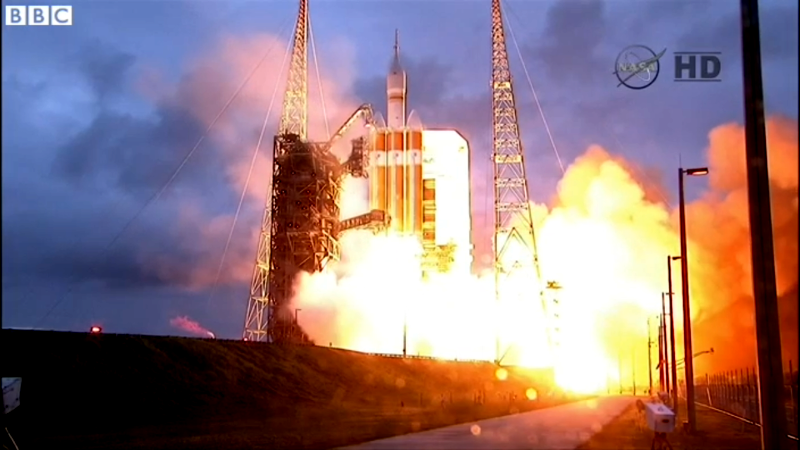
Screen capture of Delta IV Heavy rocket liftoff carrying the Orion test article into orbit on December 4, 2014. Credit .NASA via BBC
Ride back to the earth with Orion via a camera mounted in a window. The window is facing aft as the capsule re-enters the atmosphere heat shield first at 20,000 miles per hour. You’ll experience everything except the G forces. It comes with appropriate spacey music. It’s as close as I’ll ever get to ride in one of these things.
 Bob Moler's Ephemeris Blog