Archive
12/28/2018 – Ephemeris – Preview of space and astronomical events for 2019
Ephemeris for Friday, December 28th. The Sun will rise at 8:19. It’ll be up for 8 hours and 49 minutes, setting at 5:09. The Moon, 1 day before last quarter, will rise at 12:30 tomorrow morning.
Lets look at some astronomical and space events for 2019. Right off the bat on January 1st the New Horizons space craft will encounter the Kuiper Belt Object 2014 MU69 nick named Ultima Thule. I’ll have more on that Monday. January 20th overnight will see a total lunar eclipse lasting from 10:34 p.m. to 1:51 a.m. November 11th will see the planet Mercury cross the face of the Sun, a transit of Mercury from a couple of minutes after sunrise until 1:04 p.m. Among the space launches next year are several SpaceX Falcon Heavy launches, and the first launch of a uncrewed Dragon 2 capsule to fly up to the International Space Station. Boeing’s first Starliner uncrewed capsule test will occur in 2020.
The times given are for the Traverse City/Interlochen area of Michigan. They may be different for your location.
Addenda
New Horizons encounter of 2014 MU69 (Ultima Thule)
Due to the fact that NASA is affected by the partial shutdown we will probably not get much immediate information from them. However the New Horizons spacecraft is being run by Johns Hopkins Applied Physics Laboratory (JHAPL) and not NASA and it is a critical mission, it will not be affected. All news will flow from JHAPL, rather than NASA. NASA-TV appears to be operating, but on autopilot.
From JHAPL, Where to watch, timeline and links: http://pluto.jhuapl.edu/News-Center/Where-to-Watch.php.
The Planetary Society has lots of information and links to follow the encounter: http://www.planetary.org/blogs/emily-lakdawalla/2018/new-horizons-approaching-mu69-ultima-thule.html.
There is also a Planetary Society page of the time line of events for the spacecraft and the reception of data on the Earth : http://www.planetary.org/blogs/emily-lakdawalla/2018/what-to-expect-new-horizons-mu69-ultima-thule.html.
I’ll have much more Monday, less than 24 hours before the fly by.
Lunar Eclipse January 20-21, 2019
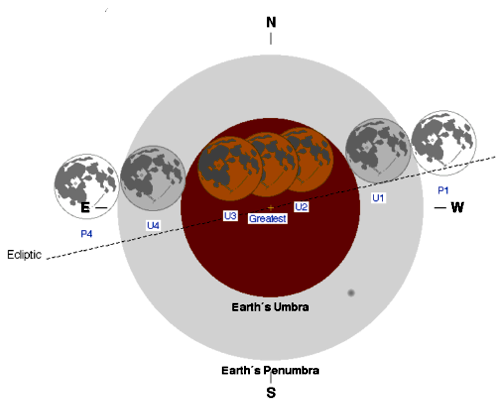
The Moon’s passage through the Earth’s shadow January 20-21, 2019. P1 and P4 events are invisible. Credit Fred Espenak, NASA/GSFC.
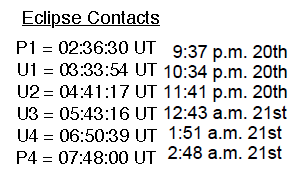
UT times are for January 21st. EST times are te nearest minute.
Transit of Mercury November 11, 2019
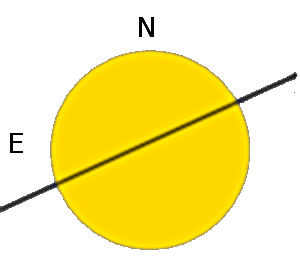
Mercury will travel from lower left to upper right across the face of the Sun. Credit Occult4.
The transit will run from about 7:34 a.m. EST
(2:34 UT) to 1:04 p.m. (8:04 UT).
05/05/2016 – Ephemeris – Previewing Monday’s transit of Mercury
Ephemeris for Thursday, May 5th. The Sun rises at 6:26. It’ll be up for 14 hours and 26 minutes, setting at 8:53. The Moon, 1 day before new, will rise at 6:38 tomorrow morning.
Next Monday, the 9th, the tiny planet Mercury will be seen to cross that face of the Sun. Astronomers call such an event a transit. The last time a planet crossed the face of it Sun, it was Venus on June 5th, 2012, almost 4 years ago. Very few, who were alive in 2012 will be around to see the next transit of Venus in 2117. Transits of Mercury are more frequent. Mercury will cross the face of the Sun from 7:12 a.m. to 2:42 p.m. on Monday. Mercury is too small to see with eclipse filters or with the naked eye. The latter could cause blindness. Only telescopes with solar filters that fit over the front of the telescope are safe to use. Mercury will be a tiny black dot, smaller than most sunspots. Tomorrow I’ll have information about where to go to see it.
Times are for the Traverse City/Interlochen area of Michigan. They may be different for your location.
Addendum
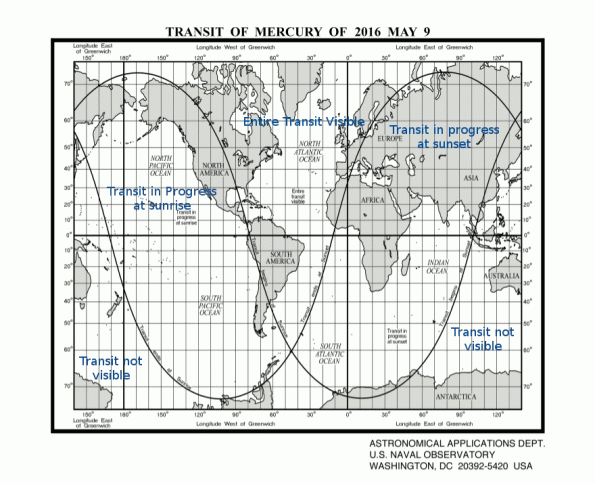
Transit visibility map with added captions to make it more readable. Credit United States Naval Observatory, The Astronomical Almanac Online! 2016
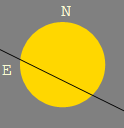
The track of Mercury across the face of the Sun. Mercury will travel from upper left to lower right. Mercury will not be visible until it impinges upon the disk of the Sun. Credit IOTA’s program Occult4.
From IOTA’s Occult4 program
Transit of Mercury on 2016 May 9 (TT)
   {'+' => next day; '-' => previous day }
                                           Overhead at
     Geocentric Event      UTC         P.A.  Long  Lat
                         h  m  s       o      o    o

[1]  Exterior Ingress   11 12 16     83.1     11   17
[2]  Minimum Separation 14 57 38             -45   18
[3]  Exterior Egress    18 42 23    224.4   -102   18

Minimum sepn 318.5";  Radii - Sun 950.4", Mercury 6.0"
delta T =  68.2 secs,  Ephemeris = DE0
Note: These timings are geocentric. Occult4 has timings for various cities of the world. Occult4.0.2 can be downloaded here. They can vary by several minutes for different cities due to parallax.
12/31/2015 – Ephemeris – Next year’s big astronomical event
Ephemeris for New Years Eve, Thursday, December 31st. The Sun will rise at 8:20. It’ll be up for 8 hours and 51 minutes, setting at 5:11. The Moon, 2 days before last quarter, will rise at 11:56 this evening.
The big astronomical event of 2016 will be the passage of the planet Mercury across the face of the Sun on May 9th. This type of event is called a transit. Back in 2012 we saw the transit of Venus, an extremely rare event that won’t be repeated for over 100 years. Transits of Mercury are not so rare. The next will be in three years. It also will not be as impressive as a transit of Venus because Mercury is a tiny planet and looks smaller than a small sunspot on the Sun. It cannot be seen without a solar filtered telescope. The actual Transit will last about 7 ½ hours. Should it be clear for all or part of that time members of the Grand Traverse Astronomical Society will be at two locations to show the event.
Times are for the Traverse City/Interlochen area of Michigan. They may be different for your location.
Addendum
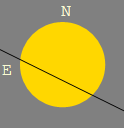
Path of Mercury across the face of the Sun from east to west. Credit IOTA/Occult4
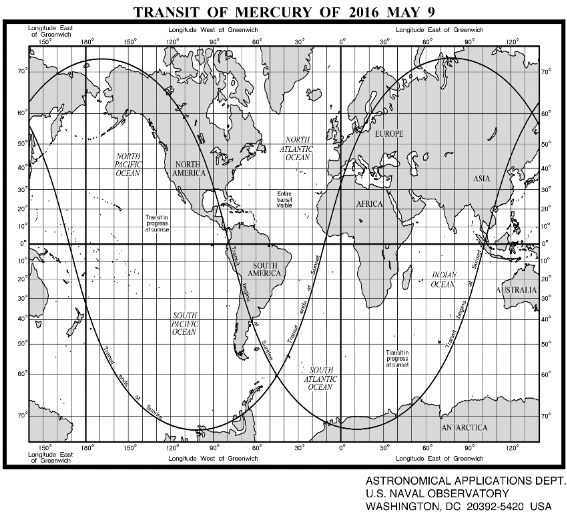
Transit of Mercury visibility map. Click on the Image to view a higher resolution pdf. Credit; Astronomical Almanac Online/USNO
       TRANSIT OF MERCURY GEOCENTRIC PHASES
                                              Position
                                   UT          Angle
                               d  h  m   s        °
Ingress, exterior contact  May 9 11 12 17.6     83.2
Ingress, interior contact      9 11 15 29.5     83.5
Least angular distance         9 14 57 25.3    153.8
Egress, interior contact       9 18 39 12.8    224.1
Egress, exterior contact       9 18 42 24.8    224.4

Least angular distance from the center of the Sun: 5' 18".5
Position angle:  Contact point measured counterclockwise from the north
   point on the face of the Sun.
UT = Universal time A.K.A. Greenwich Mean Time (GMT or Zulu).
   Subtract 4 hours to obtain Eastern Daylight Time (EDT) for
   most of Michigan.  In short the transit will span from
   7:12 a.m. to 2:42 p.m.
Above time-table is from Astronomical phenomena for 2016 Credit: USNO/UKHO
 Bob Moler's Ephemeris Blog