Archive
07/31/2017 – Ephemeris – Only 3 weeks to the eclipse (E – 21 days)
Ephemeris for Monday, July 31st. The Sun rises at 6:28. It’ll be up for 14 hours and 40 minutes, setting at 9:08. The Moon, 1 day past first quarter, will set at 1:46 tomorrow morning.
Today is E minus 21 days. E stands for Eclipse, the Great American Eclipse that is. August 21st is the day the shadow of the Moon will completely cover the United States and most of North America. The path where the Moon will completely block out the face of the Sun, called the path of totality crosses the country from parts of Oregon, Idaho, Wyoming, Nebraska, Kansas, Missouri, Illinois, Kentucky, Tennessee, North Carolina, Georgia, to South Carolina. The path of totality is only 90 miles wide at most, and 600 miles or more from northern Michigan. From here the eclipse will start shortly before 1 p.m. and end around 3:40 p.m. The official viewing spot where there will be guides from the Grand Traverse Astronomical Society will the public help view the eclipse will be at the Sleeping Bear Dunes Dune Climb.
The times given are for the Traverse City/Interlochen area of Michigan. They may be different for your location.
Addendum
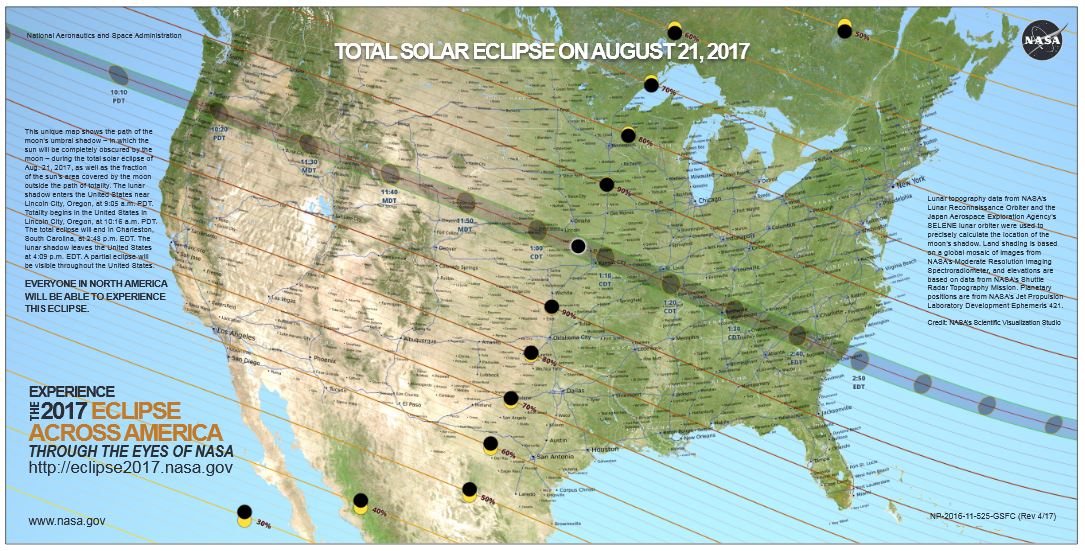
All 50 states will see some part of the August 21, 2017 solar eclipse. The face of the Sun will be totally covered by the Moon in the narrow band called the path of totality. Credit: NASA.
02/27/2017 – Ephemeris – The Great American Eclipse, August 21, 2017
Ephemeris for Monday, February 27th. The Sun will rise at 7:22. It’ll be up for 11 hours and 5 minutes, setting at 6:28. The Moon, 1 day past new, will set at 7:52 this evening.
We didn’t get a chance to see yesterday’s annular eclipse of the Sun, since it occurred mostly in the South Atlantic Ocean. But it’s a wake up call for those of us who chase the Moon’s shadow, that the Great American Eclipse is a bit less than 6 months away. August 21st to be exact. Here in northern Michigan the Sun will be 75% or so covered by the Moon at peak. For me it’s 100% or nothing. The path where the Sun will be totally eclipsed will run from Oregon to South Carolina. I’ve seen totality four times from 1963 to 1979 and accumulated 8 ½ minutes of time basking under the shade of the Moon. Well not basking, for those were hectic magical times, not to be missed. And come hell or high water I will strive to add another 2 plus minutes to that total.
Times are for the Traverse City/Interlochen area of Michigan. They may be different for your location.
Addendum
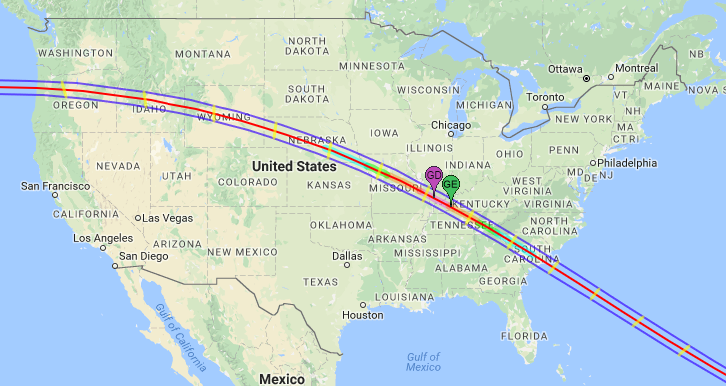
A screen cap of the map showing the path of totality of the August 21, 2017 total solar eclipse from NASA’s eclipse page. Credit: NASA and Google Maps.
NASA’s Eclipse page: https://eclipse2017.nasa.gov/
12/30/2016 – Ephemeris – Looking ahead at the eclipses of 2017
Ephemeris for Friday, December 30th. The Sun will rise at 8:19. It’ll be up for 8 hours and 51 minutes, setting at 5:11. The Moon, 1 day past new, will set at 6:53 this evening.
Looking ahead at astronomical events of the 2017. There is one big one that all of us astronomers, both amateur and professional are looking forward to. That is the total eclipse of the Sun on August 21st, where the center of the Moon’s shadow will sweep across the continental United States from Oregon to South Carolina. The closest this path of totality will get to our area is around Carbondale, Illinois. For the Grand Traverse area the Sun will be some 75% covered by the Moon. As kind of a warm up event, we’ll have a slight eclipse of the Moon February 10th, where the Moon will enter the Earth’s outer partial shadow, nearly grazing the Earth’s inner shadow in the early evening. It’s called a penumbral lunar eclipse.
Times are for the Traverse City/Interlochen area of Michigan. They may be different for your location.
Addendum
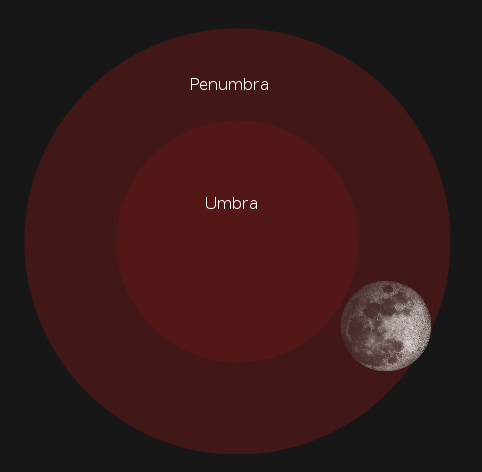
This is the maximum of the February 10th penumbral lunar eclipse. The Moon will appear to move diagonally down to the left. It is shown at maximum eclipse at 7:45 p.m. (0:45 UT February 11). Created using Cartes du Ciel.
Shadows are, of course, invisible unless they are cast on an object, so the Moon would appear alone, though the upper left part of it would be noticeably dimmer than the opposite side.
A screen cap of the map showing the path of totality of the August 21, 2017 total solar eclipse from NASA’s eclipse page. Credit: NASA and Google Maps. Click on image to enlarge.
Click here to go to the page where this interactive map is located. The magenta marker with GD is the point with the greatest duration of totality of 2 minutes 40.2 seconds. The green marker with GE denotes where the Moon’s umbral shadow is the widest. Clicking on any point on the map will pop a balloon shows all the eclipse information for viewing it from that place. The partial eclipse can be seen from all fifty states, though in Hawai’i the Sun rises with the eclipse in progress.
Here in the Grand Traverse Region, the Moon will encroach on about 8/10ths of the Sun’s diameter, covering 75% of the Sun’s face.
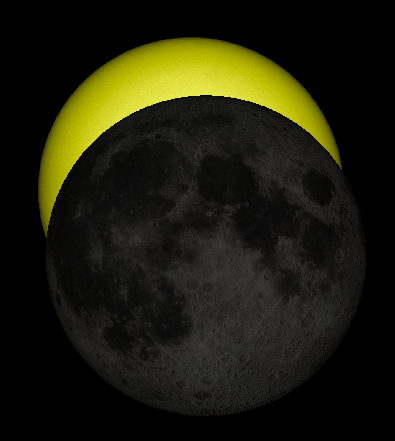
What the maximum eclipse would look like with proper filtering at Traverse City, MI. Created using Stellarium.
Eclipse Times for Traverse City
Eclipse Starts 12:58:03 p.m.
Maximum Eclipse 2:20:15 p.m.
Eclipse Ends 3:40:51 p.m.
Magnitude of the eclipse 0.798
Obscuration of the Sun 75.1%
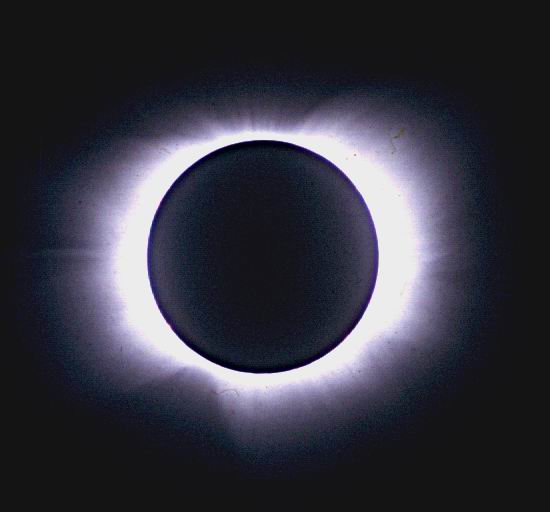
This is an inkling of what a totally eclipsed Sun looks like. No photograph can do it justice. Ya gotta be there! The solar corona displayed during the July 10, 1972* total solar eclipse from Prince Edward Island. Credit Bob Moler.
* Update: Thanks for the heads up on the typo: NationalEclipse.com.
Program Note:
I’ve developed a PowerPoint slide presentation highlighting my four total eclipses and a look at future eclipses. I will be happy to give this presentation to school groups and organizations free of charge except for mileage reimbursement over 50 miles. Contact me at bob@bjmoler.org.
December 31st – the longest day, really.
December 31st will be 24 hours and 1 second long. This “leap second” will be added as the 61st second of the minute 6:59 p.m. EST (23:59 UT). The reason is that the Earth’s rotation is slowing down ever so slightly, compared to the atomic clocks at the Bureau of Time. There is some discussion of eliminating this leap second. Most scientists want to use a constant time stream, and don’t give a hang about the rotation of the Earth. The exact time which is also affected by special and general relativity is used by GPS navigation satellites. A one second jump in time, at our latitude (45° north) is equivalent of the earth’s rotation of about two tenths of a mile. I hope everyone’s coordinated on this.
 Bob Moler's Ephemeris Blog