Archive
Ephemeris: 09/09/2025 – 3I/ATLAS, a minority view
This is Ephemeris for Tuesday, September 9th. Today the Sun will be up for 12 hours and 49 minutes, setting at 8:04, and it will rise tomorrow at 7:16. The Moon, 2 days past full, will rise at 8:51 this evening.
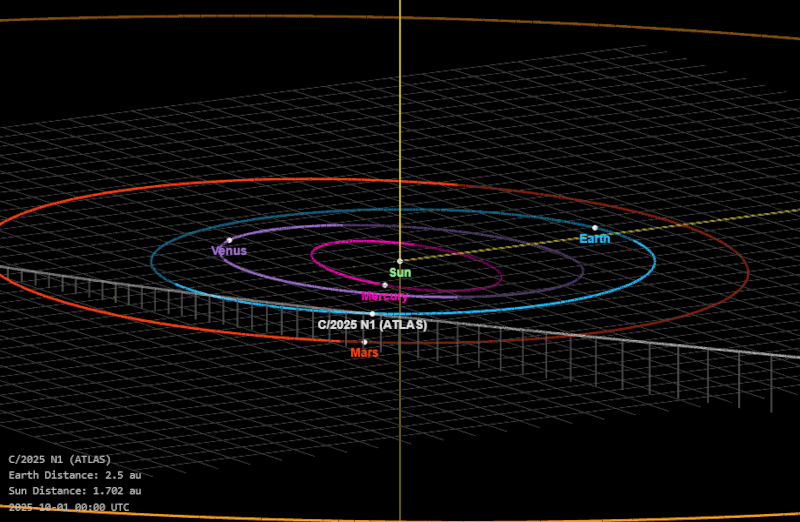
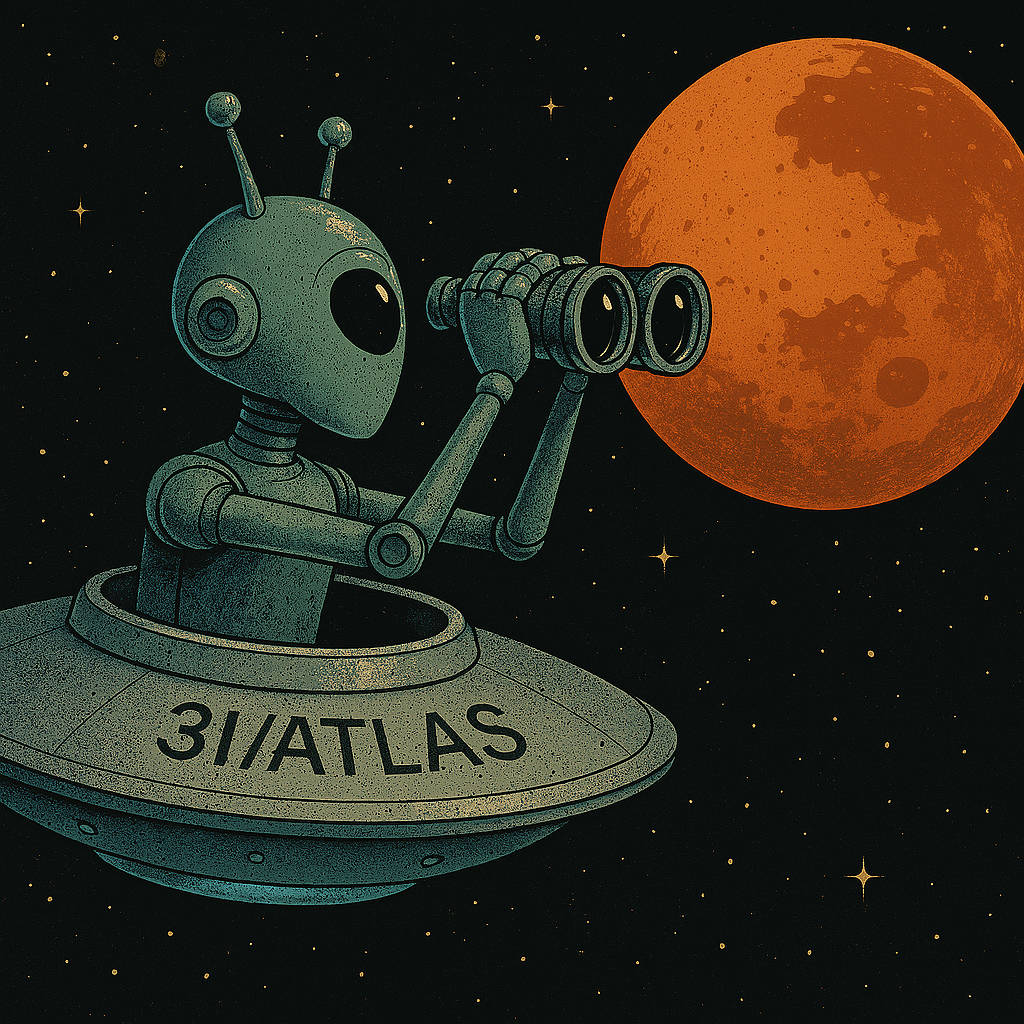
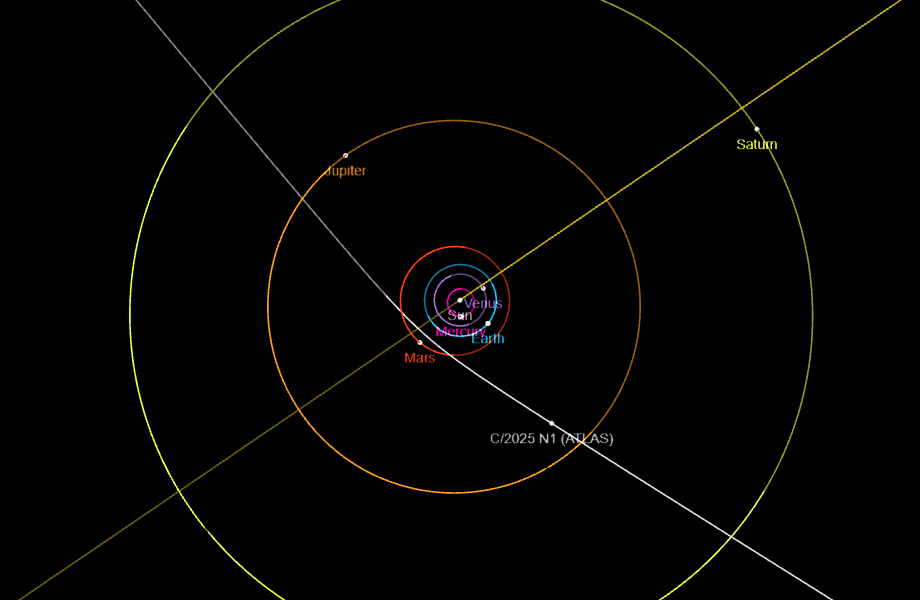
Interstellar object 3I/ATLAS is closing in on the planet Mars, which it will reach nearest to on October 1st. Some speculate, including one Harvard professor, that maybe it’s an alien probe. This object is much too slow to traverse the interstellar medium between stars with a biological crew, who are short-lived like us. More likely it would be crewed by robots run by artificial intelligence, like which we are beginning to perfect. 3I/ATLAS will not get very close to the Earth, but will get close to Mars. That got me to speculating, tongue in cheek of course, that being a machine intelligence they would be more interested in Mars. The reason being, that Mars is the only planet that’s entirely inhabited by robots, like themselves.
The astronomical event times given in this blog are for the Traverse City/Interlochen area of Michigan (Lat 44.7° N, Long 85.7° W; EDT, UT – 4 hours) unless stated otherwise. Times will be different for other locations.
Addendum
Ephemeris: 09/02/2025 – 3I/ATLAS, interstellar visitor
This is Ephemeris for Tuesday, September 2nd. Today the Sun will be up for 13 hours and 10 minutes, setting at 8:17, and it will rise tomorrow at 7:07. The Moon, 2 days past first quarter, will set at 1:54 tomorrow morning.
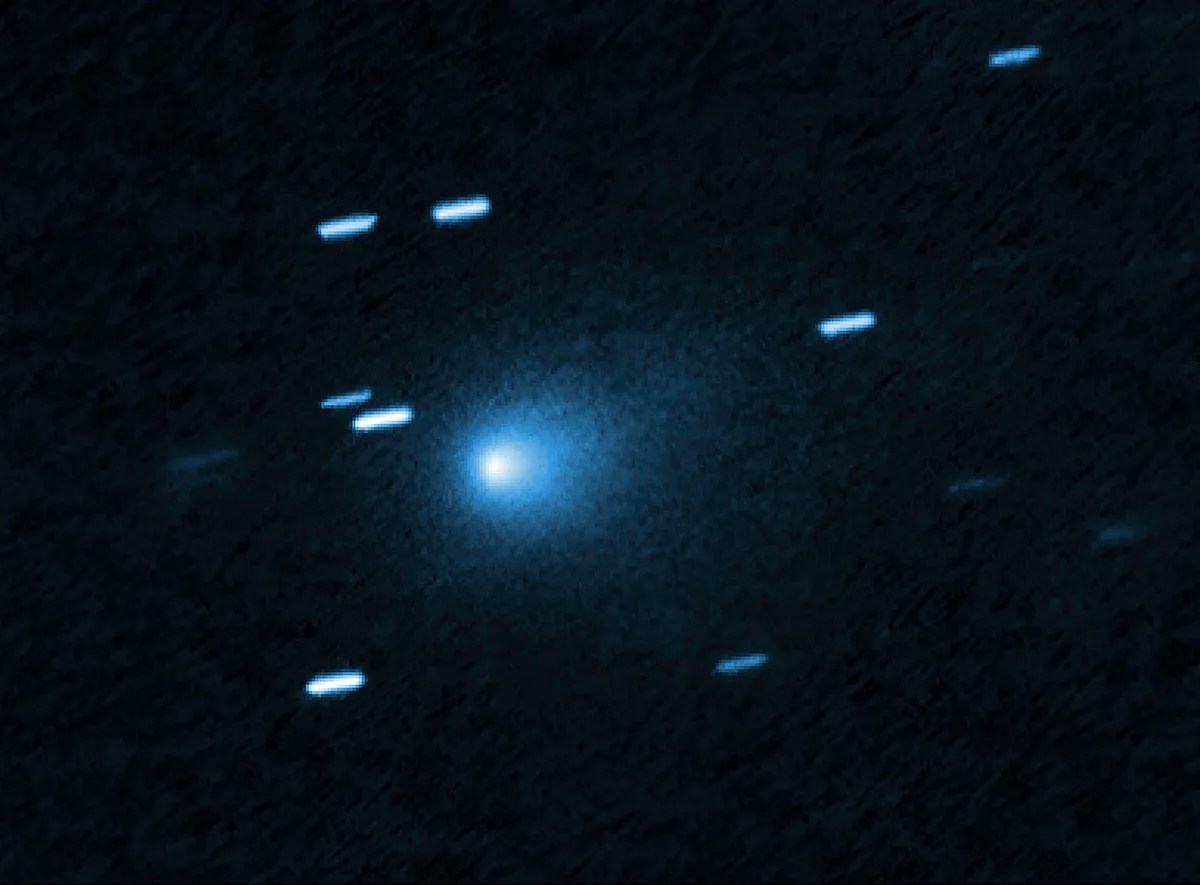
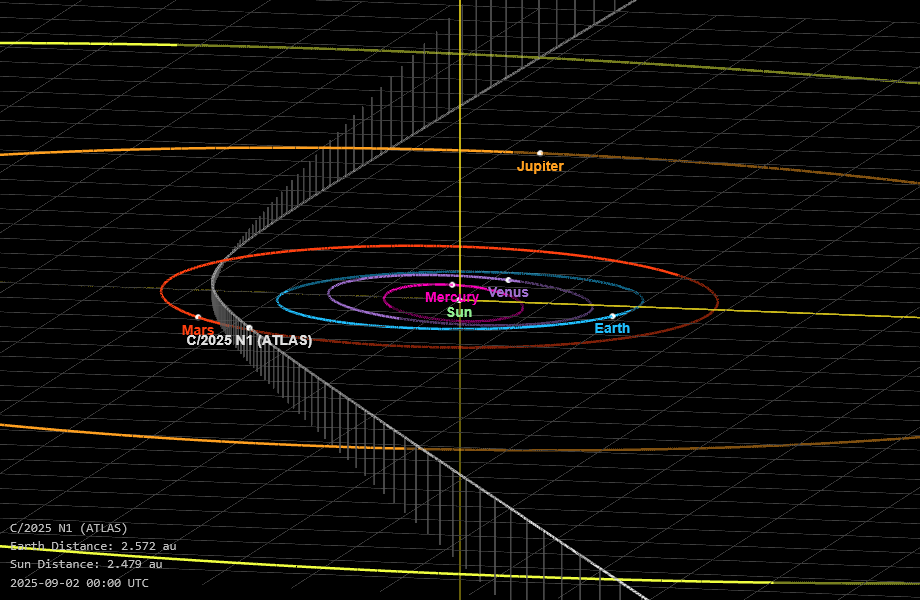
Interstellar visitor 3I/ATLAS was discovered a couple of months ago. We are lucky because it was discovered on its way into the inner solar system. The first interstellar visitor, 1I/‘Oumuamua, we didn’t spot until it had already passed and on its way out. It turns out that the chemical composition of this interstellar visitor, which astronomers think is a comet, has a great deal of carbon dioxide in its atmosphere compared to water. In the universe water is the third most common molecule after diatomic hydrogen and diatomic oxygen. But this comet appears to have about 8 times more carbon dioxide than water. Some astronomers think the 3I/ATLAS is 3 billion years older than the solar system making it 7 1/2 billion years old.
The astronomical event times given in this blog are for the Traverse City/Interlochen area of Michigan (Lat 44.7° N, Long 85.7° W; EDT, UT – 4 hours) unless stated otherwise. Times will be different for other locations.
Addendum
Ephemeris: 07/08/2025 – A third interstellar visitor discovered
This is Bob Moler with Ephemeris for Tuesday, July 8th. Today the Sun will be up for 15 hours and 23 minutes, setting at 9:29, and it will rise tomorrow at 6:06. The Moon, 2 days before full, will set at 4:20 tomorrow morning.
One week ago the third interstellar interloper to the solar system was discovered. It’s known as 3I/ATLAS. The “I” means interstellar. That is, it came from another star system. It is heading in now, crossing the asteroid belt. It will reach its closest to the Sun on October 29th, at about the distance of Mars, which it will get very close to by the way, and head out into interstellar space. This is an incredibly fast object, far exceeding the escape velocity of the Sun, and its path is only deflected by 17° by its encounter by the Sun’s gravitational force. Due to it high speed, it was first thought to be a Near Earth Object. Pre-discovery photographs showed that it was much more distant. With the new Rubin Observatory coming online we’ll discover many more.
The astronomical event times given in this blog are for the Traverse City/Interlochen area of Michigan (Lat 44.7° N, Long 85.7° W; EDT, UT – 4 hours) unless stated otherwise. Times will be different for other locations.
Addendum
 Bob Moler's Ephemeris Blog