Archive

Posts Tagged ‘Mars’

Ephemeris: 05/13/2026 – Where are the naked-eye planets this week?

May 13, 2026 Comments off

This is Ephemeris for Wednesday, May 13th. Today the Sun will be up for 14 hours and 45 minutes, setting at 9:02, and it will rise tomorrow at 6:15. The Moon, 3 days before new, will rise at 4:37 tomorrow morning.

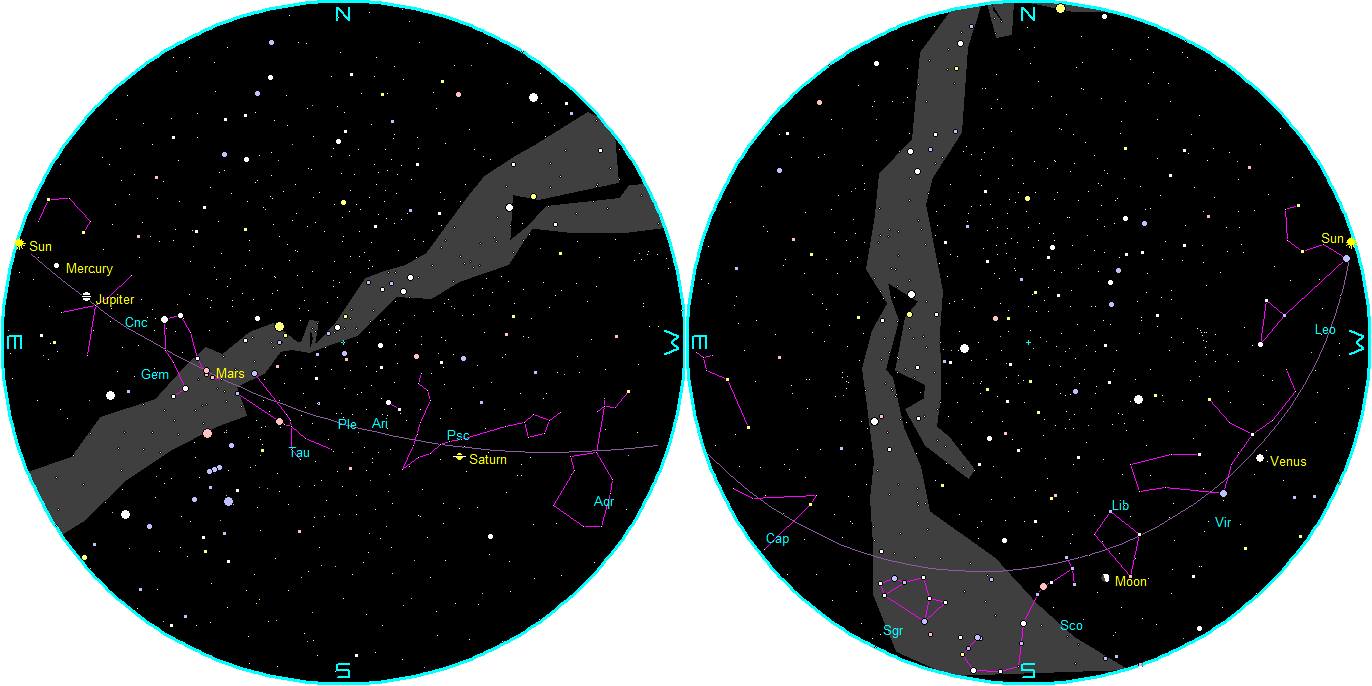
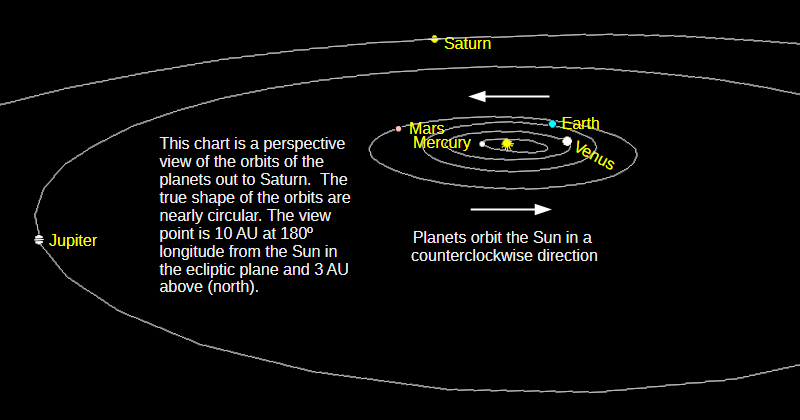
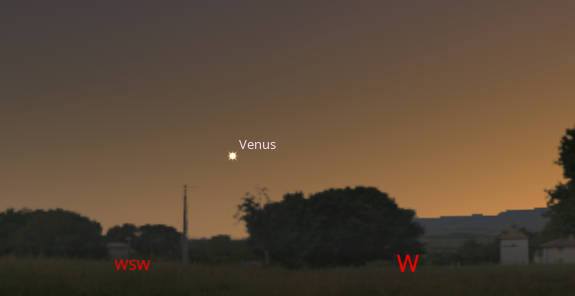
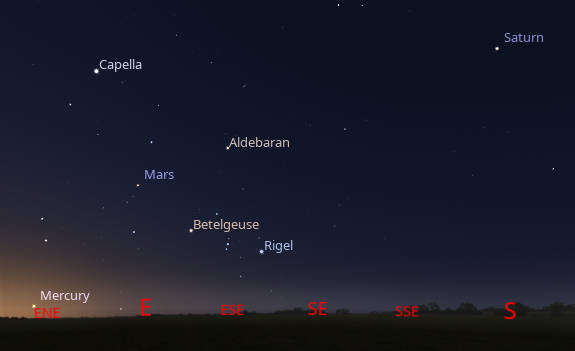
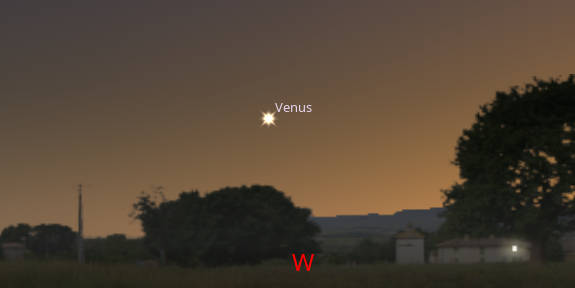
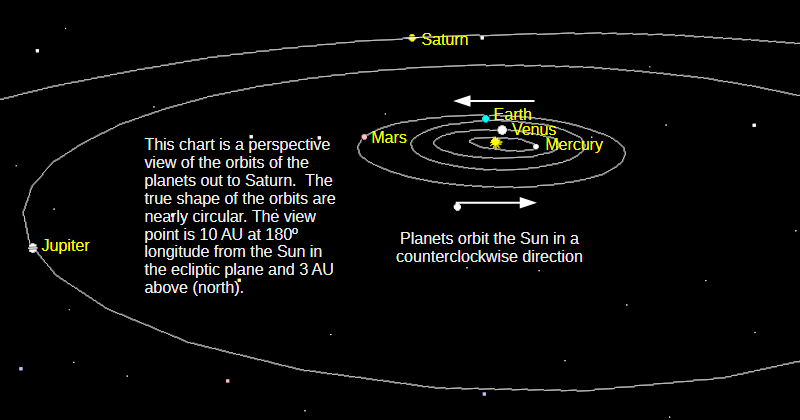
Let’s take our weekly look at the whereabouts of the naked-eye planets. By 9:30 PM tonight, about a half hour after sunset, Venus may be seen in the western sky. A telescope will show a very tiny disc on Venus, because it is still pretty much beyond the Sun, 128 million miles (205 million kilometers) away from us. Over the next 5 months it will be moving closer to us and becoming much larger. Jupiter is the second-brightest star-like object in the western sky seen before 10 PM. It is above and left of the brighter Venus. Venus will set at 11:38 PM, while Jupiter will hold out until 1:21 AM. Saturn may be glimpsed just after it rises in the east at 4:48 AM, before morning twilight overwhelms it sometime later.

The astronomical event times given in this blog are for the Traverse City/Interlochen area of Michigan (Lat 44.7° N, Long 85.7° W; EDT, UT – 4 hours) unless stated otherwise. Times will be different for other locations.

Addendum
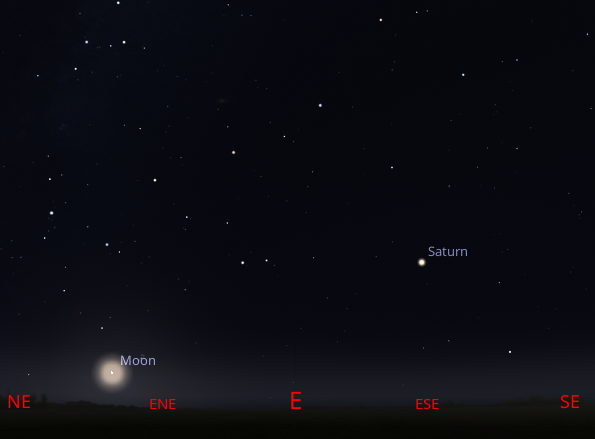
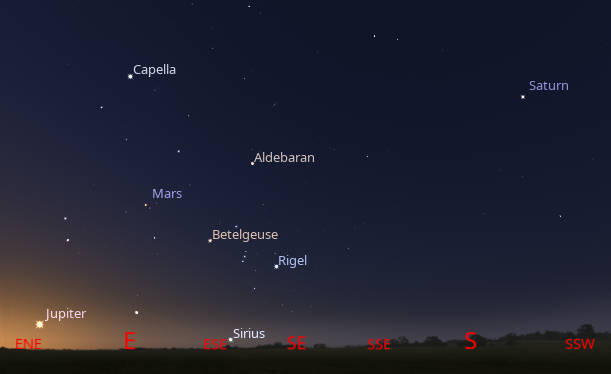
Jupiter, and Venus with a few remaining winter stars at 10 PM tonight, May 13, 2026. The planets are appearing to approach each other. They will be in conjunction on the evening of June 8th.
Jupiter, and Venus with a few remaining winter stars at 10 PM tonight, May 13, 2026. The planets are appearing to approach each other. They will be in conjunction on the evening of June 8th. Created using Stellarium.
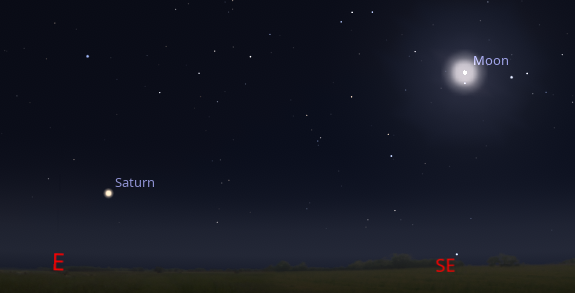
The waning crescent Moon and Saturn at 5:15 AM May 14, 2026
The waning crescent Moon and Saturn at 5:15 AM May 14, 2026. Created using Stellarium.
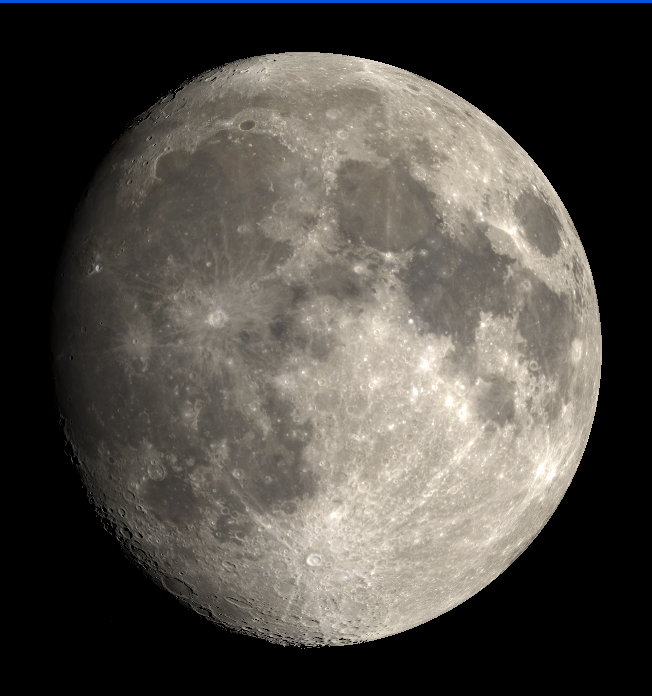
A binocular or low power view of the waning creacent Moon showing the expected earthshine on its night side.
A binocular or low power view of the waning creacent Moon showing the expected earthshine on its night side. Created using Stellarium and GIMP.
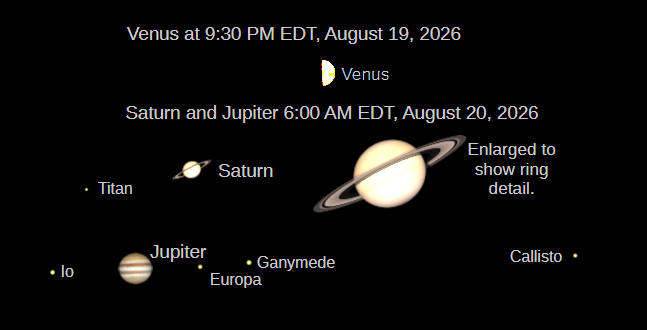
Telescopic Venus, Jupiter and Saturn (north up) as they would be seen in a small telescope with the same magnification.
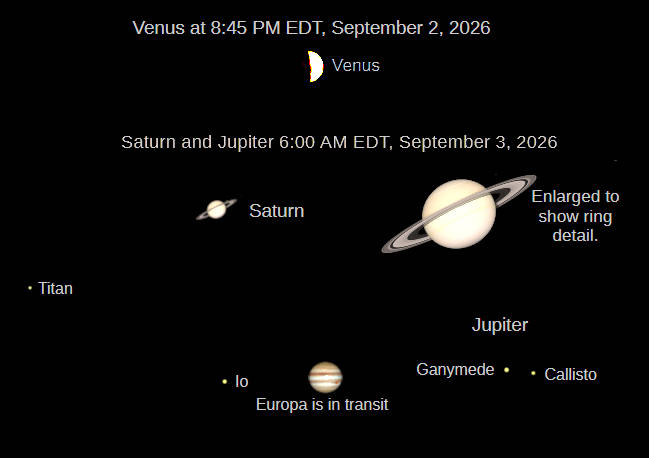
Telescopic Venus, Jupiter and Saturn (north up) as they would be seen in a small telescope with the same magnification, at the times indicated. Venus’ apparent diameter will be 12.2″, and be 84.7% illuminated. It’s on the far side of the Sun. Jupiter will be 34.4″ in diameter, with its moons shown for the time listed. The (”) symbol means seconds of arc, or 1/3600th of a degree. Created using Cartes du Ciel (Sky Charts), LibreOffice Draw and GIMP.
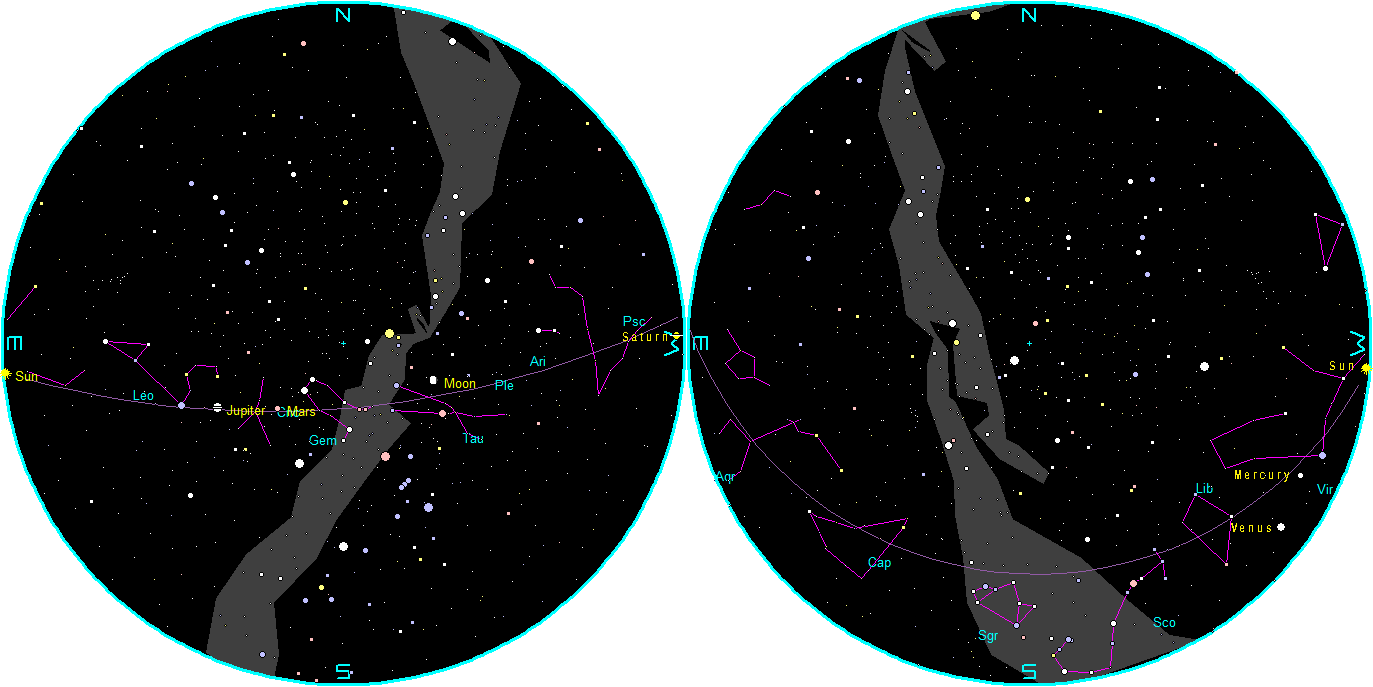
The naked-eye planets at sunset and sunrise on a single night, starting with sunset on the right on May 13, 2026. The night ends on the left with sunrise on the 14th.
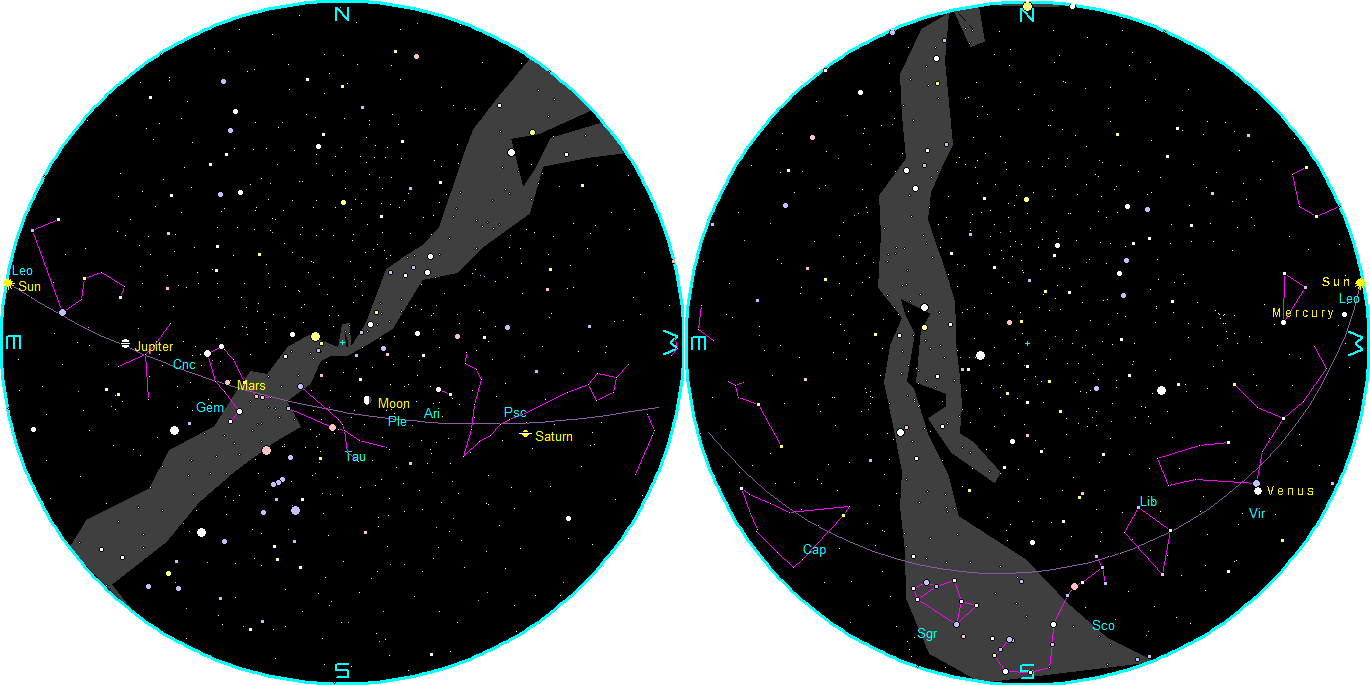
The naked-eye planets at sunset and sunrise on a single night, starting with sunset on the right on May 13, 2026. The night ends on the left with sunrise on the 14th. Click or tap on the image to enlarge it. Created using my LookingUp app and GIMP.
A low precision ephemeris of the Sun Moon and naked eye planet positions for today and tomorrow, May 13 and 14th, 2026.
This is a low precision ephemeris of the Sun Moon and naked eye planet positions for today and tomorrow, May 13 and 14th, 2026. Some of the columns are self-explanatory, others are not. The transit column is the time that the body crosses the meridian and is due south. Elong, for elongation, is the angle between the Sun and that body. RA is right ascension, which is the object’s east-west position on the celestial sphere in hours and minutes. Dec is declination which is the north-south position of the object on the celestial sphere in degrees and minutes. R is the distance of that object from the Sun in astronomical units. An astronomical unit is about 93 million miles or 150 million kilometers. And Delta is the distance of that object from the Earth, also in astronomical units. I omit the ‘m’ in am and pm for compactness. The data was generated using my LookingUp for DOS app and displayed as a table by my Ephemeris Helper app.

Ephemeris: 05/06/2026 – Taking our weekly look at the whereabouts of the naked-eye planets

May 6, 2026 Comments off

This is Ephemeris for Wednesday, May 6th. Today the Sun will be up for 14 hours and 28 minutes, setting at 8:53, and it will rise tomorrow at 6:24. The Moon, 3 days before last quarter, will rise at 1:55 tomorrow morning.

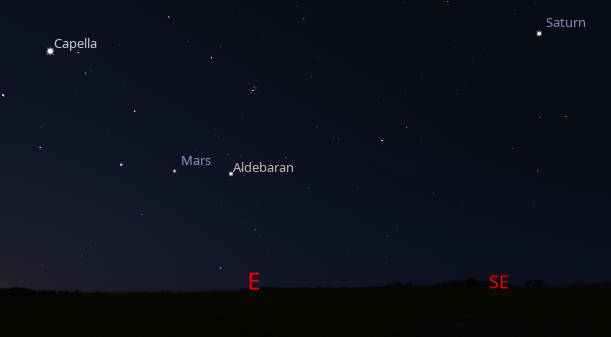
Let’s take our weekly look at the whereabouts of the naked-eye planets. By 9:30 PM tonight or about 35 minutes or so after sunset, Venus may be seen very low in the West. A telescope will show a very tiny disc on Venus, because it is still pretty much beyond the Sun, 131 million miles (211 million kilometers) away from us. Over the next 5½ months it will be moving closer to us and becoming much larger. Jupiter is the brilliant star-like object in the western before 10 PM. It is above and left of the brighter Venus. Venus will set at 11:26 PM, while Jupiter will hold out until 1:40 AM. Saturn may be glimpsed starting about next Monday just after it rises in the east around 5:15 AM, and before morning twilight overwhelms it sometime later.

The astronomical event times given in this blog are for the Traverse City/Interlochen area of Michigan (Lat 44.7° N, Long 85.7° W; EDT, UT – 4 hours) unless stated otherwise. Times will be different for other locations.

Addendum
Jupiter, and Venus with fading winter stars at 10 PM tonight, May 6, 2026.
Jupiter, and Venus with fading winter stars at 10 PM tonight, May 6, 2026. Jupiter and Venus are appearing to approach each other. They will be in conjunction on the evening of June 8th. Created using Stellarium.
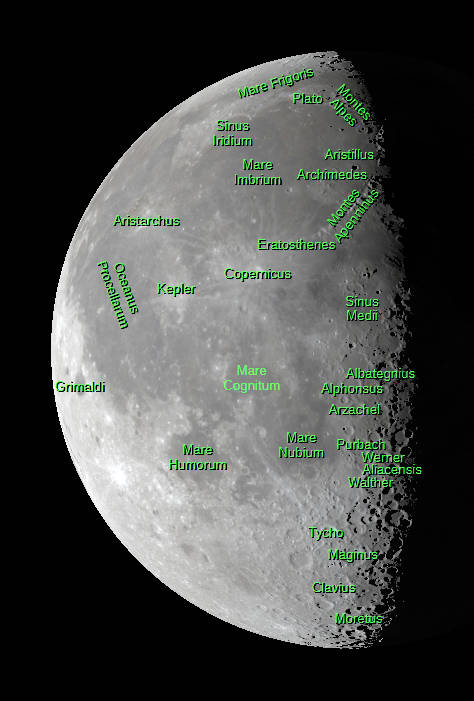
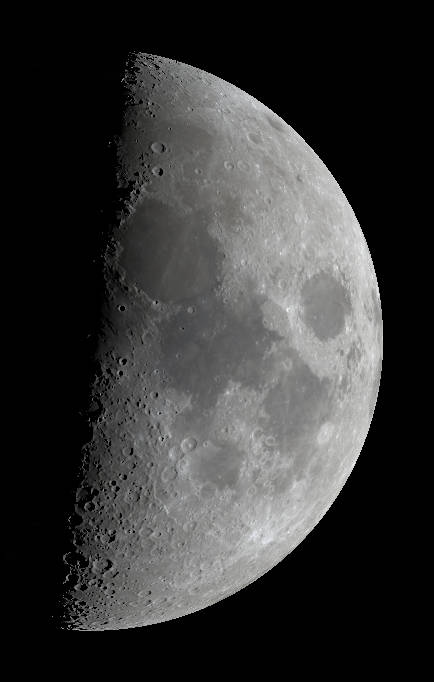
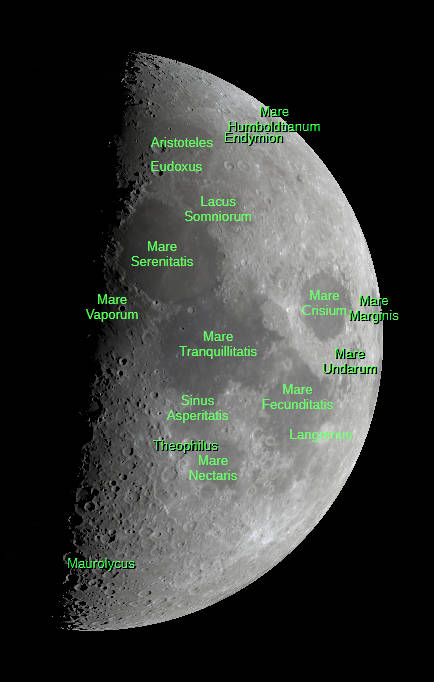
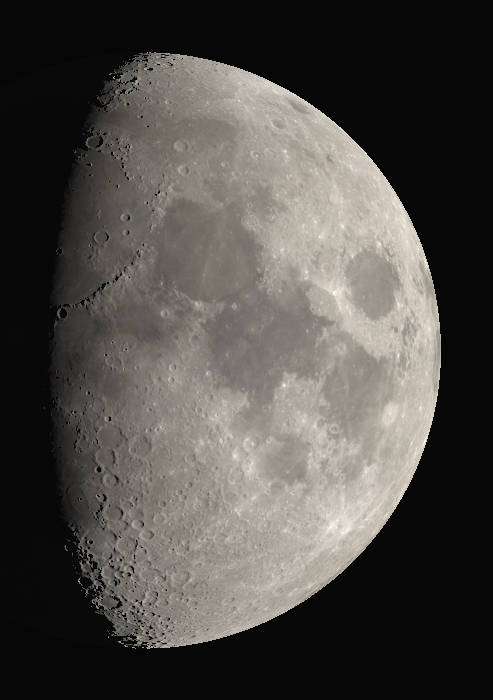
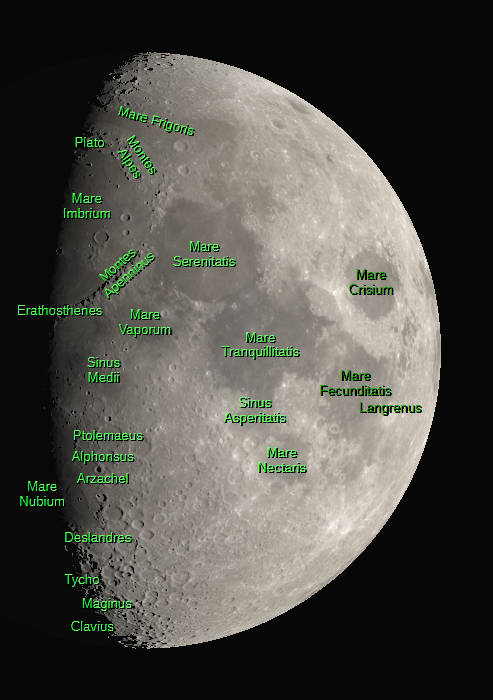
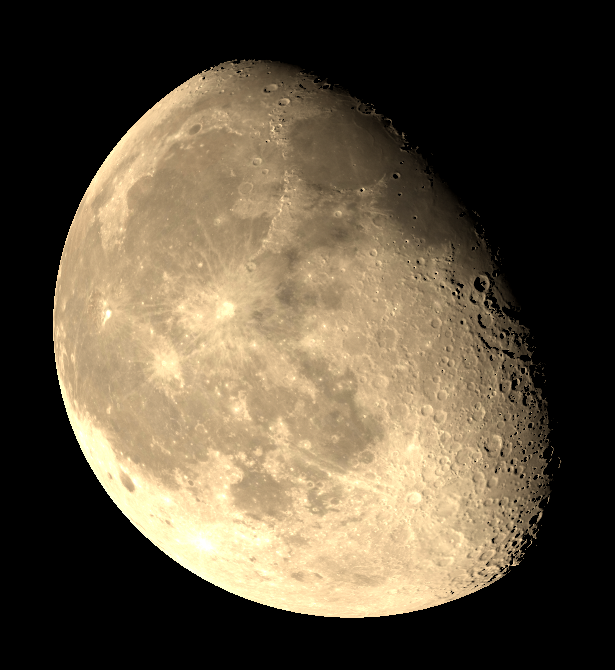
The Moon, 2 days before last quarter, as seen at 5 AM tomorrow morning, May 7, 2026. A view visible in small telescopes showing an image with and without selected features labeled. Created using Stellarium, LibreOffice Draw, and GIMP.
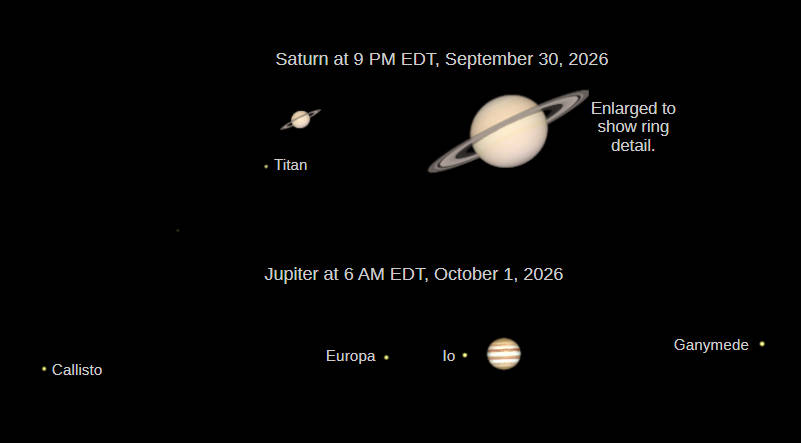
Telescopic Jupiter and Venus (north up) as they would be seen in a small telescope with the same magnification.
Telescopic Jupiter and Venus (north up) as they would be seen in a small telescope with the same magnification. Venus will be visible for a short time near the western horizon, while Jupiter will be visible until after midnight. Venus’ apparent diameter will be 11.9″, and be 86.5% illuminated. It’s on the far side of the Sun. Jupiter will be 35.0″ in diameter, with its moons shown here for 10 PM, tonight May 6, 2026. Callisto will begin to transit the face of Jupiter at 10:31 PM.. Europa will pass behind the planet (an occultation) beginning at 11:36 PM. The moons can shift noticably over an hour, especially Io and Europa. The (”) symbol means seconds of arc, or 1/3600th of a degree. Created using Cartes du Ciel (Sky Charts), LibreOffice Draw and GIMP.
The naked-eye planets at sunset and sunrise on a single night.
The naked-eye planets at sunset and sunrise on a single night, starting with sunset on the right on May 6, 2026. The night ends on the left with sunrise on the 7th. Click or tap on the image to enlarge it. Created using my LookingUp app and GIMP.
A low precision ephemeris of the Sun Moon and naked eye planet positions for today and tomorrow, May 6 and 7th, 2026.
This is a low precision ephemeris of the Sun Moon and naked eye planet positions for today and tomorrow, May 6 and 7th, 2026. Some of the columns are self-explanatory, others are not. The transit column is the time that the body crosses the meridian and is due south. Elong, for elongation, is the angle between the Sun and that body. RA is right ascension, which is the object’s east-west position on the celestial sphere in hours and minutes. Dec is declination which is the north-south position of the object on the celestial sphere in degrees and minutes. R is the distance of that object from the Sun in astronomical units. An astronomical unit is about 93 million miles or 150 million kilometers. And Delta is the distance of that object from the Earth, also in astronomical units. I omit the ‘m’ in am and pm for compactness. The data was generated using my LookingUp for DOS app and displayed as a table by my Ephemeris Helper app.

Ephemeris: 04/29/2026 – Taking our weekly look at the whereabouts of the naked-eye planets

April 29, 2026 Comments off

This is Ephemeris for Wednesday, April 29th. Today the Sun will be up for 14 hours and 9 minutes, setting at 8:45, and it will rise tomorrow at 6:34. The Moon, 2 days before full, will set at 5:42 tomorrow morning.

Let’s take our weekly look at the whereabouts of the naked-eye planets. By 9:30 PM tonight or about 45 minutes or so after sunset, Venus may be seen very low in the West. A telescope will show a very tiny disc on Venus, because it is still pretty much beyond the Sun, 136 million miles (217 million kilometers) away from us. Over the next 6 months it will be moving closer to us and becoming much larger. Jupiter is the brilliant star-like object in the western before 10 PM. It is above and left of the brighter Venus. Venus will set at 11:11 PM, while Jupiter will hold out until 2:12 AM. Meanwhile, Mercury, Mars and Saturn are breaking up just west of the Sun, but are still overwhelmed by bright morning twilight.

The astronomical event times given in this blog are for the Traverse City/Interlochen area of Michigan (Lat 44.7° N, Long 85.7° W; EDT, UT – 4 hours) unless stated otherwise. Times will be different for other locations.

Addendum
Looking west to Jupiter, and Venus with fading winter stars at 9:30 PM tonight, April 29, 2026. Jupiter and Venus are appearing to approach each other. They will be in conjunction on the evening of June 8th.
Jupiter, and Venus with fading winter stars at 9:30 PM tonight, April 29, 2026. Jupiter and Venus are appearing to approach each other. They will be in conjunction on the evening of June 8th. Created using Stellarium.
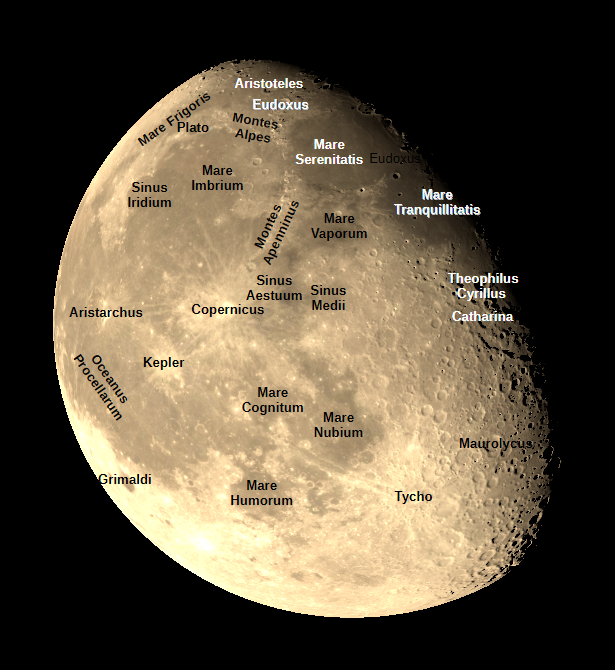
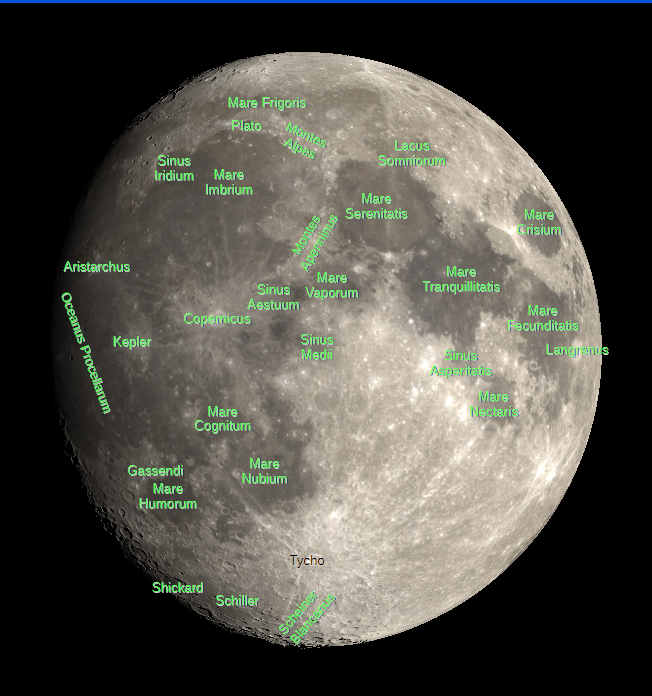
The Moon, 2 days before full, as seen at 10 PM tonight, April 29, 2026. A view visible in small telescopes showing an image with and without selected features labeled. Created using Stellarium, LibreOffice Draw, and GIMP.
Telescopic Jupiter and Venus as they would be seen in a small telescope with the same magnification.
Telescopic Jupiter and Venus (north up) as they would be seen in a small telescope with the same magnification. Venus will be visible for a short time near the western horizon, while Jupiter will be visible until after midnight. Venus’ apparent diameter will be 11.6″, and be 88.2% illuminated. It’s on the far side of the Sun. Jupiter will be 35.7″ in diameter, with its moons shown here for 10 PM, tonight April 29, 2026. The moons can shift noticably over an hour, especially Io and Europa. The (”) symbol means seconds of arc, or 1/3600th of a degree. Created using Cartes du Ciel (Sky Charts), LibreOffice Draw and GIMP.
The naked-eye planets at sunset and sunrise on a single night.
The naked-eye planets at sunset and sunrise on a single night, starting with sunset on the right on April 29, 2026. The night ends on the left with sunrise on the 30th. Click or tap on the image to enlarge it. Created using my LookingUp app and GIMP.
A low precision ephemeris of the Sun Moon and naked eye planet positions for today and tomorrow, April 29 and 30th, 2026.
This is a low precision ephemeris of the Sun Moon and naked eye planet positions for today and tomorrow, April 29 and 30th, 2026. Some of the columns are self-explanatory, others are not. The transit column is the time that the body crosses the meridian and is due south. Elong, for elongation, is the angle between the Sun and that body. RA is right ascension, which is the object’s east-west position on the celestial sphere in hours and minutes. Dec is declination which is the north-south position of the object on the celestial sphere in degrees and minutes. R is the distance of that object from the Sun in astronomical units. An astronomical unit is about 93 million miles or 150 million kilometers. And Delta is the distance of that object from the Earth, also in astronomical units. I omit the ‘m’ in am and pm for compactness. The data was generated using my LookingUp for DOS app and displayed as a table by my Ephemeris Helper app.

Ephemeris: 04/22/2026 – Taking our weekly look at the whereabouts of the naked-eye planets

April 22, 2026 Comments off

This is Ephemeris for Earth Day, Wednesday, April 22nd. Today the Sun will be up for 13 hours and 50 minutes, setting at 8:36, and it will rise tomorrow at 6:45. The Moon, 1 day before first quarter, will set at 3:07 tomorrow morning.

Let’s take our weekly look at the whereabouts of the naked-eye planets. By 9 PM tonight or about 30 minutes or so after sunset, Venus may be seen very low in the West. A telescope will show a very tiny disc on Venus, because it is still pretty much beyond the Sun, 138 million miles (222 million kilometers) away from us. Over the next 6 months it will be moving closer to us and becoming much larger. Jupiter is the brilliant star-like object high in the west-southwestern sky before 10 PM. It will appear just below the crescent Moon tonight. Venus will set at 10:54, while Jupiter will hold out until 2:30 AM. Meanwhile, Mercury, Mars and Saturn are still bunched up just west of the Sun, but are overwhelmed by bright morning twilight.

The astronomical event times given in this blog are for the Traverse City/Interlochen area of Michigan (Lat 44.7° N, Long 85.7° W; EDT, UT – 4 hours) unless stated otherwise. Times will be different for other locations.

Addendum
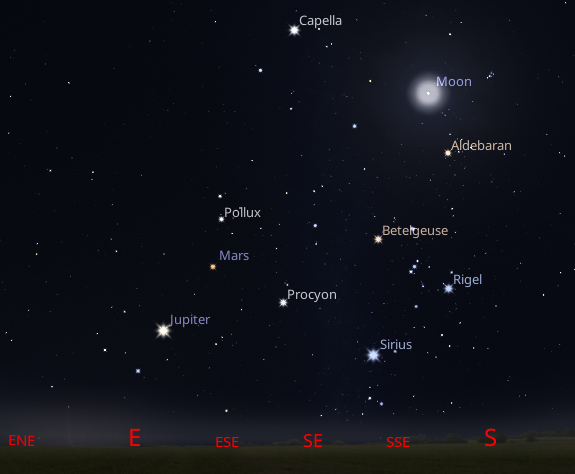
Jupiter, and Venus with the Moon and Sirius at 9 PM tonight.
Jupiter, and Venus with the Moon and Sirius at 9 PM tonight, April 22, 2026. Created using Stellarium.
A closer look at Jupiter and the Moon at 9 PM tonight.
A closer look at Jupiter and the Moon at 9 PM tonight, April 22, 2026. Created using Stellarium.
The Moon, a day before first quarter, as seen at 9:30 PM tonight, April 22, 2026. A view visible in small telescopes showing an image with and without selected features labeled. Created using Stellarium, LibreOffice Draw, and GIMP.
Telescopic Jupiter and Venus (north up) as they would be seen in a small telescope with the same magnification.
Telescopic Jupiter and Venus (north up) as they would be seen in a small telescope with the same magnification. Venus will be visible for a short time near the western horizon, while Jupiter is visible most of the night. Venus’ apparent diameter will be 11.3″, and be 89.7% illuminated. It’s on the far side of the Sun, 1.5 times the Sun’s distance from us. Jupiter will be 36.4″ in diameter, with its moons shown here for 9:30 PM, tonight April 22, 2026. The moons can shift noticably over an hour, especially Io and Europa. The (”) symbol means seconds of arc, or 1/3600th of a degree. Created using Cartes du Ciel (Sky Charts), LibreOffice Draw and GIMP.
The naked-eye planets at sunset and sunrise on a single night, starting with sunset on the right on April 22, 2026. The night ends on the left with sunrise on the 22nd.
The naked-eye planets at sunset and sunrise on a single night, starting with sunset on the right on April 22, 2026. The night ends on the left with sunrise on the 22nd. Click or tap on the image to enlarge it. Created using my LookingUp app and GIMP.
A low precision ephemeris of the Sun Moon and naked eye planet positions for today and tomorrow.
This is a low precision ephemeris of the Sun Moon and naked eye planet positions for today and tomorrow, April 22 and 23rd, 2026. Some of the columns are self-explanatory, others are not. The transit column is the time that the body crosses the meridian and is due south. Elong, for elongation, is the angle between the Sun and that body. RA is right ascension, which is the object’s east-west position on the celestial sphere in hours and minutes. Dec is declination which is the north-south position of the object on the celestial sphere in degrees and minutes. R is the distance of that object from the Sun in astronomical units. An astronomical unit is about 93 million miles or 150 million kilometers. And Delta is the distance of that object from the Earth, also in astronomical units. I omit the ‘m’ in am and pm for compactness. The data was generated using my LookingUp for DOS app and displayed as a table by my Ephemeris Helper app.

Ephemeris: 04/20/2026 – A seeming convergence of planets too close to the Sun to be seen from Michigan

April 20, 2026 Comments off

This is Ephemeris for Monday, April 20th. Today the Sun will be up for 13 hours and 44 minutes, setting at 8:34, and it will rise tomorrow at 6:48. The Moon, halfway from new to first quarter, will set at 1:20 tomorrow morning.

There’s a close planetary alignment this happening and today in the morning sky that we can’t see, of Mercury Mars and Saturn which are too close to the sun, and the time of year is not the best for seeing them. So they’re invisible to us but visible for folks in the Southern Hemisphere. Even the Artemis 2 astronauts talked about them when they went into solar eclipse on their trip around the moon. But the action is all happening yesterday and today. As of last Friday they were, from left to right, Saturn Mars and Mercury. As of today it’s almost a vertical arrangement with Mars on top Saturn in the middle and Mercury on the bottom and by tomorrow it will be Mercury on the bottom Venus on the top and Saturn off to the right.

The astronomical event times given in this blog are for the Traverse City/Interlochen area of Michigan (Lat 44.7° N, Long 85.7° W; EDT, UT – 4 hours) unless stated otherwise. Times will be different for other locations.

Addendum
The apparent convergence of three naked eye planets.
The apparent convergence of three naked eye planets which are invisible from our location in Northern Michigan, as being too close to the Sun and lost in morning twilight. Folks in the Southern Hemisphere may get a better view of it. This animation steps from April 16th through the 22nd at one day intervals, centered on Mars, as the planets Saturn and Mercury slowly switch places with respect to it. This image has an equatorial orientation with north directly up and west to the right. The orientation in the sky will be tilted about 45° to the left. Created using Stellarium and GIMP.

Ephemeris: 04/15/2026 – Taking our weekly look at the whereabouts of the naked-eye planets

April 15, 2026 Comments off

This is Ephemeris for Wednesday, April 15th. Today the Sun will be up for 13 hours and 29 minutes, setting at 8:28, and it will rise tomorrow at 6:56. The Moon, 2 days before new, will rise at 6:15 tomorrow morning.

Let’s take our weekly look at the whereabouts of the naked-eye planets. By 9:15 PM tonight or about 45 minutes or so after sunset, Venus may be seen very low in the West. A telescope will show a very tiny disc on Venus, because it is still pretty much beyond the Sun, 141 million miles (226 million kilometers) away from us. Over the next 6 months it will be moving closer to us and becoming much larger. Jupiter is the brilliant star-like object high in the southwestern sky at the same time. Venus will set at 10:35, while Jupiter will hold out to 3 AM. Meanwhile, Mercury, Mars and Saturn are lined up just west of the Sun, but unfortunately are overwhelmed by bright morning twilight. Southern Hemisphere observers will them bunched up next week.

The astronomical event times given in this blog are for the Traverse City/Interlochen area of Michigan (Lat 44.7° N, Long 85.7° W; EDT, UT – 4 hours) unless stated otherwise. Times will be different for other locations.

Addendum
Jupiter and Venus with fading constellations of winter in the west at 9:30 PM.
Jupiter and Venus with fading constellations of winter at 9:30 PM tonight, April 15, 2026. Created using Stellarium.
Telescopic Jupiter and Venus as they would be seen in a small telescope with the same magnification (north up) as they would be seen in a small telescope with the same magnification.
Telescopic Jupiter and Venus as they would be seen in a small telescope with the same magnification (north up) as they would be seen in a small telescope with the same magnification at 9:30 PM tonight, April 15, 2026. Venus will be visible for a short time near the western horizon, while Jupiter is visible most of the night. Venus’ apparent diameter will be 11.1″, and be 91.2% illuminated. It’s on the far side of the Sun. Jupiter will be 37.1″ in diameter. Io will be behind Jupiter and in its shadow until 12:16 AM, when it will appear near Europa. The (”) symbol means seconds of arc, or 1/3600th of a degree. Created using Cartes du Ciel (Sky Charts), LibreOffice Draw and GIMP.
The naked-eye planets at sunset and sunrise on a single night, starting with sunset on the right on April 15, 2026. The night ends on the left with sunrise on the 16th. Click or tap on the image to enlarge it. Created using my LookingUp app and GIMP.
A low precision ephemeris of the Sun Moon and naked eye planet positions for today and tomorrow.
This is a low precision ephemeris of the Sun Moon and naked eye planet positions for today and tomorrow, April 15 and 16th, 2026. Some of the columns are self-explanatory, others are not. The transit column is the time that the body crosses the meridian and is due south. Elong, for elongation, is the angle between the Sun and that body. RA is right ascension, which is the object’s east-west position on the celestial sphere in hours and minutes. Dec is declination which is the north-south position of the object on the celestial sphere in degrees and minutes. R is the distance of that object from the Sun in astronomical units. An astronomical unit is about 93 million miles or 150 million kilometers. And Delta is the distance of that object from the Earth, also in astronomical units. I omit the ‘m’ in am and pm for compactness. The data was generated using my LookingUp for DOS app and displayed as a table by my Ephemeris Helper app.

Ephemeris: 04/08/2026 – Taking our weekly look at the whereabouts of the naked-eye planets

April 8, 2026 Comments off

This is Ephemeris for Wednesday, April 8th. Today the Sun will be up for 13 hours and 8 minutes, setting at 8:19, and it will rise tomorrow at 7:08. The Moon, 2 days before last quarter, will rise at 3:20 tomorrow morning.

Let’s take our weekly look at the whereabouts of the naked-eye planets. By 9 PM tonight or about 40 minutes or so after sunset, Venus may be seen very low in the West. Binoculars or a telescope will show a very tiny disc on Venus, because it is pretty much behind the Sun, 145 million miles (231 million kilometers) away from us. Over the next 6 months it will be moving closer to us and becoming much larger. Jupiter is the brilliant star-like object high in the southwestern sky at 9:30 PM. Venus will set at 10:15, while Jupiter will hold out to 3:30 AM. Meanwhile, Mercury, Mars and Saturn are lined up just west of the Sun, but unfortunately are overwhelmed by bright morning twilight. The Artemis II astronauts reported seeing them during their solar eclipse.

The astronomical event times given in this blog are for the Traverse City/Interlochen area of Michigan (Lat 44.7° N, Long 85.7° W; EST, UT – 5 hours) unless stated otherwise. Times will be different for other locations.

Addendum
Jupiter and Venus with fading constellations of winter at 9:30 PM tonight.
Jupiter and Venus with fading constellations of winter at 9:30 PM tonight, April 8, 2026. Created using Stellarium.
The Moon, a day before last quarter as seen at 6 AM tomorrow morning, April 9, 2026. A view visible in small telescopes showing an image with and without selected features labeled. Created using Stellarium, LibreOffice Draw, and GIMP.
Telescopic Jupiter and Venus as they would be seen in a small telescope with the same magnification.
Telescopic Jupiter and Venus as they would be seen in a small telescope with the same magnification.Telescopic Jupiter and Venus (north up) as they would be seen in a small telescope with the same magnification. Venus will be visible for a short time near the western horizon, while Jupiter is visible most of the night. Venus’ apparent diameter will be 10.9″, and be 92.5% illuminated. It’s on the far side of the Sun. Jupiter will be 37.9″ in diameter, with its moons shown here for 10 PM, tonight April 8th, 2026. The moons can shift noticably over an hour. Io will emerge from Jupiter’s shadow at 10:21 PM. The (”) symbol means seconds of arc, or 1/3600th of a degree. Created using Cartes du Ciel (Sky Charts), LibreOffice Draw and GIMP.
The naked-eye planets at sunset and sunrise on a single night.
The naked-eye planets at sunset and sunrise on a single night, starting with sunset on the right on April 8, 2026. The night ends on the left with sunrise on the 9th. Click or tap on the image to enlarge it. Created using my LookingUp app and GIMP.

Ephemeris: 04/01/2026 – No fooling, we’re looking at the bright planets for this week

April 1, 2026 Comments off

This is Ephemeris for April Fools’ Day, Wednesday, April 1st. Today the Sun will be up for 12 hours and 47 minutes, setting at 8:10, and it will rise tomorrow at 7:21. The Moon, at full today, will rise at 8:06 this evening.

Let’s take our weekly look at the whereabouts of the naked-eye planets. By 8:40 PM tonight or about a half hour or so after sunset, Venus may be seen very low in the West. Binoculars or a telescope will show a very tiny disc on Venus, because it is pretty much behind the Sun, a good way from us. Over the next 7 months it will be moving closer to us and becoming much larger. Jupiter is the brilliant star-like object more than halfway up in the southwestern sky at 9 PM. At that time Venus will still be visible, setting at 9:57 PM. Mercury, Mars and Saturn are lined up just west of the Sun, but unfortunately are overwhelmed by bright morning twilight.

The astronomical event times given in this blog are for the Traverse City/Interlochen area of Michigan (Lat 44.7° N, Long 85.7° W; EST, UT – 5 hours) unless stated otherwise. Times will be different for other locations.

Addendum
Jupiter and Venus with the constellations of the Zodiac at 9 PM.
Jupiter and Venus with the constellations of the Zodiac at 9 PM, or 50 minutes after sunset tonight, April 1, 2026. Created using Stellarium.
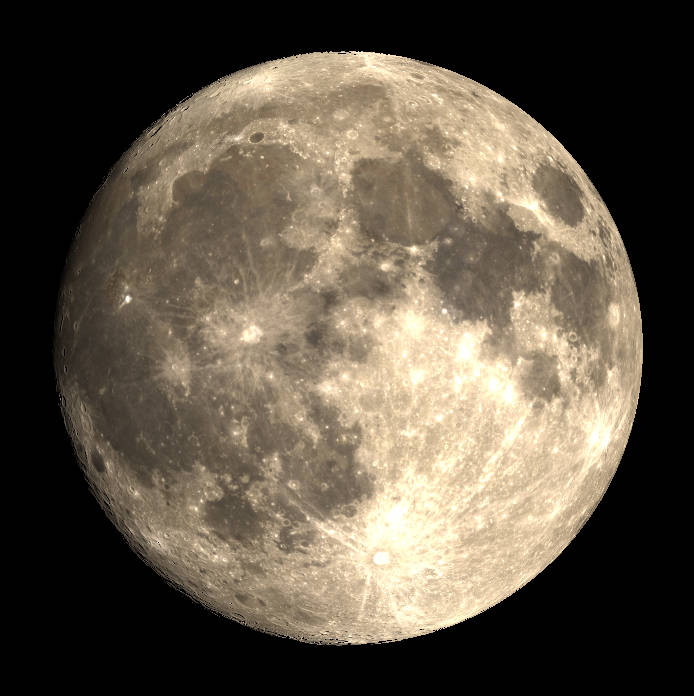
The full Moon as seen at 10 PM tonight, April 1, 2026. A view visible in small telescopes showing an image with and without selected features labeled. Created using Stellarium, LibreOffice Draw, and GIMP.
Telescopic Jupiter and Venus as they would be seen in a small telescope with the same magnification.
Telescopic Jupiter and Venus (north up) as they would be seen in a small telescope with the same magnification. Venus will be visible for a short time near the western horizon, while Jupiter is visible most of the night. Venus’ apparent diameter will be 10.7″, and be 93.6% illuminated. It’s on the far side of the Sun. Jupiter will be 38.8″ in diameter, with its moons shown here for 9 PM, tonight April 1st, 2026. The moons can shift noticably over an hour. The (”) symbol means seconds of arc, or 1/3600th of a degree. Created using Cartes du Ciel (Sky Charts), LibreOffice Draw and GIMP.
The naked-eye planets at sunset and sunrise on a single night.
The naked-eye planets at sunset and sunrise on a single night, starting with sunset on the right on April 1, 2026. The night ends on the left with sunrise on the 2nd. The Moon is missing. It is full today but is south of the ecliptic, while we are viewing from a northerly location. So the full mon rises a bit after sunset and sets a bit before sunrise. Click or tap on the image to enlarge it. Saturn is not visible, being too close to the direction of the Sun. Created using my LookingUp app and GIMP.
A low precision ephemeris of the Sun Moon and naked eye planet positions for today and tomorrow.
This is a low precision ephemeris of the Sun Moon and naked eye planet positions for today and tomorrow, April 1st and 2nd, 2026. Some of the columns are self-explanatory, others are not. The transit column is the time that the body crosses the meridian and is due south. Elong, for elongation, is the angle between the Sun and that body. RA is right ascension, which is the object’s east-west position on the celestial sphere in hours and minutes. Dec is declination which is the north-south position of the object on the celestial sphere in degrees and minutes. R is the distance of that object from the Sun in astronomical units. An astronomical unit is about 93 million miles or 150 million kilometers. And Delta is the distance of that object from the Earth, also in astronomical units. I omit the ‘m’ in am and pm for compactness. The data was generated using my LookingUp for DOS app and displayed as a table by my Ephemeris Helper app.

Ephemeris: 03/25/2026 – Taking our weekly look at the whereabouts of the naked-eye planets

March 25, 2026 Comments off

This is Ephemeris for Wednesday, March 25th. Today the Sun will be up for 12 hours and 25 minutes, setting at 8:01, and it will rise tomorrow at 7:34. The Moon, at first quarter today, will set at 4:26 tomorrow morning.

Let’s take our weekly look at the whereabouts of the naked-eye planets. Earlier this morning Saturn passed conjunction with the Sun becoming officially a morning planet. But it’ll be a couple of months before it’s visible in the morning and about seven months before it’s conveniently placed in the evening sky. By 8:30 PM tonight or about a half hour or so after sunset, Venus may be seen very low in the West. Binoculars or a telescope will show a very tiny disc on Venus, because it is pretty much behind the Sun, a good way from us. Over the next 7 months it will be moving closer to us and becoming much larger. Jupiter is the brilliant star-like object more than halfway up in the southwestern sky at 9 PM. Tonight, it’s below and left of the Moon.

The astronomical event times given in this blog are for the Traverse City/Interlochen area of Michigan (Lat 44.7° N, Long 85.7° W; EST, UT – 5 hours) unless stated otherwise. Times will be different for other locations.

Addendum
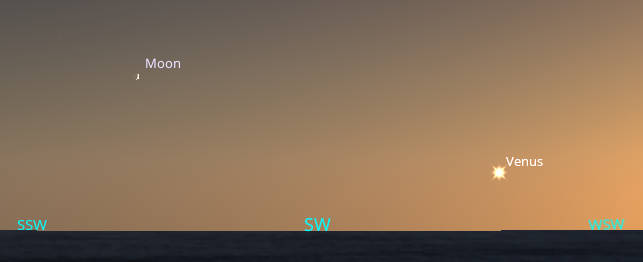
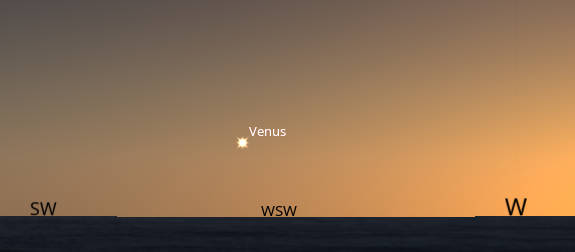
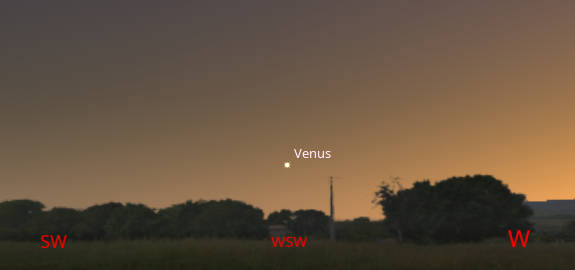
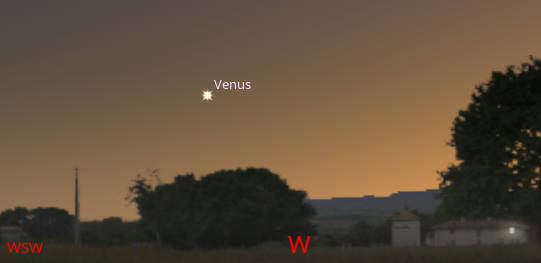
Venus is seen low in the western sky at 8:30 PM tonight.
Venus is seen low in the western sky at 8:30 PM tonight March 25, 2026, or 29 minutes after sunset. Created using Stellarium.
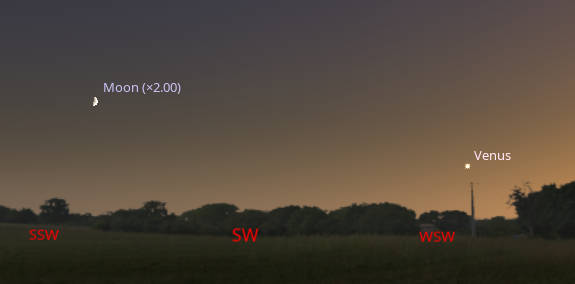
The Moon and Jupiter as they should appear tonight at 9 PM.
The Moon and Jupiter as they should appear tonight at 9 PM March 25, 2026. Created using Stellarium.
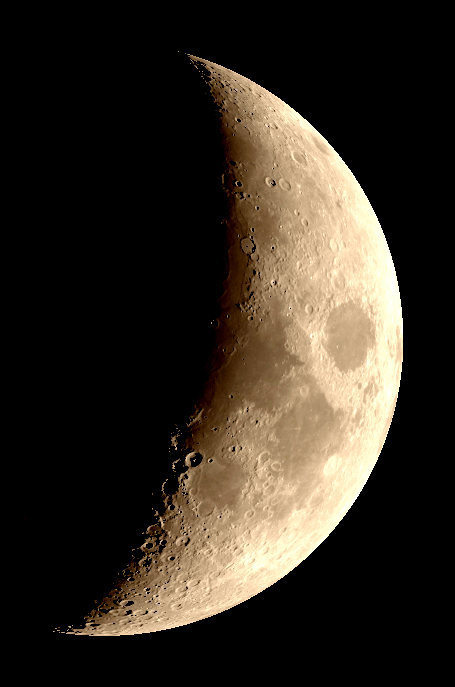
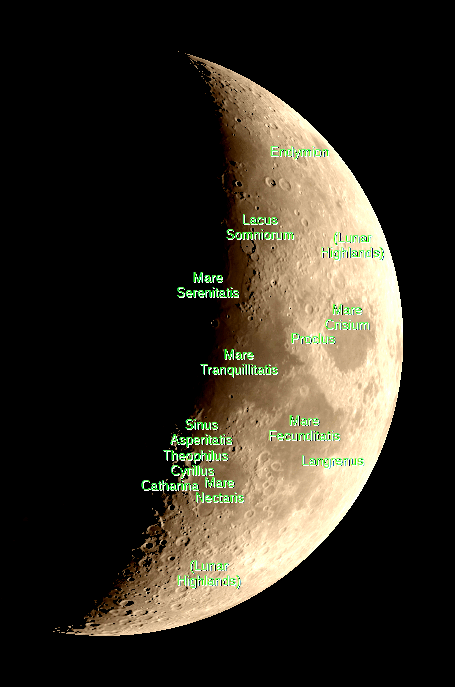
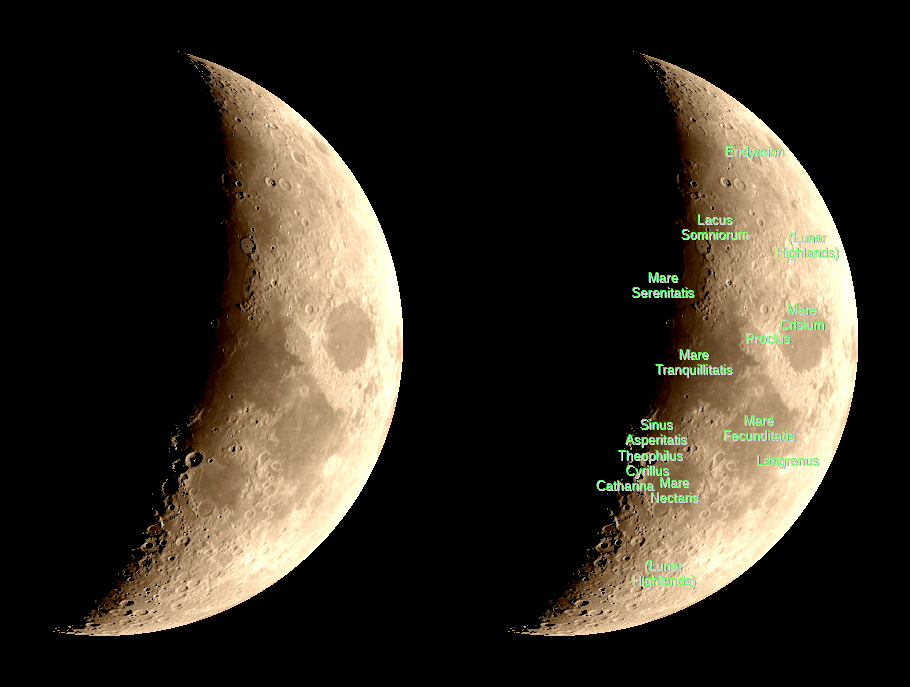
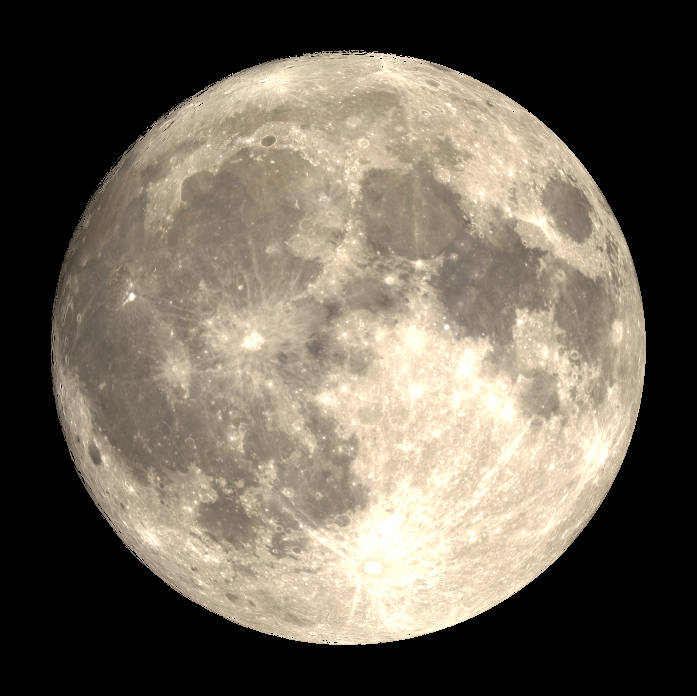
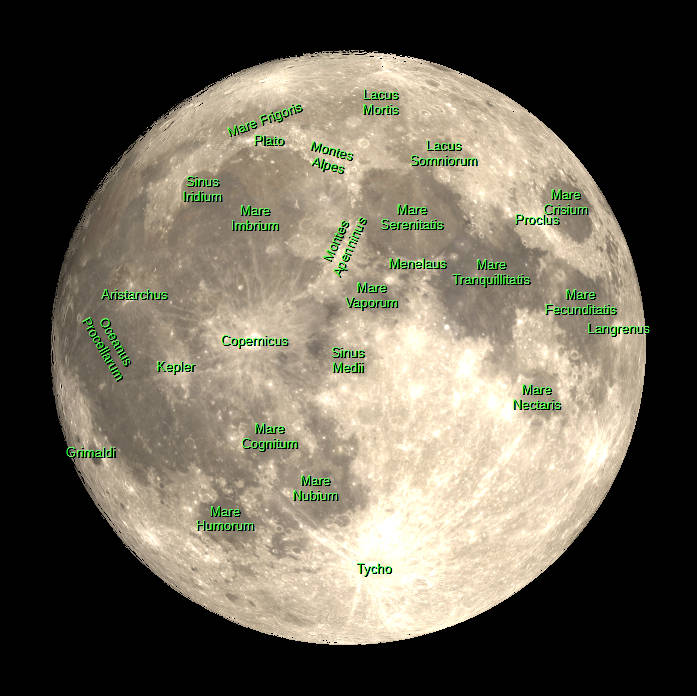
The Moon, at first quarter, as seen at 9 PM tonight, March 25, 2026. A view visible in small telescopes showing an image with and without selected features labeled. Created using Stellarium, LibreOffice Draw, and GIMP.
Telescopic Jupiter and Venus (north up) as they would be seen in a small telescope with the same magnification.
Telescopic Jupiter and Venus (north up) as they would be seen in a small telescope with the same magnification. Venus will be visible for a short time near the western horizon, while Jupiter is visible most of the night. Venus’ apparent diameter will be 10.5″, and be 94.7% illuminated. It’s on the far side of the Sun, 1.6 times the Sun’s distance from us. Jupiter will be 39.6″ in diameter, with its moons shown here for 9 PM, tonight March 25th, 2026. The moons can shift noticably over an hour. Callisto will pass behind the planet from 10:29 PM to 2:29 AM. The (”) symbol means seconds of arc, or 1/3600th of a degree. Created using Cartes du Ciel (Sky Charts), LibreOffice Draw and GIMP.
The naked-eye planets and the Moon at sunset and sunrise on a single night.
The naked-eye planets and the Moon at sunset and sunrise on a single night, starting with sunset on the right on March 25th, 2026. The night ends on the left with sunrise on the 26th. Click or tap on the image to enlarge it. Saturn is not visible, being too close to the direction of the Sun. Created using my LookingUp app and GIMP.
A low precision ephemeris of the Sun Moon and naked eye planet positions for today and tomorrow.
This is a low precision ephemeris of the Sun Moon and naked eye planet positions for today and tomorrow, March 25th and 26th, 2026. Some of the columns are self-explanatory, others are not. The transit column is the time that the body crosses the meridian and is due south. Elong, for elongation, is the angle between the Sun and that body. RA is right ascension, which is the object’s east-west position on the celestial sphere in hours and minutes. Dec is declination which is the north-south position of the object on the celestial sphere in degrees and minutes. R is the distance of that object from the Sun in astronomical units. An astronomical unit is about 93 million miles or 150 million kilometers. And Delta is the distance of that object from the Earth, also in astronomical units. I omit the ‘m’ in am and pm for compactness. The data was generated using my LookingUp for DOS app and displayed as a table by my Ephemeris Helper app.

Ephemeris: 03/18/2026 – Taking our weekly look at the whereabouts of the naked-eye planets

March 18, 2026 Comments off

This is Ephemeris for Wednesday, March 18th. Today the Sun will be up for 12 hours and 3 minutes, setting at 7:52, and it will rise tomorrow at 7:47. The Moon is new today, and won’t be visible.

Let’s take our weekly look at the whereabouts of the naked-eye planets. By 8:30 PM or about a half hour or so after sunset, Venus may be seen very low in the West. Binoculars or a telescope will show a very tiny disc on Venus, because it is pretty much behind the Sun, a good way from us. However over the next 7 months it will be moving closer to us and becoming much larger. Jupiter is the brilliant star-like object more than halfway up in the southern sky at 9 PM. It’s the brightest object in the sky at that point. It has resumed its normal eastward motion, spending most of its evening appearance making up the ground it lost in its 4 months of retrograde motion. The planet and its moons are a treat for binoculars or a telescope.

The astronomical event times given in this blog are for the Traverse City/Interlochen area of Michigan (Lat 44.7° N, Long 85.7° W; EST, UT – 5 hours) unless stated otherwise. Times will be different for other locations.

Addendum
Venus is seen low in the western sky at 8:30 PM tonight.
Venus is seen low in the western sky at 8:30 PM tonight March 18, 2026, or 38 minutes after sunset. Created using Stellarium.
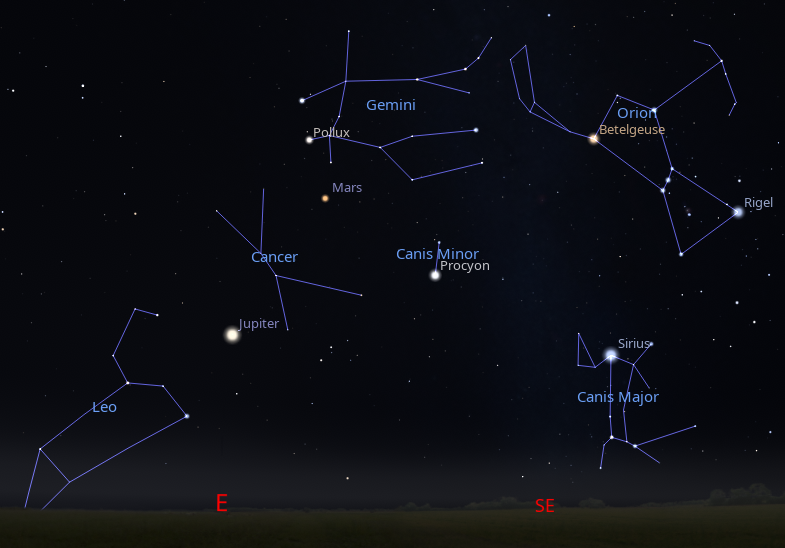
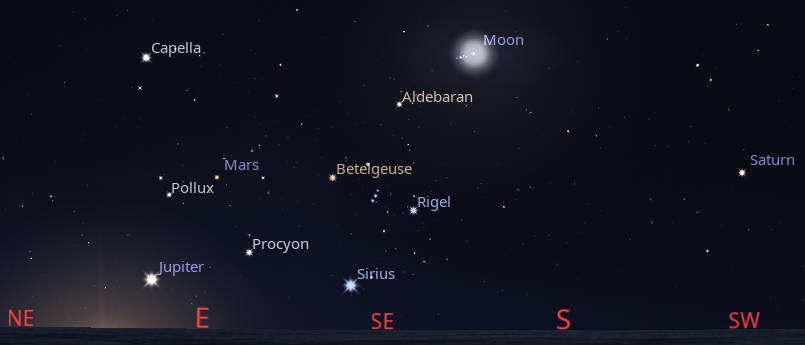
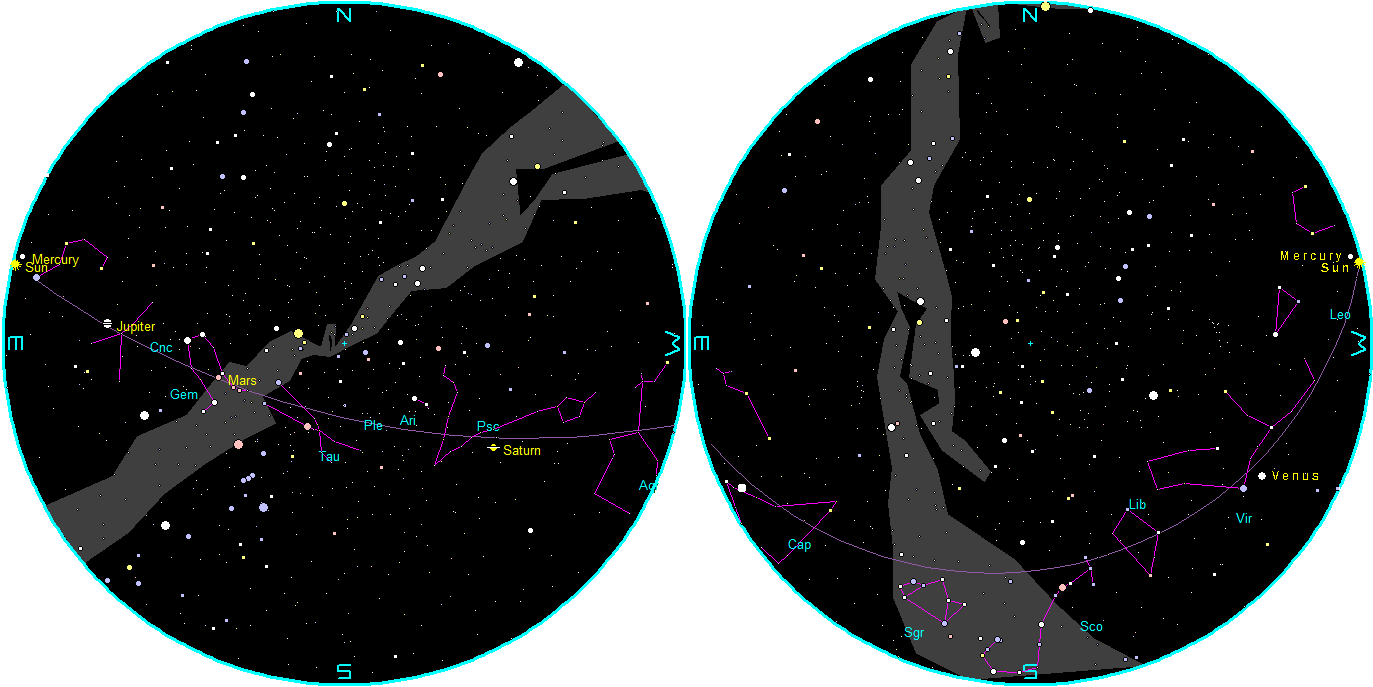
Jupiter is seen with the bright winter stars in the south at 9:00 PM tonight.
Jupiter is seen with the bright winter stars in the south at 9:00 PM tonight, March 18, 2026. Also showing are the zodiacal constellations of Taurus, Gemini, Cancer and Leo. Created using Stellarium.
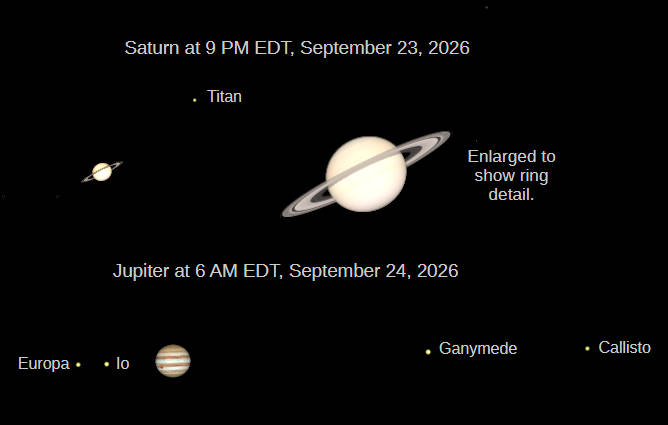
Telescopic Jupiter and Venus as they would be seen in a small telescope with the same magnification.
Telescopic Jupiter and Venus (north up) as they would be seen in a small telescope with the same magnification. Venus will be visible for a short time near the western horizon, while Jupiter is visible mopst of the night. Venus’ apparent diameter will be 10.4″, and be 95.7% illuminated. It’s on the far side of the Sun, 1.6 times the Sun’s distance from us. Jupiter will be 40.5″ in diameter, with its moons shown here for 9 PM, tonight March 18th, 2026. The moons can shift noticably over an hour. . The (”) symbol means seconds of arc, or 1/3600th of a degree. Created using Cartes du Ciel (Sky Charts), LibreOffice Draw and GIMP.
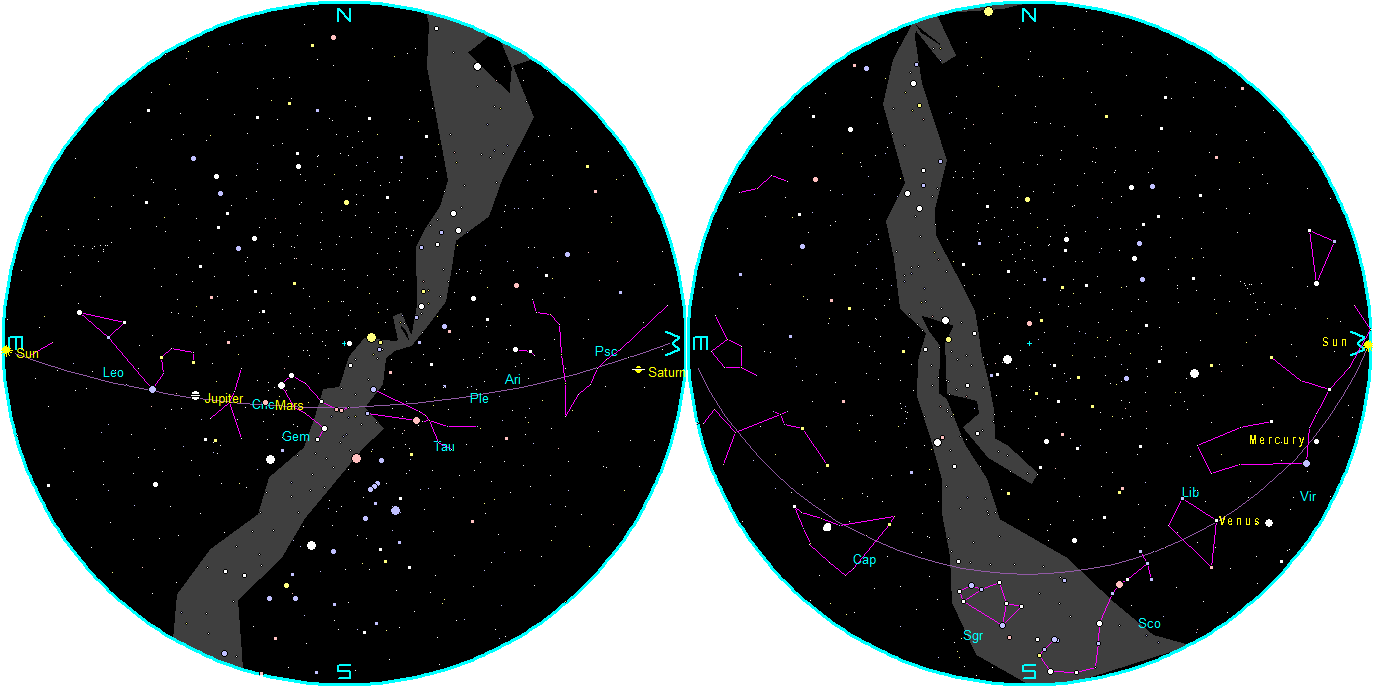
The naked-eye planets and the Moon at sunset and sunrise on a single night.
The naked-eye planets and the Moon at sunset and sunrise on a single night, starting with sunset on the right on March 18th, 2026. The night ends on the left with sunrise on the 19th. Click or tap on the image to enlarge it. Created using my LookingUp app and GIMP.
A low precision ephemeris of the Sun Moon and naked eye planet positions for today and tomorrow.
This is a low precision ephemeris of the Sun Moon and naked eye planet positions for today and tomorrow, March 18th and 19th, 2026. Some of the columns are self-explanatory, others are not. The transit column is the time that the body crosses the meridian and is due south. Elong, for elongation, is the angle between the Sun and that body. RA is right ascension, which is the object’s east-west position on the celestial sphere in hours and minutes. Dec is declination which is the north-south position of the object on the celestial sphere in degrees and minutes. R is the distance of that object from the Sun in astronomical units. An astronomical unit is about 93 million miles or 150 million kilometers. And Delta is the distance of that object from the Earth, also in astronomical units. I omit the ‘m’ in am and pm for compactness. The data was generated using my LookingUp for DOS app and displayed as a table by my Ephemeris Helper app.