Archive
Ephemeris: 02/17/2026 – There’s an annular solar eclipse today… if you’re a penguin
This is Ephemeris for Fat Tuesday, February 17th. Today the Sun will be up for 10 hours and 34 minutes, setting at 6:14, and it will rise tomorrow at 7:38. The Moon is new today, and won’t be visible.
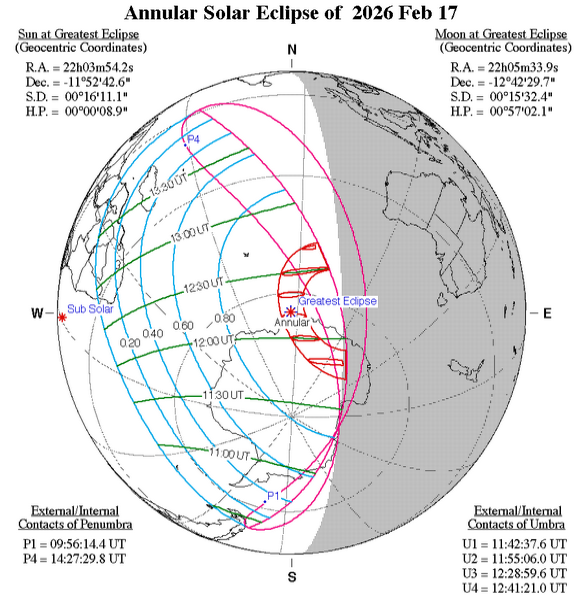
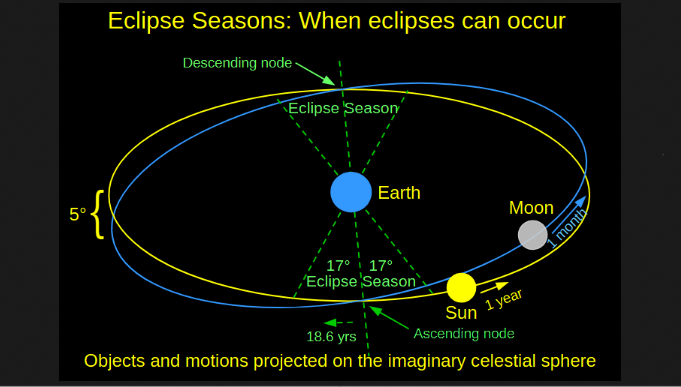
This morning there is an annular solar eclipse occurring. Don’t run outside to see it, especially if you’re here in northern Michigan. The eclipse is only visible in the Southern Ocean and Antarctica. However, this eclipse marks the beginning of an eclipse season, and we will have an eclipse that will be visible for our location in two weeks: a total lunar eclipse, which will be visible before sunrise on Tuesday morning, March 3rd. There are two periods were eclipses will occur in a year, with at least one of the sun and the moon. These periods are separated by a little less than six months, and last about 35 days. That’s about 5 1/2 days longer than a lunar month, so it is possible to squeeze in another eclipse, though not this time.
The astronomical event times given in this blog are for the Traverse City/Interlochen area of Michigan (Lat 44.7° N, Long 85.7° W; EST, UT – 5 hours) unless stated otherwise. Times will be different for other locations.
Addendum
04/29/2014 – Ephemeris – Today’s weird annular eclipse
Ephemeris for Tuesday, April 29th. The sun rises at 6:35. It’ll be up for 14 hours and 9 minutes, setting at 8:44. The moon is new today, and won’t be visible.
This event has already happened, and there was now way to be able to get to a spot too see its maximum effect. What I’m talking about was this morning’s weird annular eclipse of the sun. Australia saw the partial phase. An annular eclipse is one in which the moon is too far away to completely fill the face of the sun at maximum eclipse, leaving a bright ring of the uneclipsed sun around the moon. The path of annularity will just graze the earth over a spot in Antarctica. The center of this annular shadow called an antumbra, a new word I learned from descriptions of this eclipse, will just miss the earth. As far as I know no one had gone to the spot where the annular effect can be seen, so remote is its location. It kind of reminds one that the earth is a ball in space.
Times are for the Traverse City/Interlochen area of Michigan. They may be different for your location.
Addendum
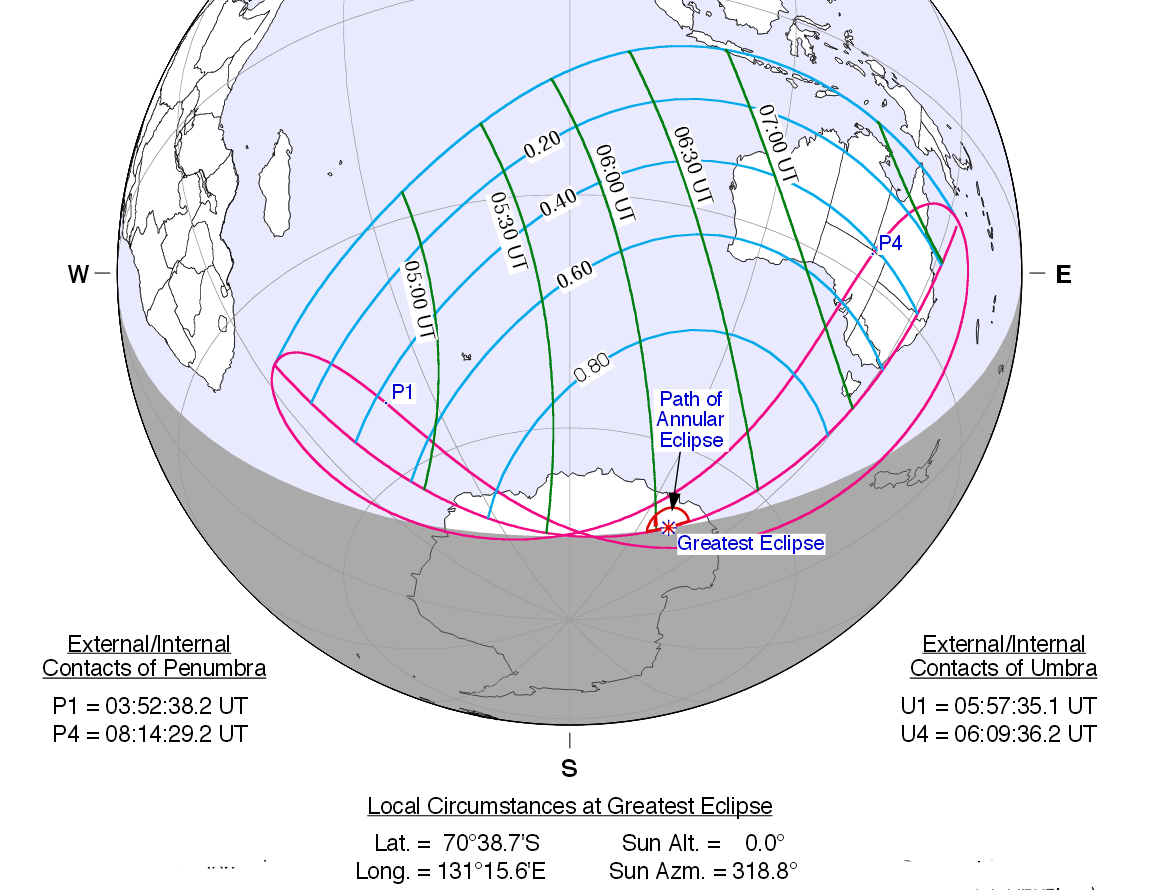
Area on the Earth where the eclipse can be seen. Credit: “Eclipses During 2014”, F. Espenak, Observer’s Handbook – 2014, Royal Astronomical Society of Canada, NASA eclipse website
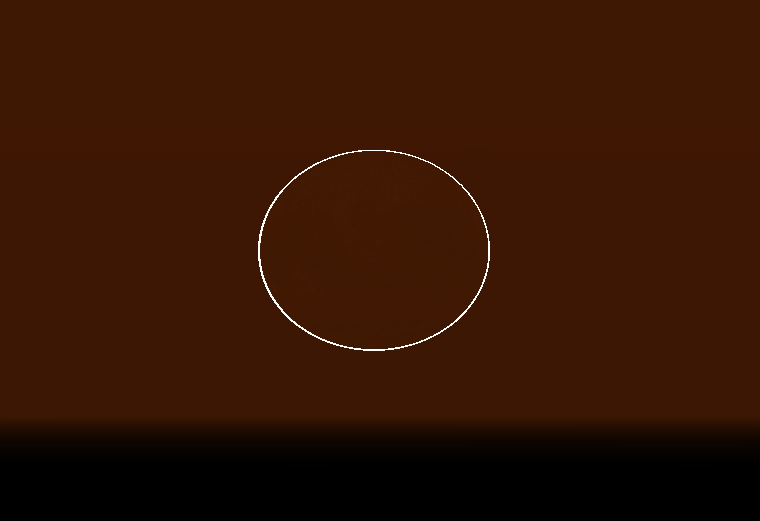
Annularity as simulated in Stellarium.
For more information on this eclipse check here: http://eclipse.gsfc.nasa.gov/OH/OH2014.html#SE2014Apr29A
 Bob Moler's Ephemeris Blog