Archive
03/16/2021 – Ephemeris – Tonight we’ll have exactly 12 hours of night
This is Ephemeris for Tuesday, March 16th. Today the Sun will be up for 11 hours and 57 minutes, setting at 7:50, and it will rise tomorrow at 7:50. The Moon, 3 days past new, will set at 11:15 this evening.
Did you notice what I just said? Sunset’s at 7:50 pm and sunrise’s at 7:50 am. Tonight we’ll have exactly 12 hours of night. That’s what the word equinox means, equal night… But the vernal or spring equinox isn’t until Saturday when spring starts. By then night, including twilight, will be down to 11 hours, 50 minutes. The disparity comes down to modern versus older definitions. Equinox, being Latin is an older definition. The modern instant of sunrise and sunset occurs when the top of the Sun’s disc touches the sea horizon. Because our atmosphere bends light, and at its greatest when looking at the horizon, the Sun will have set already, geometrically, by the time the bottom edge of the Sun appears to touch that sea horizon. Making daylight a bit longer than you’d think.
The astronomical event times given are for the Traverse City/Interlochen area of Michigan. They may be different for your location.
Addendum
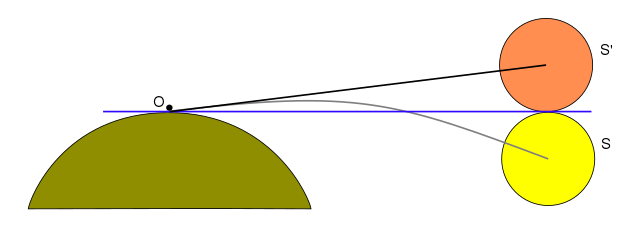
How the atmosphere bends the light of the Sun or Moon rising or setting to appear higher than it actually is. S is the actual position of the Sun, S’ is the apparent position of the Sun. The blue line is the observer O’s horizon. The gray line is the actual, though much exaggerated, light path bent or refracted by the Earth’s atmosphere. The black line is the apparent sight line to the Sun. Credit Francisco Javier Blanco González, 2017
03/21/2019 – Ephemeris – Are day and night really equal at the equinoxes?
Ephemeris for Thursday, March 21st. Today the Sun will be up for 12 hours and 11 minutes, setting at 7:56, and it will rise tomorrow at 7:42. The Moon, 1 day past full, will rise at 8:52 this evening.
What we had yesterday was the vernal equinox, the start of spring. The word equinox means “equal night”. Yesterday’s daylight hours were 12 hours and 8 minutes. What’s with the 8 minutes? The rising or setting Sun is a mirage. The Earth’s atmosphere acts like a lens and makes the Sun appear higher in the sky than when it is when near the horizon. When the bottom edge of the Sun touches the horizon the Sun is actually still completely below the horizon geometrically. If the Earth had no atmosphere sunrises would occur 4 minutes later, and sunsets would occur 4 minutes earlier around here. That would completely correct the 12 hour 8 minutes daylight time of yesterday to 12 hours even.
The times given are for the Traverse City/Interlochen area of Michigan. They may be different for your location.
Addendum
How the atmosphere bends the light of the Sun or Moon rising or setting to appear higher than it actually is. Credit Francisco Javier Blanco González, 2017.
I took a look at the related atmospheric refraction effect last month: https://bobmoler.wordpress.com/2019/02/19/02-19-2019-ephemeris-the-moon-aint-just-super-near-the-horizon/.
02/19/2019 – Ephemeris – The Moon ain’t just super near the horizon
Ephemeris for Tuesday, February 19th. Today the Sun will be up for 10 hours and 39 minutes, setting at 6:16, and it will rise tomorrow at 7:35. The Moon, at full today, will rise at 6:28 this evening.
Tonight we will have a super full Moon. It will be the closest full moon of the year, not that you could really tell. The full moon, or waning moon looks large near the horizon when it’s rising. The same is true of waxing moons setting. The same is true of sunrises and sunsets. However if you look closely at the rising or setting Moon or Sun right at the horizon you will notice that it appears a bit squashed. This is due to atmospheric refraction or bending of the light which makes the them appear higher in the sky than they actually are. It is most pronounced near the horizon. In fact by the time the Sun appears to touch the horizon, it is already completely below the horizon, and would appear be if we didn’t have an atmosphere.
The times given are for the Traverse City/Interlochen area of Michigan. They may be different for your location.
Addendum
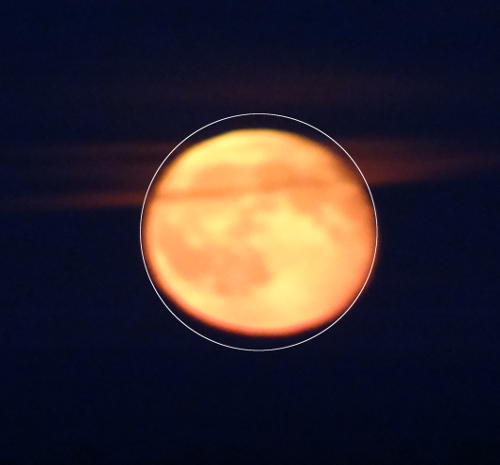
The Moon just after moonrise 1 day past full. The Moon appears squashed vertically by about 10% compared to circumscribed circle. Credit Eileen Carlisle.
How the atmosphere bends the light of the Sun or Moon rising or setting to appear higher than it actually is. Credit Francisco Javier Blanco González, 2017
 Bob Moler's Ephemeris Blog