Archive
05/27/2014 – Ephemeris – There was a meteor sprinkle but no storm
Ephemeris for Tuesday, May 27th. Today the sun will be up for 15 hours and 12 minutes, setting at 9:16. The moon, 1 day before new, will rise at 6:11 tomorrow morning. Tomorrow the sun will rise at 6:02.
The Camelopardalid meteors straggled in last Saturday morning. No real shower and definitely not a storm, but waiting through the night I saw a few genuine Camelopardalids, moving slowly that could be traced back to the north. There was no peak of activity, but what meteors we did see appeared randomly. I and others reporting via Twitter from around the country remarked the large percentage of really bright meteors. I saw one that left a smokey train that stayed visible a few seconds. I didn’t have binoculars to follow it further. Other observers had better luck with meteor trains. So yes, the Camelopardalids were a disappointment, but at least they were not a no show. This was a newly discovered comet which had no history of meteor shower activity before.
Times are for the Traverse City/Interlochen area of Michigan. They may be different for your location.
Meteor Watch cloud and meteor status May 23/24, 2014
May 24, 5;33 a.m. EDT
Just got back from the Dune Climb. Yes Virginia there are Camelopardalids. Just not many of them. I saw about 10 meteors overnight with just over half Camelopardalids. Now I was busy with other things, running the star party. However it seemed that of the ones I saw, there were a better an average, compared to the Perseids, number of bright ones. One also left a smokey train that was visible for a few seconds. I didn’t have my binoculars with me to view it longer. But it was impressive. We had maybe 40-50 folks come out, coming and going over the night, with about 11 sticking it out to the bitter end at 4 a.m.
May 23, 5:32 p.m. EDT
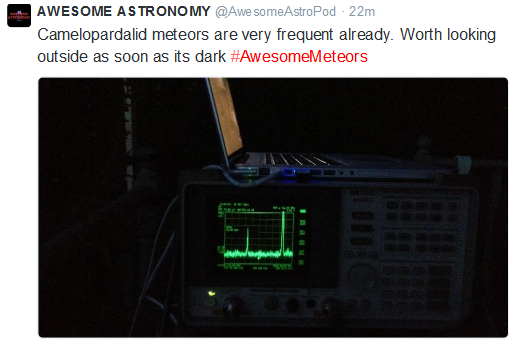
Weather is still great. Picked up a tweet saying the the Camelopardalids are being picked up via the radio reflection of their ionized trains.
 I’m going to head out in a half hour to the Visitors Center (see below) for the talk and to pick up some traffic cones.
May 23, 12:45 p.m. EDT
The weather is holding. The forecast is for clear skies through Sunday daytime. It should be a great Memorial Day weekend. For those venturing out to observe the meteor storm (we hope) dress warmly. The temperatures in northern Michigan will drop to the mid 40s. I plan to bring a light coat and my winter coat. For those who wish to lie on the ground to see the sky show bring two blankets one under you and one over you. It will get dewy. Hat, gloves and a thermos of warm drinks will also be welcome. Winter boots might be welcome for those who tend to get cold feet. Meteor watching is not an active pursuit, so you may want to walk around or climb up the dune a ways to keep warm. Remember there’s a talk by astronomer Tyler Nordgren at the Sleeping Bear Dunes National Lakeshore Philip A. Hart Visitor Center near the corner of M72 and M22 in Empire at 7 p.m. Sunset will be at 9:15 p.m.. The Grand Traverse Astronomical Society (GTAS) will be ready to observe the planets at the Dune Climb by 10 p.m.
May 22, 11:00 p.m. EDT
This is a pre-post entry. The blog will be published at noon on the 23rd and be updated as necessary. New updates will appear above older ones. I may also tweet. My twitter handle is @robertcmoler. The hashtag for the meteor shower appears to be #Camelopardalids. I hope you’re a good speller. The National Weather Service for tomorrow (Friday) and tomorrow night is for decreasing clouds during the day and mostly clear tomorrow night. Anttilla Danko’s Clear Sky Chart for the Leelanau School’s Lanphier Observatory also shows clear skies for the night of the 23rd/24th at this time. The observatory is located a few miles northeast of the Dune Climb area. New to the Sleeping Bear Dunes National Lakeshore? Here’s their website: http://www.nps.gov/slbe/index.htm Here’s a link to the map of the park. The Dune Climb is at points 7 & 8 on highway M109 just south of Glen Haven.
05/23/2014 – Ephemeris – Possible Meteor Storm overnight tonight
Ephemeris for Friday, May 23rd. Today the sun will be up for 15 hours and 5 minutes, setting at 9:12. The moon, 2 days past last quarter, will rise at 3:45 tomorrow morning. Tomorrow the sun will rise at 6:05.
If you want to see a possible meteor storm, go out tomorrow morning and find a dark location. The meteors will be seen all over the sky, but will seem to come from the north. The Grand Traverse Astronomical Society will be at Sleeping Bear Dunes National Lakeshore at the Dune Climb with telescopes starting at 10 p.m. tonight, weather permitting, to enjoy the other wonders of the sky while we wait for the meteor storm to start. Dress warmly, bring a blanket or lounge chair so you can comfortably look up. The first meteors may show by 1:40 a.m. but the peak activity is expected about 3 a.m., but that estimate may be off by an hour or more. Check bobmoler.wordpress.com for cloud and meteor status from noon through 4 a.m. if it’s clear. The latter part depends on getting a decent data signal. The dunes seem to be the end of the world as far as cell phone service goes. I might have to climb the dune to get a good signal.
Times are for the Traverse City/Interlochen area of Michigan. They may be different for your location.
Addendum
Remember these meteors should be visible from anywhere in the continental United States. Convert the times to your location. 3 a.m. EDT is 7 hours UT.
Start the evening tonight with a talk by Dr. Tyler Nordgren, astronomer, artist and dark sky advocate at the Sleeping Bear Dunes National Lakeshore Philip A. Hart Visitor Center in Empire at 7 p.m. Afterward he will be signing copies of his beautiful new poster See the Stars from Sleeping Bear Dunes National Lakeshore featuring the Great and Little Bear constellations and the bluffs of the Sleeping Bear Dunes and the Manitou Islands. After that, weather permitting see the sunset from many of the park’s locations, then, for the hardy, settle down for an all night vigil for the possible meteor storm with the Grand Traverse Astronomical Society at the Dune Climb. We’ll be viewing out the planets and the other wonders of the spring and summer skies as we wait for the meteors to appear.
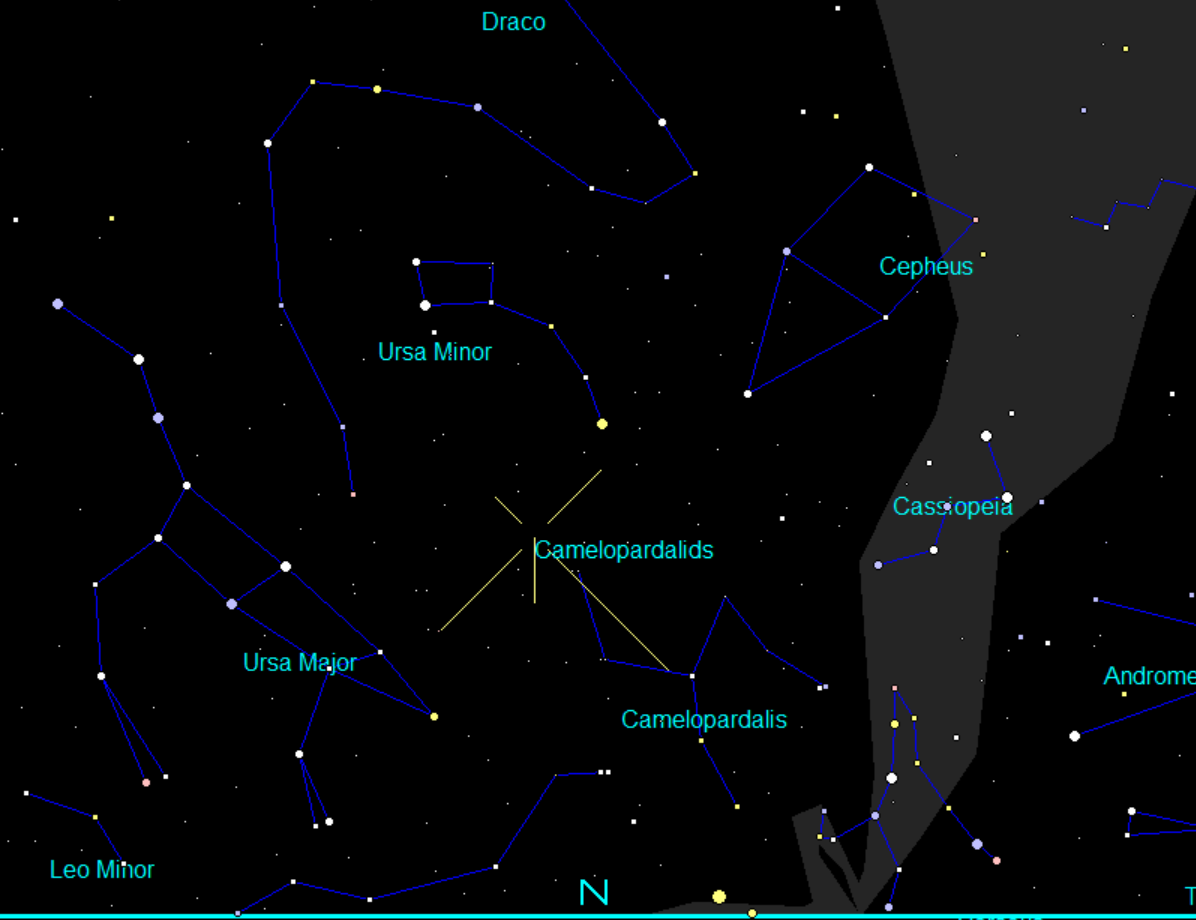
The expected radiant for the meteors of the May Camelopardalids, the meteors from the comet 209P/LINEAR at 3 a.m. on May 24, 2014. Credit: My LookingUp program.
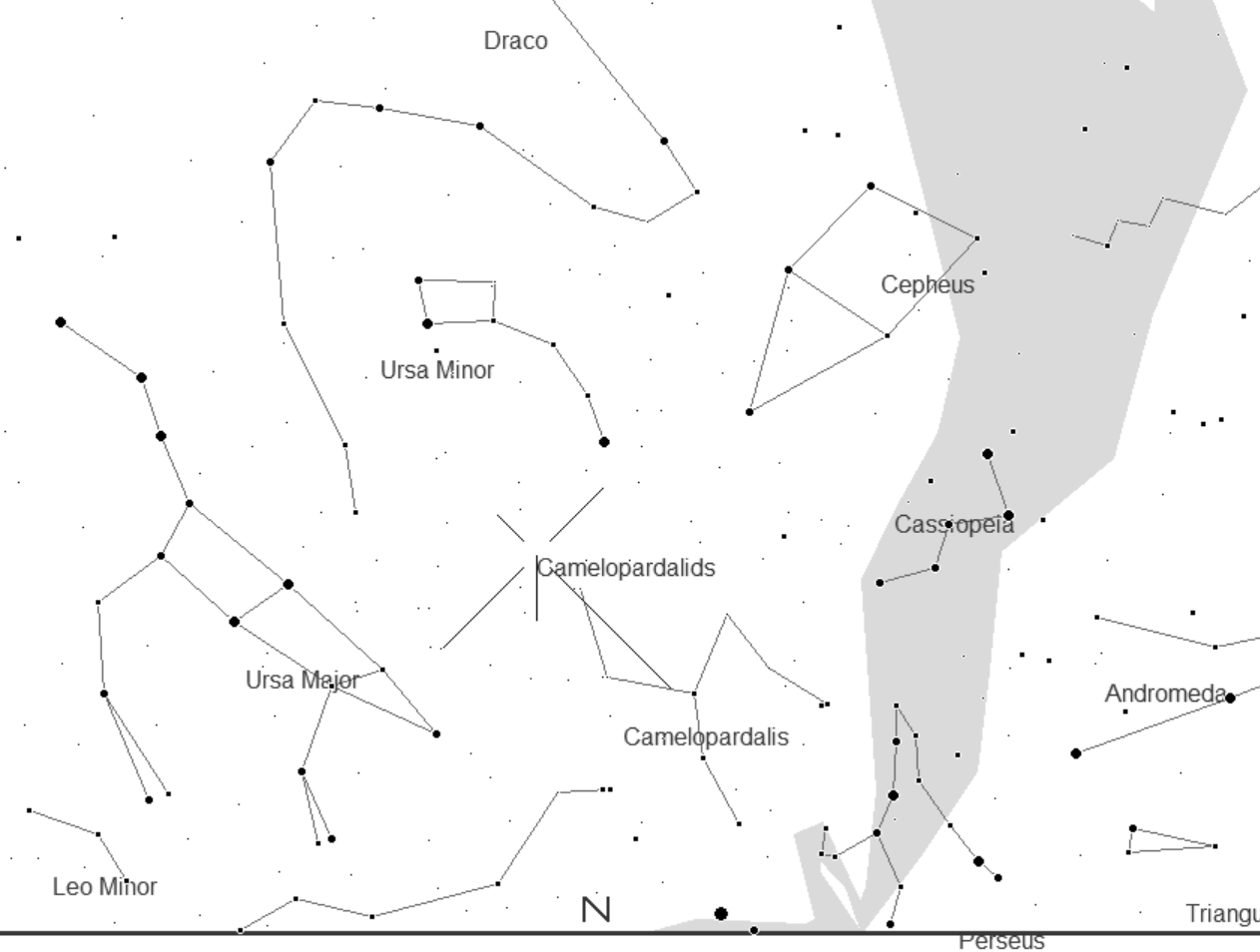
Same chart as above but black on white to save ink if you print it.
Here’s the culprit: Comet 209P/LINEAR

This May 17, 2014 image of Comet 209/LINEAR is the average of 5, 180-second exposures, taken remotely with the PlaneWave 17″+ Paramount ME+STL-6303E robotic unit of the Virtual Telescope Project. The telescope tracked the comet, so stars are trailing. This comet has the potential to generate an exceptional meteor shower (Camelopardalids) on May 24, 2014. Gianluca Masi / Virtual Telescope Project
Image and caption above from the Planetary Society blog from Bruce Betts: http://www.planetary.org/blogs/bruce-betts/20140522-one-night-only-a-new-meteor.html.
Want to find the comet?
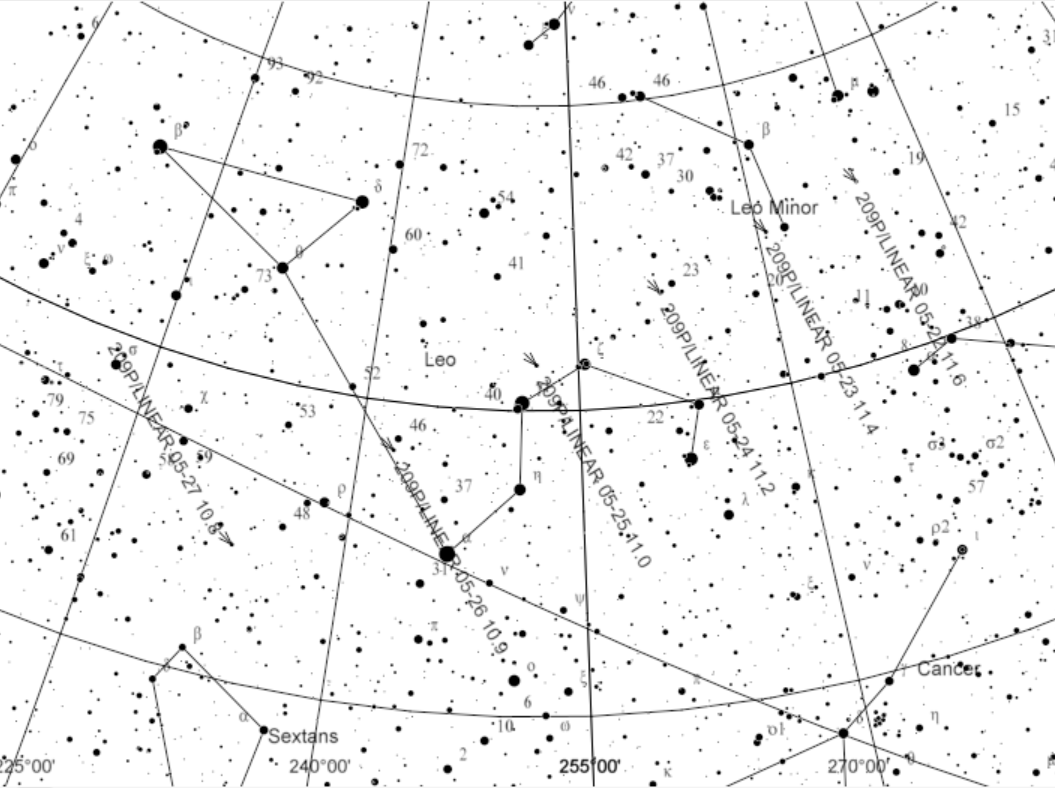
Finder chart for Comet 209P/LINEAR for 11 p.m. Note the dates are UT, 11 p.m. the 23rd is 3 a.m. UT on the 24th. Created using Cartes du Ciel (Sky Charts).
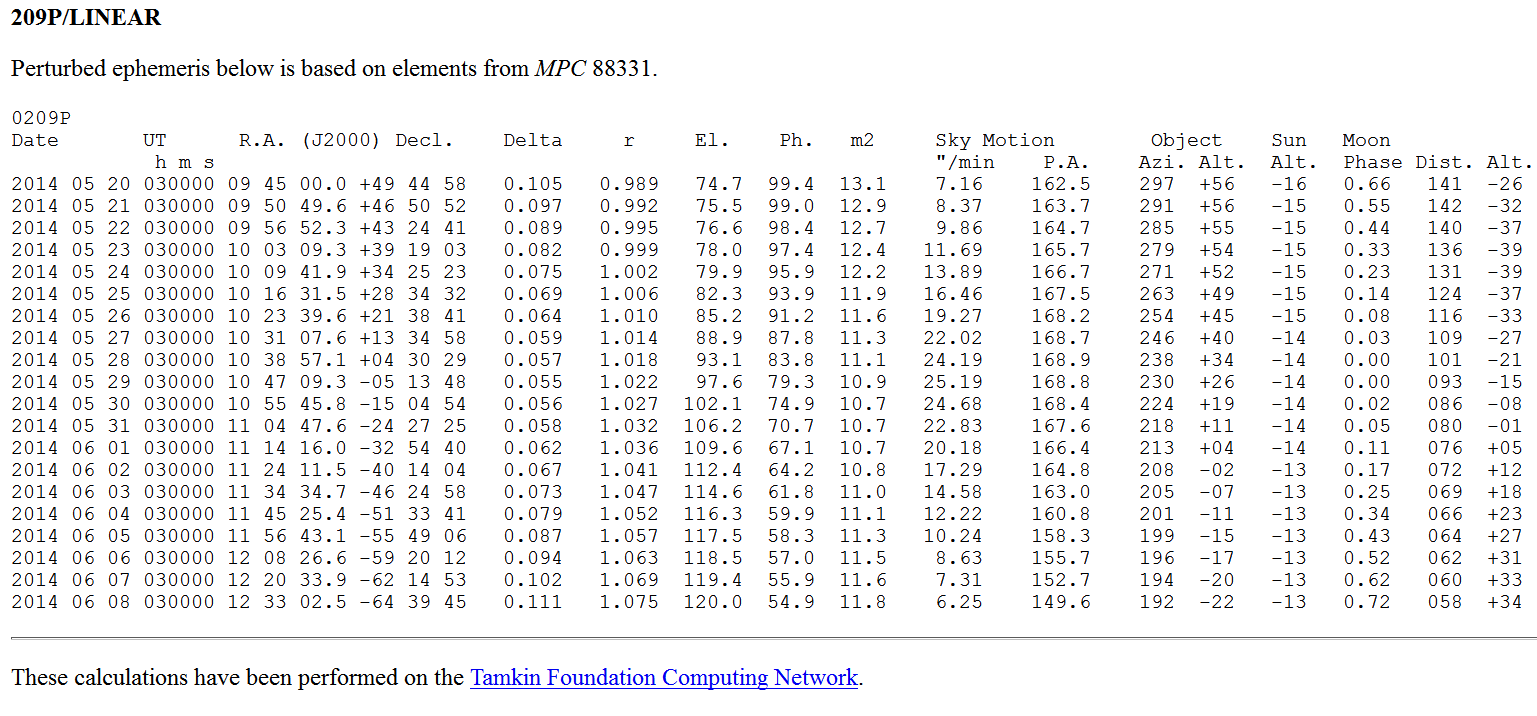
Ephemeris of positions for Comet 209P/LINEAR for May 20, 2014 to June 8, 2014 from the Minor Planet Center.
Got to http://www.minorplanetcenter.net/iau/MPEph/MPEph.html to print your own ephemeris for this or any comet. For purposes of this comet the comet name is: 209P/LINEAR.
All these images may be enlarged by clicking on them.
Note that:
Delta is the distance from Earth in Astronomical Units (AU)
r is the comet’s distance from the sun in AU.
El is the elongation in degrees from the sun
Ph. is the phase angle, not a big deal for comets.
m2 is the magnitude of the comet’s coma. Comets appear dimmer than their magnitude suggests.
05/13/2014 – Ephemeris – A possible meteor storm for the early morning hours of May 24th
Ephemeris for Tuesday, May 13th. Today the sun will be up for 14 hours and 44 minutes, setting at 9:01. The moon, 1 day before full, will set at 6:16 tomorrow morning. Tomorrow the sun will rise at 6:15.
A meteor storm is an enhanced meteor shower in terms of numbers of meteors seen over a short interval. Some astronomers predict one where no meteor shower has been seen before, on the morning of May 24th this year. In the last couple of years two astronomers have projected the orbits of the debris from the comet now known as 209P/LINEAR, discovered in 2004. These astronomers are Peter Jenniskens of the SETI Institute and NASA and Esko Lyytinen of Finland. The International Meteor Organization calendar for this year reports predictions for the peak of meteor storm to be between 3 and 4 a.m. on May 24th. But no one really knows if the meteor storm will show at all. I’ll tell you of local observing plans on Thursday.
Times are for the Traverse City/Interlochen area of Michigan. They may be different for your location.
Addendum
The expected radiant for the meteors of the May Camelopardalids, the meteors from the comet 209P/LINEAR at 3 a.m. on May 24, 2014. Credit: My LookingUp program.
Note that the meteors will appear all over the sky, but can be traced back to this radiant.
 Bob Moler's Ephemeris Blog