Archive
03/25/11 – Ephemeris – The stars Castor and Pollux
Friday, March 25th. The sun will rise at 7:36. It’ll be up for 12 hours and 24 minutes, setting at 8:00. The moon, 1 day before last quarter, will rise at 3:20 tomorrow morning
Castor and Pollux are the two brightest stars in the constellation Gemini, at the heads of their namesakes. They are high in the south at 10 p.m. Castor, the horseman is on top. It is actually 6 stars orbiting about a common center of gravity in pairs. The two brightest unresolved pairs, named Castor A and Castor B are discernible in telescopes. They all lie 45 light years away. Pollux the pugilist is a single star, slightly brighter than Castor, and somewhat closer to us at 33.7 light years. In his 1603 atlas of the heavens Johannes Bayer gave Castor the alpha designation to Pollux’s beta, even though Pollux is slightly brighter. I once took a photograph of Pollux during the daytime under special circumstances: it happened to be near the totally eclipsed sun.
* Times are for the Traverse City/Interlochen area of Michigan. They may be different for your location.
Addendum
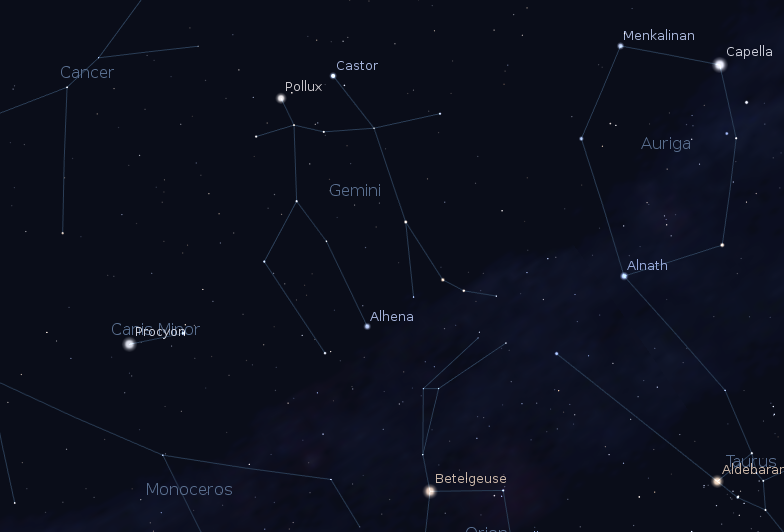
Gemini with the stars Castor and Pollux. Created using Stellarium.
Click to enlarge.
02/24/11 – Ephemeris – The sextuple star Castor
Thursday, February 24th. The sun will rise at 7:28. It’ll be up for 10 hours and 54 minutes, setting at 6:23. The moon, at last quarter today, will rise at 2:41 tomorrow morning.
High in the southeast at 9 p.m. is the constellation of Gemini the twins. The heads of the two lads contain bright stars with their names. Brighter Pollux is below and Castor is above. Stars that delineate their bodies lie to the lower right of them stretching out in the direction of Orion. Castor is an interesting star because it is actually six stars. Two are easily seen. The two brightest component stars can be resolved in a small telescope with good optics and a steady atmosphere. Each has a red dwarf companion detectable only by indirect means. The fifth and sixth stars makes a faint eclipsing binary or red dwarf stars some distance away and very faint. The Castor system resides some 50 light years away.
* Times are for the Traverse City/Interlochen area of Michigan. They may be different for your location.
* Times are for the Traverse City/Interlochen area of Michigan. They may be different for your location.
 Bob Moler's Ephemeris Blog