Archive
10/19/2015 – Ephemeris – Where did the Moon come from?
Ephemeris for Monday, October 19th. The Sun will rise at 8:03. It’ll be up for 10 hours and 48 minutes, setting at 6:51. The Moon, 1 day before first quarter, will set at 11:51 this evening.
Only two planets in the solar system have moons at least a quarter the size of the planet they orbit: The Earth and Pluto. The Moon is a bit more than a quarter the Earths diameter while Pluto’s moon Charon is half its size. Probably in the early days of the solar system, some four and a half billion years ago collisions were rather common. It is thought by many planetary scientists that a Mars sized protoplanet collided with the proto-earth with a glancing blow to rip off much of the Earth’s crust, thrust it into orbit where it coalesced into the Moon. It seems that Pluto’s Charon may have been formed much the same way. Some thing the varying axial tilts of the planets may have been caused the same way by smaller objects.
Times are for the Traverse City/Interlochen area of Michigan. They may be different for your location.
Addendum

The hypothetical collision of a Mars sized body with the young Earth. Credit: Joe Tucciarone via NASA
Breaking News
Robert Farquhar the man behind the ISEE-3 spacecraft, the first to hang out at the Earth-Sun L1 point between the Earth and the Sun back in 1978 passed away yesterday. In 1982 he “stole” the spacecraft and through an amazing number of maneuvers using very little fuel managed to send it through the tail of Comet Gicobini-Zinner ahead of the fleet of spacecraft then aimed at Halley’s Comet. Last year when the then renamed spacecraft ICE approached the Earth, he hatched a plan to return the spacecraft to its L1 position. Unfortunately apparently there was not enough fuel pressure to complete the burns necessary for the task. I’ll have a program on Robert Farquhar next Monday.
08/25/2015 – Ephemeris – Waiting for more images from New Horizons
Ephemeris for Tuesday, August 25th. The Sun rises at 6:56. It’ll be up for 13 hours and 35 minutes, setting at 8:32. The Moon, 3 days past first quarter, will set at 3:16 tomorrow morning.
The New Horizons team is downloading data now from all the instruments gathered from the encounter with Pluto, but in mid-September the pictures again will be flowing down to Earth. What was downloaded in the day and a half after close encounter with Pluto were highly compressed images of an area of Pluto and Charon’s surface showing a wider view than we will see later on and in full resolution. The team is already beginning to name the features that can be seen in sufficient detail. The International Astronomical Union has decided the types of names for Pluto, Charon and the rest of the Satellites. Pluto is set aside for explorers, both human and robotic. Charon, for mythical and fictional space and adventure heroes, vessels and authors.
Times are for the Traverse City/Interlochen area of Michigan. They may be different for your location.
Addendum
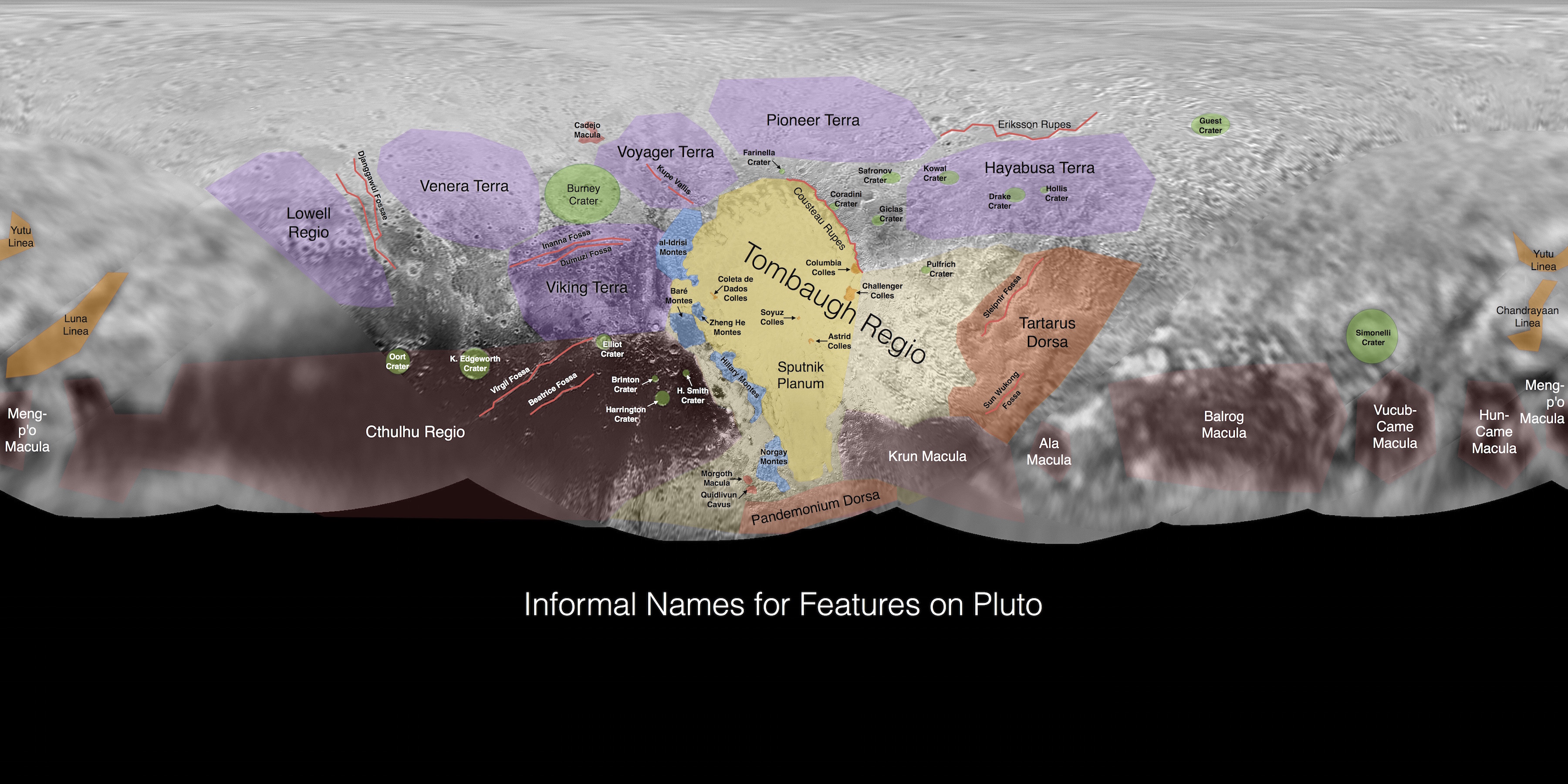
Map of Pluto with unofficial place names so far. Credit NASA/JPL. Click to enlarge.

Map of Charon with unofficial place names so far. Credit NASA/JPL. Click to enlarge.
The International Astronomical Union approves all names of objects off the Earth. Go to either http://www.iau.org or more specifically http://planetarynames.wr.usgs.gov.
07/13/2015 – Ephemeris – New Horizons’ encounter with Pluto just 1 day to go!
Ephemeris for Monday, July 13th. Today the Sun will be up for 15 hours and 17 minutes, setting at 9:27. The Moon, 2 days before new, will rise at 5:05 tomorrow morning, and tomorrow the Sun will rise at 6:10.
The New Horizons spacecraft is hopefully Go for its encounter with Pluto and its moons tomorrow morning (July 14, 2015), and tomorrow New Horizons will be working in radio silence because it will be too busy to turn and relay anything to the Earth. Tomorrow evening we should get a signal from the spacecraft with engineering data on its survival of the encounter. Any photographs will be sent starting Wednesday. Pretty pictures are not the only data to be sent back. It will take 16 months to get all the data sent back. A series of highly compressed images will be sent for the next 6 days. Then other data will be taking priority until September 14th when photographs will again be sent. We’ll be feasting on the information for quite some time.
Times are for the Traverse City/Interlochen area of Michigan. They may be different for your location.
Addendum
The following images are shown in chronological order as New Horizons approaches Pluto and Charon. Click on any of these images to enlarge.
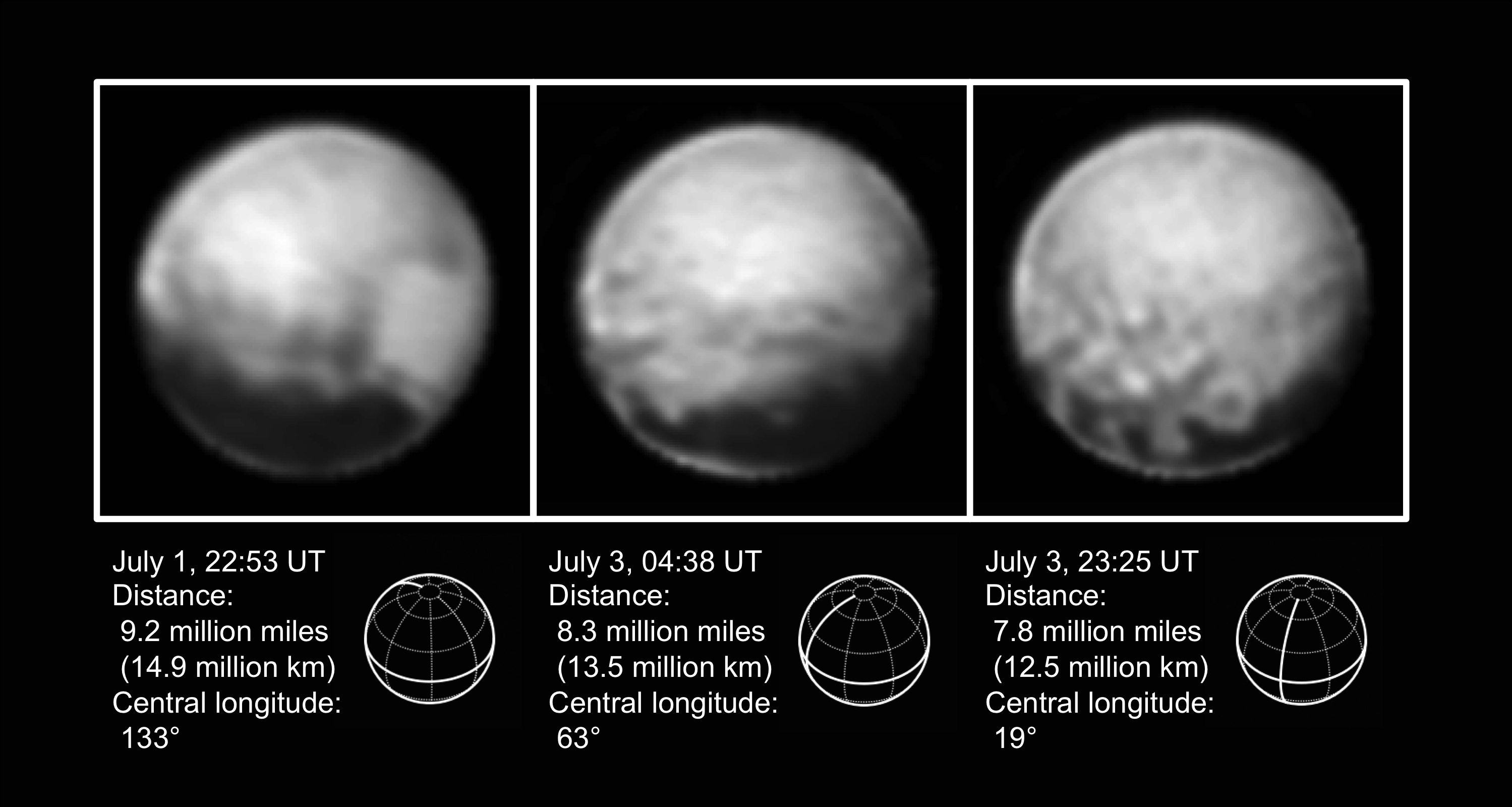
Pluto on three consecutive days: July 2-3 as the Pluto rotates not quite half a rotation. It’s rotation period is 6.4 Earth-days. Credit: NASA/Johns Hopkins University Applied Physics Laboratory/Southwest Research Institute.
On July 4, the spacecraft went into safe mode. Imaging resumed on July 8th.

Pluto on July 8th showing its love for us, or it’s just a heart-shaped feature on Pluto’s lower right edge. This is a back & white image colorized by information captured by “Ralph”, a visible and infrared imager. The detail in all these pictures is provided by LORRI the long-range imager. Credit: NASA/Johns Hopkins University Applied Physics Laboratory/Southwest Research Institute.
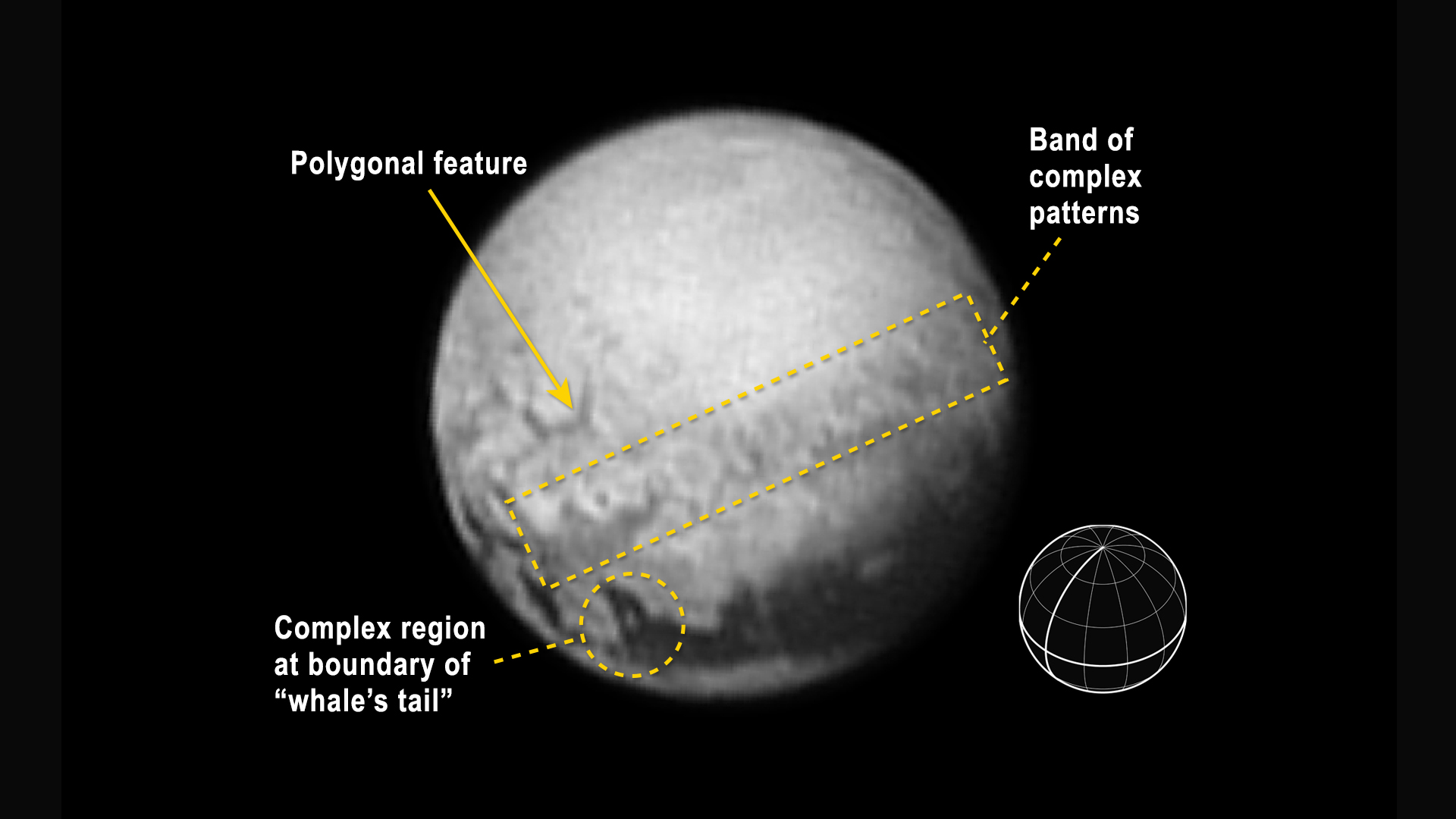
An annotated image from July 10. The rest of the “whale” can be seen impinging on the “heart” in the July 8 image. Credit: NASA/Johns Hopkins University Applied Physics Laboratory/Southwest Research Institute.
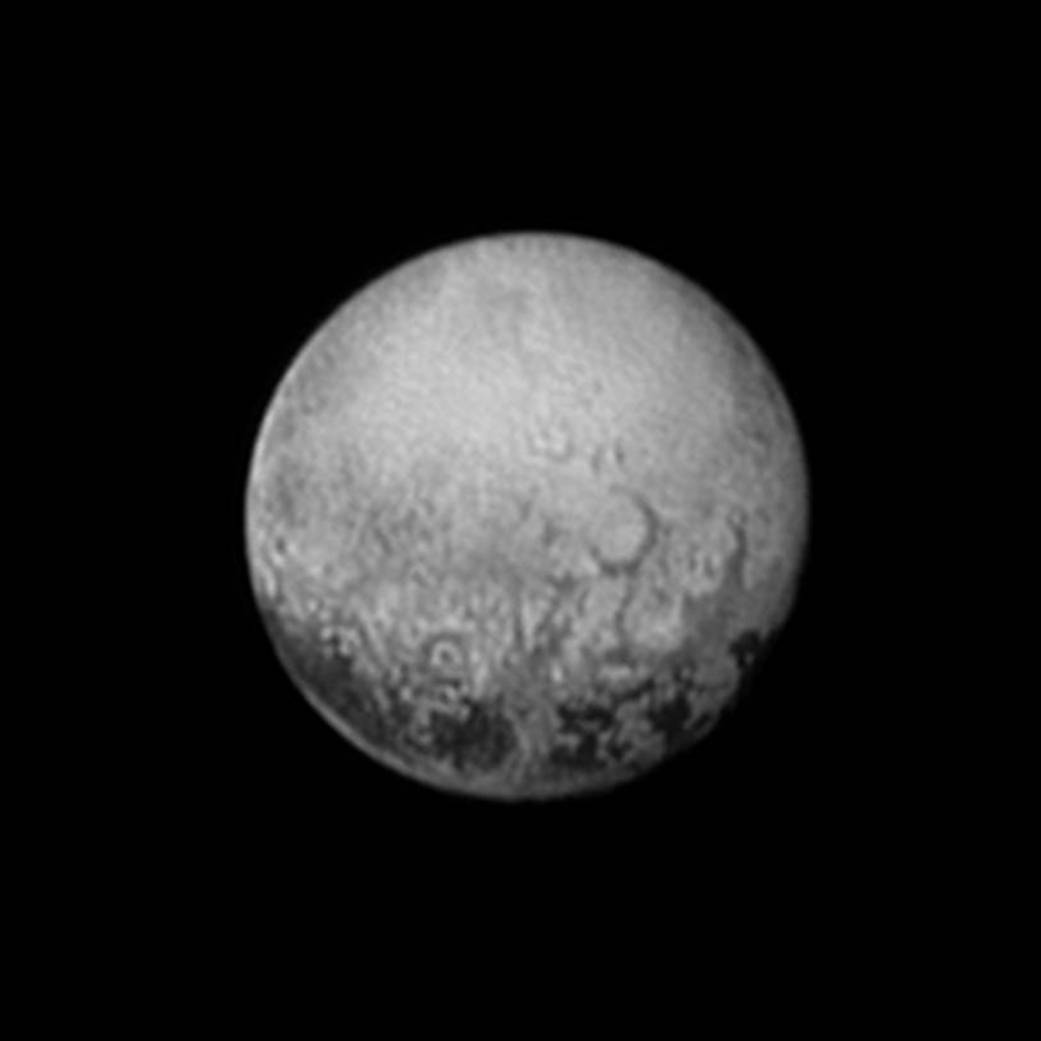
Pluto on July 11. Note the four mysterious dark spots along the bottom right of the disk. Credit: NASA/Johns Hopkins University Applied Physics Laboratory/Southwest Research Institute.
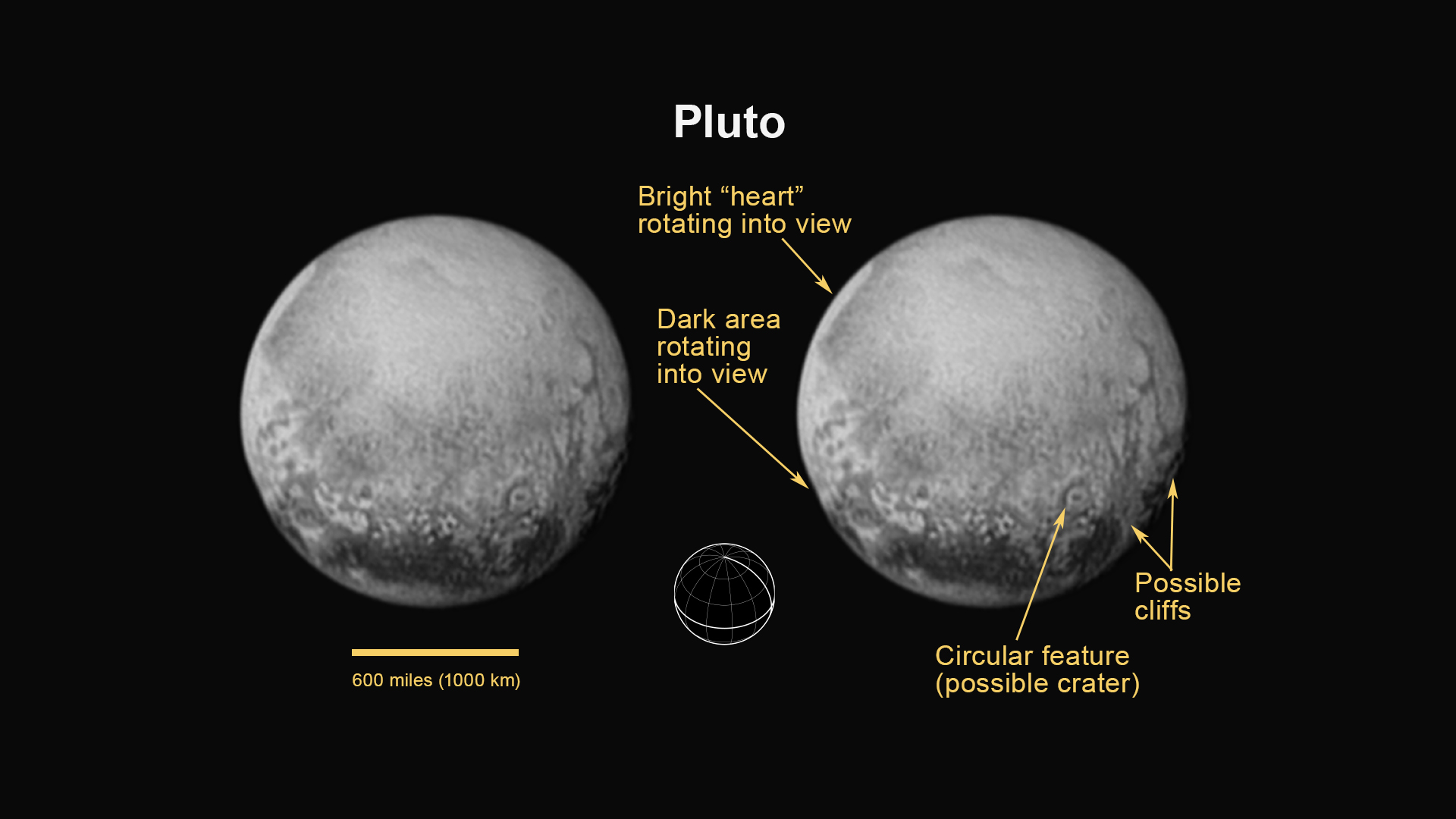
Pluto image annotated for July 12 (2 days before encounter). The features on the right are intriguing, but we’ll have to wait for the next mission to resolve. New Horizons can’t stop. Credit: NASA/Johns Hopkins University Applied Physics Laboratory/Southwest Research Institute.
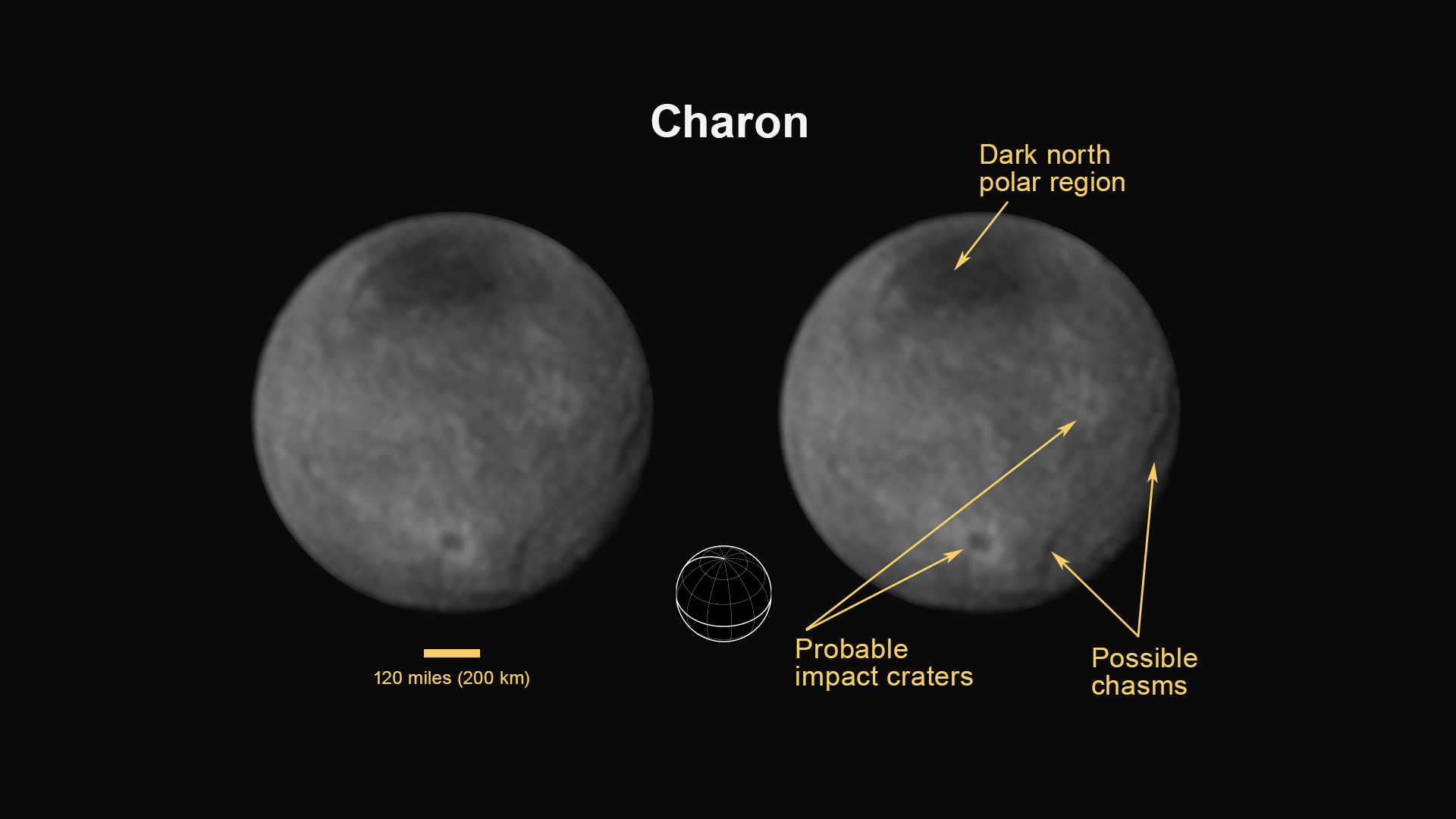
The moon Charon on July 12 with some of its features noted. Credit: NASA/Johns Hopkins University Applied Physics Laboratory/Southwest Research Institute.
04/23/2015 – Ephemeris – New Horizons’ first glimpse of Pluto and Charon in color
Ephemeris for Thursday, April 23rd. Today the Sun will be up for 13 hours and 52 minutes, setting at 8:37. The Moon, 2 days before first quarter, will set at 1:44 tomorrow morning. Tomorrow the Sun will rise at 6:43.
Last week NASA’s New Horizons team running the spacecraft that’s been in flight to the dwarf planet Pluto released their first color of Pluto and it’s moon Charon. The photo doesn’t show any surface features. That’s to come in the next month or two. However, Pluto shows kind of a pale orange-pink color, hinting of the colorful images to come. Charon is a dull gray like the dwarf planet Ceres, which Dawn is approaching, and our own Moon. How could two bodies with a common origin appear so different? Stay tuned. New Horizons will pass through the Pluto system in a couple of hours on July 14th, but will send back the mother lode of its data over the next 16 months.
Times are for the Traverse City/Interlochen area of Michigan. They may be different for your location.
Addendum

First color picture of Pluto and its moon Charon taken by the New Horizons spacecraft. Credit: NASA/Johns Hopkins University Applied Physics Laboratory/Southwest Research Institute. Click to enlarge.
From the NASA website:
“This image of Pluto and its largest moon, Charon, was taken by the Ralph color imager aboard NASA’s New Horizons spacecraft on April 9 and downlinked to Earth the following day. It is the first color image ever made of the Pluto system by a spacecraft on approach. The image is a preliminary reconstruction, which will be refined later by the New Horizons science team. Clearly visible are both Pluto and the Texas-sized Charon. The image was made from a distance of about 71 million miles (115 million kilometers)—roughly the distance from the Sun to Venus. At this distance, neither Pluto nor Charon is well resolved by the color imager, but their distinctly different appearances can be seen. As New Horizons approaches its flyby of Pluto on July 14, it will deliver color images that eventually show surface features as small as a few miles across.”
 Bob Moler's Ephemeris Blog